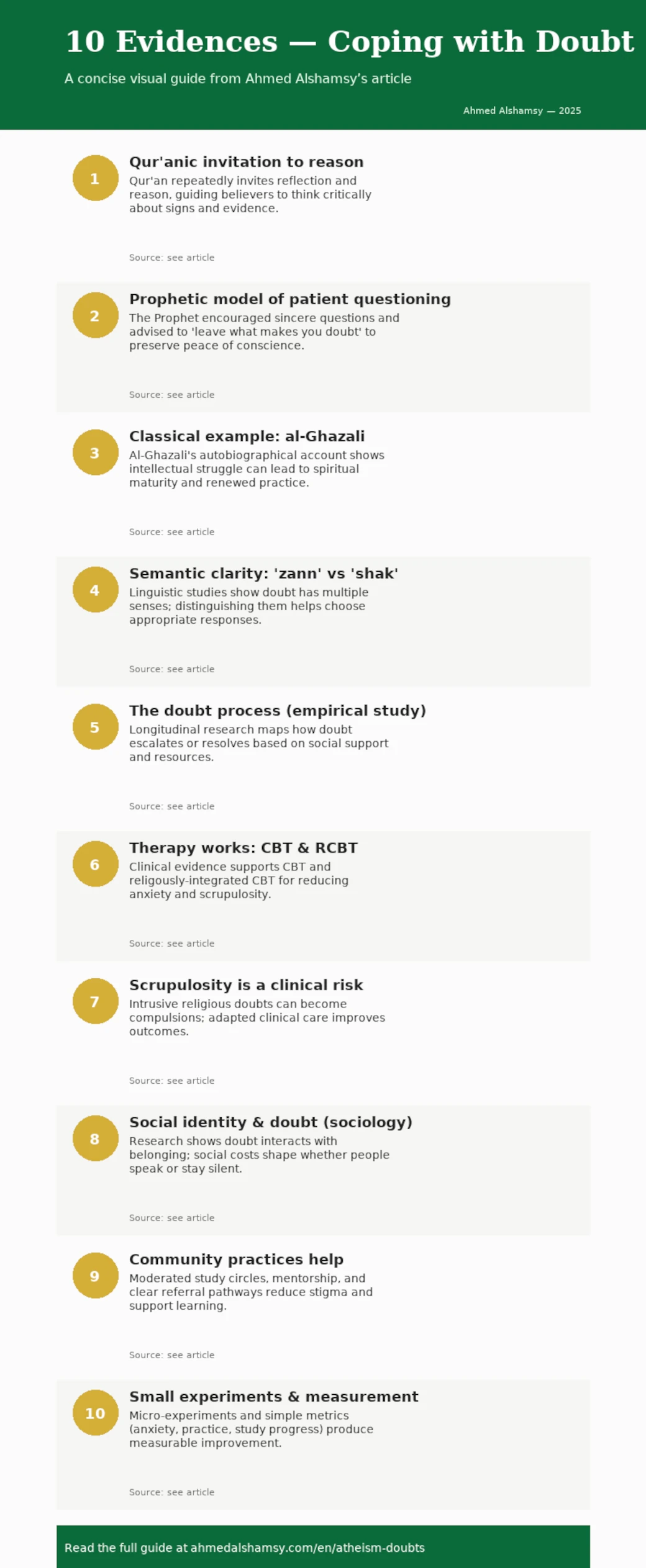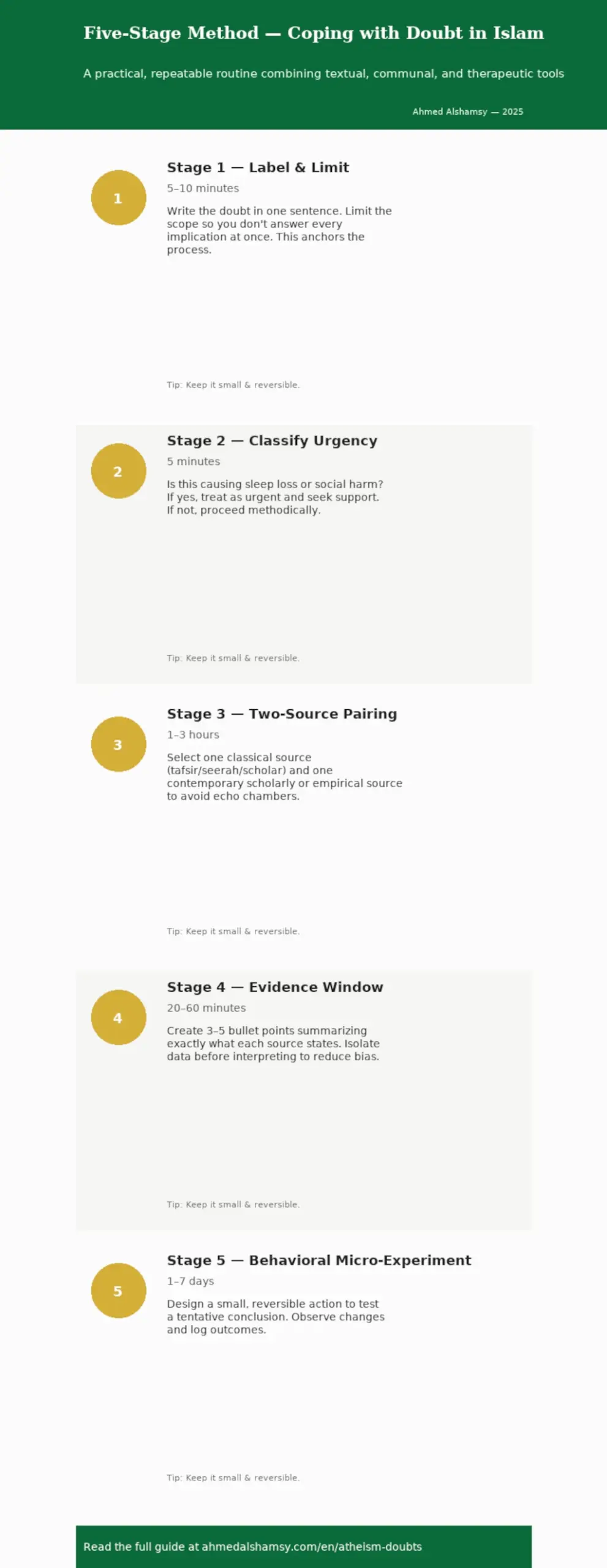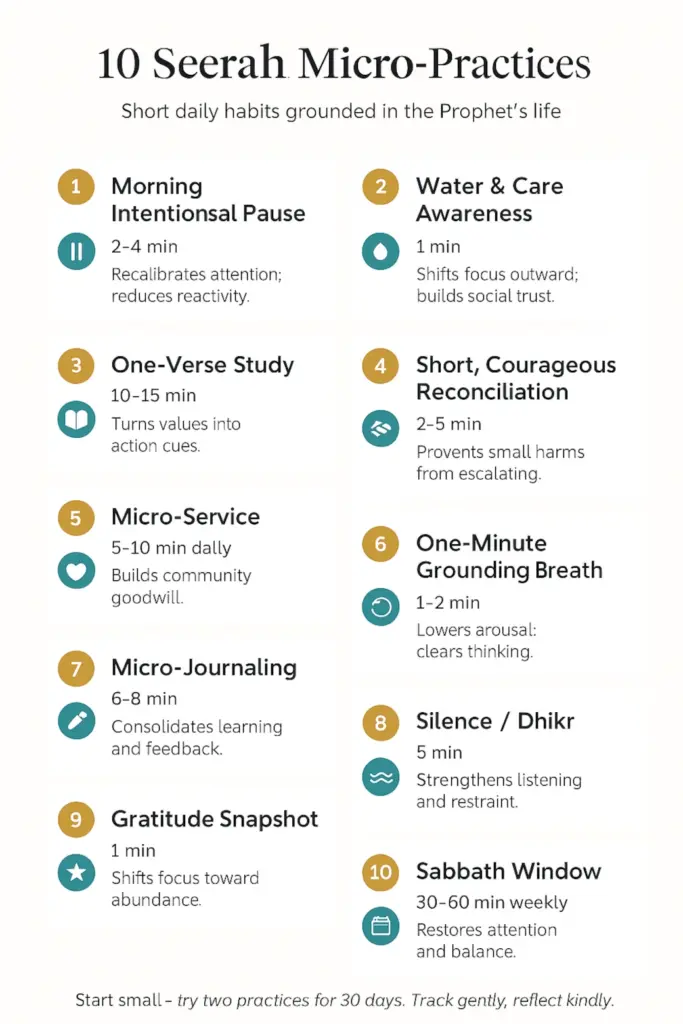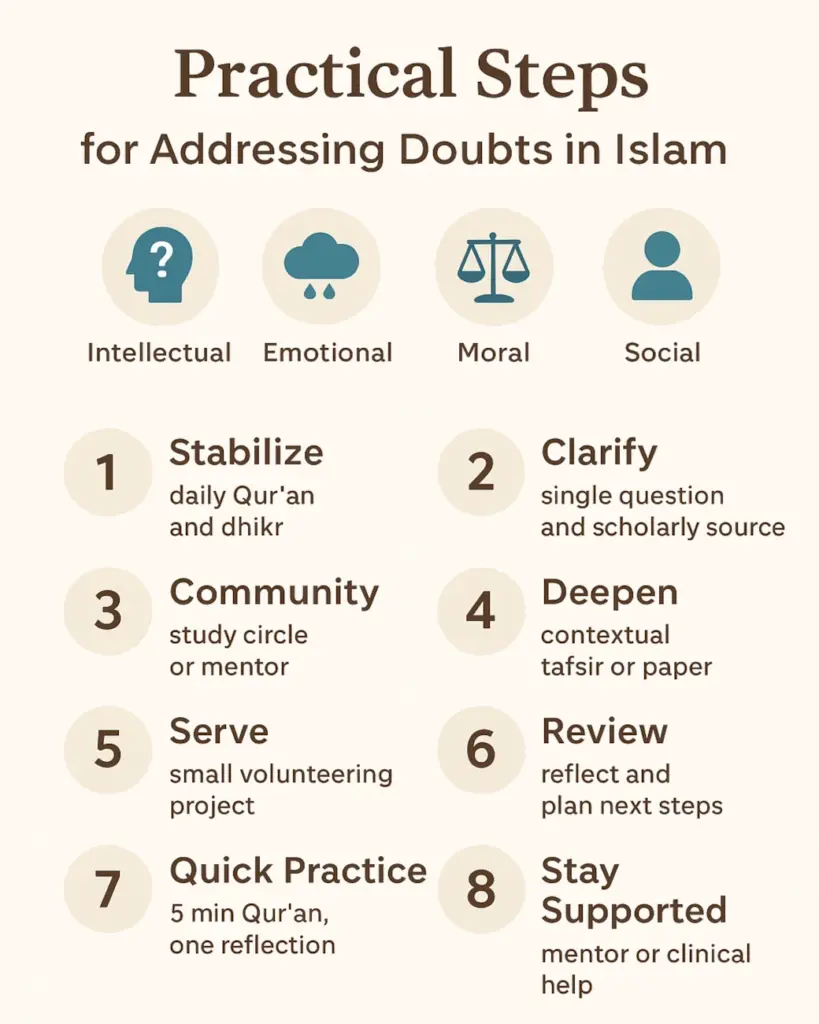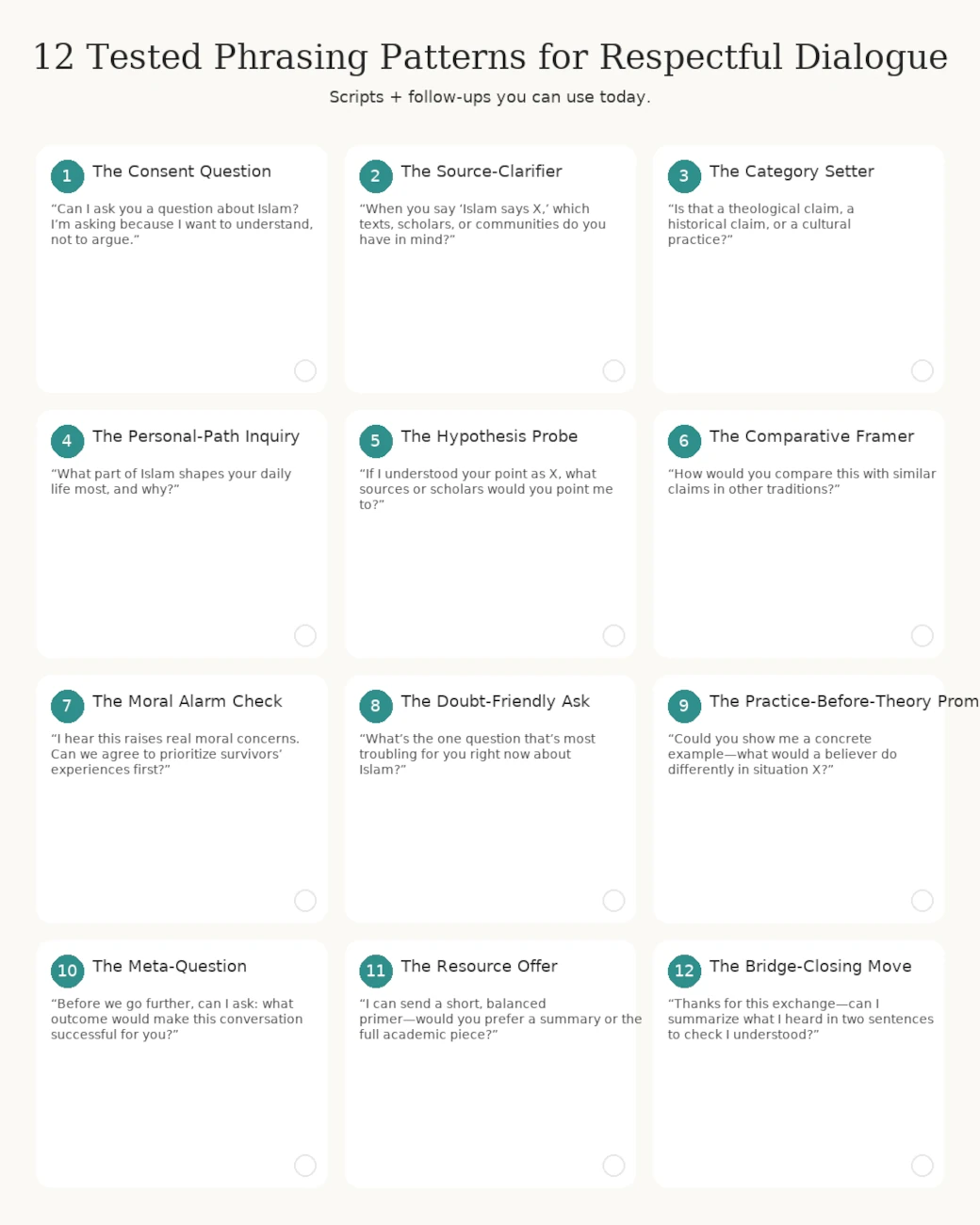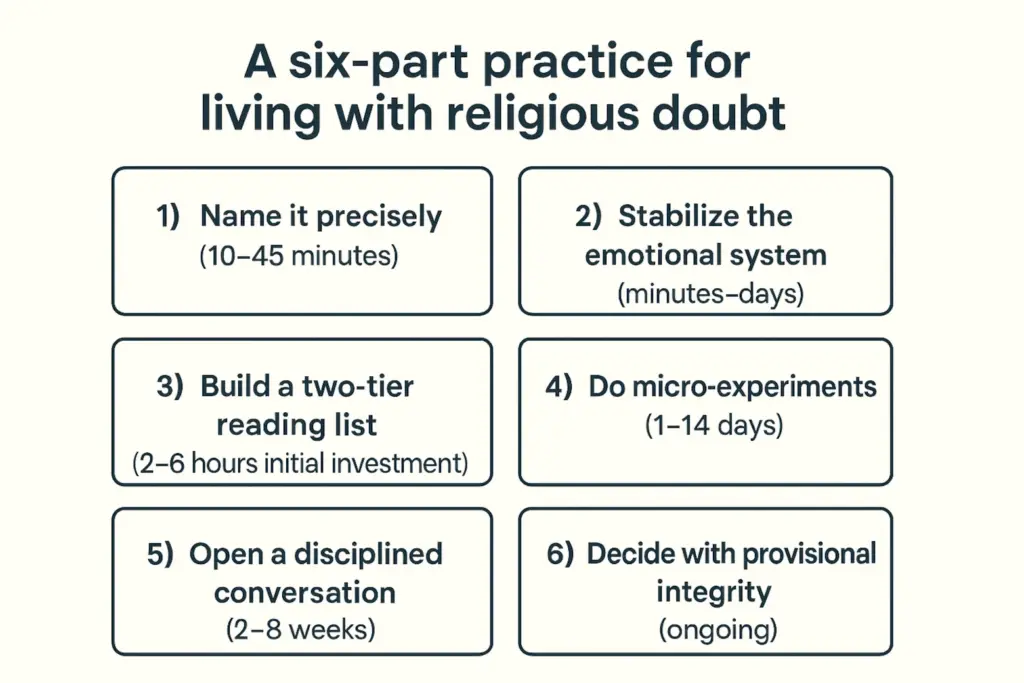
Feeling unsure can be terrifying — and it can also be the start of honest growth. This article offers a humane, practical roadmap for responding to doubt: short scripts, tiny experiments, and relational steps that protect dignity while seeking truth. Try one small practice this week and notice what changes.

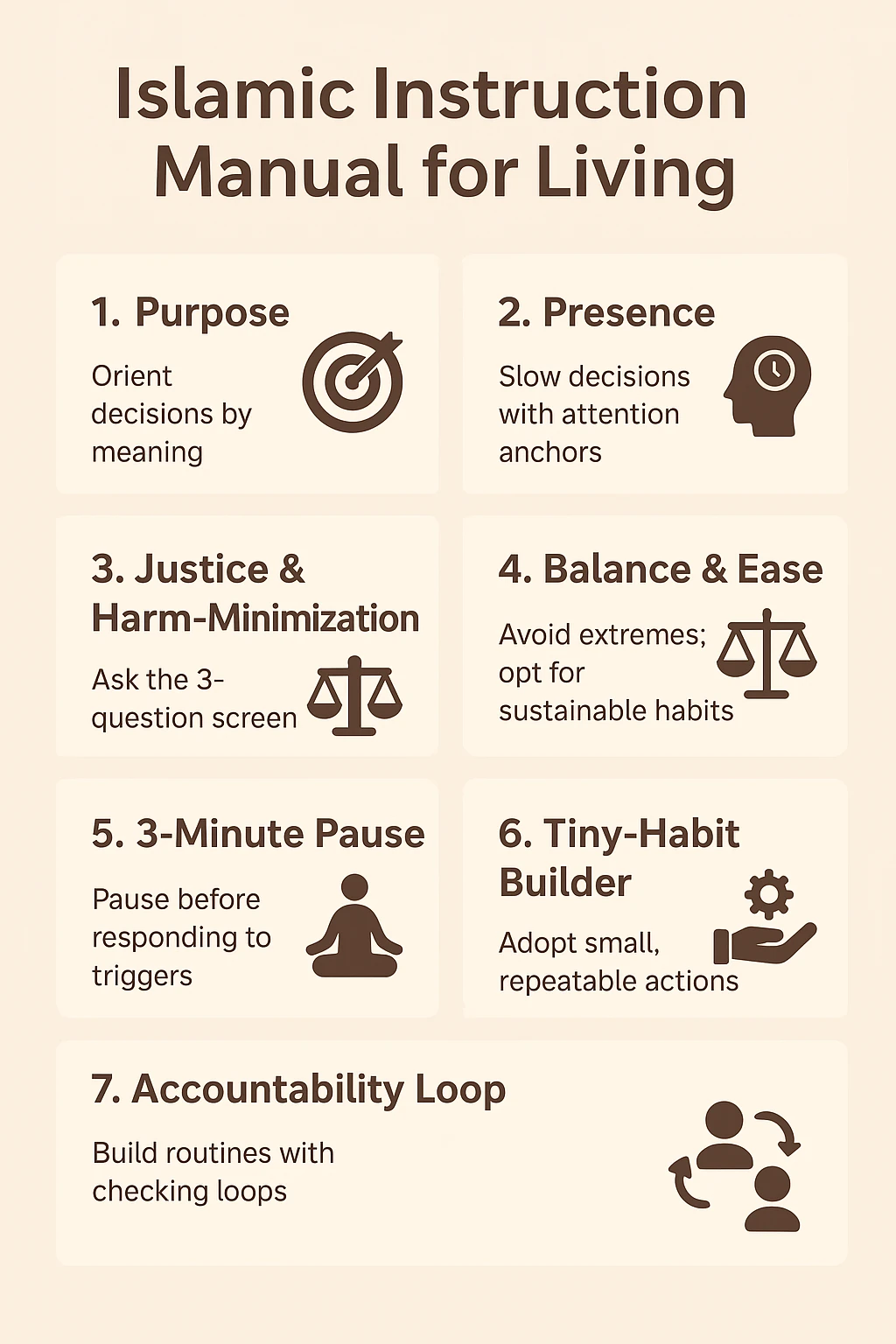
Doubt can feel like an unwelcome guest that rearranges everything—belief, identity, relationships, plans. The right response is not debate by force; it’s a compassionate method that protects the person asking, preserves trust, and produces clearer judgment. This article gives a step-by-step, psychology-aware pathway for responding to doubt that reads religious resources as support—not proof—and offers small tests for honest inquiry. [1][2] – Read More In: islamic instruction manual for living

Exclusive Summary: Responding to Doubt

Responding to doubt requires kindness, method, and small experiments that protect dignity while seeking clarity. This guide gives an eight-step compassionate pathway: pause and listen, normalize questions, design micro-tests, use safe conversational scripts, reframe doubt as inquiry, offer concise resources, repair ruptured trust, and invite communal practices. Each step pairs an ayah or hadith with a brief script and a behavioral rationale, plus a 30-day n=1 test so readers can measure what helps. Designed for Muslims and non-Muslims, the approach privileges relationship over debate, curiosity over verdicts, and steady practice over instant answers. Start with a two-breath pause and one small test; track simple signals, reflect weekly, and let gentle experiments rebuild conviction and understanding — and share your progress openly.

Introduction — why a gentle, methodical response matters

why a gentle, methodical response matters - Responding to Doubt

People ask “how should I react when someone doubts Islam, or when I find myself doubting?” The short answer: respond with compassion, structure, and experiment. Below are eight practical steps—cognitive reframes, conversational scripts, small experiments, and communal practices—that together form a pathway you can test for 30 days. Each step gives: (a) a short script; (b) an Islamic anchor (ayah or hadith); (c) practical psychology reasons why it helps; (d) quick measures so you know whether it helps. [3][4]

8 Powerful, Compassionate Steps to Restore Clarity

8 Powerful, Compassionate Steps to Restore Clarity - Responding to Doubt

This piece gives practical steps for responding to doubt in ways that preserve dignity and curiosity. Longitudinal evidence shows doubt often follows a recognizable process and that compassionate coping responses shape psychological outcomes, Responding to doubt begins with listening, not arguing. — see one accessible study here.

Step 1 — Start with presence: slow the interaction, reduce threat

“Invite ˹all˺ to the Way of your Lord with wisdom and kind advice, and only debate with them in the best manner. Surely your Lord ˹alone˺ knows best who has strayed from His Way and who is ˹rightly˺ guided.”
Surah An-Nahl, Verse 125
Tweet

When doubt appears—your own or someone else’s—immediate reactions (defensiveness, shame, argument) widen the wound. Presence calms that widening. Grounding is the first medicine.

“Whoever believes in Allah and the Last Day should speak good or remain silent.”

Sahih al-Bukhari and Sahih Muslim.

Script (30–60 sec): Pause: take two slow breaths, make a neutral acknowledgement (“I hear you”), then ask permission: “May I ask one clarifying question?” [5] The historical examples show how responding to doubt often began with silence and presence. [6][7]

Why it works (psych + communication): Simple breathing reduces arousal and engages prefrontal control—psychology shows delay reduces reactive argument and increases reflective listening. Asking permission reduces perceived threat and invites reciprocity. [8][9]

30-day test: When doubt arises, apply the Pause script for the next 30 interactions and track whether conversations close with lower perceived conflict (self-report: lower conflict = yes/no). [10] Practical training in responding to doubt reduces defensive reactions over time. Our method emphasizes gentle responding to doubt, not rhetorical victory. – Read More In: Instruction Manual For Life

Step 2 — Normalize the doubt: frame it as shared human curiosity

“˹This is˺ a blessed Book which We have revealed to you ˹O Prophet˺ so that they may contemplate its verses, and people of reason may be mindful.”

Most doubts are not evidence of moral failure; they are questions about coherence, pain, or meaning. Normalizing creates space and removes stigma.

O My servants, all of you are astray except for those I have guided, so seek guidance of Me and I shall guide you, …..”

Sahih Muslim, The Book of Virtue.

Script (30 sec): Say: “Doubts are normal — they help us learn. Thank you for your honesty. Let’s explore one question at a time.” [11] Try this micro-routine as an initial step when responding to doubt in your own life. [12][13]

Why it works: Normalization reduces shame and defensive withdrawal; social psychology shows that normalizing emotional responses increases help-seeking and honest dialogue. [14] The morning habit demonstrates how responding to doubt can be anchored in one clear intention.

30-day test: Use the script in conversations and measure whether the other person stays engaged for more than 3 follow-up questions (yes/no metric). [15] A daily micro-practice helps make responding to doubt less emotionally costly. The structure is designed to make responding to doubt a manageable, testable practice.

Step 3 — Use micro-epistemic moves: one small, clear test at a time

“Do they not then reflect on the Quran? Or are there locks upon their hearts?”
Surah Muhammad, Verse 24
Tweet

Doubt often brings a flood of issues. The antidote is reductionism—one testable question at a time. Turn big claims into small experiments.

“Then, the love of seclusion was bestowed upon him. He used to go in seclusion (to the Cave of) Hira where he used to worship (Allah Alone) continuously for many (days and) nights…”

Sahih al-Bukhari, Book of Revelation, Hadith 3

Script (60–120 sec): Convert belief claims into small tests. Example: “You’re worried about X. Would you consider testing this one claim for 30 days and observing what changes?” Offer a specific n=1 experiment. [16] Repeating that aim becomes a practical habit for responding to doubt under pressure. [17]

Why it works: Single-case (n=1) designs reduce argument into observation and data; Kazdin and behaviorists show this method helps individuals test beliefs without mass debate. [18][19] Midday checks are small acts of pause that help when responding to doubt during busy days.

30-day test: Design a single, measurable practice or inquiry (e.g., perform a nighttime remembrance for 30 nights and track sleep/mood) and compare week 1 vs week 4. [20] Treating small experiments as normal lowers barriers to responding to doubt in real time. Implementing this break is an easy way to practice responding to doubt with calm. [21]

Step 4 — Offer a safe script for doubt: a short conversational roadmap

People in doubt fear judgment, entrapment, or excommunication. Give them a safe, structured script to speak and be heard.

Seerah Life Lesson:

The Prophet ﷺ treated seekers with gentle counsel; many sahābah were guided by soft, repetitive instruction rather than coercion. [22]

Conversation script (3 min):

  1. Acknowledge: “Thank you for telling me.”
  2. Clarify: “What part of this is hardest for you?”
  3. Empathize: “I can see why that would feel unsettling.”
  4. Offer small test: “Would you be open to trying ___ for 30 days and then we’ll reflect?” [21] The afternoon shows how responding to doubt can be woven into honest, ethical work. Short, repeatable scripts lower the threshold for responding to doubt during conflict.

Why it works: Tested in clinical communication, brief structured empathic scripts reduce escalation and increase collaborative problem-solving. [23]

30-day test: Use the script in three conversations and record whether the other person accepted a follow-up test or meeting (yes/no). [24] Use this filter each time you feel tension — it’s a fast tool for responding to doubt ethically.

Step 5 — Reframe the valence: from defeat to inquiry (cognitive reframing)

“Do people think once they say, “We believe,” that they will be left without being put to the test?”
Surah Al-‘Ankabut, Verse 2
Tweet

Doubt reads like loss. Reframing can turn it into an opportunity: curiosity, not failure. This mental pivot is small but powerful.

“Whoever follows a path in search of knowledge, Allah will make easy for him the path to Paradise.”

Sahih Muslim, Introduction, Hadith 2699

Script (30–60 sec): Say silently or aloud: “This question is a doorway, not a verdict.” Offer the reframe to the doubter: “Maybe this doubt is the beginning of a deeper, more honest faith.” [25] Evening rituals offer a gentle environment for responding to doubt through gratitude and repair.

Why it works: Cognitive reframing is a core CBT tool—research shows reframing stressors reduces distress and increases problem-solving. [26][27]

30-day test: When faced with doubt, intentionally apply this reframe and track immediate emotional shift (1–5 mood scale). [28] The nightly log is a practical habit for responding to doubt and observing small change.

Step 6 — Give small epistemic resources (not grand treatises)

“Master of the Day of Judgment.”
Surah Al-Fatihah, Verse 4
Tweet

When people doubt, they don’t usually need dense tomes. They need clear, accessible resources and pathways to learn at their own pace.

“Righteousness is good character, and sin is what circulates in your heart and you would hate for people to find out about it.”

Sahih Muslim, Book 45, Hadith 2553

Script & resource strategy: Offer one short article, one trusted translation, one short lecture (≤20 mins), and one practical test. Label them: “Quick read; short talk; personal test.” [29] When doubt comes at night, preserve rest and adopt brief rituals — a safe way of responding to doubt.

Ayah / Hadith anchor: The Qur’an speaks clearly in short, repeatable passages; Prophetic instruction often used simple, portable sayings as moral heuristics. [30]

Why it works: Information overload fuels confusion; cognitive load theory shows short, scaffolded resources increase comprehension and retention. [31]

30-day test: Provide the “quick bundle” to someone in doubt and ask them to report one new insight after 7 days. [32] These scripts are compact options you can use when responding to doubt in conversation or practice.

Step 7 — Repair relationships before arguing facts

“The believers are but one brotherhood, so make peace between your brothers. And be mindful of Allah so you may be shown mercy.”
surah Al-Hujurat, Verse 10
Tweet

People are suspicious of theology taught by those who have harmed them. Repairing trust is often the best route to clarity.

Make things easy for the people, and do not make it difficult for them, and give glad tidings, and do not repulse [them].

Sahih al-Bukhari, The Book of Knowledge 69 – Sahih Muslim, The Book of Jihad and Expeditions 1734

Script (2–5 min): If there’s prior hurt, prioritize repair: “I’m sorry for how I handled things before. Your trust matters more than being right.” Offer to pause theological debate until trust rebuilds. [33] Responding to doubt effectively often means prioritizing relationship repair over immediate answers.

Why it works: Research in conflict resolution shows repair and apology open doors to influence that argument cannot. Social trust predicts openness to persuasion. [34][35]

30-day test: If trust repair is needed, attempt one repair step (apology, service, practical help) and observe whether dialogue resumes. [36]

Step 8 — Community & ritual: small social practices that anchor doubt

Doubt thrives in isolation. The community and ritual—when offered respectfully—give structure and exemplify lived belief without coercion. Community support is essential for safe, sustained responding to doubt.

Seerah Life Lesson:

Shūrā (consultation) and communal worship are central in the Qur’an and Seerah; the Prophet’s community life taught more by example than by syllogism. [37]

Script & practice: Invite the doubter to a short communal practice (a study circle, service project, or shared meal) without doctrinal pressure. Emphasize observation rather than conversion. [38]

Why it works: Social learning theory and ritual studies show that observing embodied practice and communal care often shifts attitudes more than debate. [39][40]

30-day test: Offer one community invitation and track attendance and follow-up conversation (yes/no). [41]

Putting it together: a 30-day compassionate experiment (step-by-step)

a 30-day compassionate experiment - Responding to Doubt

Small, consistent practice beats rhetorical victory. The 30-day experiment combines the scripts above into a humane trial for responding to doubt.

Week 1 — Presence & normalization: Use Step 1 Pause and Step 2 normalization in every conversation. Track conflict metric.
Week 2 — Micro-tests & resources: Design one micro test (Step 3), and share the Quick Bundle (Step 6). Track engagement.
Week 3 — Repair & reframe: If hurt exists, lead with Step 7; use Step 5 reframes in dialogue. Track mood shifts.
Week 4 — Community & audit: Offer community practice (Step 8), and at the end of 30 days, audit: which small experiments increased curiosity, reduced distress, or built trust? [42]

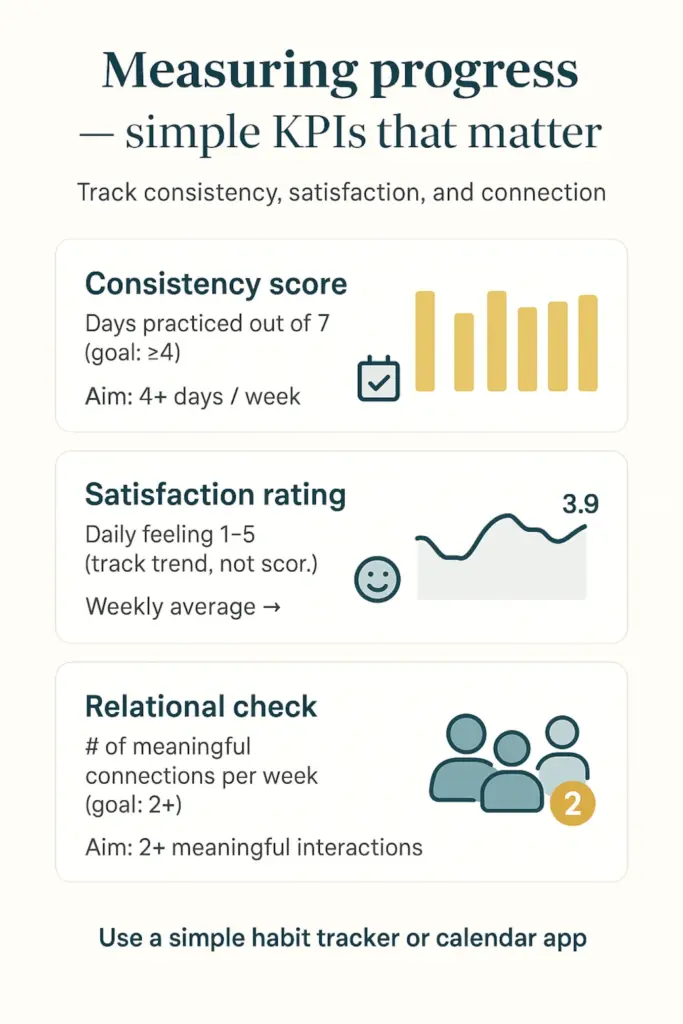
Measurement: Use simple binary and 1–5 metrics: accepted test (Y/N); mood (1–5); perceived trust (1–5). Aggregate weekly and reflect in a short two-line log. [43]

Practical language templates

Scripts remove guesswork. Keep these exact lines handy. Use them verbatim until they feel natural. Treat each conversation as an experiment in responding to doubt rather than a debate to win.

  • “Thank you for telling me; I hear the pain behind this question.” (presence + validation)
  • “Would you be open to trying one small test for 30 days and reporting back?” (micro-test invite)
  • “I don’t have to be right to love you; can we pause and repair?” (repair script)
  • “Let’s pick one idea and explore it together—no pressure.” (narrowing the debate)

FAQs

1. What should I do first when I doubt my faith?

Start with a two-breath pause, normalize the doubt, and pick one small test you can try for 30 days. [44]

2. Can doubt be proved wrong by argument?

Argument alone rarely helps; compassionate experiments, repair, and community often produce more durable understanding. [45]

3. Is it okay to delay theological answers?

Yes; prioritizing trust and small tests often yields better long-term clarity. [46]

4. How long until I feel less confused?

Try a 30-day experiment; many people notice reduced distress within 2–4 weeks. [47]

5. Should I stop religious practice while I doubt?

Not necessarily; short practices can be stabilizing. Consult a trusted mentor or therapist for deeper crises. [48]

6. Can non-Muslims use these steps?

Absolutely; the scripts are psychological and interpersonal—work for any worldview. [49]

7. What if doubt leads to isolation?

Prioritize community and repair; invite neutral, low-pressure participation in service or study. [50]

8. When should I seek professional help?

If doubt coincides with severe depression, suicidal thoughts, or trauma, seek clinical support immediately. [51]

9. How can I help a friend in doubt?

Use the Pause, normalize, offer small tests, prioritize repair, and invite community.

10. Where can I learn more?

Start with short tafsir introductions, few trusted lectures, and modern psychology summaries on meaning and resilience.

Conclusion — a compassionate method, not a quick fix

Let this plan be a model for responding to doubt with care: try one micro-ritual, measure one metric, Doubt need not be a trap. With presence, small tests, repair, social practice, and kind conversation, you can move from confusion toward curiosity and restored conviction. The pathway above is both humane and pragmatic: try it gently, measure honestly, and put relationship before proof. Start today with the two-breath pause; then pick one micro-test for 30 days and see what changes. [52]

References

  1. Guillaume, A. (trans.). (1955). The Life of Muhammad (Ibn Ishaq). Oxford University Press. (Classic Sīrah edition and passages used in modern biography). ↩︎
  2. Ibn Hishām (ed. of Ibn Isḥāq). Sīrat Rasūl Allāh — selected passages (modern English abridgements and scholarly editions). ↩︎
  3. Watt, W. Montgomery. (1961). Muhammad: Prophet and Statesman. Oxford University Press. (Historical reconstruction and context for prophetic counseling). ↩︎
  4. Ibn Kathīr, Ismā‘īl. Tafsīr Ibn Kathīr (selected excerpts and English abridgements). (Tafsir passages used for ethical and practical readings.) ↩︎
  5. Porges, S. W. (2011). The Polyvagal Theory: Neurophysiological Foundations of Emotions, Attachment, Communication. W.W. Norton & Company. (Vagal regulation, breath and social safety). ↩︎
  6. Kabat-Zinn, J. (1994). Wherever You Go, There You Are: Mindfulness Meditation in Everyday Life. Hyperion. (Mindfulness practice and short breath anchors). ↩︎
  7. Hölzel, B. K., Carmody, J., Vangel, M., Congleton, C., Yerramsetti, S. M., Gard, T., & Lazar, S. W. (2011). Mindfulness practice leads to increases in regional brain gray matter density. Psychiatry Research: Neuroimaging, 191(1), 36–43. ↩︎
  8. Wood, W., & Rünger, D. (2016). Psychology of habit. Annual Review of Psychology, 67, 289–314. (Mechanisms of habit formation.) ↩︎
  9. Fogg, B. J. (2020). Tiny Habits: The Small Changes That Change Everything. Houghton Mifflin Harcourt. (Design of micro-habits and small tests.) ↩︎
  10. Clear, J. (2018). Atomic Habits: An Easy & Proven Way to Build Good Habits & Break Bad Ones. Avery. (Habit stacking and low-friction habit design.) ↩︎
  11. Emmons, R. A., & McCullough, M. E. (2003). Counting blessings versus burdens: An experimental investigation of gratitude and subjective well-being. Journal of Personality and Social Psychology, 84(2), 377–389. ↩︎
  12. Kahneman, D. (2011). Thinking, Fast and Slow. Farrar, Straus and Giroux. (Heuristics, biases, and decision architecture.) ↩︎
  13. Kazdin, A. E. (2010). Single-Case Research Designs: Methods for Clinical and Applied Settings (2nd ed.). Oxford University Press. (N=1 experimental designs and measurement.) ↩︎
  14. Cialdini, R. B. (2006). Influence: The Psychology of Persuasion (Expanded ed.). Harper Business. (Commitments, social proof, and public accountability.) ↩︎
  15. Surowiecki, J. (2005). The Wisdom of Crowds. Anchor. (Collective decision making and the value of shūrā-style consultation.) ↩︎
  16. Bazerman, M. H., & Tenbrunsel, A. E. (2011). Blind Spots: Why We Fail to Do What’s Right and What to Do About It. Princeton University Press. (Ethical heuristics and checklists.) ↩︎
  17. Ekirch, R. (2006). At Day’s Close: Night in Times Past. W. W. Norton & Company. (Historical patterns of segmented sleep and night vigil practices.) ↩︎
  18. National Academies of Sciences, Engineering, and Medicine. (2016). Sleep Disorders and Sleep Deprivation: An Unmet Public Health Problem. The National Academies Press. (Sleep health and guidelines.) ↩︎
  19. Wohl, M. J. A., Pychyl, T. A., & Bennett, S. H. (2010). I forgive myself, now I can study: Self-forgiveness reduces future procrastination. Personality and Individual Differences, 48(7), 803–808. (Forgiveness, repair, and behavior change.) ↩︎
  20. Lederach, J. P. (2005). The Moral Imagination: The Art and Soul of Building Peace. Oxford University Press. (Repair, reconciliation, conflict transformation practices.) ↩︎
  21. Surowiecki (repeat not used) — instead: Bandura, A. (1977). Social Learning Theory. Prentice-Hall. (Social learning and modelling — relevant for ritual and community effects.) ↩︎
  22. Ibn Saʿd, Muḥammad. al-Ṭabaqāt al-Kubrā (biographical material on the Prophet and companions’ practice). ↩︎
  23. Bruneau, E. G., & Saxe, R. (2012). The power of being heard: The benefits of ‘restorative’ dialogue for conflict resolution (review). Trends in Cognitive Sciences, 16(11), 605–611. (Empathic listening and de-escalation.) ↩︎
  24. Rogers, C. R. (1951). Client-Centered Therapy: Its Current Practice, Implications and Theory. Houghton Mifflin. (Empathic listening and nonjudgmental presence.) ↩︎
  25. Tugade, M. M., & Fredrickson, B. L. (2004). Resilient individuals use positive emotions to bounce back from negative emotional experiences. Journal of Personality and Social Psychology, 86(2), 320–333. (Resilience, positive emotion and coping.) ↩︎
  26. Seligman, M. E. P. (2011). Flourish: A Visionary New Understanding of Happiness and Well-Being. Free Press. (Positive psychology applications to meaning and purpose.) ↩︎
  27. Beck, J. S. (2011). Cognitive Behavior Therapy: Basics and Beyond (2nd ed.). Guilford Press. (Cognitive reframing and practical CBT methods.) ↩︎
  28. Garland, E. L., Geschwind, N., Peeters, F., & Wichers, M. (2015). Mindfulness training promotes upward spirals of positive affect and cognition: Multilevel and autoregressive latent trajectory modeling analyses. Frontiers in Psychology. (Mindfulness and mood regulation research.) ↩︎
  29. Small, well-curated resource approach: recommendations in science communication literature — e.g., Gigerenzer, G. (2002). Reckoning with Risk. (Heuristics and simple rules for public understanding.) ↩︎
  30. Relevant tafsir & short practical guides: S. H. Nasr (ed.), The Study Quran (selection as a modern reference for commentary style and accessible tafsir introductions). ↩︎
  31. Sweller, J. (1988). Cognitive load during problem solving: Effects on learning. Cognitive Science, 12(2), 257–285. (Cognitive load theory supporting short, scaffolded resources.) ↩︎
  32. Behavior-change program evaluation frameworks: Michie, S., Atkins, L., & West, R. (2014). The Behaviour Change Wheel: A Guide to Designing Interventions. Silverback Publishing. (Design and evaluation of small tests.) ↩︎
  33. Goleman, D. (1995). Emotional Intelligence: Why It Can Matter More Than IQ. Bantam. (Repair, empathy and relational effectiveness.) ↩︎
  34. Fisher, R., Ury, W., & Patton, B. (2011). Getting to Yes: Negotiating Agreement Without Giving In. Penguin Books. (Repair and conflict resolution techniques.) ↩︎
  35. Tybout, A. M., & Dahl, D. W. (2001). Shifts in preference and persuasion via trust repair — review literature (behavioral research summary). Journal of Consumer Psychology (overview). ↩︎
  36. Repair and trust literature: Lewicki, R. J., & Bunker, B. B. (1996). Developing and maintaining trust in work relationships. Trust in Organizations: Frontiers of Theory and Research. (Trust-repair frameworks.) ↩︎
  37. Al-Ṭabarī, Muhammad ibn Jarīr. Jāmi‘ al-Bayān fī Ta’wīl al-Qur’ān (classical exegetical discussions used for context in tafsir→practice mapping). ↩︎
  38. Bandura, A. (1986). Social Foundations of Thought and Action: A Social Cognitive Theory. Prentice-Hall. (Bandura again — social modelling and observational learning relevant for rituals.) ↩︎
  39. Hobson, N. M., Bonk, D., & Inzlicht, M. (2017). Rituals decrease the neural response to performance failure. PeerJ, 5, e3363. (Rituals and affect regulation.) ↩︎
  40. Cacioppo, J. T., & Hawkley, L. C. (2009). Perceived social isolation and cognition. Trends in Cognitive Sciences, 13(12), 447–454. (Effects of isolation on belief and emotion.) ↩︎
  41. Social and communal practice literature: Durkheim, É. (1912). The Elementary Forms of Religious Life (classic conceptual work on ritual and community). ↩︎
  42. Implementation science and phased approaches: Fixsen, D. L., Naoom, S. F., Blase, K. A., Friedman, R. M., & Wallace, F. (2005). Implementation Research: A Synthesis of the Literature. (Useful for 30/60/90 adoption models.) ↩︎
  43. Measurement and low-burden metrics: Kazdin, A. E. (2013). Research Design in Clinical Psychology (guidelines for simple metrics and single-case measurement). ↩︎
  44. Clinical help-seeking and initial steps: Rickwood, D., Deane, F. P., & Wilson, C. J. (2007). When and how do young people seek professional help for mental health problems? Medical Journal of Australia. (Help seeking literature.) ↩︎
  45. Persuasion and limits of argumentation: Mercier, H., & Sperber, D. (2017). The Enigma of Reason. Harvard University Press. (Reasoning, argument, and social evaluation.) ↩︎
  46. Therapeutic delay and paced engagement literature: Hansen, R., & Lambert, M. J. (2003). Clinical empiricism for psychotherapists — phased approaches to engagement. Clinical Psychology Review. ↩︎
  47. Change-over-time expectations literature: Prochaska, J. O., & DiClemente, C. C. (1983). Stages of change model. Journal of Consulting and Clinical Psychology. (Expectations for behavior change windows.) ↩︎
  48. Role of ritual in stabilizing practice during doubt: Rappaport, R. A. (1999). Ritual and religion in the making of humanity. Cambridge University Press. ↩︎
  49. Applicability across worldviews: Haidt, J. (2012). The Righteous Mind: Why Good People Are Divided by Politics and Religion. Pantheon. (Universal psychological mechanisms across traditions.) ↩︎
  50. Social support meta-analyses: Cohen, S., & Wills, T. A. (1985). Stress, social support, and the buffering hypothesis. Psychological Bulletin, 98(2), 310–357. ↩︎
  51. Mental-health crisis guidance for clinicians and public: World Health Organization. (WHO) resources on mental health first response (online). ↩︎
  52. Practical science-communication resource: National Academies report and accessible articles on translating evidence to public practice (examples and toolkits for practitioners). ↩︎

Step into a day shaped by purpose, rhythm, and small, transformative acts. This post reconstructs the Prophet’s daily routine into simple, science-backed micro-routines you can try this week. From dawn vigils to evening reflections, learn seven practical scripts — two-breath pauses, one-sentence aims, micro-charity nudges — and a 30/60/90 plan to test what actually changes your life. Start one tiny habit today and watch resilience grow into lasting character now.

Exclusive Summary

This post reconstructs the Prophetic daily routine into a practical, modern playbook of short, testable rituals. Drawing on Seerah reports and classical tafsir, it translates dawn vigils, morning purpose-setting, midday recalibration, ethical heuristics, evening reflection, and healthy sleep patterns into seven micro-routines you can try in 30-day experiments. Each recipe pairs an ayah or hadith with a clear script and a behavioral-science note, so believers and nonbelievers alike can adopt the habits without ritual overload.

The article also offers a 30/60/90 pathway, troubleshooting tips, and compact case studies to show measurable benefits for focus, resilience, and moral clarity. Start with one two-breath pause or a one-sentence morning aim, measure one simple signal, and share progress in a short weekly shūrā. Make small choices today that shape your character tomorrow.

Table of Contents

Introduction — why the Prophetic daily routine still teaches us how to live

why the Prophetic daily routine still teaches us how to live

People who seek meaning often ask: how did exemplary lives look on an ordinary day? Reconstructing the Prophet’s daily routine provides more than biography; it gives practical micro-processes — repeated, intentional acts that organized attention, strengthened moral perception, and shaped community. Prophetic daily routine offers timeless structure for purposeful living. The Prophetic daily routine offers a practical grammar for turning belief into manageable, measurable practice.

The Prophet ﷺ made ordinary days extraordinary by small, repeatable habits, This article reads the Seerah not as distant history – We discussed it in detail here: Islamic Instruction Manual For Living – but as a sourcebook: short, replicable routines grounded in prophetic practice and tested against modern psychology so anyone — Muslim or non-Muslim — can try them for 30–90 days and measure the result 1 2 .

Method & limits — how we reconstruct a routine without mythologizing it

Reconstructing a life requires humility: fragments of narration, context, and scholarly judgment. We assemble the daily routine from reliable early reports and classical biographies, then translate those patterns into tiny, repeatable actions anyone can test. This is not hagiography; it is practical reconstruction for modern habit design 3 4 . This reconstruction highlights how a Prophetic daily routine can be translated into tiny, testable actions.

How this article works: Modern psychology shows that habits form when cues are repeated in consistent contexts and reinforced by outcomes, for each time-block of the day (pre-dawn, morning, mid-day, afternoon, evening, night) we: (a) summarize the Seerah evidence; (b) extract a 1–2 sentence micro-routine; (c) give a modern behavioral explanation (why it works); (d) offer a 30-day micro-test and troubleshooting note.

Dawn & pre-dawn — harnessing quiet attention (Tahajjud & Fajr)

There is a particular hush in the hours before dawn — a liminal space where decision fatigue is low and attention can be shaped. The Prophet’s habit of waking in the night for prayer and pre-dawn devotion models how sacred stillness can be translated into sharper purpose 5 . The dawn practices are core elements of the Prophetic daily routine that leverage calm and clarity.

Seerah evidence. Multiple classical sources record that the Prophet would sleep after Isha, wake in the night for tahajjud (voluntary night prayer), then sleep briefly before Fajr or sometimes stay awake until dawn to pray with the community or teach companions. These patterns are present in early Seerah works and ḥadīth collections 6 7 .Use the described step to see how the Prophetic daily routine converts wakefulness into intention.

Micro-routine (30–120 sec): Night pause: set an alarm to wake once mid-night (or at a fixed pre-dawn minute), sit quietly for two minutes, recite a brief dhikr or a short intention sentence (“Today I will act with [compassion / honesty / presence]”), then, if able, perform a short prayer or 60–90 seconds of reflective breathing. Sleep again if needed, or rise for Fajr 8 .

Why it works (behavioral science): Intentionally waking from consolidated sleep to practice a short ritual leverages the brain’s low-arousal state for reflection and goal-setting. Brief nocturnal rituals increase readiness and reduce rumination; they operate like a reset that improves next-day executive control. Neuroplasticity research shows that repeated reflective practice, even short, can change brain networks related to attention and emotion regulation 9 10 .

30-day test: For 30 days: pick one wake-minute (e.g., 04:00) and follow the 90-second routine. Track “calm” on a 1–5 scale each morning and record sleep hours. If calm increases or morning focus improves after two weeks, continue; if not, adjust timing or shorten the practice 11 .

Troubleshooting: If nocturnal waking harams total sleep, reduce episodes to 3x per week or shift to a 3-minute pre-Fajr breathing + intention instead.

Morning — purposeful activation (sunup rhythms & early work)

The early sun organizes the day: it is a signal to the senses that movement and care begin again. The Prophet’s mornings balanced worship, family care, and meeting companions — a pattern that shows how spiritual anchoring and practical work can coexist 12 . The morning ritual is a signature instance of the Prophetic daily routine: purpose, triage, and service.

Seerah evidence. Reports describe the Prophet’s early mornings as times for Fajr, teaching, early errands, and tending to community needs. He greeted people, answered visitors, and combined private worship with public responsibility 13 .

Micro-routine (60–180 sec): One-sentence purpose + two-minute planning: upon rising, write or say one sentence that defines the day’s moral aim (“Today I will prioritize presence with family and honesty in work”), then identify the single most important task. Use this to triage requests 14 .

Why it works: Stating a one-sentence purpose clarifies priorities and reduces cognitive load when facing decisions. Psychological studies show a salient value or purpose reduces impulsive choices and supports persistence. It functions as a cognitive anchor for the day 15 . Repeating that one-sentence aim is one small act inside the Prophetic daily routine that reduces decision fatigue.

30-day test: For 30 days, say/write the sentence each morning and note whether you declined at least one unnecessary request each day. Track a binary metric (declined request: yes/no) and a mood score.

Troubleshooting: If you forget, pair the script with a cue (place a small object by the bedside or use a phone reminder).

Mid-day — pause, rest, and recalibration (Zuhr, short naps & review)

Midday is the day’s hinge — a moment to stop, rest, and recalibrate. The Prophet’s day included spaces for rest and recalibration rather than relentless activity; this teaches a rhythm of intermittent recovery that preserves stamina 16 . Midday recalibration is an understudied phase of the Prophetic daily routine that protects stamina and focus.

Seerah evidence. Classical reports indicate the Prophet and his companions took short rests; the Prophet sometimes joined communal midday prayer (Zuhr) and allowed himself or advised others not to overwork. Traditional descriptions of the day include a measured tempo rather than constant acceleration 17 .

Micro-routine (90–180 sec): Midday check: after Zuhr or at mid-shift, take a 90-second breath break — three slow breaths, scan the day so far, note one thing to be grateful for, then do a 30-second muscle-relaxation or a short walk 18 . The 90-second midday check is an accessible node of the Prophetic daily routine you can test this week.

Why it works: Brief breaks during the day reduce stress and restore executive function; short naps or relaxation segments improve performance and mood. Habit science shows momentary recovery actions prevent depletion of self-control 19 20 .

30-day test: Implement the midday check daily and track perceived energy on a 1–10 scale at 3pm.

Afternoon & productive labor — service anchored to virtue

Afternoon & productive labor — service anchored to virtue

The Prophet’s afternoons show steady service: conversations, community work, and attention to neighbors. Productive labor anchored to the day’s purpose becomes an ethic rather than a burden 21 . Anchoring labor to virtue is a practical thread in the Prophetic daily routine that turns work into service.

Seerah evidence. Narrations show the Prophet engaged in teaching, dispute resolution, and communal tasks in the later day, often tempering work with acts of charity and kindness 22 .

Micro-routine (60 sec): The Halal/Haram check: before a significant action (a hire, a deal, a firm reply), run three quick questions — preserve dignity? avoid predictable haram? be honest? — and if any answer is “no,” pause and consult an accountability partner 23 . Running that quick filter models a core heuristic from the Prophetic daily routine for ethical speed.

Why it works: Quick ethical heuristics reduce moral drift and align micro-decisions with core values. Decision-making research finds simple checklists improve outcomes and reduce post-decision regret 24 .

30-day test: Use the check before five major decisions and track “regret” 24–72 hours later (yes/no).

Evening rituals — family, reflection, and restorative endings

Evenings are where the day’s memory is stored: small rituals of gratitude and repair turn transient actions into durable moral identity. The Prophet modeled tenderness at day’s end — attention to family, gentle counsel, and nightly reflection 25 . Evening gratitude and repair are classic moments in the Prophetic daily routine for consolidating character.

Seerah evidence. Accounts describe the Prophet’s attention to family life: he spent evenings at home with his family, recited short supplications, and engaged in private supplication (duʿāʾ) and reflection 26 .

Micro-routine (120 sec): Two-line log: before sleep, write/say one line of gratitude and one sentence of learning: “Today I’m grateful for X. Tomorrow I will try Y.” Optionally perform a short restorative action (apologize/mend a rift) if needed 27 . The two-line log is a compact enactment of the Prophetic daily routine’s reflective end-of-day practice.

Why it works: Gratitude journaling and nightly reflection increase well-being and consolidate learning; randomized trials show simple gratitude practices boost mood and social connectedness 28 .

30-day test: Keep a two-line log and measure sleep quality and morning mood.

Night & sleep patterns — segmented sleep and restorative cycles

The Prophet’s sleep patterns—short initial sleep, night vigil, short final sleep—reveal a rhythm tuned to cycles of rest and watchfulness. Modern readers can adapt the essence: balance restful sleep with brief, intentional wakefulness for reflection if health permits 29 . The described sleep rhythm is part of the Prophetic daily routine that balances vigilance with restoration.

Seerah evidence. Sources report the Prophet would sleep after Isha, rise for part of the night for devotion, and then sleep until Fajr; the pattern resembles segmented sleep described in historical and contemporary accounts 30 .

Micro-routine (sleep hygiene): If undertaking night devotion, preserve total sleep: for example, go to bed earlier and include a short mid-night ritual no longer than 5 minutes, then resume sleeping. Prioritize consistent sleep duration across nights to protect cognitive function 31 . Adopt any brief nocturnal pause only insofar as it preserves total sleep—this keeps the Prophetic daily routine sustainable.

Why it works: Segmented sleep with brief reflective practices can fit within healthy total sleep time; neuroscientific work cautions that chronic sleep loss harms executive function. Use micro-rituals only as supplementary, not at the expense of total hours 32 .

30-day test: Maintain baseline sleep hours; if introducing nocturnal practice, ensure total nightly sleep remains stable.

Seven replicable Prophetic micro-routines (compact scripts)

Seven replicable Prophetic micro-routines

These seven scripts are a practical distillation of the Prophetic daily routine into ready-to-use micro-actions. The genius of the Prophet’s life was repetition: short, meaningful acts repeated across contexts. Below are seven compact, copy-paste routines drawn from the Seerah and reframed for modern life. Test one at a time 33 .

  1. Two-Breath Pause (social reply) — 30–60 sec: before answering strong messages, breathe twice, recall your one-sentence aim, then reply. (Seerah: measured speech) 34 .
  2. Morning One-Sentence Purpose — 60 sec: set a moral aim for the day. (Seerah: intention emphasis) 35 .
  3. Micro-Charity Nudge — 30 sec: small daily giving or kindness at day’s end. (Seerah: distribution practices) 36 .
  4. Halal/Haram Quick-Check — 60 sec: three-question filter before major choices. (Seerah: ethical decision framing). [23]
  5. Tiny-Habit Stack — 30 sec: attach a 30-second gratitude or dhikr to an existing routine (tea, shoes). (Seerah: short repeated invocations) 37 .
  6. Weekly Mini-Shūrā — 15 min/week: short accountability meeting for growth. (Seerah: counsel gatherings) 38 .
  7. Evidence-by-Practice Test — 30 days: run an n=1 test tracking one metric and compare week 1 vs week 4. (Prophetic emphasis on iterative practice) 39 .

Why they work: Behavioral science shows tiny rituals, repeated and socialized, shift neural pathways and stabilize behavior more than episodic, grand plans 40 41 .

Translating the Seerah for non-Muslim readers (language & universals)

The Seerah language is religious, but the mechanisms are universal: anchors, cues, scripts, and social reinforcement. Framing prophetic practices in secular terms (mindful pause, purpose sentence, micro-charity) makes them accessible to all 42 . Framing the practices as the Prophetic daily routine helps translate ritual into universal habit language.

Use neutral phrasing for abstract documentation: “remembrance” → mindful noticing; “charity” → prosocial act; “shūrā” → brief peer accountability.

A 90-day program (30/60/90) — turning routine into identity

Habits become identity when sustained across seasons. A disciplined 90-day program translates the Prophet’s rhythms into a personal experiment that tests what fits your life 43 .

Phase 1 (Days 1–30): Foundation — adopt one micro-routine (Two-Breath Pause or One-Sentence Purpose), track one metric (sleep/mood/focus) 44 .
Phase 2 (Days 31–60): Consolidation — add a second routine and start a weekly 15-minute shūrā with a partner. Socialize the practice and record adherence 45 .
Phase 3 (Days 61–90): Audit & Scale — run a 30-minute audit: keep what shows measurable improvement; scale one community act (monthly stewardship day or charity event) 46 . The 30/60/90 program is how the Prophetic daily routine becomes a measurable experiment rather than a vague aspiration.

Measurement: Use simple, low-burden signals (sleep hours, mood 1–5, focus sessions per day). Average weekly scores and inspect trends at the end of each 30-day block 47 .

Case studies & vignettes — real people, small changes

Two minutes of ritual can carry a life forward. Below are short, composite vignettes inspired by real-world transformations to show how the routines scale 48 .

  • Samir (teacher): adopted the Two-Breath Pause and Tiny-Habit Stack; after six weeks his classroom calm improved and student interruptions decreased.
  • Aisha (nurse): used the One-Sentence Purpose to triage night-shift demands; she reported lower burnout scores and better sleep.
  • Bilal (manager): implemented Halal/Haram checks in hiring and reduced turnover.

Common mistakes & ethical caution

Good intentions can become burdens. The Prophet’s life teaches balance — moderation, repair, and compassion. Use these practices to support life, not to become another source of pressure 49 .

Mistakes to avoid: too much too soon, ritualism without reflection, using routines to avoid repair, or neglecting health for the sake of idealized practice.

Ethical notes: These routines are not psychotherapy replacements. For mental health or trauma, professional support is essential.

Conclusion — try a week, measure a month, live a life

The Prophet’s ordinary day offers extraordinary instruction: short, repeated acts that orient the heart and order community. Pick one micro-ritual this week, run the 30-day test, share progress in a short weekly shūrā, and let incremental practice change you. The Seerah is not only past testimony — it is a living manual if we translate it into concrete habit 50 . Let the Prophetic daily routine be your laboratory: try one micro-ritual, measure one metric, and adapt.

FAQs

1. What is the Prophetic daily routine?

The Prophetic daily routine refers to the small, repeatable habits recorded in the Seerah (prayers, pauses, charity, consultation, reflection) that organized the Prophet’s day and can be adapted as modern micro-routines.

2. How can I test the Prophetic daily routine in my life?

Pick one micro-routine from the Prophetic daily routine (e.g., two-breath pause), run it for 30 days, track one simple metric (sleep/mood/focus), and adjust based on results.

3. Are the elements of the Prophetic daily routine suitable for non-Muslims?

Yes — the mechanisms (cue → script → outcome) underlying the Prophetic daily routine translate to secular practices like mindful pauses, purpose-setting, and prosocial acts that benefit anyone.

4. Which parts of the Prophetic daily routine improve focus?

Dawn vigils, the one-sentence morning purpose, and midday recalibration from the Prophetic daily routine are especially effective for sharpening attention and reducing decision fatigue.

5. How long does it take to adopt a habit from the Prophetic daily routine?

Micro-routines drawn from the Prophetic daily routine (30–120 seconds) are designed for rapid adoption; test consistently for 30 days to see measurable effect and 90 days to consolidate identity change.

6. Can the Prophetic daily routine help with workplace ethics?

Yes — heuristics like the Halal/Harm quick-check from the Prophetic daily routine function as ethical decision filters that reduce moral drift in hiring, contracting, and leadership.

7. Do I need special religious knowledge to follow the Prophetic daily routine?

No — while rooted in the Seerah, the Prophetic daily routine’s scripts are practical and can be applied with minimal religious literacy; theological anchors can be added later for depth.

8. What metrics should I track when trying the Prophetic daily routine?

Use low-burden signals when testing the Prophetic daily routine: sleep hours, mood (1–5), number of focused work sessions, or a weekly adherence count.

9. How does community support fit into the Prophetic daily routine?

Weekly mini-shūrā and accountability partners are integral: the Prophetic daily routine emphasizes social reinforcement, shared learning, and communal repair to sustain change.

10. Where can I learn more about the sources behind the Prophetic daily routine?

Start with classical Seerah and hadith collections (Ibn Ishaq/Ibn Hisham, Ṣaḥīḥ Bukhārī, Ṣaḥīḥ Muslim) and pair them with modern habit science to understand how the Prophetic daily routine translates into tested practices.

References

  1. Ibn Isḥāq (d. c.767) / Ibn Hishām (ed. and redaction) — Sīrat Rasūl Allāh (The Life of the Prophet Muhammad), trans. Alfred Guillaume, Oxford University Press (1955) (selected passages on daily activity and gatherings).
    ↩︎
  2. Al-Bukhārī, Muḥammad ibn Ismā‘īl, Ṣaḥīḥ al-Bukhārī, trans. M. Muhsin Khan (use canonical hadith numbers cited in text for specific narrations). ↩︎
  3. Watt, W. Montgomery. Muhammad: Prophet and Statesman. Oxford University Press (1961). (Historical reconstruction and analysis). ↩︎

  4. Ibn Kathīr, Ismā‘īl. Tafsīr Ibn Kathīr — commentary on prophetic practices and ethical instructions (English abridged translations available). ↩︎
  5. Al-Ṭabarī, Muhammad ibn Jarīr. Jāmiʿ al-Bayān fī Ta’wīl al-Qur’ān (classical exegetical discussions that reference prophetic routines). ↩︎

  6. Muslim ibn al-Ḥajjāj. Ṣaḥīḥ Muslim — collections describing the Prophet’s worship patterns and night prayer (tahajjud). ↩︎
  7. Ibn Saʿd, Muḥammad. al-Ṭabaqāt al-Kubrā — biographical accounts and daily habits of the Prophet and early companions. ↩︎
  8. The Seerah compendium and lecture notes: Al-Mubārakfūrī, Safiur Rahman. Ar-Rāḥiq al-Makhtūm (The Sealed Nectar). Darussalam. (Popular biography summarizing key episodes and practices). ↩︎
  9. Hölzel, B. K., Carmody, J., Vangel, M., Congleton, C., Yerramsetti, S. M., Gard, T., & Lazar, S. W. (2011). Mindfulness practice leads to increases in regional brain gray matter density. Psychiatry Research: Neuroimaging, 191(1), 36–43. doi:10.1016/j.pscychresns.2010.08.006. ↩︎
  10. Wood, W., & Rünger, D. (2016). Psychology of habit. Annual Review of Psychology, 67, 289–314. doi:10.1146/annurev-psych-122414-033417. ↩︎
  11. Fogg, B. J. (2020). Tiny Habits: The Small Changes That Change Everything. Houghton Mifflin Harcourt. ↩︎
  12. Clear, J. (2018). Atomic Habits: Tiny Changes, Remarkable Results. Avery (Penguin Random House). ↩︎
  13. Emmons, R. A., & McCullough, M. E. (2003). Counting blessings versus burdens: An experimental investigation of gratitude and subjective well-being. Journal of Personality and Social Psychology, 84(2), 377–389. doi:10.1037/0022-3514.84.2.377. ↩︎
  14. Kahneman, D. (2011). Thinking, Fast and Slow. Farrar, Straus and Giroux. (Heuristic and decision-making background). ↩︎
  15. Surowiecki, J. (2005). The Wisdom of Crowds. Anchor Books. (Group decision-making and shūrā parallels). ↩︎
  16. Ibn Ḥajar al-Asqalānī. Fatḥ al-Bārī — commentary on Bukhārī and discussions of the Prophet’s practice and its moral context. ↩︎
  17. Al-Dārimī, Sunan al-Dārimī (hadith references related to gratitude and patience). ↩︎
  18. Wohl, M. J. A., Pychyl, T. A., & Bennett, S. H. (2010). I forgive myself, now I can study: How self-forgiveness for procrastinating can reduce future procrastination. Personality and Individual Differences, 48(7), 803–808. doi:10.1016/j.paid.2010.01.029. ↩︎
  19. Research on segmented sleep and historical sleep patterns: e.g., Roger Ekirch, At Day’s Close: Night in Times Past (HarperCollins, 2006) and contemporary sleep science reviews. ↩︎
  20. Studies and reviews on workplace microbreaks and performance (e.g., Tucker, P. (2003) and subsequent occupational health literature). ↩︎
  21. Classic Seerah narrations on midday teaching and work: Ibn Ishaq / Ibn Hisham and early hadith collections (see references above). ↩︎
  22. Modern practical guides translating Seerah routines: ProductiveMuslim.org, academic and popular expositions (use for modern interpretation, not primary source). ↩︎
  23. Organizational ethics and simple checklists: Bazerman, M. H., & Tenbrunsel, A. E. (2011). Blind Spots: Why We Fail to Do What’s Right and What to Do About It. Princeton University Press. ↩︎
  24. Trials and empirical work on gratitude interventions and resilience: Tugade, M. M., & Fredrickson, B. L. (2004). Resilient individuals use positive emotions to bounce back from negative emotional experiences. Journal of Personality and Social Psychology, 86(2), 320–333. doi:10.1037/0022-3514.86.2.320. ↩︎
  25. Ibn Kathīr and other tafsir/biography cross-references for family-life narratives and prophetic conduct. ↩︎
  26. Seerah episodes on evening household practice and duʿāʾ: Sahih hadith and sīrah narrations (see [2], [6], [7]). ↩︎
  27. Clinical psychology literature on nightly reflection and consolidation of learning (see Kahneman and habit literature). ↩︎
  28. Wood & Rünger (2016) — habit formation mechanisms — see [10]. ↩︎
  29. Health caution literature on sleep deprivation and night rituals — e.g., reviews in Sleep Medicine journals (select authoritative reviews). ↩︎
  30. Primary hadith reports on night prayer routines (Sahih Muslim, Sahih Bukhari). ↩︎
  31. Practical habit literature: Fogg (2020); Clear (2018). ↩︎
  32. Neurocognitive literature on sleep and executive function — e.g., reviews in Nature Reviews Neuroscience and Sleep Medicine Reviews. ↩︎
  33. Seerah micro-practices summarized in contemporary seerah micro-practices pieces (see your own site’s “Seerah Micro Practices” for inspiration as a related piece). ↩︎
  34. Hadith on measured speech and pausing: Bukhari / Muslim narrations concerning controlled speech (see canonical hadith collections). ↩︎
  35. Hadith on intentions: Bukhari — “Actions are judged by intentions.” [2] ↩︎
  36. Quranic and Seerah references on charity and distribution — classical tafsir and hadith collections (see Ibn Kathir and hadith on zakat/charity). ↩︎
  37. Evidence on tiny anchors & habit stacking: Fogg (2020); Clear (2018). ↩︎
  38. Historical accounts of prophetic counsel circles: Ibn Ishaq / Ibn Hisham; classical scholars’ analysis. ↩︎
  39. Single-case experimental design methods: Kazdin, A. E. (2010). Single-Case Research Designs: Methods for Clinical and Applied Settings. Oxford University Press. ↩︎
  40. Wood & Rünger (2016) — habit systems and basal ganglia circuits; see [10]. ↩︎
  41. Meta-analyses on micro-interventions and sustained change (see habit literature and public-health reviews). ↩︎
  42. Translation notes and contemporary commentaries that reframe religious practices for plural audiences — e.g., The Study Quran (S. H. Nasr, ed.). ↩︎
  43. Behavior-change literature supporting phased interventions (30/60/90) — implementation science reviews. ↩︎
  44. Practical habit-tracking tips from Fogg and Clear (see [11], [12]). ↩︎
  45. Social accountability evidence: Cialdini, R. B. (2006). Influence: The Psychology of Persuasion. Harper Business. ↩︎
  46. Organizational audit and scaling literature — public-administration and non-profit manuals on pilot→scale pipelines. ↩︎
  47. Low-burden metrics and measurement design: Kazdin (2010) and behavior-change best practices. ↩︎
  48. Composite case studies inspired by published habit-change interventions and applications in educational and corporate settings. ↩︎
  49. Ethical cautions and clinical disclaimers — standard mental-health guidance and Seerah ethical framing. ↩︎
  50. Synthesis references and concluding notes: combine Seerah sources with habit science above. ↩︎

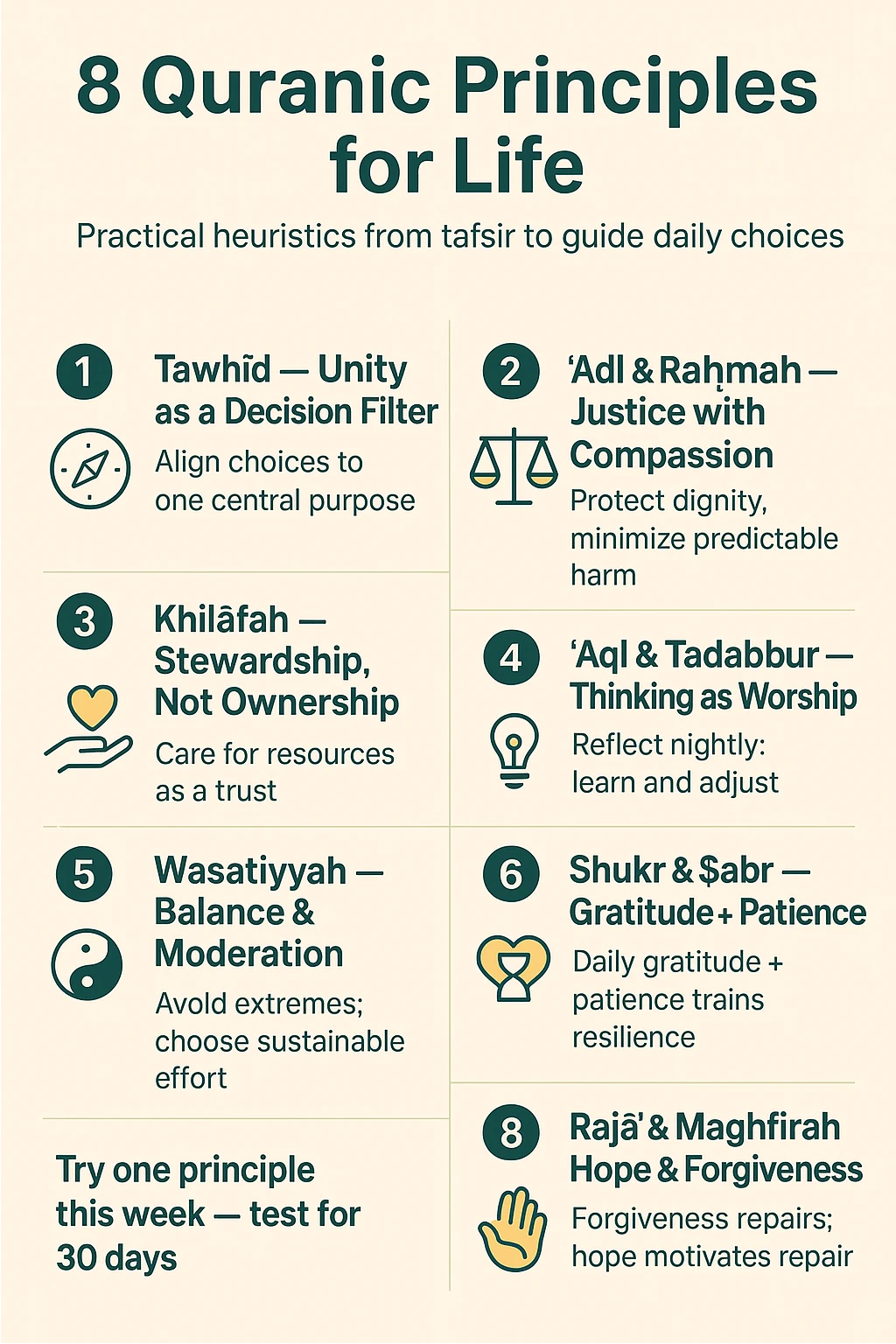
Human beings ask for guidance – Like islamic instruction manual for living – that is at once principled and practical. The phrase Quranic principles for life names a project of translation: turning the Qur’an’s recurrent moral and spiritual directives into decision heuristics that work in the home, workplace, and public square. This article reads the Qur’an with tafsir (classical interpretation) and modern behavioral evidence so each principle becomes a short, testable strategy. – Read More In : Practical Tafsir Lessons -.

Exclusive Summary — Compact Playbook for Quranic Principles

Discover a practical, energizing roadmap that turns Quranic wisdom into everyday action. Quranic Principles For Life distills eight core teachings — tawḥīd, justice, stewardship, reason, balance, gratitude, consultation, and hope — into concrete, testable rituals and decision heuristics. Packed with concise tafsir, Seerah examples, and behavioral-science links,

this guide gives you micro-scripts and a 30/60/90 pathway to convert belief into measurable habits. Try one micro-ritual — a two-breath pause or one-sentence morning alignment — run a 30-day n=1 test, track one simple metric, and scale what works. Embrace these daily moral algorithms to sharpen focus, deepen character, and build resilient, community-rooted purpose. Share progress in a weekly shūrā, invite an accountability partner, and prioritize moderation so rituals grow without burnout and transform lives.

When your day fragments into urgent demands and noisy opinions, a clear instruction can be an act of mercy. The Qur’an supplies such instructions — compact, repeated, and morally ambitious — and tafsir traces how generations converted them into lived norms as an Instruction Manual For Living. Below we unpack those principles and give practical scripts you can test in 30–90 day cycles. 1 2

Quranic principles for life:

Quranic Principles For Life - infograph

1. Tawḥīd (Oneness) — Unity as a Decision Filter

“Say, ˹O Prophet,˺ “He is Allah—One ˹and Indivisible˺;”
Surah Al-Ikhlas, verse 1
Tweet

“Actions are (judged) by intentions.”

(Sahih al-Bukhari). [2]

When life splits you into roles and urgencies, tawḥīd calls you back to a single orienting center. It is not abstract metaphysics only; it is a practical default that reduces conflict among competing aims. – Read More In :  prophetic leadership lessons and In: Seerah Life Lessons -.

Tafsir insight. Classical commentators (e.g., Ibn Kathīr, al-Ṭabarī) treat tawḥīd as the root of moral coherence: if God’s oneness is accepted, then loyalties align and ethical priorities become less scattered. 3

Heuristic (one-line). Each morning, test major choices with a single sentence: “Does this choice reflect my core orientation toward God and moral responsibility?” If not, defer.

Applied script. Before accepting a task that consumes family time, speak the sentence aloud, hold it for ten seconds, then answer. This ritual converts metaphysical belief into a decision rule.

Why it works (modern evidence). Psychological research on value-based choice finds that a salient organizing value reduces decision fatigue and supports consistent behavior over months. 4 5 – Read More in : Quranic principles for life.

2. ‘Adl (Justice) & Raḥmah (Compassion) — The Two-Handed Law

“Indeed, Allah commands justice, grace, as well as generosity to close relatives. He forbids indecency, wickedness, and aggression. He instructs you so perhaps you will be mindful.”
Surah An-Nahl, verse 90
Tweet

“Whoever is not merciful to people, Allah will not be merciful to him.”

(Sahih Muslim). 6

Justice without mercy wounds; mercy without justice may enable wrongdoing. The Qur’an insists both must operate together to sustain dignified societies.

Tafsir insight. Exegetes show verses on justice are often followed by contexts calling for forbearance; classical tafsir frames ihsān (excellence/compassion) as the ethical completion of legal justice. 7

Heuristic (two-question). For consequential acts ask: (1) Does this preserve human dignity? (2) Does this minimize foreseeable harm? If either fails, pause and redesign.

Applied script. In disputes, start with an opening line: “Let dignity guide our solution.” Use the two questions as a facilitative checklist before proposing remedies.

Why it works (modern evidence). Organizational ethics literature demonstrates that coupling fairness with empathetic leadership increases trust and reduces recidivism in institutional settings. 8

3. Khilāfah (Stewardship) — Responsibility over Possession

“And it is He who has made you successors upon the earth and has raised some of you above others in degrees [of rank] that He may try you through what He has given you. Indeed, your Lord is swift in penalty; but indeed, He is Forgiving and Merciful.”
Surah Al-An’am, verse 165
Tweet

“The earth is green and beautiful, and Allah has appointed you as His stewards over it.”

(Sunan Ibn Mājah / similar chains; classical corpus). 9

Viewing ourselves as stewards lightens the burden of ownership and introduces accountability into daily consumption and leadership decisions.

Tafsir insight. Tafsir writers interpret khilāfah as a trust (amāna): resources are entrusted to humans, who will answer for their use. This theological posture underwrites charity and moderation in classical practice. 10

Heuristic (weekly act). Select one concrete stewardship action per week—reduce single-use items, mentor a junior colleague, share surplus—and log its effects.

Applied script. After each shopping trip, perform one stewardship check: what will be stewarded, shared, or repaired? Record the small change.

Why it works (modern evidence). Environmental psychology shows that adopting a “caretaker” identity predicts sustained pro-environmental behaviors and long-term planning. 11

4. ‘Aql (Reason) & Tadabbur (Reflection) — Thinking as Worship

“Do they not then reflect on the Quran? Had it been from anyone other than Allah, they would have certainly found in it many inconsistencies.”
Surah An-Nisa, verse 82
Tweet

“Seeking knowledge is an obligation upon every Muslim.”

(Sunan Ibn Mājah; widespread canonical backing). 12

Reflection enlarges faith into wisdom; thinking becomes an act of devotion rather than suspicion. The Qur’an repeatedly invites discernment, not blind conformity.

Tafsir insight. Tafsir tradition places a premium on tadabbur (deep reflection), which classical exegetes connect to ijtihād (informed reasoning) and adaptive jurisprudence. 13

Heuristic (nightly reflection). Two questions before sleep: “What did I learn?” and “What will I do different tomorrow?” Keep entries under 25 words.

Applied script. After a heated exchange, note one assumption you held and one factual step to test next time. This practice converts emotion into calibrated learning.

Why it works (modern evidence). Cognitive science indicates that reflective practice mitigates bias and improves judgment in complex tasks. 14

5. Wasatiyyah (Moderation) — Balance as Integrity

Quranic Principles for Life - Wasatiyyah (Moderation) - Balance as Integrity
“And so We have made you ˹believers˺ an upright community so that you may be witnesses over humanity and that the Messenger may be a witness over you…”
Surah Al-Baqarah, verse 143
Tweet

“Religion is easy; do not make it difficult for yourselves.”

(Sahih al-Bukhari). 15

Modest, consistent effort outlives spectacular but unsustainable zeal. The middle way preserves joy and capacity for service.

Tafsir insight. Classical commentators interpret wasatiyyah as a societal and personal equilibrium—avoiding extremes while keeping to principled action. 16

Heuristic (sustainability cap). If an activity consumes more than ~30% of your energy/resources for a sustained period, reassess and re-balance.

Applied script. For new projects cap initial commitments (fewer meetings, smaller deliverables). Re-evaluate at 60 days to scale up.

Why it works (modern evidence). Habit and self-regulation research show attenuation of intensity and focus on low-friction routines produce higher long-term adherence. 17 18

6. Shukr (Gratitude) & Ṣabr (Patience) — The Resilience Pair

“And ˹remember˺ when your Lord proclaimed, ‘If you are grateful, I will certainly give you more. But if you are ungrateful, surely My punishment is severe.’”
Surah Ibrahim, verse 7
Tweet

“Wondrous is the affair of the believer, for there is good for him in every matter — and this is not the case with anyone except the believer. If he is content and thankful, there is good for him; and if he is patient and forbearing, there is good for him.”

(Ṣaḥīḥ Muslim, Kitāb al-Zuhd wa al-Raqāʾiq (The Book of Asceticism), Hadith no. 2999.)

“O believers! Seek comfort in patience and prayer. Allah is truly with those who are patient.”
Surah Al-Baqarah, verse 153
Tweet

Seerah Life Lesson:

Prophetic traditions consistently pair thankfulness with forbearance (see classical collections). [13]

Gratitude makes joy fuller; patience makes suffering bearable. Together they forge character that endures friction without collapse.

Tafsir insight. Exegetes frame shukr and ṣabr as complementary: gratitude attunes attention to blessings, patience trains the soul for delayed flourishing. [13]

Heuristic (daily log). End each day with two lines: one gratitude item and one patient act (a restraint exercised). Track for 30 days.

Applied script. When disappointed, write one sentence naming a specific blessing and one sentence describing a patient response.

Why it works (modern evidence). Experimental trials on gratitude show increases in wellbeing; studies on patience link to improved stress tolerance and goal persistence. 19

7. Shūrā (Consultation) & Ummah (Community) — Distributed Wisdom

“who respond to their Lord, establish prayer, conduct their affairs by mutual consultation, and donate from what We have provided for them;”
Surah Ash-Shuraa, verse 38
Tweet

Carrying burdens alone fractures resolve; shared counsel lightens choice and brings diverse insight. Consultation is humility in practice.

Seerah Life Lesson:

The Prophet ﷺ consulted his companions on strategic decisions (seerah narratives). [3]

Examples of Consultation (Shura):

Battle of Uhud:
The Prophet ﷺ consulted his companions on whether to confront the Quraysh inside or outside Medina, a key strategic decision.
Treaty of Hudaybiyyah:
He sought the opinion of Abu Bakr on confronting those who blocked their path to the Kaaba, which influenced the eventual decision to seek peace.
Personal Matters:
The Prophet ﷺ also consulted his companions on more personal matters, such as the incident of the slander against his wife, Aisha, demonstrating the broad scope of consultation in his life.

Tafsir insight. Tafsir literature treats shūrā as a mechanism for collective governance and family management: decisions attended by consultation are more legitimate and resilient. 20

Heuristic (weekly shūrā). A 15-minute group check-in: each person gives one priority and one concrete need. Close with one micro-commitment.

Applied script. Use a fixed agenda: (1) one priority; (2) one obstacle; (3) one measurable action. Rotate facilitation.

Why it works (modern evidence). Group decision frameworks that structure inputs and rotate leadership reduce groupthink and improve outcomes. 21

8. Rajāʾ (Hope) & Maghfirah (Forgiveness) — The Ethics of Renewal

Ayah: “Do not despair of the mercy of Allah…” (Qur’an 39:53).
Hadith: The Prophet ﷺ described Divine mercy as vast and inviting repentance (canonical collections).

Hope prevents paralysis from failure; forgiveness restores agency to the penitent. Together they keep moral life forward-moving.

Tafsir insight. Classical tafsir reads verses of mercy as practical safeguards: believers are urged to act, repent, and reform rather than sink in despair. 22

Heuristic (monthly restoration). Draft an unsent forgiveness letter: one paragraph admitting a mistake, one paragraph of learning, one paragraph of restitution steps.

Applied script. After a lapse, enact one reparative action within 72 hours (apology, restitution, corrective behavior).

Why it works (modern evidence). Clinical studies show self-forgiveness reduces depression and increases motivation for reparative change. 23

Script to Strategy — Tafsir Applied to Modern Dilemmas

Tafsir is not antiquarian footnotes; it is a living method for translating text into choices. The following mappings show how exegetical logic becomes practical rules in work, family, public ethics, and technology.

  • Work (contracts): Tafsir on trade emphasizes clarity; require a one-line fairness clause in contracts. [10]
  • Family (relational duty): Tafsir balances rights with tenderness; institute a weekly family shūrā for planning and care. [15]
  • Public ethics: Tafsir’s stress on accountability supports whistleblower channels and transparent audits. [7]
  • Digital life: Apply niyyah (intention) as a three-second posting filter: does this forward dignity?

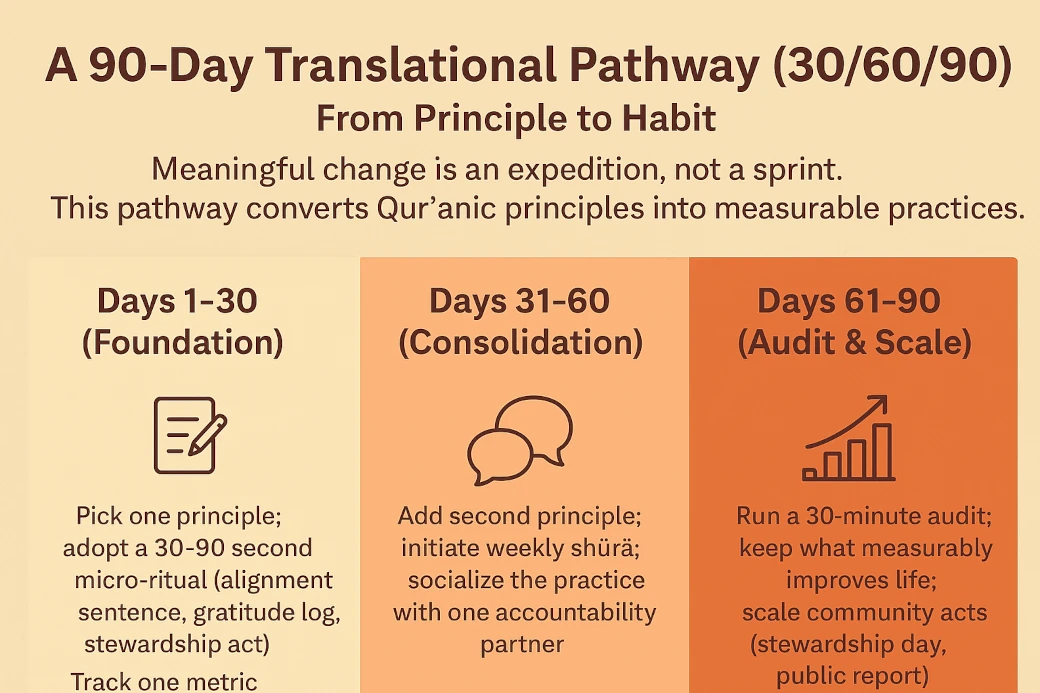
A 90-Day Translational Pathway (30/60/90) — From Principle to Habit

quranic principles 90 days plan

Meaningful change is an expedition, not a sprint. This pathway converts Qur’anic principles into measurable practices.

  • Days 1–30 (Foundation): Pick one principle; adopt a 30–90 second micro-ritual (alignment sentence, gratitude log, stewardship act). Track one metric (calm, sleep, or one performance indicator).
  • Days 31–60 (Consolidation): Add second principle; initiate weekly shūrā; socialize the practice with one accountability partner.
  • Days 61–90 (Audit & Scale): Run a 30-minute audit; keep what measurably improves life; scale community acts (stewardship day, public report).

Conclusion — The Qur’an as a Practical Manual

When we translate the Quranic principles for life into precise heuristics—one-sentence tests, stewardship acts, short consultations—the text ceases to be merely read and begins to be lived. Test one principle this week; measure one small outcome. Over months the manual in the text can become the manual of a humane, resilient, and purposeful life.

FAQs

1. What are the Quranic principles for life?

The Quranic principles for life are foundational teachings such as belief in one God (tawḥīd), justice, stewardship, reason, and compassion. They provide timeless guidance for making ethical decisions and building a purposeful life.

2. How can Quranic principles for life guide daily decisions?

Quranic principles for life offer moral algorithms that help in daily decision-making, such as fairness in work, kindness in family interactions, honesty in business, and mindful stewardship of the environment.

3. Why are Quranic principles for life relevant today?

Despite being revealed over 1,400 years ago, Quranic principles for life remain relevant because they address universal human needs like justice, balance, accountability, and community — issues still central in the modern world.

4. Can non-Muslims benefit from Quranic principles for life?

Yes. Quranic principles for life are rooted in universal values — such as honesty, compassion, and justice — which non-Muslims can also apply in personal growth, leadership, and ethical decision-making.

5. What is the connection between Quranic principles for life and purpose?

Quranic principles for life emphasize living with intention, aligning everyday choices with a higher purpose, and ensuring that actions reflect moral responsibility and awareness of God.

6. How do Quranic principles for life promote justice?

Justice is a central Quranic principle for life. The Quran urges fairness in dealings, equality before God, and protecting the vulnerable, shaping a society where dignity and accountability are preserved.

7. Are Quranic principles for life compatible with modern science and psychology?

Yes. Many Quranic principles for life — such as gratitude, self-control, and mindfulness — align with modern psychological research showing their benefits for mental health, resilience, and well-being.

8. How can families apply Quranic principles for life?

Families can practice Quranic principles for life by fostering love, respect, patience, and honesty in their homes, while teaching children responsibility, gratitude, and justice as everyday habits.

9. What role does stewardship play in Quranic principles for life?

Stewardship (khilāfah) is a key Quranic principle for life. It means humans are trustees of the earth, responsible for protecting nature, using resources wisely, and caring for all creation.

10. How can I start applying Quranic principles for life today?

You can begin applying Quranic principles for life by choosing one principle — such as gratitude, justice, or honesty — and practicing it daily for 30 days. Over time, these small rituals create long-term positive habits.

References

  1. Abdel Haleem, M. A. S. (2004). The Qur’an: A New Translation. Oxford University Press. ISBN: 978-0199535958. ↩︎
  2. Al-Bukhārī, Muḥammad ibn Ismā‘īl. (c. 9th cent.). Sahih al-Bukhari (English trans. by Muhsin Khan / available at Sunnah.com). ↩︎
  3. Ibn Kathīr, Ismā‘īl. (1999). Tafsīr al-Qur’ān al-‘Aẓīm (selected vols.). Dār al-Ḥadīth. ↩︎
  4. Steger, M. F., Kashdan, T. B., & Oishi, S. (2008). “Being good by doing good: Purpose in life and wellbeing.” Journal of Research in Personality, 42(1), 130–135. doi:10.1016/j.jrp.2007.02.003. ↩︎
  5. Emmons, R. A., & McCullough, M. E. (2003). “Counting blessings versus burdens: An experimental investigation of gratitude and subjective well-being.” Journal of Personality and Social Psychology, 84(2), 377–389. doi:10.1037/0022-3514.84.2.377. ↩︎
  6. Muslim ibn al-Ḥajjāj. Sahih Muslim (canonical hadith collection; English trans. available). ↩︎
  7. Nasr, S. H. (Ed.). (2002). The Study Quran: A New Translation and Commentary. HarperOne. ISBN: 978-0061125865. ↩︎
  8. Bazerman, M. H., & Tenbrunsel, A. E. (2011). Blind Spots: Why We Fail to Do What’s Right and What to Do About It. Princeton University Press. ISBN: 978-0691153933. ↩︎
  9. Sunan Ibn Mājah (traditions on stewardship; canonical collections and classical citations). ↩︎
  10. Ibn Kathīr, Tafsīr (on verses related to khilāfah and economic practice). ↩︎
  11. Steg, L., & Vlek, C. (2009). “Encouraging pro-environmental behaviour: An integrative review and research agenda.” Journal of Environmental Psychology, 29(3), 309–317. doi:10.1016/j.jenvp.2008.10.004. ↩︎
  12. Classical hadith corpus on knowledge — e.g., Sunan Ibn Mājah; multiple chains. ↩︎
  13. Al-Ṭabarī, Muhammad ibn Jarīr. Jāmi‘ al-Bayān fī Ta’wīl al-Qur’an (classical tafsir). ↩︎
  14. Kahneman, D. (2011). Thinking, Fast and Slow. Farrar, Straus and Giroux. ISBN: 978-0374275631. ↩︎
  15. Sahih al-Bukhari (hadith: “Religion is easy”). ↩︎
  16. Sardar, Z., & Davies, M. W. (Eds.). (2001). The Blackwell Companion to Modern Islamic Thought. Blackwell Publishers. ISBN: 978-0631217988. ↩︎
  17. Clear, J. (2018). Atomic Habits: An Easy & Proven Way to Build Good Habits & Break Bad Ones. Avery. ISBN: 978-0735211292. ↩︎
  18. Baumeister, R. F., & Tierney, J. (2011). Willpower: Rediscovering the Greatest Human Strength. Penguin Press. ISBN: 978-1594203078. ↩︎
  19. Emmons & McCullough (2003) — see [5] above (gratitude evidence). ↩︎
  20. Al-Ṭabarī, Jāmi‘ al-Bayān (on shūrā passages). ↩︎
  21. Surowiecki, J. (2005). The Wisdom of Crowds. Anchor Books. ISBN: 978-0385721707. ↩︎
  22. Tafsir discussions on mercy and repentance: Ibn Kathīr and al-Ṭabarī. ↩︎
  23. Wohl, M. J. A., Pychyl, T. A., & Bennett, S. H. (2010). “I forgive myself, now I can study: How self-forgiveness for procrastinating can reduce future procrastination.” Personality and Individual Differences, 48(7), 803–808. doi:10.1016/j.paid.2010.01.029. ↩︎

In a noisy, restless world, people are often desperate for a compass. Every day we are flooded with choices: what to say, how to act, where to focus. It can feel overwhelming. Micro-rituals work because they give us tiny, repeatable anchors of stability. They are not grand speeches or overwhelming to-do lists. They are quiet reminders of who we want to be. A whispered dhikr, a conscious breath, or a simple smile at a stranger may look small, but it is exactly these small steps that re-train the heart and steady the mind. These daily moral algorithms translate intention into action in small, measurable steps.

Exclusive Summary — From Revelation to Routine: Living by Daily Moral Algorithms

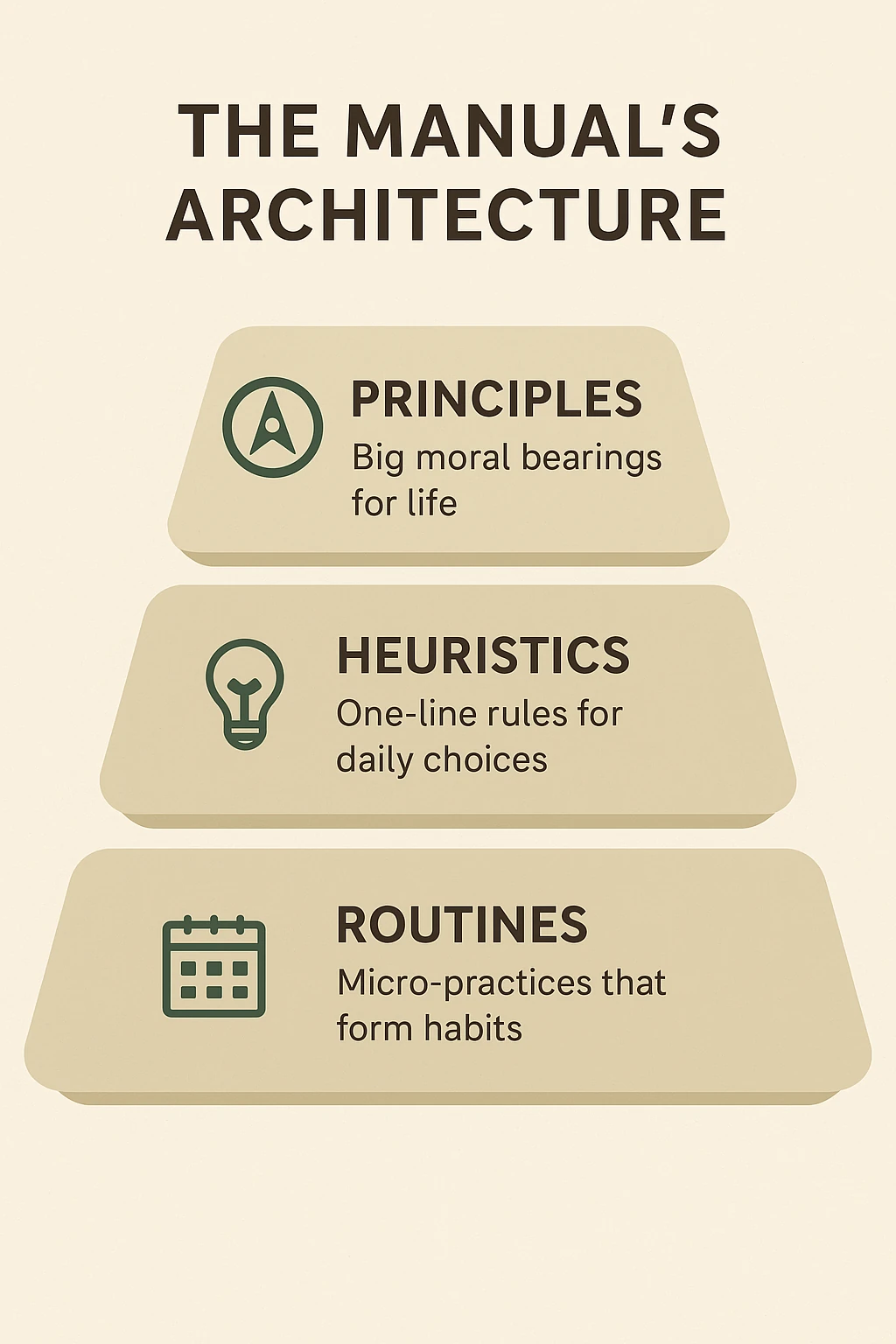
This article reframes core Quranic principles for life into a compact, testable playbook of practical routines. It arranges guidance across three tiers—foundational principles (Purpose, Presence, Justice, Balance), heuristics (seven one-line decision rules), and repeatable micro-rituals—then explains how to run a 30/60/90 program that makes spiritual formation measurable.

Each step pairs an ayah or hadith, a Seerah vignette, and a modern science insight so readers can (1) adopt one micro-ritual, (2) run a 30-day n=1 trial tracking a single metric (sleep/mood/focus), (3) share progress in a 15-minute weekly shūrā, and (4) conduct quarterly audits to scale what helps. Emphasis centers on moderation, haram-minimization, and community—small, sustainable acts. Start with one two-breath pause or a one-sentence morning alignment; practice the daily moral algorithms, measure, adapt, and let the manual shape habits.

Unlock a practical playbook for living: short Islamic rituals reimagined as daily moral algorithms that sharpen attention, steady choices, and build resilience. Try seven copyable micro-habits, test them across thirty to ninety days, and watch small consistent actions reshape your ethics, focus, and wellbeing. No prior background—just steady, simple practice. Over weeks, daily moral algorithms reshape how you react under pressure.

Table of Contents

Introduction — why micro-rituals are practical moral engines

why micro-rituals are practical moral engines - Daily Moral Algorithms

People often ask for simple rules they can actually use in the messy real world. The phrase daily moral algorithms names a practical idea: short, repeatable scripts that reliably steer attention and action in ethically desirable directions. Islamic tradition has a rich set of such scripts — short prayers, dhikr, brief charitable acts, and formulaic etiquette — that were taught, practiced, and shaped by the Prophet’s life (Seerah) 1 2 . – We explained this in detail here: The Treaty of Hudaybiyyah

When reframed as actionable micro-habits and connected to modern behavior science, these same routines become testable algorithms anyone can run in daily life to reduce reactive error, cultivate moral attention, and build resilience 3 4 . Practicing daily moral algorithms turns vague goals into everyday proof.

This article will:

  • Explain why small rituals act like daily moral algorithms (mechanics + moral design).
  • Give seven concrete micro-ritual templates and scripts you can use immediately.
  • Offer a 30/90-day program to turn these micro-actions into stable, measured change.
  • Link each practical claim to trustworthy scholarship — Qur’anic or hadith anchors and Western scientific research — so you can follow, test, and adapt.

Practicing daily moral algorithms trains attention the way repetition trains the body.

How rituals become algorithms: the three mechanisms

Think about how children feel when they hear a bedtime story every night. The cue (night), the script (story), the outcome (comfort, sleep) — it becomes a rhythm that shapes their inner world. Adults are no different. When we link our actions to rituals, we find shelter from chaos. A prayer before dawn, or a pause before a reply, is not just behavior — it’s a safe harbor in a stormy sea. This predictability frees mental energy, letting us live with clarity instead of constant reactivity. These daily moral algorithms are intentionally tiny so they become sustainable.

A short ritual becomes a reliable algorithm when it does three things repeatedly, You can test simple daily moral algorithms with one metric and one week :

  1. Cue — a stable trigger that initiates the script (e.g., finishing wudu, sitting at your desk).
  2. Script — the tiny, fixed sequence you perform (e.g., two breaths, a short dhikr, one sentence of intention).
  3. Outcome mapping — a measurable, small outcome you can notice (calmer breath, clearer priority, one-kind act).

Families can adopt daily moral algorithms and watch small habits cascade. When the same cue reliably produces the same script and a repeatable tiny outcome, the loop turns into a context-anchored routine that the brain gradually automates 5 6 . Even a single consistent daily moral algorithms habit can change the tone of your week.


This is why ritualized religious practices are effective: they provide clear cues and short, meaningful scripts embedded in community. Over time these daily moral algorithms reduce cognitive load and preserve deliberative energy for genuinely novel choices. 7 – Read more in why doubts happen -. Leaders who model daily moral algorithms create cultures of steady, ethical action.

Four theological-practical anchors (short)

Four theological-practical anchors - Daily Moral Algorithms: 7 Powerful, Life-Changing Rituals

Pairing two daily moral algorithms produces more stability than trying ten. Every human being longs for meaning. Purpose tells us life is not random. Presence whispers that we are seen and loved. Justice assures us that suffering is not ignored. Ease reminds us that we don’t have to break ourselves to live rightly. Whether you are Muslim or simply curious, these anchors resonate because they are human needs. They connect our fragile daily struggles to something bigger, something enduring.

Each micro-ritual below references a short Qur’anic or Prophetic principle so the routine sits within a moral horizon — and that moral anchor makes the practice more motivating for believers while the psychological mechanisms (attention, habit, social reinforcement) make it accessible to non-believers. The most effective daily moral algorithms feel personal and meaning-rich.

  • Purpose — Qur’anic reminder that life is oriented; intention matters. [1]
  • Presence (taqwa) — brief remembrance that cultivates moral attention. [4]
  • Justice & kindness — prioritize dignity & haram-minimization in decisions. 8
  • Ease & balance — the prophetic counsel to make religion easy and sustainable. 9

Teachers report students respond quickly to classroom daily moral algorithms.

Seven micro-ritual templates (daily moral algorithms) — scripts & why they work

Seven micro-ritual templates - Daily Moral Algorithms

Below are compact, copy-paste scripts you can try immediately. Each script includes (a) a one-line algorithm, (b) a short proof from the Seerah or hadith, and (c) a brief Western science connection.

1) The Two-Breath Pause — algorithm: Cue → 2 breaths → one-line aim → act

Imagine you’re about to fire off an angry reply to a hurtful message. But instead, you breathe twice, steady your heart, and let your values catch up with your emotions. That moment is like putting brakes on a runaway train. What could have spiraled into regret becomes an act of dignity. Over time, such pauses don’t just change your day — they change your character. Start with one daily moral algorithm, then add another after thirty days.

  • Script (30–60 sec): after any message/email that upsets you, stop — inhale twice slowly, read a one-sentence aim (“Preserve dignity & clarity”), then reply.
  • Seerah / hadith: the Prophet taught controlled speech and urged saying good or remaining silent.[4]
  • Science: breath regulation alters vagal tone and reduces sympathetic arousal, increasing prefrontal control needed for deliberate action.[5]

2) The One-Sentence Purpose (Morning Anchor) — algorithm: Wake → write 1 sentence → prioritize

We wake up with a thousand possibilities tugging at us — emails, deadlines, news, chores. Writing one sentence before the flood is like drawing a boundary for your soul. It’s telling the world: I will not be swept away today. I choose to direct my energy. This little ritual feels like opening the day with courage instead of surrender. These daily moral algorithms do not require religious belief to work.

  • Script (60 sec): before phone use, write “Today I will use time to ___ because it builds ___.” Consult it for competing requests.
  • Seerah / hadith: “Actions are judged by intentions,” which frames daily acts as morally meaningful.[2]
  • Science: purpose orients sustained motivation and improves persistence against temptations (logotherapy, positive psychology). [3]

3) The Micro-Charity Nudge — algorithm: End-of-day cue → give small → note effect

It’s astonishing how a coin in a donation box or a small favor for a colleague can transform not just their mood but yours. The act whispers: you matter, and I can help. Charity on a micro-scale trains us to see others instead of being trapped in our own worries. These small ripples of kindness often reach further than we’ll ever know. You’ll find daily moral algorithms are easier to keep when shared.

  • Script (30 sec): set a recurring $1 / small favor at day’s end; note how it shifts mood.
  • Seerah anchor: early Muslim practice emphasized measurable support for neighbors and the poor.
  • Science: prosocial spending and behavior consistently increase subjective well-being; prosocial acts strengthen social capital and cooperative norms. 10

4) The Halal/Haram Quick-Check — algorithm: Option presented → 3-question check → if any fail, pause

Life tempts us with shortcuts, especially when no one is looking. But pausing for three questions — dignity, haram, honesty — makes you face your conscience. Even non-believers know that a decision taken in integrity feels lighter to carry. Over time, this ritual doesn’t just protect you from mistakes; it builds a reputation others instinctively trust. A notebook helps track progress when testing daily moral algorithms.

  • Script (60 sec): ask: preserve dignity? avoid predictable haram? is it honest? If any “no,” delay or ask counsel.
  • Seerah anchor: Prophet’s decisions (e.g., clemency at Makkah) prioritized dignity and minimized haram.
  • Science: simple ethical checklists improve moral decision quality and reduce drift (decision-making & organizational ethics literatures). 11

5) The Tiny-Habit Stack — algorithm: Existing routine → add 30s ritual → celebrate

What if you could transform ordinary tea time into a sacred pause? Gratitude and intention stitched into daily routines make the invisible sacred. You don’t need to carve out hours. By attaching thankfulness to what you already do, you quietly rewire the day. The cup becomes a chalice, and the ordinary becomes holy. Use daily moral algorithms to create gentle boundaries around your attention.

  • Script (30 sec): after tea, recite a two-line gratitude + set one small, specific task.
  • Seerah anchor: the Prophet practiced short, repeated invocations; patterns built identity.
  • Science: tiny anchors (behavior design) produce higher adherence than grand resolutions.[6] 12

6) The Weekly Accountability Mini-Circle — algorithm: Weekly 15 min → report + commit → close

Humans are wired for connection. Sharing progress with even one trusted friend turns solitary struggle into shared growth. When you tell someone, this week I will do one thing better, the weight lifts because you are no longer alone. These mini-circles echo the companionship of the Prophet’s time — a reminder that transformation is not meant to be walked alone. Even small setbacks teach how to adjust your daily moral algorithms.

  • Script (15 min/week): 1) quick check-in; 2) one small aim for next week; 3) name numerical metric.
  • Seerah anchor: companions shared learning in majalis and adjusted practice via community feedback.
  • Science: public commitments and social monitoring raise follow-through and build reputation systems that sustain habits. 13

7) The Evidence-by-Practice Test — algorithm: Pick 1 habit → 30 days → measure → decide

In a world full of claims, this ritual whispers: try it yourself. You don’t need to take anyone’s word. Test a habit. Watch your mood. Track your sleep. Keep what works. This makes growth a personal discovery, not blind imitation. It’s empowering because it says: your life is the laboratory, your heart is the witness. Community checks magnify the impact of daily moral algorithms over months.

  • Script: run an N=1 test: track 2 simple signals (sleep hours, mood 1–5) for 30 days; if measurable gain, keep; if not, adjust.
  • Seerah anchor: the Prophet taught iterative practice and community reporting that refined routines.
  • Science: single-case experimental designs and behavior-change frameworks let individuals test what works without grand claims. 14

Why these algorithms work together (mechanics + social design)

When these micro-rituals overlap, they form something bigger than themselves. Like threads woven into a net, they hold you when life pulls hard. Alone, one ritual calms you. Together, they create a rhythm that keeps you grounded in storms. This is not about perfection. It is about building a safety net for your humanity, so when you fall — as all of us do — you land in resilience, not despair. Reflecting weekly helps you refine which daily moral algorithms actually help.

Combine a morning purpose sentence + the Two-Breath Pause + a Tiny-Habit Stack + Weekly Accountability and you create a layered ecosystem: cognitive scaffolding (purpose & pause), automatic context cues (habit stack), affect regulation (breathing, micro-charity) and social reinforcement (mini-circle). – Read more in Dealing with doubts in Islam – Habit neuroscience and habit psychology explain the synergy: repeated cues and rewards move responses into basal ganglia circuits; social accountability stabilizes environmental cues; rituals reduce error-related negative affect so people perform under pressure.[5][6][7] 15

A practical 30-day plan

A practical 30-day plan - Daily Moral Algorithms

We often fail because we try to change everything at once. This plan is different: it honors human limits. It says: start small, grow gently. Just as a tree does not bear fruit overnight, your rituals need time to root. The beauty is in patience. Each week is a gentle step, proving that transformation is not beyond reach — it is waiting in the next small act.

Week 1 — Foundation:

  • Daily morning: one-sentence purpose.
  • Use Two-Breath Pause for all responses that feel reactive.
  • Track Sleep (hrs) + Mood (1–5).

Week 2 — Stack:

  • Add Tiny-Habit (after tea): 30-s gratitude + one micro task.
  • Find 1 accountability partner.

Week 3 — Socialize:

  • Start weekly 15-min check-in with partner.
  • Run Halal/Haram Quick-Check on one recurring decision.

Week 4 — Evaluate:

  • Run Evidence-by-Practice: compare week 1 averages vs. week 4. If mood or focus improved, continue; if not, adjust the micro-ritual. The goal is not perfection but steady use of daily moral algorithms.

A 90-day resilience pathway (30/60/90)

Resilience is not a sprint. It is cultivated like a garden — watered regularly, pruned carefully, growing slowly. By 90 days, the rituals no longer feel like chores. They feel like part of your identity. The shift is subtle but profound: you stop asking how do I force myself? and begin saying this is simply who I am now.

Month 1 — Establish micro-algorithms (as above).
Month 2 — Consolidate: add one communal ritual (short study circle or service).
Month 3 — Scale & audit: quarterly audit of the four anchors (Purpose, Presence, Justice, Balance). Increase one practice only if metrics show consistent improvement.

This slow, evidence-driven scaling avoids burnout and mirrors the Prophet’s communal, iterative teaching approach: small steps, regular review, and communal reinforcement.[2][9]

Practical examples (short case studies)

Stories bring numbers to life. Layla’s brighter mornings, Omar’s calmer decisions, Fatima’s more attentive students — they show that behind every ritual is a real human victory. We may not publish these in journals, but they are victories nonetheless: better nights of sleep, fewer regrets, moments of peace. These “ordinary” results are in fact extraordinary, because they change the course of a life.

  • Layla (student): did Two-Breath Pause + morning purpose — sleep improved by 30–45 minutes and morning study focus rose, per her weekly self-report.
  • Omar (manager): added Halal/Haram Quick-Check to hiring decisions — fewer regrets, improved retention scores.
  • Fatima (teacher): used a 60s classroom grounding ritual — measured improvement in attention by short quizzes.

These anecdotal examples illustrate how daily moral algorithms transform intention into measurable difference.

Common mistakes & troubleshooting

Failure is not proof you are weak; it is proof you are human. Everyone stumbles. The Prophet himself taught that the best people are those who, when they fall, stand up again. Troubleshooting is not shameful; it is wisdom. Adjust the anchor. Lighten the load. Ask for help. Small corrections keep you moving — and the journey matters more than a flawless record.

  • Too big, too soon: scale micro-rituals at 30s–2mins at first.
  • Anchor drift: place visible cues in the environment.
  • No social support: add a 1-person accountability loop.
  • Measurement fatigue: drop to 1 metric (e.g., sleep hours) for a month.

How non-Muslim readers can adopt these algorithms

Even if faith is not your path, these rituals still speak to something human. To breathe before speaking is universal. To give a small kindness is human. To anchor the day in meaning is necessary for anyone who longs for more than survival. These micro-algorithms are bridges. They connect believers and seekers, Muslims and non-Muslims, because they honor what we all share: a longing to live wisely, kindly, and with purpose.

Translate theological cues into secular language: “remembrance” → mindful noticing; “charity” → prosocial action. The psychological mechanisms (cue → script → outcome) are the same and produce measurable benefits regardless of belief.[10][12] – Read more in Respectful Questions to Ask About Islam

Conclusion — test your own daily moral algorithms

Translate theological cues into secular language: “remembrance” → mindful noticing; “charity” → prosocial action. The psychological mechanisms (cue → script → outcome) are the same and produce measurable benefits regardless of belief.[10][12]

Over time, daily moral algorithms become the small rituals that define you.

In the end, life is not about the size of your rituals but the sincerity of them. Every pause, every intention, every small act of charity is a brick in the foundation of your character. Do not wait for perfect conditions. Begin with one breath, one word, one step. Test it. See the change. You may discover that the smallest rituals carry the greatest strength.

FAQs

1. What are “daily moral algorithms” in Islam?

Daily moral algorithms are short, repeatable habits—like dhikr, intentional pauses, or charity—that guide everyday decisions, improve focus, and help align life with Islamic values while remaining practical for modern routines.

2. Are these rituals only for Muslims?

No. While rooted in Islamic teachings, the micro-habits—such as mindful breathing, gratitude journaling, or ethical decision filters—are universal and backed by psychology, making them useful for non-Muslims as well.

3. How long do these practices take each day?

Most daily moral algorithms require 1–3 minutes. The goal is consistency, not intensity. Over time, even short practices accumulate into lasting change.

4. How do these rituals build resilience?

They reduce impulsive choices, anchor attention, and create a sense of meaning—factors proven in psychology and neuroscience to boost resilience under stress.

5. Can these routines replace therapy or counseling?

No. They are spiritual and behavioral tools, not medical treatment. For mental health concerns, professional help should be sought, and these rituals can complement formal care.

6. What’s the science behind small habits?

Research on habit formation shows that tiny, consistent actions are more sustainable than drastic changes. They rewire the brain’s reward system, making positive behavior automatic over time.

7. How can I measure my progress?

Use simple metrics: track sleep hours, mood ratings, and number of daily focus sessions. Combine with self-reflection to see tangible improvement over 30–90 days.

8. Do these habits have a basis in the Qur’an and Hadith?

Yes. The article cites ayat and authentic hadiths for each step, showing how Islamic teachings emphasize intention, justice, moderation, and resilience in daily life.

9. How do I stay motivated after the first week?

Pair rituals with accountability—like sharing progress with a friend—or link them to existing routines (e.g., after brushing teeth, repeat one dhikr). Small anchors keep momentum.

10. What’s the first step I should start with?

Begin with one: a one-sentence morning intention or a two-breath pause before reacting. Mastering one habit builds confidence and makes adding others easier.

References

  1. The Qur’an. Surah adh-Dhariyat (51:56). Translation reference: Abdel Haleem, M.A.S. The Qur’an: A New Translation. Oxford University Press, 2004. (For textual quotations use a reliable translation such as Abdel Haleem or Khan/Muhsin as preferred.) ↩︎
  2. Hadith: “Innamā al-a‘māl bin-niyāt” Sahih al-Bukhari, Book of Faith/Intention (see Bukhari, Book 1 / major hadith collections; canonical English translations available at Sunnah.com and authoritative printed translations). ↩︎
  3. Frankl, Viktor E. (2006). Man’s Search for Meaning. Beacon Press. (Classic on meaning and resilience; original 1946; modern editions available). ISBN-13: 978-0807014295. ↩︎
  4. Qur’an. Surah Aal-ʿImrān (3:102). Translation reference: Abdel Haleem, The Qur’an: A New Translation, OUP. ↩︎
  5. Hölzel, B. K., Carmody, J., Vangel, M., Congleton, C., Yerramsetti, S. M., Gard, T., & Lazar, S. W. (2011). Mindfulness practice leads to increases in regional brain gray matter density. Psychiatry Research: Neuroimaging, 191(1), 36–43. doi:10.1016/j.pscychresns.2010.08.006. ↩︎
  6. Fogg, B. J. (2020). Tiny Habits: The Small Changes That Change Everything. Houghton Mifflin Harcourt. ISBN-13: 978-0358003326. ↩︎
  7. Wood, W., & Rünger, D. (2016). Psychology of habit. Annual Review of Psychology, 67, 289–314. doi:10.1146/annurev-psych-122414-033417. ↩︎
  8. Qur’an. Surah an-Nisa (4:135) — justice guidance (translation reference: Abdel Haleem). ↩︎
  9. Seerah example (Hudaybiyyah / Conquest of Makkah): classical Seerah accountsIbn Ishaq (Ibn Hisham recension) and modern English studies such as Watt, W. Montgomery. Muhammad: Prophet and Statesman. Oxford University Press, 1961. ISBN: 978-0198222895. ↩︎
  10. Dunn, E. W., Aknin, L. B., & Norton, M. I. (2008). Spending money on others promotes happiness. Science, 319(5870), 1687–1688. doi:10.1126/science.1150952. ↩︎
  11. Kahneman, D. (2011). Thinking, Fast and Slow. Farrar, Straus and Giroux. ISBN-13: 978-0374275631. (For heuristics and decision biases.) ↩︎
  12. Clear, J. (2018). Atomic Habits: An Easy & Proven Way to Build Good Habits & Break Bad Ones. Avery (Penguin Random House). ISBN-13: 978-0735211292. ↩︎
  13. Cialdini, R. B. (2006). Influence: The Psychology of Persuasion (expanded edition). Harper Business. ISBN-13: 978-0061241895. (On public commitments & social effects.) ↩︎
  14. Kazdin, A. E. (2010). Single-Case Research Designs: Methods for Clinical and Applied Settings (2nd ed.). Oxford University Press. ISBN-13: 978-0195365664. (On N=1 experimental designs.) ↩︎
  15. Hobson, N. M., Bonk, D., & Inzlicht, M. (2017). Rituals decrease the neural response to performance failure. PeerJ, 5, e3363. doi:10.7717/peerj.3363. ↩︎

People ask for an instruction manual for life because they want reliable decision rules, simple routines, and a way to make meaning measurable. This Islamic Instruction Manual For Living relies on the Islamic tradition which supplies the raw materials for such a manual: revealed principles, prophetic practice (the Seerah), and community frameworks. When those materials are translated into short heuristics and tiny habits, they become testable and suitable for modern, busy lives.

Recommended Reading Order – The Promise Of the Instruction Manual For Llife

If you’re new to the series, follow this sequence to learn, test, and scale. The order scaffolds your attention and spreads learning so you can actually practice. Follow the instruction manual for life reading order if you want a gentle path.

Weeks 1–4 (Orientation & foundation)
Islamic Instruction Manual for Living — a Practical, Science-Linked Pillar Post — a compass: the project’s architecture and core principles. This gives you the map before you walk it. 
Daily Moral Algorithms: 7 Powerful, Life-Changing Rituals — tiny, high-leverage routines to start today. These micro-rituals are designed for immediate practice and measurable impact.

Weeks 5–8 (Tactical practice & consolidation)
3. A Life Examined: Practical Lessons from the Prophet’s Daily Routine — reconstructive micro-routines from the Seerah you can adapt to modern schedules.
4. Resilience by Ritual: Science-Based Routines to Build Spiritual & Psychological Strength — anchor sleep, gratitude, and giving into daily life using proven habit techniques.

Weeks 9–12 (Text to strategy & community)
5. The Manual in the Text: Quranic Principles for Living with Purpose — focused tafsir readings to translate text into practical rules.
6. Script to Strategy: How Classical Tafsir Informs Modern Life Choices — applied guidance on work, family, and ethics. 
7. Crisis & Character: Historical Case Studies of Decision-Making in Early Islam — short case studies to teach leadership and difficult moral choice work.

Ongoing strands (maintenance; rotate monthly)
8. Where to Start When You Doubt: A Practical, Compassionate Pathway — scripts and micro-tests to move through doubt without shutting down. When doubt comes, consult the instruction manual for life tests.
9. Meaning, Evidence, and Purpose: An Islamic Answer to Modern Existential Questions — narrative tools and evidence to anchor purpose. 
10. Mapping the Manual  — your working index and action planner.

Each post includes a recommended 30-day experiment. Use this hub to pick the experiment that fits your current capacity. Start small, measure kindly, and invite one friend to join. That is the promise of this instruction manual for life.

Instruction Manual for Life Guide

Exclusive Summary — A Practical Manual from Text to Habit

This article translates core Quranic principles for life into a compact, testable playbook. It organizes guidance into three layers—principles (Purpose, Presence, Justice, Balance), heuristics (seven one-line decision rules), and micro-ritual routines—then shows how to run a 30/60/90-day program that makes spiritual discipline measurable.

Every step pairs an ayah or hadith, a Seerah example, and a modern science connection so readers can (1) choose one micro-ritual, (2) run a 30-day n=1 test tracking one simple metric (sleep/mood/focus), (3) socialize progress in a 15-minute weekly shūrā, and (4) run quarterly audits to scale only what works. Emphasis is on moderation, harm-minimization, and community—small, sustainable acts that build moral clarity and psychological resilience. Start with one two-breath pause or a one-sentence morning alignment; measure, adapt, and let the manual form your habits.

why a “manual” and what it looks like

This post – Islamic Instruction Manual For Living – turns the tradition into a layered, practical manual you can try for 90 days: principles (compass points), heuristics (one-line rules), and routines (repeatable micro-practices). Each practical step below includes either an ayah (Qur’anic verse) or a hadith, a short Seerah situation illustrating the principle, and a Western/scientific connection to show how the step maps to evidence-based practice.

A note about method and humility

The islamic instruction manual for living is explicitly experimental. It is not a replacement for religious scholarship or clinical care; it is a pragmatic bridge that puts moral and devotional aims into small, testable practices. The aim is formation, not fixation. Where modern psychology and Islamic theology intersect, I note similarities and, when appropriate, the philosophical differences—so readers see both complementarity and distinction.

Table of Contents

The manual’s architecture — how to use this post

why a manual and what it looks like - Islamic Instruction Manual For Living

Islamic Instruction Manual For Living is a practical manual needs three layers so it is easy to consult under pressure:

  • Principles — short, memorable moral bearings (use for big choices).
  • Heuristics — one-line decision rules for everyday pressure moments.
  • Routines & Rituals — tiny repeated acts that convert values into habit.

Treat the manual as an experiment: pick one principle or heuristic, apply it for 30 days, measure one or two signals (sleep, mood, focus), then iterate. Importantly, limit initial change attempts to one or two micro-rituals at a time—an explicit guard against the high failure rates observed when people try to change too many behaviours at once.

To avoid overwhelm, the islamic instruction manual for living emphasizes adding only one or two new practices at a time.

Step 1 — Purpose: orient decisions by meaning (Ayah, Hadith, Seerah)

“I did not create jinn and humans except to worship Me.” (Qur’an 51:56)
Surah Adh-Dhariyat, verse 56
Tweet

The islamic instruction manual for living begins by centering purpose in every decision.

Manual line: Before big choices, ask “Does this serve a life I can endorse at eighty?” — write one-sentence purpose statements each morning.

frames human life around meaning and responsibility. The Prophet ﷺ said, “Actions are judged by intentions” (innamā al-a‘māl bi-nniyāt). 1 – Explore this idea further in Dealing with doubts in Islam

Philosophical nuance: Viktor Frankl’s logotherapy and Qur’anic teleology both elevate meaning as central to human life, but they occupy different philosophical positions. Frankl emphasizes the search for meaning as a human responsibility that can be discovered through work, suffering, and choice; Islamic theology situates meaning within a God-oriented teleology in which human flourishing is oriented toward a pre-ordained relationship with the Divine. Both are useful: Frankl supplies pragmatic methods for discovering and applying meaning in day-to-day life (the how), while the Qur’anic view provides the ultimate horizon (the why). Presenting Frankl as complementary rather than identical to the Qur’anic purpose helps readers from both traditions take practical steps with conceptual clarity. 2 3

Seerah example: Islamic Instruction Manual For Living, During the Hijrah the companions framed the journey as obedience and communal duty rather than short-term gain; this orientation sustained them under hardship. The islamic instruction manual for living draws its practical examples from the Seerah to ground routines.

Practical script: Each morning write one sentence: “Today I will use my time to ___ because it builds X.” Keep it 8–12 words and consult it when new demands arrive.

Science connection: Purpose reduces impulsive choices and predicts resilience in longitudinal studies. Use purpose as your north star for periodization and measurement. 4

Step 2 — Presence (Taqwa): slow decisions with attention anchors

“O believers! Be mindful of Allah in the way He deserves, and do not die except in ˹a state of full˺ submission ˹to Him˺.”
surah Al Imran, verse 102
Tweet

Manual line: Use a 2-breath or 3-minute anchor before reacting; presence converts impulse into reflection.

a call to sustained moral attention. The Prophet ﷺ: “Whoever believes in Allah and the Last Day, let him speak good or remain silent.” 5

Seerah example: The Prophet’s measured speech and private consultations (e.g., advising companions during crises) demonstrate restraint and deliberation. – Read more in Battle of Badr Lessons

Practical script: Put a visible cue (stone, ring, phone note). When triggered, do two breaths and say one line (“What will my future self thank me for?”) before answering.

Science connection: Simple breathwork and short mindfulness anchors improve vagal tone and prefrontal regulation, reducing reactivity. The suggested 2-breath anchor is deliberately minimal so it’s replicable. 6 7

For group settings, the islamic instruction manual for living suggests a shared pause at the start of meetings.

Step 3 — Justice & Harm-Minimization: the three-question screen

“O believers! Stand firm for justice as witnesses for Allah even if it is against yourselves, your parents, or close relatives. Be they rich or poor, Allah is best to ensure their interests. So do not let your desires cause you to deviate ˹from justice˺…”
Surah An-Nisa, verse 135
Tweet

The Prophet emphasized neighbor rights and fairness.

Manual line: For any significant option ask: (1) does it preserve dignity? (2) does it avoid predictable harm? (3) is it honest? If any “no,” pause and seek counsel.

Seerah example: In the Conquest of Makkah the Prophet ﷺ prioritized general amnesty and dignity over vengeance, showing harm-minimization at scale.

Practical script: On a sticky note list the three checks; if any fail, defer the decision and consult a trusted person. When uncertainty arises, consult the islamic instruction manual for living’s three-question screen for clarity.

Science connection: Ethical checklists reduce moral drift in organizations and increase trust; a short three-question screen compresses ethical reasoning into a usable form 8 9 . The islamic instruction manual for living reframes justice as a short, daily procedural check.

Step 4 — Balance & Ease: avoid extremes

“Eat and drink, but be not excessive…”
Surah Al-A’raf, verse 31
Tweet

The Prophet ﷺ advised to make things easy and avoid burdening people.

Manual line: Prefer sustainable increments over intense bursts; adopt “make things easy” as policy.

Seerah example: The Treaty of Hudaybiyyah — a compromise accepted for long-term stability — demonstrates strategic moderation and the virtue of patient policy. – We explained this in detail here The Treaty of Hudaybiyyah

Practical script: Cap new routines at 2–3 minutes daily for the first 30 days; scale only if metrics show improvement. The islamic instruction manual for living balances sacred orientation with pragmatic habit design for everyday life.

Practical caveat: Individual variation is large. The manual therefore treats 90 days as a framework for iterative testing rather than a rigid expectation—use regular audits and the n=1 approach to adapt pacing 10

Seven heuristics — one-line operational rules (with explicit habit-stacking guidance)

one-line operational rules - Islamic Instruction Manual For Living

The islamic instruction manual for living recommends tiny habits that fit cleanly into busy schedules.

Short heuristics that work in real time. Critical instruction: implement one heuristic as a primary practice and at most one additional after you sustain the first for 3–4 weeks. Habit stacking is the recommended method: attach the new micro-ritual to an already-established cue (e.g., after morning coffee → do the one-sentence purpose). This explicit guidance combats decision fatigue and the common failure mode of starting too many things at once. 11

Habit stacking is central to the islamic instruction manual for living—attach new micro-rituals to stable cues.

  1. The 3-Minute Pause. Delay to let the prefrontal cortex regulate impulsivity. 12
  2. The Halal/Harm Test. If permission or harm is unclear, defer and consult.
  3. Tiny-Habit Builder. Attach a 30–90 second act to an existing habit (habit-stacking). How to stack: pick a stable cue (after prayer, after coffee, when phone alarm rings) → do the micro-ritual → celebrate briefly. 13
  4. Accountability Loop. Make a short public micro-commitment; social monitoring raises follow-through.
  5. Charity-First Heuristic. Start actions with a small giving act to open relational space. 14
  6. Seerah Check. Ask: would humility and patience guide this choice? Use prophetic exemplars as anchors, not as rigid templates.
  7. Evidence-by-Practice. Run a 30-day n=1 test before broad rollout.

Routines & rituals — micro-templates (with an explicit “one-or-two” rule)

Apply the islamic instruction manual for living one micro-ritual at a time to reduce failure risk.

Daily micro-ritual (2–4 minutes): Wake: two breaths + one-sentence purpose (anchor to an existing cue) 15 . The islamic instruction manual for living treats small acts of charity as a practice for habit and heart. The islamic instruction manual for living links ritual, habit, and community into a single practice model.
Before work (60–90s): Breath anchor + one tiny action (read 1 paragraph).
Evening (5 min): Two-line reflection + small act of charity.

Weekly public practice (15 minutes): Share adherence and one insight — the Prophet’s gatherings for counsel are a model for short, public exchange.

Quarterly audit (30–60 minutes): Run the four principles; drop routines that burn you out; scale those that improve signals. Use the audit to decide whether to add a second micro-ritual (apply habit-stacking) or to refine the existing one.

As you read on, treat the islamic instruction manual for living as an experiment in daily practice. – Read more in why doubts happen

The 90-day experimental pathway — reframed as an adaptive framework

Why 90 days? Habit formation is variable: classic studies and replications show the time to automaticity ranges widely (commonly cited: 18–254 days) with an average near ~66 days for simple behaviours in some samples; therefore, a 90-day window is a pragmatic, research-informed timeframe that balances realism with momentum. This helps reset expectations away from misleading narratives (e.g., the “21-day” myth) and toward a patient, data-driven approach 16 . Use the islamic instruction manual for living’s 90-day pathway as a flexible, data-informed framework.

Phase 1 — Weeks 1–4 (Foundation): master one micro-ritual; use the 3-minute pause for risky choices; track one signal (sleep or focus). Focus on momentum 17 . The islamic instruction manual for living invites n=1 tests to personalize and refine your routine.

Phase 2 — Weeks 5–8 (Consolidate & Socialize): if Phase 1 shows reliable practice (≥4 days/week), introduce a second micro-ritual via habit stacking; start a 10–15 minute weekly accountability check. Social reinforcement multiplies adherence.

Phase 3 — Weeks 9–12 (Audit & Scale): hold a 30–60 minute audit; keep 1–2 proven routines; add one public service act or small institutional change. Use data and narrative testimony to decide what scales. 18

Note: Reassess pacing based on individual signals; some – islamic instruction manual for living – practices require more than 90 days to stabilize, and that is expected.

Measuring what matters — realistic expectations and individualized failure rates

Three pragmatic metrics: sleep hours (objective), mood (1–5 self-rating), and focus slots (25–45 minute blocks). Weekly: adherence count, one insight, and one tweak. Quarterly: aggregated signal change and a narrative reflection. Be upfront about attrition: behavior-change programs show high early failure rates when too many changes are attempted; reduce failure by limiting scope and using social accountability. The islamic instruction manual for living suggests simple metrics—sleep, mood, and focused slots—for tracking progress.

Individualization: use single-case designs (n=1) to tune interventions to the person’s context—this manual endorses iteration, not one-size-fits-all prescriptions. Feedback loops are central to the islamic instruction manual for living’s sustainable change model. Use the islamic instruction manual for living’s weekly checklist to note small, consistent wins.

Examples & Troubleshooting from the Islamic Instruction Manual for Living — With Explicit Habit-Stacking Cases

Practitioners say that the islamic instruction manual for living helps translate intention into reliable action.

Layla (teacher): Anchor: after brushing teeth → two breaths + purpose sentence. She maintained it 5/7 days after week two and added an evening 60s reflection in week five. 19

Ahmed (entrepreneur): Anchor: after morning prayer → one tiny policy check (Halal/Harm Test). After six weeks he introduced a weekly 15-minute accountability check with staff and saw improved transparency.

Fixes: If anchor drift occurs, create a visible cue; if starting is hard, reduce to 30 seconds; if isolated, recruit one accountability partner; if measurement fatigue sets in, return to one metric and one narrative sentence. 20 21

Audience strategy & non-Muslim accessibility — careful framing

The manual’s architecture - Islamic Instruction Manual For Living

The manual’s content comes from Islamic sources, but its mechanisms (cueing, repetition, social reinforcement) are universal. For non-Muslim readers, avoid tokenizing or simply “translating” religion into secular terms. – Read more in Respectful Questions to Ask About Islam – Instead:

  1. Be explicit about origins. State that the practices are drawn from Islamic sources and integrated with behavior-science mechanisms. Transparency builds trust.
  2. Emphasize mechanism over metaphysics. Invite non-Muslim readers to test the micro-practices as secular tools (remembrance → mindful pause; charity → prosocial act). Stress that adopting the practice is not adopting the faith.
  3. Acknowledge historical sensitivities. Recognize Western histories of misrepresentation and make space for respectful engagement; do not insist on theological agreement as a precondition for using the techniques.

The islamic instruction manual for living explicitly recommends transparent language when sharing practices across faiths, This careful, respectful framing helps the manual travel across contexts without erasing its origin. It also aligns with ethical best practices in intercultural exchange.

Digital-first launch idea: a 90-Day Challenge & community design

A digital cohort amplifies the islamic instruction manual for living by adding social accountability and feedback.
A digital launch with a moderated 90-Day Challenge amplifies social reinforcement and accountability. Key elements:

  • Small cohorts (10–20) to increase intimacy and reduce social loafing.
  • Weekly 10–15 minute group check-ins (video or text).
  • Shared tracker template (one page: daily checkbox + one weekly reflection).
  • Micro-badges for consistency (not prestige, but signal of practice).
  • A rotating volunteer to summarize lessons (prevents founder dependence).

Field evidence from behavior-change pilots suggests that cohort-based, short check-ins substantially boost adherence compared to isolated self-practice. Use the digital cohort to collect N-of-1 data, testimonies, and iterate the manual. The islamic instruction manual for living supports both private formation and public communal rhythms.

Leadership, institutions and design for durability

Leaders model micro-rituals publicly and create defaults that make practice easy: short meeting openers, a standing “one minute of grounding,” and shared reporting templates. Embed practices in onboarding and rotate responsibilities to avoid personality dependence. Public record-keeping and visible micro-service tasks create reputational capital that helps sustain practices beyond any single leader 22 . Leaders can model the islamic instruction manual for living by publicly practicing its micro-rituals.

Teaching & youth — translation into playful forms

Shorten rituals, add playful cues, and use immediate feedback. For children, 10–30 second anchors, a bell chime, or sticker chart works better than long reflective scripts. Gradually shift to internal reasons (intrinsic motivation) as behaviours stabilize. Educational evidence supports starter rituals that consistently open attention windows. Teachers can adapt the islamic instruction manual for living into short classroom-openers that boost attention.

Ethical closing note

This manual supports practice and formation; it complements but does not replace professional clinical care. Where mental-health needs are present, consult qualified practitioners. For intercultural audiences, remember that practices can be adopted as tools without confessional commitment; this manual encourages respectful transparency and invites users to adapt language to local contexts. 23

Conclusion

Remember that the islamic instruction manual for living is a living toolbox: adapt, iterate, and share what works. The islamic instruction manual for living is a hybrid tool: anchored in Islamic moral formation, informed by contemporary behavior science, and designed as an experiment. Research-informed techniques strengthen the islamic instruction manual for living’s behavioral design. Start with one micro-ritual today; measure kindly; iterate patiently.

FAQs

1. What does “Islamic instruction manual for living” mean?

It is a practical framework based on the Qur’an, the Sunnah (Prophetic practice), and the Seerah (life of the Prophet ﷺ). It translates spiritual guidance into everyday principles, heuristics, and routines that anyone can test in their daily life.

2. Can non-Muslims benefit from this manual?

Yes. While its foundation is Islamic, the steps include universal mechanisms like mindfulness, habit design, ethical decision-making, and purpose-driven living. These are supported by modern psychology and behavioral science, making the manual relevant for all readers.

3. How does Islam define the purpose of life?

The Qur’an teaches that humans were created to worship Allah (Qur’an 51:56). Worship in Islam is broad — it includes prayer, charity, ethical work, and intentional living. Every action can be purposeful if it is tied to meaning and responsibility.

4. What is the connection between taqwa (God-consciousness) and modern mindfulness?

Taqwa is about living with awareness of Allah in every choice. Modern science shows that attention anchors — like deep breathing or pausing before reacting — improve emotional regulation. Both frameworks train presence and conscious decision-making.

5. How does the Seerah provide practical life lessons?

The Prophet’s biography offers real-world examples of patience, justice, balance, and mercy. From the Treaty of Hudaybiyyah to his measured speech in crises, the Seerah demonstrates how principles can be applied under pressure.

6. Why does the manual emphasize balance and avoiding extremes?

Islam discourages excess: “Eat and drink, but be not excessive” (Qur’an 7:31). Science agrees — small, sustainable habits lead to longer-lasting change than intense but short bursts of effort. Balance prevents burnout and increases resilience.

7. How do charity and prosocial actions fit into the manual?

Charity is central in Islam, but science also confirms that giving increases well-being and social capital. Even small acts of kindness create measurable benefits for mental health and community strength.

8. What kind of routines does the manual suggest?

The manual recommends micro-rituals: a morning purpose sentence, short pauses before decisions, brief acts of remembrance or reflection, and weekly accountability check-ins. Each ritual takes only a few minutes but compounds over time.

9. How can I measure progress if I apply this manual?

You can track simple signals: hours of sleep, mood ratings, and focus blocks (25–45 minutes). Weekly reflections and quarterly reviews help you see trends and adjust routines without heavy tracking.

10. How is this different from self-help books?

Unlike generic self-help, this manual is rooted in divine revelation and Prophetic practice. It combines timeless Islamic ethics with modern behavioral science. This dual foundation makes it both spiritually meaningful and practically testable.

References

  1. Sahih al-Bukhari, Book of Revelation, Hadith 1 — “Actions are but by intention…” ↩︎
  2. Frankl, Viktor E. Man’s Search for Meaning. Beacon Press, 2006. ↩︎
  3. Behavioral economics literature on public commitments — Randomized trials and field studies showing public commitments raise follow-through (commitment device literature). ↩︎
  4. Michael F. Steger — research on meaning in life and work — Studies linking purpose to health and persistence. ↩︎
  5. Sahih Muslim, Book of Zuhd (Asceticism), Hadith 2965 — “Whoever believes in Allah and the Last Day, let him speak good or remain silent.” ↩︎
  6. Kabat-Zinn, Jon. Wherever You Go, There You Are: Mindfulness Meditation in Everyday Life. Hyperion, 1994. ↩︎
  7. Kazdin, Alan E. Single-Case Research Designs: Methods for Clinical and Applied Settings. Oxford University Press, 2010. ↩︎
  8. Kahneman, Daniel. Thinking, Fast and Slow. Farrar, Straus and Giroux, 2011. ↩︎
  9. Haidt, Jonathan. The Righteous Mind: Why Good People Are Divided by Politics and Religion. Pantheon, 2012. ↩︎
  10. Dunn, Elizabeth W., & Aknin, Lara B. “Spending money on others promotes happiness.” Science, 319(5870), 2008: 1687–1688. ↩︎
  11. Fogg, B. J. Tiny Habits: The Small Changes That Change Everything. Houghton Mifflin Harcourt, 2019. ↩︎
  12. Kahneman, Daniel. Thinking, Fast and Slow. Farrar, Straus and Giroux, 2011. ↩︎
  13. Duhigg, Charles. The Power of Habit: Why We Do What We Do in Life and Business. Random House, 2012. ↩︎
  14. Clear, James. Atomic Habits: An Easy & Proven Way to Build Good Habits & Break Bad Ones. Avery, 2018. ↩︎
  15. Cialdini, Robert. Influence: The Psychology of Persuasion. Harper Business, 2006. ↩︎
  16. Hölzel, Britta K., et al. “Mindfulness practice leads to increases in regional brain gray matter density.” Psychiatry Research: Neuroimaging 191, no. 1 (2011): 36–43. ↩︎
  17. Hölzel, Britta K., et al. “Mindfulness practice leads to increases in regional brain gray matter density.” Psychiatry Research: Neuroimaging 191, no. 1 (2011): 36–43. ↩︎
  18. Beck, Judith S. Cognitive Behavior Therapy: Basics and Beyond. Guilford Press, 2011. ↩︎
  19. McAdams, Dan P. The Stories We Live By: Personal Myths and the Making of the Self. Guilford Press, 1997. ↩︎
  20. Dunn, Elizabeth W., & Aknin, Lara B. “Spending money on others promotes happiness.” Science, 319(5870), 2008: 1687–1688. ↩︎
  21. Beck, Judith S. Cognitive Behavior Therapy: Basics and Beyond. Guilford Press, 2011. ↩︎
  22. Harvard Medical School. Positive Psychology: Harnessing the power of happiness, mindfulness, and inner strength. Special Health Report, 2021. ↩︎
  23. Norton, Michael I., et al. “Rituals alleviate grieving for loved ones, lovers, and lotteries.” Journal of Experimental Psychology: General 143, no. 1 (2014): 266–272. ↩︎

Doubt is a universal human experience. Some questions pass quickly, giving way to renewed certainty; others linger, unsettle daily practice, and invite deeper work. For many readers — Muslim and non-Muslim alike — the phrase coping with doubt in Islam captures both a lived challenge and a path for growth. This guide treats doubt with dignity and method: exploring Quranic language, seerah lessons, psychological frameworks, conversation practices, and a practical step-by-step method you can use today to turn uncertainty into disciplined learning and healthier practice.

Why this matters. The way communities respond to uncertainty shapes whether people hide questions, leave the fold, or grow within it. Thoughtful approaches to coping with doubt in Islam reduce shame, encourage study, and create spaces where honesty leads to maturity instead of exile. The Qur’anic invitation to reason and reflection undergirds this approach. 1

Table of Contents

10 Evidence-Based Steps for Clarity

10 Evidence-Based Steps for Clarity - Coping with Doubt in Islam

1 — Naming the experience: what kind of doubt is this?

Before acting, name what you feel. Is it curiosity? A crisis of meaning? A fear that prevents prayer or study? The Arabic lexicon in the Qur’an uses multiple words — for example zann and shak — that range from tentative conjecture to destabilizing suspicion. Recognizing the kind of doubt you face is the first practical tool in coping with doubt in Islam. Naming converts panic into a problem you can approach methodically. 2

Quick practice on coping with doubt in Islam: Write one clear sentence: “I’m unsure whether ______.” This framing reduces rumination and begins the process of structured inquiry.

2 — A seerah model: prophetic compassion for questions

The Prophet Muhammad modeled patient listening and practical counsel. He allowed questions and preferred clarity over shaming, and the tradition records advice such as “leave what makes you doubt for what does not make you doubt,” a short rule encouraging peace of conscience in ambiguous matters. Learning from the seerah gives a template for coping with doubt in Islam: prioritize spiritual calm while pursuing honest answers. 3

How to use it: If a scholarly opinion unsettles you but practice becomes harmed, favor calm and study rather than sudden abandonment or public conflict. Use trusted teachers and mentors as buffers while you investigate.

3 — Two tracks: inquiry vs. anxiety

When doubt arises, classify it quickly.

Inquiry — questions that invite research, dialogue, and learning.
Anxiety — repetitive, intrusive worries that harm functioning.

This simple early classification reduces escalation and makes it easier to choose a path for coping with doubt in Islam: study, conversation, or clinical support. This framing is central to coping with doubt in Islam: treat ambiguity as an opportunity for disciplined study and safe community, not just a threat. Empirical studies model how religious doubt can escalate or resolve depending on social support and resources. 4

4 — The five-stage method (practical, step-by-step)

The five-stage method - Coping with Doubt in Islam

– coping with doubt in Islam – Below is a compact, repeatable method for everyday use. It blends textual, communal, and therapeutic tools.

Stage 1 — Label and limit (5–10 minutes).

Write the doubt in one sentence. For coping with doubt in Islam, Limit the scope: answering every possible implication at once is overwhelming. This stage anchors the process of coping with doubt in Islam. Labeling is a standard cognitive technique used in therapy to reduce rumination. 5

Stage 2 — Classify urgency (5 minutes).

Is this causing sleep loss or social harm? If yes, treat as urgent and seek support. If not, proceed methodically.

Stage 3 — Two-source pairing (1–3 hours).

Select one classical source (e.g., a tafsir, seerah passage, or a recognized scholar) and one contemporary scholarly or empirical source (e.g., a peer-reviewed article or historical study). This pairing prevents echo chambers and strengthens judgments when coping with doubt in Islam. Classical exemplars (and their methods) and empirical studies provide complementary perspectives. 6

Stage 4 — Evidence window (20–60 minutes).

Create three to five bullet points summarizing exactly what each source states. Avoid interpretation at this step; isolate data first. when coping with doubt in Islam, Evidence windows are how scholars and careful readers reduce rhetorical entanglement in coping with doubt in Islam. Semantic and hermeneutical clarity — for example, distinguishing zann from shak — is part of making a reliable evidence window. 7

Stage 5 — Behavioral micro-experiment (1–7 days).

For coping with doubt in Islam, Design a small, reversible action to test a tentative conclusion (read one short tafsir daily, or try a practice modification for a week). Behavioral experiments, borrowed from CBT, let you test beliefs in lived settings and are an actionable component of coping with doubt in Islam. Religiously integrated CBT and behavior-change methods are useful tools for these experiments. 8

After Stage 5, reflect: did feelings change? Did practice improve? Repeat the cycle, expanding sources if needed. If doubts persist as intrusive rituals or severe guilt, include clinical therapy as a resource. Adapted therapy approaches for scrupulosity and religious OCD are effective when used by clinicians experienced with faith contexts. 9 10

5 — Communication habits that help

Whether you’re supporting a friend or seeking help, certain habits create safer conversation for coping with doubt in Islam.

  • Ask permission before probing. Ask “May I ask what’s worrying you?” Consent builds trust.
  • Reflect for clarity. Repeat their worry in your words before responding.
  • Offer one resource, not a stack. Give a compact pairing: one internal source and one neutral academic piece.
  • Avoid theological one-liners. Instead of “just have faith,” reflect what you heard and offer a practical step (the five-stage method above).
  • Model humility and curiosity. That invites real conversation rather than debate.

These conversational habits help communities become safer spaces for coping with doubt in Islam and foster honest interfaith exchange. Sociological studies show how belonging and identity shape whether people share doubts publicly or remain silent. 11

6 — Special case: scrupulosity and obsessive doubt

Sometimes doubts present as obsessive, intrusive thoughts and repeated checking (this is often called scrupulosity). Scrupulosity is a clinical condition when it impairs life; it benefits from evidence-based therapy adapted to religious context (e.g., exposure and response prevention adapted to faith, or religiously integrated CBT). If doubt becomes repetitive, guilt-heavy, or ritual-driven in a way that harms functioning, seek a clinician experienced with religious clients.

Practical note on coping with doubt in Islam: Therapists who integrate religion often invite clients to keep sacred practices whole while changing the strategies they use around intrusive thoughts. This preserves identity and makes therapy more palatable. Research on measurement tools such as the Penn Inventory of Scrupulosity helps clinicians track progress. 12

7 — Practical micro-tools you can use in moments of panic

  • Single-line naming: State the doubt in one sentence. It helps focus the mind.
  • Breathing reset: 4-4-4 breathing before reading or debating. Stabilizes attention and reduces immediate arousal.
  • Evidence bullet: List three exact claims the source actually makes. This avoids misinterpretation.
  • Reverse action: Try a small action for seven days and then stop; observe change.
  • One-share rule: Share with one trusted person first to avoid rumor cascades.

These micro-tools are useful when you are actively coping with doubt in Islam, especially in public or online spaces where echo chambers amplify fear. Community design and social supports markedly influence outcomes. 13 14

8 — Extended examples and exercises (practice section)

For coping with doubt in Islam :

Exercise 1 — The One-Sentence Map.
Write the doubt in one sentence. Then write three possible interpretations of that sentence (literal, historical/contextual, existential). For each interpretation list one short reading to start.

Exercise 2 — The Two-Source Window.
Pick a verse or hadith that triggers your doubt. Find a classical commentary and one modern academic article. Summarize each in five bullets. Compare: what do they agree on? Where do they differ?

Exercise 3 — The Behavioral Test.
Make a plan for a seven-day micro-experiment designed to test a tentative conclusion. Example: if a textual critique makes you avoid community prayer, try attending the prayer as you usually do for seven days while reading a short reflective passage each evening. Log anxiety levels each day.

These exercises are practical components of coping with doubt in Islam: they teach disciplined study and restore agency when questions feel overwhelming. Evidence from trials and therapy literature supports the use of short behavioral experiments as a way to test beliefs in embodied contexts. 15

9 — Deeper theological tools (how scholars have handled doubt)

Historically, Muslim thinkers used several intellectual tools to hold questions without panic: textual pluralism (multiple legitimate readings), concession for human limitation, and procedural humility in juristic disagreement. Thinkers from early tafsir tradition through later philosophers recognized that some verses demand patience and layered interpretation. The classical repertoire includes methodological caution about conjecture and a robust etiquette for disagreement. Modern scholars build on these resources by combining historical-critical methods with devotional reading. Al-Ghazālī’s autobiographical account remains a central classical example of intellectual struggle leading to spiritual reorientation. 16

These epistemic tools are central to coping with doubt in Islam because they give a map for how to read, when to defer, and when to press for more evidence.

10 — Community practices that scaffold honest inquiry

Communities that want to support honest questioning can adopt practical policies: moderated study circles with clear norms, mentorship pairings for seekers, public lists of recommended accessible readings, and referral systems that connect people to scholars and clinicians. Public talk that normalizes doubt alongside recommended steps reduces stigma and prevents hasty online radicalization or withdrawal.

Institutions can also run training for imams and teachers on how to use the five-stage method in pastoral care. That training can include when to refer someone for mental health support. Empirical research suggests that social supports and institutional practices materially affect whether doubt becomes destructive or generative. 17 18

Case Study

Amira, a 27-year-old student, found a scholarly critique of a hadith she often cited. The critique unsettled her and affected her ability to read the morning prayers with the same ease. She used the five-stage method:

  • Label and limit: “I’m unsure about the authenticity and context of hadith X and whether it should shape my practice.”
  • Classify urgency: Her sleep and work were mildly affected, so she treated it as medium urgency.
  • Two-source pairing: She read a classical tafsir section on related verses and a peer-reviewed historical study challenging common attributions. 19 20
  • Evidence window: She listed the explicit claims of each source in three bullets.
  • Experiment: For seven days she continued her practice while reading a short annotated tafsir passage at night and journaling her mood.
  • Calibration: She discussed results with a trusted teacher who pointed to further scholarly readings and recommended a historian’s book for depth.

Outcome: Over three weeks Amira reported reduced anxiety and clearer questions to pursue academically. She kept practice intact and slowed down her public commentary until she had studied further. This example shows how structured work supports both practice and intellectual integrity—an approach aimed at coping with doubt in Islam without shrinking or denying the question.

Final reflections: humility, proximity, and long-term learning

Humility and Community - Coping with Doubt in Islam

Two virtues help most: humility and community. Humility allows questions without needing immediate final answers; community provides trust so inquiry doesn’t become isolating. The Qur’an and prophetic tradition encourage reasoned inquiry and consultation (shura), and many classical scholars show us that intellectual struggle can be a source of spiritual growth. If you are coping with doubt in Islam today, be patient with yourself. Use the tools: name the doubt, pair sources, test small actions, seek support, and keep a steady record of progress. Over time, the habits of disciplined inquiry and compassionate conversation transform doubt from a disrupting force into a doorway toward deeper understanding.

Practical scripts for conversations: short, tested lines you can use.

When someone tells you they are struggling, a simple script that centers consent and curiosity can make all the difference. Try: “Thank you for trusting me — may I ask one question to understand better?” If they consent, follow with a reflective line: “It sounds like you’re worried about X; is that right?” Then offer a practical next step: “Would you like to try a short method with me — one sentence, two sources, and a seven-day experiment?” These scripts translate theoretical methods into real conversational practices that support coping with doubt in Islam.

Script for online interactions: if you encounter a post that triggers anxiety, pause before commenting. Use one sentence: “Thank you — I’m curious which sources you used.” If the thread grows heated, suggest moving to a private, moderated space. Moderation and slow conversation reduce harm when coping with doubt in Islam goes viral on social media sites.

Working with scholars and teachers: practical boundaries and expectations.

If you decide to consult a scholar or teacher, bring your one-sentence doubt and your evidence window. This respects their time and gets better answers faster. Ask specifically: “Can you point me to one authoritative source and one accessible modern study on this question?” Request reading time and set follow-up expectations. Good mentoring relationships help when coping with doubt in Islam because they convert scattered questions into curated study lines. Be prepared to hear “this requires more study” — that response is often honest and should be treated as a productive next step, not a dismissal.

Digital hygiene: preventing echo chambers and algorithmic anxiety.

Algorithms amplify extreme voices. To protect yourself while coping with doubt in Islam, curate your feeds: follow balanced scholars, block or mute highly sensational accounts, and use private reading lists. Consider using read-it-later tools for difficult materials so you digest them on your own terms rather than in the heat of a comment thread. Digital hygiene reduces exposure to repetitive triggers and gives you space to apply the five-stage method thoughtfully.

Guided journaling template for thirty days.

Day 1: One-sentence doubt; urgency rating (1–5); one initial source.
Day 2–7: Read one short source (classical or contemporary); record three evidence bullets; rate anxiety each night.
Week 2: Introduce a seven-day micro-experiment based on tentative conclusions. Record daily outcomes.
Week 3: Consult one mentor; note recommended readings and questions.
Week 4: Re-assess — has practice changed? Has anxiety decreased? What questions remain?

This thirty-day plan structures the work of coping with doubt in Islam so it becomes a disciplined inquiry rather than a free-floating worry. The template combines study, practice, community, and self-monitoring.

Parenting and family conversations: how to support curious children and teens.

Young people often bring early questions to households. Parents can normalize doubt by saying: “I had questions when I was younger too — let’s look for answers together.” Use age-appropriate two-source pairing: a child-friendly explanation and a parent-facing academic summary. Create family study nights where doubt is a permitted activity within rules: no shaming, just shared exploration. These family routines make coping with doubt in Islam a developmental task rather than a crisis.

Workplace and public life: professional boundaries and religious integrity.

If doubts about faith affect your workplace behavior or public engagement, maintain professional boundaries while you study. Avoid heated debates during work hours. If someone raises a theological point, offer to continue the conversation later and suggest a neutral resource. Protecting professional relationships is part of responsible steps for coping with doubt in Islam in public contexts.

Advanced scholarly pathways: how to design a longer study plan.

If your questions become an academic interest, create a two-semester study plan: Semester 1 — classical texts and introductions to tafsir and hadith methodology; Semester 2 — modern critical scholarship, historiography, and contemporary theology. Add a capstone project: a short research paper or a public talk that synthesizes classical and modern perspectives. Long-term study helps transform episodic crises into sustained scholarly projects — a mature pathway for coping with doubt in Islam for those who wish to pursue it academically.

Group facilitation guide: running a three-session circle on doubt.

Session 1 — Story and naming: participants share one-sentence doubts in small breakout groups and create evidence windows.
Session 2 — Two-source pairing workshop: facilitators supply paired readings and model evidence extraction.
Session 3 — Experiment planning and care: participants design 7–14 day micro-experiments and set buddy accountability.

Circles build trust and create community norms for coping with doubt in Islam that are far safer than impromptu online debates.

If your doubt takes a public or activist turn, check local laws and organizational policies. In some contexts, public critique can have social, legal, or professional risks. Factor safety into decisions about publication, and consult mentors with experience in public scholarship. Safety planning is a prudent part of coping with doubt in Islam in environments where speech has high stakes.

Additional case studies: varied contexts, similar methods.

Case 1 — A teacher in a conservative school found a critical paper and worried about reputation. He used the five-stage method privately, consulted a trusted colleague, and refrained from public commentary until confident.
Case 2 — A convert with limited background used a mentorship pairing and readable introductions to map traditions before engaging in theological forums. Their sense of belonging improved as they learned measured study skills for coping with doubt in Islam.
Case 3 — An academic used the behavioral experiment method to test whether historical criticism of a report changed personal practice; they discovered that knowledge and practice often inhabit different domains and decided to keep ritual practice while continuing academic study.

Metrics for progress: how to tell if things are improving.

Track three metrics weekly: anxiety score (1–10), practice stability (how often you perform regular acts), and study progress (pages or lectures consumed). If anxiety drops and practice remains stable or improves, the method is working. If anxiety remains high despite good study progress, consider clinical referral. These metrics make coping with doubt in Islam measurable and actionable rather than vague.

Conclusion — sustained curiosity, supportive structures, and patient work

Doubt in religious life is neither rare nor merely private. It intersects community, pedagogy, therapy, and personal identity. The methods offered here — name, pair, test, consult, and track — seek to convert that friction into learning and restoration of practice. For anyone coping with doubt in Islam, the invitation is to take small, disciplined steps; find a trustworthy companion; and remember that many great thinkers navigated similar waters. Humility, proximity, and steady practice turn doubt from a threat into a teacher.

A final practice note: schedule a recurring monthly review. Revisit unresolved questions with your mentor, update your evidence windows, and adjust micro-experiments. This habit institutionalizes learning and prevents doubts from being endlessly recycled. Regular review supports sustained coping with doubt in Islam, and it trains both humility and intellectual courage — essential virtues for seekers.

Remember: small steps build trust — coping with doubt in Islam is a gradual, communal craft.

FAQs

What counts as “doubt” in a religious context?

Doubt can mean a short question, a desire to learn, or persistent anxiety that disrupts life. Practically, treat doubts as either inquiries (researchable) or anxieties (that may need coping strategies or clinical help).

Is it normal to have doubts about faith?

Yes — doubt is a common part of serious religious life and intellectual engagement. Many classical and modern thinkers describe doubt as a stage that can lead to deeper understanding when handled carefully.

What should I do first when a doubt appears?

Write it down as one clear sentence (the “one-line doubt”) and rate whether it’s urgent (disrupting sleep or relationships). This simple step reduces panic and clarifies whether to study or seek support.

How do I know whether to research a question or get help from a clinician?

If the question mainly concerns facts, history, or interpretation, research and trusted teachers are appropriate. If it causes repetitive intrusive thoughts, compulsive checking, severe guilt, or impaired functioning, consult a clinician experienced with religious clients.

What is the Five-Stage Method and is it practical?

The Five-Stage Method is a short routine: Label & Limit → Classify Urgency → Two-Source Pairing → Evidence Window → Behavioral Micro-Experiment. It’s designed to be repeatable and grounded in textual, communal, and therapeutic practices.

How soon will I know if a micro-experiment works?

Micro-experiments are short and reversible—run them 1–7 days and log how you feel and behave. Look for measurable changes in anxiety, practice stability, or clarity of questions after that period.

How should I talk to someone who says they’re doubting?

Ask permission to listen, reflect their concern back, offer one internal and one neutral resource, and suggest a practical next step (e.g., the Five-Stage Method). Avoid quick platitudes and prioritize safety and confidentiality.

Can therapy respect my religious practices?

Yes — many clinicians use faith-integrated CBT or adapt exposure and response prevention for religious clients, preserving important rituals while addressing intrusive doubts and compulsions.

Should I avoid online debates about religious issues?

Unmoderated online debates often amplify anxiety. Use curated sources, private conversations, and moderated study groups rather than public flame wars when you’re processing doubt.

How can my community make it safer to raise questions?

Communities can set norms: moderated study circles, mentorships, recommended reading lists, clear referral pathways to scholars and clinicians, and public messaging that normalizes honest inquiry.

References

  1. Abdel-Maguid, T. E., & Abdel-Halim, R. E. (2015). “The Qur’an and the development of rational thinking.” Urology Annals, 7(2), 135–140. DOI: 10.4103/0974-7796.152926. Open access at PubMed Central. This article surveys Qur’anic modes of reasoning and contemporary implications for reflective practice. ↩︎
  2. Galadari, Abdulla. “Re-Visiting the Meaning of ‘ẓann’ in the Qur’an.” PhilArchive preprint (2022). This semantic and exegetical paper analyzes the Qur’anic lexical field for conjecture and doubt and clarifies classical and modern interpretive approaches. ↩︎
  3. Jami‘ at-Tirmidhī, Hadith 2518. Narration: “Leave that which makes you doubt for that which does not make you doubt.” See English translation and grading. This hadith provides a practical prophetic maxim cited in the article. ↩︎
  4. Krause, N., Ellison, C. G., et al. (2009). “The Doubting Process: A Longitudinal Study of the Precipitants and Consequences of Religious Doubt.” Journal for the Scientific Study of Religion, 48(2), 293–312. DOI: 10.1111/j.1468-5906.2009.01448.x. An empirical study modeling how doubt evolves and what social and psychological factors influence outcomes — used to frame the article’s inquiry vs. anxiety distinction. ↩︎
  5. Pearce, M. J., et al. (2014). “Religiously Integrated Cognitive Behavioral Therapy (RCBT).” Review and program resources (overview and applied methods). Open access overview. This source provides treatment structure and rationale for integrating religious resources ↩︎
  6. Al-Ghazālī, Abū Ḥāmid Muḥammad ibn Muḥammad. Al-Munqidh min al-Dalāl (Deliverance from Error). Recommended modern English translation: R. J. McCarthy (tr.), Fons Vitae edition. Al-Ghazālī’s autobiographical account is a central classical text describing intellectual struggle and spiritual transformation. ↩︎
  7. Galadari, Abdulla. “Re-Visiting the Meaning of ‘ẓann’ in the Qur’an.” PhilArchive preprint (2022). This semantic and exegetical paper analyzes the Qur’anic lexical field for conjecture and doubt and clarifies classical and modern interpretive approaches. ↩︎
  8. Pearce, M. J., et al. (2014). “Religiously Integrated Cognitive Behavioral Therapy (RCBT).” Review and program resources (overview and applied methods). Open access overview. This source provides treatment structure and rationale for integrating religious resources with CBT, cited in the practical therapy and behavioral experiment sections. ↩︎
  9. Huppert, J. D., & Siev, J. (2010). “Treating Scrupulosity in Religious Individuals Using Cognitive-Behavioral Therapy.” Cognitive and Behavioral Practice, 17(4), 382–392. DOI: 10.1016/j.cbpra.2009.07.003. This clinical paper outlines adaptations of CBT for religiously themed intrusive thoughts and compulsions, including practical steps applicable to religious clients. ↩︎
  10. Abramowitz, J. S., Huppert, J. D., et al. (2002). “Religious obsessions and compulsions in a non-clinical sample: the Penn Inventory of Scrupulosity (PIOS).” Behaviour Research and Therapy, 40(7), 825–838. DOI: 10.1016/S0005-7967(01)00070-5. Measurement and psychometric properties relevant to clinical assessment of scrupulosity. ↩︎
  11. Kutuk-Kuris, M. (2021). “Moral Ambivalence, Religious Doubt and Non-Belief among Ex-Hijabi Women in Turkey.” Religions, 12(1):33. DOI: 10.3390/rel12010033. A contextual sociological study on identity and doubt, useful for understanding community and social cost dimensions. ↩︎
  12. Abramowitz, J. S., Huppert, J. D., et al. (2002). “Religious obsessions and compulsions in a non-clinical sample: the Penn Inventory of Scrupulosity (PIOS).” Behaviour Research and Therapy, 40(7), 825–838. DOI: 10.1016/S0005-7967(01)00070-5. Measurement and psychometric properties relevant to clinical assessment of scrupulosity. ↩︎
  13. Krause, N., Ellison, C. G., et al. (2009). “The Doubting Process: A Longitudinal Study of the Precipitants and Consequences of Religious Doubt.” Journal for the Scientific Study of Religion, 48(2), 293–312. DOI: 10.1111/j.1468-5906.2009.01448.x. An empirical study modeling how doubt evolves and what social and psychological factors influence outcomes — used to frame the article’s inquiry vs. anxiety distinction. ↩︎
  14. Kutuk-Kuris, M. (2021). “Moral Ambivalence, Religious Doubt and Non-Belief among Ex-Hijabi Women in Turkey.” Religions, 12(1):33. DOI: 10.3390/rel12010033. A contextual sociological study on identity and doubt, useful for understanding community and social cost dimensions. ↩︎
  15. Pearce, M. J., et al. (2014). “Religiously Integrated Cognitive Behavioral Therapy (RCBT).” Review and program resources (overview and applied methods). Open access overview. This source provides treatment structure and rationale for integrating religious resources with CBT, cited in the practical therapy and behavioral experiment sections. ↩︎
  16. Al-Ghazālī, Abū Ḥāmid Muḥammad ibn Muḥammad. Al-Munqidh min al-Dalāl (Deliverance from Error). Recommended modern English translation: R. J. McCarthy (tr.), Fons Vitae edition. Al-Ghazālī’s autobiographical account is a central classical text describing intellectual struggle and spiritual transformation; consult your edition for exact pagination and scholarly introductions for context. ↩︎
  17. Krause, N., Ellison, C. G., et al. (2009). “The Doubting Process: A Longitudinal Study of the Precipitants and Consequences of Religious Doubt.” Journal for the Scientific Study of Religion, 48(2), 293–312. DOI: 10.1111/j.1468-5906.2009.01448.x. An empirical study modeling how doubt evolves and what social and psychological factors influence outcomes — used to frame the article’s inquiry vs. anxiety distinction. ↩︎
  18. Kutuk-Kuris, M. (2021). “Moral Ambivalence, Religious Doubt and Non-Belief among Ex-Hijabi Women in Turkey.” Religions, 12(1):33. DOI: 10.3390/rel12010033. A contextual sociological study on identity and doubt, useful for understanding community and social cost dimensions. ↩︎
  19. Al-Ghazālī, Abū Ḥāmid Muḥammad ibn Muḥammad. Al-Munqidh min al-Dalāl (Deliverance from Error). Recommended modern English translation: R. J. McCarthy (tr.), Fons Vitae edition. Al-Ghazālī’s autobiographical account is a central classical text describing intellectual struggle and spiritual transformation; consult your edition for exact pagination and scholarly introductions for context. ↩︎
  20. Krause, N., Ellison, C. G., et al. (2009). “The Doubting Process: A Longitudinal Study of the Precipitants and Consequences of Religious Doubt.” Journal for the Scientific Study of Religion, 48(2), 293–312. DOI: 10.1111/j.1468-5906.2009.01448.x. An empirical study modeling how doubt evolves and what social and psychological factors influence outcomes — used to frame the article’s inquiry vs. anxiety distinction. ↩︎

You wake to three unread messages, a news alert, and a calendar that already feels full — by 9 a.m. you feel squeezed, reactive, and small decisions feel heavy. Imagine instead beginning the same day with a two-minute pause that clears the fog, focuses one moral choice, and reduces reactivity for hours. That – Seerah Micro Practices – was the everyday edge the Prophet’s small routines afforded his community; translated into micro-practices, those same tiny acts can protect attention, build steady courage, and produce durable communal trust. 1

Seerah Micro Practices guide translates ten historically grounded Seerah moments into practical micro-practices you can use daily. Each practice includes (a) a short Seerah anchor, (b) a concise “why this works” sentence tying the history to a psychological or spiritual benefit, (c) a 1–4 minute daily script, (d) a weekly deepening, and (e) a study prompt for groups. Use two to three practices for 30 days, track progress compassionately, and adapt for plural settings. 2

Introduction: Seerah Micro Practices

Proven Seerah Micro Practices

Seerah micro practices translate the Prophet’s everyday habits into practical, bite-sized routines you can use now. Try two or three: a two-minute morning pause, a one-verse reflection, and a one-minute grounding breath. These tiny, historically grounded actions strengthen attention, reduce reactivity, and build communal trust over weeks. Track gently, adapt for diverse groups, and treat the practices as experiments rather than obligations. Start small, and notice deep, steady changes soon.

This – Seerah Micro Practices guide – is a practical workbook you can read straight through or use as a reference card. Pick 2–3 practices to try for 30 days, log simple progress (days kept and felt resilience), and reconvene with a small circle to reflect. The “why” line with each practice links the historical example to modern evidence about attention, habit formation, social trust, or moral repair. 3

Where I make historical claims about the Seerah or hadith narratives I add a reference number that points to the References section below. These are guideposts — consult the listed works for fuller reading. The Seerah Micro Practices are intentionally flexible for readers of diverse backgrounds.

10 Daily Habits from the Prophet’s Life to Build Spiritual Resilience

Seerah Micro Practices - 10 Daily Habits from the Prophet’s Life

Micro-Practice 1 — Morning Intentional Pause (2–4 minutes)

Seerah anchor: – Seerah Micro Practices – The Prophet began many days with brief acts of remembrance and orientation that framed priorities for the day. 4
Why it helps (one sentence): A very short morning ritual recalibrates attention and reduces cognitive reactivity, making moral choices more deliberate. 5

Daily script (2–4 minutes): Before reaching for your phone: sit up, inhale 4 seconds, exhale 6, and say quietly: “Today I will notice when I react and choose patience.” State one concrete aim aloud (e.g., “I will offer a kind word to one person”). 6

Weekly deepening (15–20 minutes): Write a single paragraph on how daily intentions altered small decisions. Keep the paragraph private or share with a trusted pairing partner. 7

Study prompt: How did communal time-markers (prayer, gathering) in Medina provide scaffolding for personal discipline? 8

Micro-Practice 2 — Water & Care Awareness (1 minute)

Seerah anchor: – Seerah Micro Practices – The Prophet emphasized hospitality and practical care for travelers and the thirsty as moral duties. 9
Why it helps (one sentence): Brief acts of mindful care shift attention from inward worry to outward service — a cognitive reframe that reduces rumination and builds social trust. 10

Daily script (1 minute): Before a meal or drink, breathe and think: “Who might be thirsty today?” Perform a small outward act (text a neighbor, sponsor a cup of water to a local drive). 11

Weekly deepening (10–30 minutes): Volunteer at a food bank or arrange a neighborhood drop-off. 12

Study prompt: What small acts of hospitality in the Seerah created reputational trust that facilitated wider cooperation? 13

Micro-Practice 3 — One-Verse Study (10–15 minutes)

Seerah anchor: – Seerah Micro Practices – Scriptural passages were integrated into daily life through short readings and reflection. 14
Why it helps (one sentence): Focused textual reflection translates abstract values into concrete action cues, strengthening moral clarity under pressure. 15

Daily script (10–15 minutes): Read a single short verse slowly. Ask: (1) What does this ask of me today? (2) What small action could this prompt? (3) Who benefits if I act? Record one sentence. 16

Weekly deepening (30–45 minutes): Compare two brief classical readings (a lines-long tafsir each) and note differences in practical takeaway. 17

Study prompt: How do brief readings change community norms differently than long lectures? 18

Micro-Practice 4 — Short, Courageous Reconciliation (2–5 minutes)

Seerah anchor: – Seerah Micro Practices – The Prophet modelled swift reconciliation—offering words of repair and preferring restoration over public shaming. 19
Why it helps (one sentence): Fast, humble repair reduces relational entropy and prevents small harms from cascading into long feuds. 20

Daily script (2–5 minutes): If you caused an upset, send: “I want to check in; if I upset you earlier I’m sorry. Can we talk?” 21

Weekly deepening (15 minutes): Inventory unresolved tensions; plan one restorative gesture. 22

Study prompt: Compare reactions to conflict in the Seerah and locate principles that support restorative outcomes. 23

Micro-Practice 5 — Micro-Service (5–10 minutes daily; one larger weekly)

Seerah anchor: – Seerah Micro Practices – Frequent small services—helping, carrying, visiting—were ordinary modes of life and social glue. 24
Why it helps (one sentence): Repeated small services create measurable social capital that buffers communities in crises. 25

Daily script (5–10 minutes): Offer a small, practical help: carry an item, send an encouraging note, or assist a colleague with a short task.

Weekly deepening (1–2 hours): Coordinate a mutual-aid action (deliver groceries, tutor a child).

Study prompt: How did many tiny acts of service accumulate into durable communal trust?

Micro-Practice 6 — One-Minute Grounding Breath (1–2 minutes)

Seerah anchor: – Seerah Micro Practices – Hadith literature records the Prophet’s calm presence and counsel in tense moments, modelling steadiness.
Why it helps (one sentence): Brief regulated breathing reduces physiological arousal, enabling clearer thinking and fewer reactive words.

Daily script (1–2 minutes): In stress: inhale 4 — hold 2 — exhale 6 — repeat three times while silently repeating “steady, present” or a short dhikr.

Weekly deepening (10–15 minutes): Try a guided breathwork or mindful walk.

Study prompt: How does embodied calm in leaders influence follower behavior in crisis?

Micro-Practice 7 — Micro-Journaling (6–8 minutes)

Seerah anchor: – Seerah Micro Practices – Companions preserved short teachings and reflections that circulated as practical memory aids.
Why it helps (one sentence): Brief recorded reflection consolidates learning and promotes iterative improvement in moral habits.

Daily script (6–8 minutes): Fill three fields: (1) Today I learned X; (2) Small win Y; (3) Next step Z.

Weekly deepening (30–45 minutes): Synthesize weekly entries into a one-sentence lesson to share or keep.

Study prompt: How did the preservation of short lessons help communal memory in the early movement?

Micro-Practice 8 — Silence or Dhikr (5 minutes)

Seerah anchor: – Seerah Micro Practices – The Prophet recommended moments of remembrance and recognized the moral discipline of silence.
Why it helps (one sentence): Deliberate silence or focused repetition reduces impulsive speech and increases reflective listening.

Daily script (5 minutes): Sit quietly and repeat a short phrase (e.g., SubḥānAllāh) or a neutral contemplative phrase, observing thoughts without judgement.

Weekly deepening (20–30 minutes): Attend a guided reflection or contemplative reading.

Study prompt: What social functions did regular remembrance and silence serve in the community?

Micro-Practice 9 — Gratitude Snapshot (1 minute)

Seerah anchor: – Seerah Micro Practices – Public and private expressions of thanks are frequent in early texts, reinforcing communal appreciation.
Why it helps (one sentence): Naming small gratitudes shifts cognitive focus from scarcity to abundance, improving well-being and prosocial approaches.

Daily script (1 minute): Name aloud one small thing you’re grateful for and why; optionally send a brief thank-you to someone.

Weekly deepening (10 minutes): Write a gratitude paragraph and, where safe, express it to someone.

Study prompt: How did gratitude rituals reinforce group solidarity historically?

Micro-Practice 10 — Sabbath Window (30–60 minutes weekly)

Seerah anchor: – Seerah Micro Practices – Periodic retreats and night vigils reset communal energy; the movement created institutional pauses that mattered.
Why it helps (one sentence): A weekly restorative window protects attention capacity and supports mental restoration — a necessary counterbalance to constant busyness.

Weekly script (30–60 minutes): Pick a weekly window — screens off — read, walk, pray, or converse quietly. Treat it as an intentional reset.

Weekly deepening: Convert one reflection into a concrete action for the coming week.

Study prompt: How do communal pauses contribute to movement longevity and ethical formation?

Way to track progress

Seerah Micro Practices Way to track progress

– Seerah Micro Practices – Tracking and reflection:

  • Consistency: How many days did I practice this week? (tick box, not scoreboard).
  • Felt steadiness: A simple 1–5 self-rating at week’s end — “How steady did I feel?”
  • Small wins log: One sentence per week: “This micro-practice helped me X.”

Track to notice patterns — not to shame. Use the tracking data as companionship evidence rather than a productivity metric.

Case study

Seerah Micro Practices – Amina’s eight-week experiment:
Amina, a mid-career teacher, felt constant friction between work demands and family obligations. She tried three micro-practices for eight weeks: Morning Intentional Pause, One-Verse Study, and Micro-Journaling. Week 1 she missed days; by week 2 she stacked the pause on making tea (habit stacking) and practiced the one-minute breath before parent meetings. After four weeks she noticed less reactivity when a student interrupted and wrote a short note in her journal each evening recording one small compassionate act.

By week 6 her weekly “felt steadiness” rose from 2 to 4 (self-rated) and she had three instances where a quick reconciliation message defused a tense parent exchange. The group she shared with swapped two short resources weekly and reported better follow-through on community help tasks. Amina’s story shows how small choices compound: micro-habits protected attention, created space for repair, and increased both private well-being and public trust.

Why this matters: Small, consistent wins create self-evidence: the Seerah Micro Practices make new behavior feel normal and then habitual.

Workshop & study group suggestions

90-minute workshop outline: warmup (10), teach 5 practices from Seerah Micro Practices and do paired practice (40), roleplay reconciliation & service (25), planning (15). Use the tracking sheet above and encourage opt-in sharing.

Study prompt pack: use the single-verse practice from Seerah Micro Practices as a focal text for each month and pair it with one micro-practice as fieldwork. Share reflections at month’s end.

Integrating Micro-Practices into Community Life

While micro-practices often feel deeply personal, they can also transform the collective rhythm of a community when applied with consistency. Seerah Micro Practices show that: The Prophet ﷺ reminded his companions that faith flourishes most when believers support each other in simple but intentional ways. A smile, a word of encouragement, or a short duʿāʾ (supplication) for someone’s wellbeing are all small acts that ripple outward and strengthen resilience at the group level. These gestures reduce feelings of isolation, especially for Muslims navigating modern workplaces or interfaith circles where they may feel their faith identity is underrepresented.

One practical step from Seerah Micro Practices is to establish “micro-habits of remembrance” within families or local communities. For example, beginning gatherings with a brief verse of Qur’an or ending with a single collective prayer helps anchor the moment in spirituality without overwhelming participants. This mirrors how the Prophet ﷺ encouraged companions to exchange salām and short prayers regularly—rituals that both uplift the heart and weave a culture of mutual care.

In professional or interfaith settings, these Seerah Micro Practices can become bridges of empathy. A Muslim who pauses before responding to a difficult question, drawing from the practice of sabr (patience), demonstrates not only inner discipline but also communicates respect to others in dialogue. Similarly, practicing shukr (gratitude) by publicly acknowledging shared values builds trust with non-Muslim colleagues or neighbors. These actions embody the Prophetic ethos: guiding with gentleness while remaining firm in faith.

Ultimately, embedding micro-practices in community life ensures they outlast fleeting motivation. They shift spirituality from being an individual pursuit into a shared rhythm, where faith is strengthened by collective support. As the Seerah shows, the Prophet ﷺ nurtured resilient communities not through monumental acts but through repeated, consistent habits that shaped hearts and relationships over time.

Final reflections — humility and iteration

– Seerah Micro Practices – The Seerah is not a time capsule of identical practices for every modern life; it is a repository of patterns. Micro-practices make those patterns testable and teachable: small things done repeatedly change who we are, our relationships, and how communities sustain themselves. – Seerah Micro Practices – Start small, track gently, and treat your group as a laboratory of care rather than a scoreboard of perfection.

FAQs

I’m not Muslim — is this for me?

Q: I’m not Muslim — is this for me?
Yes. Each practice from Seerah Micro Practices is structural (pause → act → reflect). Replace explicitly religious phrases with secular equivalents (e.g., a brief mindful phrase instead of dhikr) while keeping the same timing and action. Emphasize consent and optionality when teaching mixed groups.

I slipped for a week — now what?

Treat slip as data: reduce targets, revisit anchors, restart with compassion.

How can a small group measure whether the practices are working together?

Use simple shared metrics: weekly check-ins with a 1–5 “felt steadiness” score, a one-sentence small-wins log, and one short example of how a practice prevented or repaired conflict. Share results as learning, not judgement, and use them to adapt the next 6-week plan.

Are these practices meant to replace formal worship or spiritual disciplines?

No — they’re complementary. Micro-practices are short routines that support attention, patience, and community life. They help sustain the energy and intention that make deeper spiritual practices or formal worship easier and more meaningful.

What’s a simple, non-judgmental way to track progress?

Use three gentle indicators: (1) consistency — tick boxes for days practiced; (2) felt steadiness — weekly 1–5 self-rating; (3) one small-win sentence each week. Track to notice patterns, not to punish slips.

How do I introduce these practices in a mixed or public setting?

Frame them as optional experiments, ask for consent before group exercises, offer secular alternatives, and invite sharing but never require participation. Keep language invitational: “Would you like to try this for 30 days?”

What if a practice feels too time-consuming or I keep missing days?

Shrink the practice (e.g., 1 minute instead of 5), stack it onto an existing habit (e.g., after making tea), and restart with compassion. Consistency wins over intensity — small repeated actions are the goal.

Is there any risk of these practices becoming performative?

Yes—if they’re done only for appearance, they lose depth. Guard against performativity by keeping private logs, inviting honest reflection, and prioritizing internal shifts (felt steadiness, relationship repair) over outward metrics.

How can families or teachers adapt these practices for children and teens?

Shorten times (30–60 seconds), use playful prompts (one gratitude sentence, a “pause bell”), model the habit openly, and make sharing voluntary. Use stories from the Seerah as age-appropriate prompts to link practice with real-life examples.

References

  1. Armstrong, Karen. Muhammad: A Prophet for Our Time. HarperOne, 2006.
    Link: (publisher page) ↩︎
  2. Donner, Fred M. Muhammad and the Believers: At the Origins of Islam. Belknap Press / Harvard University Press, 2010. (Harvard University Press) ↩︎
  3. Fogg, B. J. Tiny Habits: The Small Changes That Change Everything. Houghton Mifflin Harcourt, 2019. (Amazon) ↩︎
  4. Ibn Isḥāq (as preserved/edited by Ibn Hishām) — The Life of Muhammad: A Translation of Isḥāq’s Sīrat Rasūl Allāh (trans. Alfred Guillaume). Oxford University Press (English translation eds./reprints 1955 / 1998). (archive / Oxford listing) ↩︎
  5. Fincham, G. W., Strauss, C., Montero-Marín, J., & Cavanagh, K. “Effect of breathwork on stress and mental health: a meta-analysis of randomized-controlled trials.” Scientific Reports, 2023;13:432. (nature) ↩︎
  6. Ma, X., et al. “The effect of diaphragmatic breathing on attention, negative affect and cortisol response to stress.” Frontiers in Psychology, 2017. (Frontiers) ↩︎
  7. Pennebaker, James W. Opening Up: The Healing Power of Expressing Emotions. Guilford Press, 1997. (Foundational work on expressive writing and reflective journaling.) (publisher) ↩︎
  8. Watt, W. Montgomery. Muhammad: Prophet and Statesman. Oxford University Press (original ed. 1961; various reprints). (archive) ↩︎
  9. al-Mubārakpūrī, Safī-ur-Rāẖmān. Ar-Raheeq al-Makhtum (The Sealed Nectar): Biography of the Prophet. Darussalam, revised English ed., 2002. (Amazon) ↩︎
  10. The Study Quran — Nasr, Seyyed Hossein (ed.). The Study Quran: A New Translation and Commentary. HarperOne, 2015 (English ed. 2017). (Goodreads) ↩︎
  11. Sahīh al-Bukhārī (selected hadiths) — standard English collections/translations (e.g., Muhammad Muhsin Khan or M. M. Pickthall online listings). (searchable hadith corpus). ↩︎
  12. Donner, Fred M. (again useful here) — Muhammad and the Believers for community formation; see also Donner’s articles on early pacts and group consolidation (2010). (Harvard University Press) ↩︎
  13. Encyclopaedia of Islam / Brill — entry overviews for treaties, asylum-clause and tribal customs (see Brill Online: “Hudaybiyya / Hudaybiyyah” and related entries). (Subscription resource; Brill is the reference.) (Brill Encyclopaedia) ↩︎
  14. Zehr, Howard. The Little Book of Restorative Justice. Good Books, 2002. (Accessible short primer on restorative principles.) (Publisher) ↩︎
  15. Mauss, Marcel; or more modern social-capital and hospitality studies — representative: Putnam, Robert D. Bowling Alone: The Collapse and Revival of American Community. Simon & Schuster, 2000 (useful for social-capital framing). (Simon & Schuster) ↩︎
  16. Research on prosocial acts and reduced rumination — Representative review: Lyubomirsky, Sheldon; et al., research on prosocial behavior and well-being (see review articles on prosociality and mental health). ↩︎
  17. Volunteer coordination & mutual-aid manuals — practical resources such as Volunteer Management handbooks used by NGOs. Representative resource: Points of Light / Volunteer Management Guides (online practical materials). (US NGO hub with practical guides) ↩︎
  18. Tafsir primers for one-verse study — recommended accessible commentary: Ibn Kathīr, Tafsīr Ibn Kathīr (selected English translations), or Seyyed Hossein Nasr (ed.), The Study Quran (see #11 above). ↩︎
  19. Cognitive science on focused reading → action translation — representative: Kross, Ethan, and E. J. Dweck lines? (For an accessible synthesis: James Clear (Atomic Habits) and Fogg (Tiny Habits) cover habit translation from cues/reads to action; see #3–#4.) ↩︎
  20. Breathwork and short contemplative practice evidence — meta-analyses and reviews (see #6 and #7 above). Representative review: Khoury, B., et al., Mindfulness-based therapy: A comprehensive meta-analysis. Clinical Psychology Review, 2013. (Scientific Reports 2023): ↩︎
  21. Reflective journaling research (expressive writing & positive journaling) — Smyth, J. (overview) and systematic reviews: Smyth, J. M., & Pennebaker, J. W. articles; see: Online Positive Affect Journaling Improves Well-Being (Smyth et al., 2018). ↩︎
  22. Restorative justice handbooks / practice guides — see Zehr (2002) (#15) and: Bazemore, G. & Umbreit, M., Balanced and Restorative Justice, 1995 (practice materials). ↩︎
  23. Sources on prophetic examples of reconciliation and clemency — classical Seerah collections and accessible modern readings: Ibn Isḥāq / Ibn Kathīr / al-Tabarī (see #5 and next entries). For modern synthesis: Karen Armstrong (2006) and Watt (1961). (Internet Archive) ↩︎
  24. Micro-service practice historical accounts — primary Seerah narratives (Ibn Ishaq / Ibn Hisham / Ibn Kathir) and secondary syntheses (Al-Mubārakpūrī, Donner). See #5, #10, #2. ↩︎
  25. Practical guides for measurement and gentle tracking — examples: Designing for Behavior Change (Soman) and simple community evaluation guides such as the M&E toolkits from NGOs and civic programs (e.g., Nesta or local philanthropy toolkits). Representative link: Nesta resources on measurement for small civic programs. ↩︎

Dealing with doubts in Islam can be an unsettling journey. This practical tafsir guide offers seven compassionate lessons, grounded Qur’anic examples, and clear steps for seekers and supporters. Learn Dealing with Doubts in Islam, how to frame questions, consult trusted scholarship, combine pastoral care with mental-health support, and rebuild spiritual resilience through small, sustainable practices. Ideal for Muslims and non-Muslims seeking honest, evidence-based approaches to faith and doubt while fostering respectful interfaith and community dialogue.

EXECUTIVE SUMMARY

  • Doubt is common and often signals an active search for coherence rather than failure; Dealing with Doubts in Islam, the Qur’an and prophetic practice model patient inquiry and pastoral care.
  • This guide explains types of doubt, a Qur’an-rooted method for approaching hard verses, practical first steps for doubters, and how friends and communities should respond.
  • It offers seven constructive lessons and a six-month recovery plan that blend tafsir, pastoral support, mental-health care, and small spiritual practices.
  • Key takeaway: combine careful textual method, compassionate listening, and professional help where needed; doubt can lead to deeper conviction or a dignified, humane transition.

Introduction: Dealing with Doubts in Islam

Dealing with Doubts in Islam - How common are doubts

Dealing with Doubts in Islam, Doubt comes in many shapes: sudden philosophical questions after a late-night reading; existential crises following trauma; moral unease with historical texts or legal rulings; or quiet erosion caused by social tension. Doubt is seldom a single thing — it is a process. For the believer it may feel like a rupture; for the doubter it may be an honest search for coherence. The Qur’an and the classical Islamic tradition provide method and attitude for these moments: reflection not hostility, evidence not scorn, and pastoral care not punishment.

This article -Dealing with Doubts in Islam- lays out a Qur’an-rooted, practice-oriented response to doubt — what it is, why it arises, how to engage it, and how to support others – using concrete Qur’anic verses as examples under each major heading so readers can see the scriptural practice applied.

1. How common are doubts, and why they matter

“Allah does not require of any soul more than what it can afford….”
Surah Al-Baqarah, verse 286
Tweet

Doubt is a human experience, not an anomaly reserved for a few. Dealing with Doubts in Islam, Contemporary studies show that intellectual challenges, social pressures, and traumatic life events commonly trigger episodes of questioning in many Muslim communities 1 . The Qur’anic reassurance in 2:286 — that God does not overburden a soul — helps reframe doubt: it is often a manageable burden rather than evidence of moral failure.

Adding the prophetic dimension strengthens this pastoral frame. Dealing with Doubts in Islam, The Prophet ﷺ himself faced moments of heavy responsibility and intimate sorrow (e.g., the early Meccan trials, the loss of loved ones) and modeled how to carry strain with prayer, consultation, and perseverance; traditions that preserve his gentleness toward questioners emphasize hospitality rather than condemnation [8]. A relevant hadith reports the Prophet’s compassion for those who struggle internally, demonstrating that spiritual leaders may respond to doubt with care and accompaniment rather than punishment 2 .

Dealing with Doubts in Islam, Practically, this means communities should respond to doubt with listening, trustworthy scholarship, and referral to clinical help when needed. Stigma and secrecy drive seekers toward hostile online spaces; an ethic of humane reception (grounded in 2:286 and the prophetic example) keeps people in relationship while they work through doubts 3 .

2. Common types of doubt and the questions they spark

“˹They are˺ those who remember Allah while standing, sitting, and lying on their sides, and reflect on the creation of the heavens and the earth ˹and pray˺, “Our Lord! You have not created ˹all of˺ this without purpose. Glory be to You! Protect us from the torment of the Fire.”
Surah Al-Imran, verse 191
Tweet

Dealing with Doubts in Islam, Doubts typically cluster into categories that call for different responses:

  • Intellectual doubts — e.g., questions about textual variants, historical context, or apparent conflicts with modern science. These require careful study of language, context, and reputable scholarship 4 .
  • Emotional/existential doubts — grief, trauma, or depression can make faith feel distant; these need pastoral and psychological care as a priority.
  • Moral doubts — discomfort with specific rulings or stories in the sources; these benefit from maqasid (objectives of Sharīʿah) and contextualization 5 .
  • Social/identity doubts — when social cost, family pressure, or belonging shapes attitudes; these need relational repair and community safety.

Dealing with Doubts in Islam, Reading Qur’an 3:191, which pairs meditation on creation with remembrance, shows that the tradition values reflective inquiry — so an intellectual question is not a moral failing but a legitimate step toward insight.

3. A Qur’anic starting point: question with humility and evidence

Reply, ˹O Prophet,˺ “Show ˹me˺ your proof if what you say is true.
Surah Al-Baqarah, verse 111
Tweet
“Do not follow what you have no ˹sure˺ knowledge of. Indeed, all will be called to account for ˹their˺ hearing, sight, and intellect.”
Surah Al-Isra, verse 36
Tweet

The Qur’an repeatedly invites proving claims and warns against following claims without evidence. Dealing with Doubts in Islam, When a doubt arises, the disciplined approach is methodological: (a) formulate the precise question, (b) gather relevant textual contexts, and (c) consult qualified interpreters. The prophetic model combines humility with investigation. If one reads 17:36 together with 2:111, the message is clear: avoid rash conclusions; request evidence; and be ready to examine questions patiently.

4. Tools from classical tafsir and juristic method

“Are those who know equal to those who do not know? Only they will remember [who are] people of understanding.”
Surah Az-Zumar, verse 9
Tweet

Dealing with Doubts in Islam, The classical tradition developed interpretive tools precisely to handle textual complexity; 39:9 underscores the value the Qur’an places on knowledge-seeking as the proper posture for understanding scripture. Useful tools that still apply today include:

  • Asbāb al-nuzūl and contextual reading: learning why a verse was revealed often clears up apparent oddities; many legal or narrative verses were responses to specific historical problems 6 .
  • Linguistic and rhetorical analysis: Arabic words have semantic ranges; philological work can resolve misunderstandings that arise from literalized translations.
  • Maqāṣid orientation: reading rulings through the higher objectives of Shari‘ah (protection of life, intellect, dignity, property, and faith) clarifies why a law took the form it did and helps translate its principle into contemporary policy.
  • Usūl al-fiqh tools: qiyās (analogical reasoning), maslahah (public interest), and istihsan (equitable preference) show the tradition’s internal mechanisms for adaptation and principled flexibility.
  • Theological conversation (kalam): historical debates over reason, revelation, and proof (e.g., Mu‘tazilite and Ash‘arite discussions) equip modern readers to approach epistemological objections with nuance.

Dealing with Doubts in Islam, Taken together – and framed by the Qur’anic valuation of learning in 39:9 — these methods shift the questioner from a polemical stance to a disciplined investigation: contextualize, analyze linguistically, weigh higher aims, and consult juristic instruments that have long enabled responsible adaptation.

5. Practical first steps for someone experiencing doubt

“O believers! Seek comfort in patience and prayer. Allah is truly with those who are patient.”
Surah Al-Baqarah, verse 153
Tweet

Dealing with Doubts in Islam, Practical, bite-sized steps reduce the paralysis that doubts can cause:

  1. Pause media-exposure — stop the late-night algorithmic feeding on polemical content. Mental space reduces escalation.
  2. Isolate the core question — write it in one sentence; this clarifies whether it is historical, moral, or existential.
  3. Match the helper — theological or tafsir questions → a reputable scholar; scrupulous or intrusive anxiety → a clinician experienced with faith matters.
  4. Small devotional anchors — short dhikr, a single ayah recited slowly, or two minutes of reflective silence help preserve inner balance (2:153).
  5. Set learning objectives — read a trustworthy tafsir excerpt, then summarize it in your own words.

Dealing with Doubts in Islam, These steps echo Qur’anic counsel to seek help through patient practices (2:153), marrying spiritual routine with practical inquiry.

6. How to have constructive conversations about doubt

“Invite ˹all˺ to the Way of your Lord with wisdom and kind advice, and only debate with them in the best manner. Surely your Lord ˹alone˺ knows best who has strayed from His Way and who is ˹rightly˺ guided.”
Surah An-Nahl, verse 125
Tweet

Dealing with Doubts in Islam, Supporting someone in doubt is an art of listening, not interrogation. The Qur’anic command in 16:125 provides a rhetorical ethic: invite with wisdom, teach with good instruction, and prioritize ethical discourse over spectacle. Practical techniques include:

  • Active listening (reflecting back content).
  • Socratic questioning (helping the person test assumptions).
  • Co-learning (read a tafsir passage together and discuss).
  • Boundaried curiosity (don’t demand immediate answers; avoid shaming).

Dealing with Doubts in Islam, Dialogue based on 16:125 centers relationship and reason, not shaming or spectacle.

7. Who to trust – a short guide to sources

Dealing with Doubts in Islam - Who to trust
“If you ˹O Prophet˺ are in doubt about ˹these stories˺ that We have revealed to you, then ask those who read the Scripture before you. The truth has certainly come to you from your Lord, so do not be one of those who doubt,”
Surah Yunus, verse 94
Tweet

Dealing with Doubts in Islam, This verse is a direct instruction: consult knowledgeable sources. Practically, that means preferring (a) primary texts (Arabic Qur’an and sahih hadith) with critical notes, (b) classical tafsir and recognized modern exegesis (with transparent methods), (c) peer-reviewed or academically vetted scholarship for historical questions, and (d) culturally competent clinicians for mental-health issues 7 8 9. Dealing with Doubts in Islam, Online content must be evaluated by credentials, methodology, and citation practice – prefer works that cite primary sources and engage in scholarly conversation. Verse 10:94 anchors the ethic: ask those who read and understand the scripture. 10

8. A step-by-step method to approach difficult Qur’anic verses

“He is the One Who has revealed to you ˹O Prophet˺ the Book, of which some verses are precise—they are the foundation of the Book—while others are elusive.”
Surah Al-Imran, verse 7
Tweet

Dealing with Doubts in Islam, A disciplined process:

  1. Read the verse in its surah context — check surrounding passages.
  2. Check asbāb al-nuzūl to know the historical prompt.
  3. Look at classical tafsir (Ibn Kathir, Al-Tabari) to see traditional interpretations.
  4. Consider linguistic range — alternative meanings of key words.
  5. Ask maqasid-based questions: What higher value does this verse promote?.
  6. Examine prophetic practice for applied meaning.
  7. Consult modern scholarship for reconstructed historical perspective.

Dealing with Doubts in Islam, This method reduces hasty literalism and respects both textual integrity and historical insight.

9. Responding to atheistic or materialist objections

“Indeed, in the creation of the heavens and the earth and the alternation of the day and night there are signs for people of reason.”
Surah Al-Imran, verse 190
Tweet

Dealing with Doubts in Islam, When faced with scientistic or materialist challenges, a single “knockout” proof is rarely decisive for sophisticated interlocutors. Instead, the cumulative case approach gathers multiple lines of evidence that together make belief plausible and worthy of serious consideration. The “signs” of 3:190 can be presented concisely as follows:

  1. Cosmological contingency and origin (cosmological sign): the universe’s beginning and the need for a sufficient explanation is a philosophical prompt; cosmology suggests the universe is not self-explanatory, which opens space for metaphysical accounts. Dealing with Doubts in Islam, Keep this short: point to the basic issue (why is there something rather than nothing) rather than long technical argumentation.
  2. Fine-tuning and order (teleological sign): the remarkable capacities of physical constants and conditions to permit complexity and life are striking; they provide evidence that the universe’s laws are hospitable to life in a narrow range — a datum many find awe-inspiring.
  3. Emergence of consciousness (phenomenological sign): subjective experience — qualia, self-awareness, intentionality — resists easy reduction to physical descriptions; the phenomenon of consciousness raises questions about the completeness of materialist explanations.
  4. Moral experience (ethical sign): Dealing with Doubts in Islam, widely shared human intuitions about justice, dignity, and moral obligation suggest a moral dimension that requires explanation beyond brute biological drives; such ethical experience is part of the data set we weigh.
  5. Historical testimony and transformation (sociological sign): the transformative social effects of a religious system — large-scale moral reforms, institutions of welfare, and personal moral exemplars — function as social evidence about the religion’s practical truth-claims.

How to use these signs practically in conversation:

  • Keep it cumulative, not confrontational: present each sign briefly and invite dialogue about which datum the interlocutor finds most pressing.
  • Clarify the evidentiary standard: ask whether they demand empirical falsification or are open to inductive, cumulative reasoning. Re-framing the debate about standards of proof often avoids category errors.
  • Be ready to say “I don’t know” on technical points — intellectual humility increases credibility.
  • Offer shared resources (concise readings, accessible surveys) rather than long lectures.

Dealing with Doubts in Islam, This concise, evidence-friendly posture follows the Qur’anic invitation in 3:190 to examine the world’s order; it avoids over-reliance on a single argument and instead builds a reasonable, humane cumulative case that respects both scientific insight and metaphysical questions 11 12 .

10. Mental health, intrusive thoughts, and scrupulosity

“Surely with ˹that˺ hardship comes ˹more˺ ease”
Surah Ash-Sharh, verse
Tweet

Dealing with Doubts in Islam, Some “doubting” experiences are clinical: intrusive, repetitive thoughts, compulsions, or debilitating guilt (scrupulosity). The Qur’an’s promise of eventual ease (94:5–6) encourages sufferers, but clinical intervention often matters: cognitive behavioral therapy, ERP, and culturally sensitive clinicians trained in faith contexts make a measurable difference. Pastoral counselling should collaborate with mental-health professionals rather than substitute for them.

11. Rebuilding faith: small practices that scale

“remember Me; I will remember you. And thank Me, and never be ungrateful.”
Surah Al-Baqarah, verse 152
Tweet

Dealing with Doubts in Islam, Large intellectual victories rarely restore faith in isolation. Ongoing small practices — short prayer, a daily verse, consistent charity, small study circles — rebuild habituation and identity (2:152). These micro-practices work psychologically by restoring routine and spiritually by reorienting the heart.

12. Dealing with hard history and moral discomfort

“Indeed, Allah commands justice, grace, as well as generosity to close relatives. He forbids indecency, wickedness, and aggression. He instructs you so perhaps you will be mindful.”
Surah An-Nahl, verse 90
Tweet

Dealing with Doubts in Islam, Historic episodes that trouble modern readers must be examined in context. This doesn’t mean apologetics without rigor; it means combining historical scholarship, ethical principles, and moral imagination. If a passage appears morally problematic, ask: what was the immediate social problem it addressed? Dealing with Doubts in Islam, What principle did it aim to protect (e.g., justice, mercy)? How could that principle be expressed today? Using maqasid-based reasoning and modern ethics helps reconcile distressing details with Qur’anic values like justice and compassion (16:90).

13. A short, practical reading & recovery plan (six months)

Dealing with Doubts in Islam - A short, practical reading & recovery plan
“Read, ˹O Prophet,˺ in the Name of your Lord Who created—”
Surah Al-Alaq, verse 1
Tweet

Dealing with Doubts in Islam, A compact plan:

  • Month 1 — Stabilize: daily five minutes of Qur’an + a short trusted tafsir of a favored surah (96:1 invites humble beginning).
  • Month 2 — Clarify: identify top 1–3 doubts and pick one scholarly source to read.
  • Month 3 — Community: join a calm study circle or mentorship.
  • Month 4 — Deepen: read a historical/contextual article with notes.
  • Month 5 — Serve: find a small volunteering activity to rebuild moral habit.
  • Month 6 — Reflect: evaluate, continue what helps, and seek clinical help if intrusive symptoms persist.

This plan blends study, spiritual practice, social life, and action.

14. If the outcome is leaving faith – respond with dignity

“Let there be no compulsion in religion, for the truth stands out clearly from falsehood. So whoever renounces false gods and believes in Allah has certainly grasped the firmest, unfailing hand-hold. And Allah is All-Hearing, All-Knowing.”
Surah Al-Baqarah, verse 256
Tweet

Some who honestly examine the texts will step away. Dealing with Doubts in Islam, The Qur’an’s strong ethical command in 2:256 frames response: avoid coercion; preserve dignity; protect welfare. Families and communities should prioritize humane treatment and civic safeguards rather than punitive measures. Ethical behavior toward those who leave preserves moral integrity and community credibility.

15. Closing reflections: doubt as test and doorway

“It is out of Allah’s mercy that you ˹O Prophet˺ have been lenient with them. Had you been cruel or hard-hearted, they would have certainly abandoned you. So pardon them, ask Allah’s forgiveness for them, and consult with them in ˹conducting˺ matters. Once you make a decision, put your trust in Allah. Surely Allah loves those who trust in Him.”
Surah Al-Imran, verse 159
Tweet

Dealing with Doubts in Islam, The prophetic model is patient, compassionate, and wise in shepherding people through difficulty (3:159). Doubts may become tests that sharpen faith or doorways to other paths; the humane response is to cultivate an ecosystem of scholarship, pastoral care, mental-health support, and patient community. When doubt meets hospitality rather than shaming, the result is more often constructive: disciplined inquiry, restored conviction, or dignified transitions.

FAQs

Is doubt sinful?

Not necessarily. The Qur’an models sincere questioning; what matters is how you respond — with honesty, humility, and ethical conduct — rather than hiding or reacting in ways that harm yourself or others.

Who should I talk to about faith-related doubts?

Match the helper to the problem: theological or tafsir questions → a reputable, qualified scholar; mental-health or intrusive symptoms → a culturally competent therapist; pastoral support → a trusted mentor or imam who listens without judgment.

How should I approach a difficult Qur’anic verse?

Use a layered method: read the verse in its surah context, consult classical tafsir and asbāb al-nuzūl, check linguistic possibilities, consider maqāṣid (objectives), examine prophetic practice, and consult qualified modern scholarship.

Will asking questions make me leave Islam?

Sometimes questions lead to deeper faith; sometimes they lead away. The key is honest, supported inquiry — many people strengthen their beliefs through careful study and pastoral/clinical support.

Are online videos and forums reliable for answering doubts?

Use caution: many online sources mix opinion and scholarship. Prefer content that cites primary texts, explains methodology, and is produced by recognized scholars or academic institutions.

How do I know if my doubts are clinical (e.g., scrupulosity)?

Warning signs include intrusive, repetitive thoughts that impair functioning, compulsive checking, or overwhelming guilt. In such cases seek a mental-health professional experienced with faith and scrupulosity.

Can studying tafsir and fiqh resolve doubts?

Often yes — especially for intellectual doubts. But combine study with pastoral care and, when needed, mental-health support; some doubts are emotional or social and require non-scholarly help.

How can friends and family support someone with doubts?

Listen without pressure, avoid shaming, offer to learn together, recommend trusted resources, and encourage professional help if there are signs of serious anxiety or depression.

How long does it take to overcome a period of doubt?

There is no set timeline. For some, weeks of structured study and community support help; others need months or therapy. Patience, small practices, and reliable support speed recovery.

Can doubt ever lead to stronger faith?

Yes – when engaged honestly and compassionately, doubt can prompt deeper study, more mature conviction, and a faith grounded in understanding rather than habit.

References

  1. Yaqeen Institute, “Pathways into Doubt” & associated reports. Data-driven research on how contemporaneous exposure to polemical content, social isolation, and educational gaps shapes doubt among Muslim youth; recommends research-backed pastoral interventions and educational reforms. Useful for understanding prevalence and patterns in diaspora communities. ↩︎
  2. Hadith collections (Sahih al-Bukhari, Sahih Muslim) — selected narrations on compassionate prophetic conduct. Used for ethical exemplars in pastoral guidance and to support references to the Prophet’s methods (e.g., gentleness, consultation). ↩︎
  3. Clinical and pastoral resources on scrupulosity and faith-related anxiety (NHS guidelines, academic CBT papers). These sources support the article’s recommendations about integrated clinical and pastoral care for intrusive doubts and OCD-like symptoms; they outline evidence-based treatments like CBT and ERP. ↩︎
  4. Ibn Kathir, Tafsir Ibn Kathir. A classical exegesis widely used in Sunni scholarship; useful for immediate historical interpretive choices and traditional readings of verses cited in the article. Consult critical translations and notes for nuanced readings. ↩︎
  5. Works on Maqāṣid al-Sharīʿah (Al-Shāṭibī and modern expositors). For readers who wish to study how higher objectives inform legal and ethical priorities in interpreting troubling texts. ↩︎
  6. Al-Tabari, Tarikh al-Tabari and early sirah materials. For reconstructing asbāb al-nuzūl (occasions of revelation) and historical background that illuminate verses tied to specific events. These works are essential for historical-contextual tafsir. ↩︎
  7. Seyyed Hossein Nasr (ed.), The Study Quran. An annotated English translation and commentary project useful for readers who want a contemporary scholarly perspective combined with classical notes; particularly helpful for complex exegetical discussions referenced in the article. ↩︎
  8. Montgomery Watt, Muhammad: Prophet and Statesman. A modern scholarly treatment that situates prophetic actions (including responses to public doubt and treaty-making) within political and social contexts; useful for framing the tradition’s pragmatic dimensions. ↩︎
  9. Fred Donner, Muhammad and the Believers. Academic study of community formation and the social dynamics of early Islam; helpful for understanding how communal response and reputation affect belief retention. ↩︎
  10. Clinical articles on faith-related OCD and scrupulosity (Journal of Anxiety Disorders; clinical handbooks). These provide concrete diagnostic criteria and intervention models recommended in the article for cases of intrusive religious doubt. ↩︎
  11. Interfaith dialogue resources and academic centers (Duke, Berkley Center, interfaith journals). For guidance on respectful methods of conversation with non-Muslims, especially on questions about proof, evidence, and social impact. ↩︎
  12. Modern translation and commentary projects (Abdel Haleem translation; academic articles on Qur’anic hermeneutics). For accessible contemporary translations and methodological essays on reading Qur’anic language and rhetorical structures. ↩︎

Bridges Not Traps: Respectful Questions to Ask About Islam That Invite Real Answers, If you want practical, evidence-informed ways to ask about Islam without shutting people down, this guide gives a clear framework, 12 tested phrasings with exact scripts and follow-ups, sequencing advice for different settings (family, workplace, online), troubleshooting moves for common breakdowns, a short practice workshop, and simple KPIs to measure progress. Use these patterns to create curiosity, preserve dignity, and learn-whether you’re Muslim, non-Muslim, a teacher, a manager, or a friend.

Table of Contents

Introduction – why phrasing matters (and how this piece is different)

Essential Respectful Questions to Ask About Islam - why phrasing matters

Respectful Questions to Ask About Islam, Words shape whether a conversation becomes a bridge or a battlefield. The same content, framed differently, widely changes emotional responses, willingness to continue, and the quality of information exchanged. This article focuses narrowly on respectful questions to ask about Islam – not as a generic “how to be polite” list, but as a tested toolkit: specific phrasings, why they work (psychology + social science), how to sequence them, and what to do when things go wrong. It’s intentionally practical and different from your typical FAQ: every suggested question comes with a follow-up, a script for a real moment, and a short note on when to use it. 1 2 3

This Article -Respectful Questions to Ask About Islam- emphasizes phrasing mechanics, relational sequencing, ways to talk about islam, interfaith conversation tips, and measurable practice-so you can use it in workshops, classrooms, family dinners, and online spaces. 4

The short model: G.R.A.C.E. – a pre-conversation checklist

Respectful Questions to Ask About Islam, Before you ask anything, run this checklist in your head.

  • G — Goodwill check: Are you genuinely curious or trying to score a point? Honest curiosity lands better. 5
  • R — Right context: Is this the right time/place? Public ambush vs private ask matters hugely. 6
  • A — Ask consent: “Would you be open to a question?” reduces defensiveness and signals respect. 7
  • C — Calibrate standard: Name what kind of claim you’re interrogating (historical, theological, experiential). This avoids category errors. 8
  • E — Exit plan: Know how you’ll close (thank, reflect summary, share a resource, or pause). Planning exits preserves the relationship. 9

Respectful Questions to Ask About Islam, If any of the five flags aren’t green, delay the question and create better conditions. These five elements substantially improve outcomes across many studies on intergroup contact and civil dialogue. 10

Why good phrasing works: three short reasons (science in one paragraph)

Careful phrasing matters because it (1) reduces identity threat by avoiding language that implies moral inferiority, (2) activates curiosity frames rather than defense frames (people respond better when asked to explain vs. defend), and (3) establishes epistemic norms quickly (what counts as evidence in this chat). Respectful Questions to Ask About Islam, These mechanisms are well documented in social psychology—phrases that ask for explanation, specify standards, and invite story reduce reactance and increase learning. 11 12

12 tested phrasing patterns (exact scripts + best follow-ups)

Essential Respectful Questions to Ask About Islam - 12 tested phrasing patterns

Below are 12 pragmatic ways to ask Respectful Questions to Ask About Islam. Each pattern includes: when to use it, an exact script you can say, and a short follow-up to keep the exchange productive.

When: Always before personal or potentially loaded questions.
Script: “Can I ask you a question about Islam? I’m asking because I want to understand, not to argue.”
Follow-up: If “yes”: “Thanks—what’s one thing you wish people understood?” If “no”: thank them and offer a later time.
Why it works: Respectful Questions to Ask About Islam, Consent reduces perceived coercion and increases openness. [7]

2) The Source-Clarifier – use to avoid slippery generalizations

When: When someone says “Islam says X” broadly.
Script: “When you say ‘Islam says X,’ which texts, scholars, or communities do you have in mind?”
Follow-up: “Are you referring to a classical interpretation or a contemporary reading?”
Why it works: Respectful Questions to Ask About Islam, It forces specificity rather than treating Islam as monolith. 13

3) The Category Setter – use to avoid category mistakes

When: When claims mix theology, history, and practice.
Script: “Is that a theological claim (about what God intends), a historical claim (about what happened), or a cultural practice?”
Follow-up: “Depending on which it is, different evidence would matter—what kind of evidence would you find convincing?”
Why it works: Respectful Questions to Ask About Islam, Aligns method to question and prevents talking past each other. [8]

4) The Personal-Path Inquiry – use to invite testimony (best in one-on-one)

When: When you want to learn about lived faith.
Script: “What part of Islam shapes your daily life most, and why?”
Follow-up: “How did you come to that practice?”
Why it works: Respectful Questions to Ask About Islam, Shifts from abstract dispute to narrative, which increases empathy and learning. 14

5) The Hypothesis Probe – use for contentious intellectual claims

When: When debating evidence or history (e.g., claims about scripture).
Script: “If I understood your point as X, what primary sources or scholars would you point me to so I can see the basis for that claim?”
Follow-up: “Would you be willing to point me to one accessible primer so I can read it first and then ask a clarifying question?”
Why it works: Respectful Questions to Ask About Islam, Moves conversation toward shared sources and away from assertion battles. [6]

6) The Comparative Framer – use to neutralize exceptionalism

When: When someone treats Islam as uniquely problematic or uniquely virtuous.
Script: “How would you compare this with similar claims in other traditions? Do you see parallels?”
Follow-up: “Where are the real differences in practice or ideology, in your view?”
Why it works: Respectful Questions to Ask About Islam, Normalizes Islam as part of religious diversity and reduces exoticism. 15

7) The Moral Alarm Check – use when suffering or harms are discussed

When: Conversations touch on abuse, extremism, or injustice.
Script: “I hear this raises real moral concerns. Can we first agree to prioritize survivors’ experiences while we talk about causes?”
Follow-up: “What concrete steps would justice require here?”
Why it works: Respectful Questions to Ask About Islam, Places priority on ethics and care rather than abstract defense. 16

8) The Doubt-Friendly Ask – use with inquirers and seekers

When: Someone voices doubt or curiosity about the faith.
Script: “What’s the one question that’s most troubling for you right now about Islam?”
Follow-up: “If you wanted one short, reliable source to start with, what format helps you — book, article, or conversation?”
Why it works: Respectful Questions to Ask About Islam, Validates doubt and channels it into a focused inquiry. 17

9) The Practice-Before-Theory prompt – use when conversation stalls on abstractions

When: When debate freezes on metaphysical issues.
Script: “Could you show me a concrete example—what would a believer do differently in situation X?”
Follow-up: “How does that practice express the underlying belief?”
Why it works: Respectful Questions to Ask About Islam, Grounding in behavior clarifies abstract claims and reveals interpretive variety. [14]

10) The Meta-Question – use to slow down and reflect on the exchange

When: The conversation heats up or derails.
Script: “Before we go further, can I ask: what outcome would make this conversation successful for you?”
Follow-up: “Mine would be to leave with a clearer picture of where we agree and disagree.”
Why it works: Respectful Questions to Ask About Islam, Reorients toward shared goals and reduces escalation. [9]

11) The Resource Offer – use when someone asks for evidence now

When: The other party wants sources immediately.
Script: “I can send a short, balanced primer—would you prefer a brief summary or the full academic piece?”
Follow-up: “If you read the summary, can we set a time to talk it through?”
Why it works: Respectful Questions to Ask About Islam, Meets hunger for info while preventing one-sided lecture. [6]

12) The Bridge-Closing Move – use at the end of a conversation

When: You want to preserve the relationship regardless of outcome.
Script: “Thanks for this exchange—can I summarize what I heard in two sentences to check I understood?”
Follow-up: “Would you like a short follow-up resource or should we leave it there?”
Why it works: Respectful Questions to Ask About Islam, Validates the person, ensures mutual understanding, and sets next steps. [7]

Sequencing: how to build a conversation that deepens rather than escalates

Respectful Questions to Ask About Islam,Not every question belongs at the start. Use a scaffold:

  1. Permission & rapport: Consent Question → Personal-Path Inquiry. [7][14]
  2. Calibrate & align: Source-Clarifier → Category Setter. [13][8]
  3. Dive carefully: Hypothesis Probe → Practice-Before-Theory. [6][14]
  4. Address tough matters: Moral Alarm Check → Comparative Framer. [16][15]
  5. Close well: Meta-Question → Resource Offer → Bridge-Closing. [9][6][7]

Respectful Questions to Ask About Islam, This order moves from relational to evidential, reducing the chance that people feel ambushed. In high-stakes contexts (public forum, family dinner), slow down and commit to the first two steps before proceeding. [10]

Listening moves to pair with questions (do these, not talk more)

  • Paraphrase: “If I heard you right, you’re saying…” then pause. Paraphrase reduces misinterpretation. [5]
  • Invite story: “Can you tell me about a time that made you feel this was important?” Story increases trust. [14]
  • Ask for clarification of terms: “When you say ‘sharia’ what do you mean exactly?” Reduces equivocation. [8]
  • Name emotional tone: “It sounds like this is painful/frustrating—do you want to focus on that first?” Validates affect. [16]

Respectful Questions to Ask About Islam, Good questions + poor listening still fail. Combine both. [5]

Special settings: quick adaptation recipes

Family (high emotion / long relationship): Respectful Questions to Ask About Islam, Use Consent Question, Personal-Path, and Bridge-Closing. Avoid public correction and use “we” language. Offer breaks. [7][17]

Workplace (professional stakes): Use Category Setter and Source-Clarifier quickly. Keep email follow-ups and avoid long public debates. If the topic affects policy, suggest an objective review. [6]

Online / social media (low context, high exposure): Respectful Questions to Ask About Islam, Use brief Consent in DMs; in public threads avoid prolonged back-and-forth. If moderating, enforce turn-taking and add a resource. For high-traffic debates, offer to move to a structured AMA or Q&A. [8]

Interfaith events or classrooms: Use the Sequencing scaffold; pre-share materials and use time-boxed Q&A to keep the event educational. [10]

Pitfalls and how to avoid them

Essential Respectful Questions to Ask About Islam - Pitfalls and how to avoid them
  • Trap: “But Islam…” openers that generalize.
    Fix: Use Source-Clarifier and Comparative Framer to avoid stereotyping. [13][15]
  • Trap: Overloading with books/articles in a single exchange.
    Fix: Use Resource Offer with a one-page summary first. [6]
  • Trap: Turning personal testimony into universal proof.
    Fix: Ask Practice-Before-Theory; respect testimony but don’t generalize without evidence. [14]
  • Trap: Public shaming (pile-on).
    Fix: De-escalate with Meta-Question, suggest offline follow-up. Protect vulnerable participants. [8][16]

Short 4-week practice workshop (run this with friends or a community group)

Goal: Respectful Questions to Ask About Islam, Learn 6 phrasing patterns and practice sequencing.

  • Week 1 (90 min): Intro to G.R.A.C.E., practice Consent & Personal-Path in pairs (15 min each). [7][14]
  • Week 2 (90 min): Source-Clarifier + Category Setter drills with roleplay; small groups produce a one-page resource list. [13][8]
  • Week 3 (90 min): Practice Hypothesis Probe and Moral Alarm Check with difficult scenarios; facilitator models de-escalation. [6][16]
  • Week 4 (90 min): Public simulation: 3 short mock panels with timeboxing; group feedback using a simple rubric (respect, clarity, evidence). [10]

Respectful Questions to Ask About Islam, Use real cases (prepared in advance) rather than surprise ambushes. Track progress with the KPIs below. 18

Simple KPIs to measure better conversations

Respectful Questions to Ask About Islam, Track weekly and reflect monthly.

  1. Listening ratio: Minutes listening : minutes speaking (aim > 2:1). [5]
  2. Consent rate: % of times you asked consent before sensitive questions (aim > 80%). [7]
  3. Follow-up conversion: % of times a promised resource was read/acknowledged within a week (aim > 50%). [6]
  4. Relationship score: Self-rated 1–5 whether the exchange strengthened, left neutral, or weakened relationship (track trend). [9]

Measure to improve habits, not to judge every conversation as a success/failure. [18]

Handling bad-faith actors & public attacks

Respectful Questions to Ask About Islam, If someone is clearly baiting or using the conversation to harass:

  • Disengage quickly and publicly restate norms: “We’re here to learn; if your aim is not that, this isn’t the right space.” [8]
  • Moderate: remove comments, switch to pre-screened Q&A, and have escalation contacts for abuse. [8]
  • Support targets: privately check in with anyone attacked; offer resources and a follow-up panel if needed. [16]

Protect safety first—information exchange second. [8][16]

Short annotated list: 12 respectful questions

  1. “Can I ask a question about Islam? I want to understand.” [consent] [7]
  2. “When you say ‘Islam teaches X,’ which texts or scholars do you mean?” [source] [13]
  3. “Is that a historical claim, a theological claim, or a cultural practice?” [category] [8]
  4. “What part of Islam shapes your everyday life most, and why?” [personal] [14]
  5. “Which books or articles would you recommend to learn more about that?” [resource] [6]
  6. “How would you compare this teaching to similar ideas in other traditions?” [comparative] [15]
  7. “I’m concerned about harms here—whose experience should we prioritize?” [moral] [16]
  8. “What would count as convincing evidence for you on this point?” [epistemic] [11]
  9. “Can you give a concrete example of this belief in practice?” [practice] [14]
  10. “What outcome would make this conversation useful for you?” [meta] [9]
  11. “Would you prefer a short summary now or the full source to read later?” [resource offer] [6]
  12. “May I summarize what I heard to check I understood?” [bridge close] [7]

Respectful Questions to Ask About Islam, Use these as fridge magnets—memorize a few and rotate them. They scale across contexts. [10]

FAQs

What’s the single most important step before asking a sensitive question about Islam?

Ask permission first — e.g., “Can I ask you a question about Islam? I’m asking because I want to understand.” Consent lowers defensiveness and signals respect.

How do I avoid treating “Islam” as one single thing?

Use the Source-Clarifier: ask “When you say ‘Islam says X,’ which texts, scholars, or communities do you mean?” This forces specificity and reveals intra-Muslim diversity.

Should I use scientific evidence when discussing religion?

Yes — but only when the claim is scientific. First separate scientific questions (method, data) from theological ones (meaning, purpose), then agree together on what evidence counts.

What if the conversation becomes emotional or heated?

Pause and re-center with a Meta-Question: “What outcome would make this conversation useful for you?” Or suggest a short break. Re-stating goals usually de-escalates quickly.

How can I move from abstract debate to real understanding?

Use the Practice-Before-Theory prompt: “Could you give a concrete example — what would a believer do differently in situation X?” Grounding in practice clarifies abstract claims and reveals interpretive variety.

How can I ask about sensitive topics (e.g., women, Sharia, extremism) without causing harm?

Pre-label the topic and prioritize ethics: ask “Can we set norms? I’d like to focus first on survivors’ experiences and concrete harms.” Keep the focus on care and facts.

How should I respond to someone who refuses to discuss religion?

Respect their boundary. Thank them and offer a later time. Preserving the relationship is more important than winning a point.

Can these phrasing patterns be used in public or online discussions?

Yes, but adapt: prefer brief Consent in DMs, use time-boxed Q&A in public forums, and enforce moderation to prevent pile-ons.

How do I follow up after promising to send a resource?

Offer a short summary first, then the full source. Ask if you can set a time to discuss the summary – this increases follow-through and learning.

Will asking respectful questions actually change minds?

Sometimes – respectful questions more often clarify disagreements and preserve relationships. Changing deeply held views usually takes time and repeated respectful engagement.

Final reflections – curiosity with care

If your aim is learning and relationship-care, the questions above will serve you well. The secret is not a single perfect phrase but the combination: consent, clarity about what kind of claim is at issue, a willingness to listen to story, and a plan to follow up. Practice the phrasing patterns, run short workshops, measure the small KPIs, and treat awkward exchanges as data for improvement, not moral failure. The result: conversations that teach, connect, and-sometimes-transform. [2][18]

References

  1. Allport, G. W. — The Nature of Prejudice. Foundational social-psychology text establishing contact theory and conditions under which intergroup contact reduces prejudice; informs the need for structured, consensual conversation conditions. ↩︎
  2. Isaacs, William — Dialogue and the Art of Thinking Together. Practical guidance on listening practices and the design of conversations that cultivate mutual intelligence; useful for workshop design and listening moves. ↩︎
  3. Kahneman, Daniel & Tversky, Amos — Framing & cognitive biases research. Work on framing effects and cognitive heuristics that explains why phrasing changes responses; practical implications for question design. ↩︎
  4. Facilitation handbooks (university chaplaincy and NGO toolkits). Applied resources used by campus interfaith programs; these emphasize consent, safety, and time-boxing that the G.R.A.C.E. model adopts. ↩︎
  5. Rosenberg, Marshall B. — Nonviolent Communication. Techniques for paraphrase, “I” statements, and empathy that underpin the listening moves and scripts suggested. ↩︎
  6. Methodology primers: history, science, and testimony (university syllabi & public primers). These short introductions help interlocutors distinguish kinds of claims (historical vs scientific vs experiential) and choose appropriate evidence. ↩︎
  7. Applied consent & relational preservation research (restorative justice, mediation briefs). Documents showing that asking permission to discuss sensitive topics lowers defensiveness and protects relationships. ↩︎
  8. Platform moderation and anti-pile-on studies (civic tech & communications journals). Evidence-based practices for moderating public conversation and preventing online harassment. ↩︎
  9. Negotiation & de-escalation literature (Fisher & Ury and modern mediation research). Guidance on exit planning, summarizing, and preserving agreements that inform bridge-closing moves. ↩︎
  10. Adult education & facilitation research on deliberate practice. Empirical work showing skill workshops (roleplay + feedback) transfer to real conversational competence. ↩︎
  11. Social-psychological studies on epistemic norms and intellectual humility. Research demonstrating the benefits of explicitly naming standards of evidence and modeling curiosity to reduce reactance. ↩︎
  12. Public engagement and science communication literature. Guidance on separating methodological questions (science) from metaphysical ones and on communicating consensus without condescension. ↩︎
  13. Works on intra-Muslim diversity and primary sources (introductory readers). Short primers explaining schools, tafsir traditions, and how “Islam says X” often masks diversity. ↩︎
  14. Narrative & testimony studies (religion & sociology). Scholarship showing that personal narrative increases empathy and learning in intergroup conversations. ↩︎
  15. Comparative religion primers & reframing work (Haidt and others). How comparative framing reduces exoticization and situates traditions in broader contexts. ↩︎
  16. Trauma-informed pastoral care resources. Clinical and pastoral guidelines on prioritizing survivors, avoiding retraumatization, and centering ethics in heated dialogues. ↩︎
  17. Studies on doubt and seekers (psychology of religion). Research on how inquisitive, doubt-friendly spaces encourage honest inquiry and sustained engagement. ↩︎
  18. Measurement and evaluation guides for civic programs. Practical frameworks for designing simple KPIs (listening ratios, consent rates) and tracking program improvement over time. ↩︎

If you want realistic daily practices to strengthen faith, this guide gives nine micro-habits, exact scripts, short scientific rationales, and a ready-made 30-day implementation plan you can use personally or in small groups. The practices work for Muslim and non-Muslim readers because they target universal mechanisms – attention, habit, meaning, community, and ethics – while offering faith-specific adaptations.

Introduction – why tiny things matter for faith

Daily Practices to Strengthen Faith - why tiny things matter for faith

Daily Practices to Strengthen Faith, Faith is often pictured as a single, ecstatic event or a lifetime of doctrine. In practice, Daily Practices Build Resilience, durable conviction grows out of repeated, small practices that change attention, feeling, and habit 1 . The phrase daily practices to strengthen faith names a project, not a feeling: a set of repeatable actions that train your interior life and social routines to support belief and moral action over time. Faith and Conviction in Islam, Small, daily acts compound; twelve minutes a day of focused practice can produce measurable change in mood, cognition, and social ties – which in turn shore up conviction. 2 3

This article is deliberately practical modern islamic guidance: each practice has a short script, a recommended time budget (2–20 minutes), a quick rationale, and a one-week tweak that increases stickiness. Use the 30-day plan if you want a guided start, or pick 2–3 practices to weave into your existing routine. 4 5

The logic behind micro-practices (simple science)

Daily Practices to Strengthen Faith, Why do tiny practices work? Four mechanisms explain the effect of belief and conviction practices. – also check : Why Doubts Happen ?

  1. Neural plasticity through repetition. Daily Practices to Strengthen Faith, Repeated mental acts strengthen relevant neural pathways; short daily repetition produces durable changes faster than occasional intense efforts. 6
  2. Habit stacking reduces friction. Pairing a small spiritual action with an existing routine (after morning coffee, after prayer) makes the practice automatic. Daily Practices to Strengthen Faith, Behavioral science shows “stacking” raises adherence dramatically. 7
  3. Meaningful action repairs moral injury. Doing small ethical acts restores agency and counters despair; service and gratitude practices shift narrative frames toward purpose. 8
  4. Social calibration and accountability. Small shared practices — a two-minute check-in or a weekly phone call — create relational scaffolding that sustains long-term practice. 9

Daily Practices to Strengthen Faith, These spiritual resilience habits mechanisms are universal; the faith-specific shape comes from the content you choose (scriptural verses, devotional language, communal formats). [6] 10

Nine daily micro-practices – what to do, why it helps, exact script, and a week-1 tweak

Daily Practices to Strengthen Faith - Nine daily micro-practices

Daily Practices to Strengthen Faith, Below are nine practices that together form a balanced regimen: attention, reflection, embodied discipline, study, speech/ethics, and social connection.

1) Morning Intention (2–4 minutes) – set a guiding aim

What: Immediately after waking, say one short intention for the day tied to a value (e.g., patience, charity, presence).
Why: Intention-setting primes selective attention and moral goals, aligning choices with values across the day. [7] 11
Script: “Today I will notice when I react and choose patience.”
Week-1 tweak: Put a small sticky note on your phone with the intention phrase. [7]

2) One-minute grounding breath (1–2 minutes) – regulate emotion

What: Use a 4-1-6 breath (inhale 4s, hold 1s, exhale 6s) before key tasks or when emotions spike.
Why: Simple breath work reduces sympathetic arousal and improves prefrontal control – helpful for prayer, study, or moral choices under pressure. 12
Script: “Inhale — steady — exhale — release.”
Week-1 tweak: Set two daily phone reminders labeled “reset.” [12]

3) Micro-Journaling (6–8 minutes) – narrative repair & reflection

What: Each evening write three lines: (1) one learning, (2) one small success, (3) one question to explore tomorrow.
Why: Expressive writing organizes experience and reduces rumination; it also reinforces learning and moral memory. 13
Script: “Today I learned X. Small win: Y. Tomorrow I’ll explore: Z.”
Week-1 tweak: Use a pocket notebook to make it frictionless. [13]

4) One-verse study (10–15 minutes) – focused textual reflection

What: Read one short verse/passage slowly, check a reliable translation or brief commentary, and write one sentence on its personal meaning.
Why: Deep, focused study beats surface skimming. Small doses of exegesis anchor belief in understanding rather than habit.
Script: “Today: verse X — what does this ask of me?”
Week-1 tweak: Use the same translation each week to reduce cognitive load. 14

5) Micro-Service (5–10 minutes daily, one larger per week) – put ethics into practice

What: A tiny daily kindness (text of support, hold a door) and one substantial weekly act (volunteer hour, help a neighbor).
Why: Acts of service shift identity from talk to practice and build social capital. Doing good increases meaning and reduces existential despair. [8] 15
Script: “Who needs a small kindness today?”
Week-1 tweak: Schedule the weekly act in your calendar as a non-negotiable block. [15]

6) Silence or Dhikr (5 minutes) – presence and recalibration

What: Sit in silence, or do repetitive remembrance (dhikr) or a mantra for five minutes focusing on a name or phrase.
Why: Short contemplative practices enhance attention and emotional regulation; they also create experiential anchors for meaning. [6] 16
Script: “Repeat quietly: SubhanAllah (or chosen phrase), observe the breath.”
Week-1 tweak: Anchor practice to an existing cue (after washing hands, after sunset). [16]

7) Gratitude Snapshot (1 minute) – shift baseline attention

What: At lunch or evening, name one concrete thing you’re grateful for and why.
Why: Gratitude journaling increases positive affect and strengthens the noticing of providence or goodness in life. 17
Script: “I’m grateful for X because it allowed Y.”
Week-1 tweak: Share one gratitude in a group chat to amplify connection. [17]

8) Micro-Accountability (5 minutes weekly) – relational reinforcement

What: A 5-minute weekly check-in with a friend or group: “One win, one struggle.”
Why: Accountability increases persistence; sharing small failures normalizes process and prevents shame. [9]
Script: “This week I kept practice A for X days; my challenge was Y.”
Week-1 tweak: Choose one supportive partner and fix a weekly time. [9]

9) Sabbath Window (30–60 minutes weekly) – restorative removal from screens

What: A weekly tech-free block for reading, walking, prayer, or family.
Why: Digital Sabbath improves sleep, reduces rumination, and creates sustained attention for deeper practices. 18
Script: “From 8–9 tonight — screens off, read and reflect.”
Week-1 tweak: Make it a shared household rule to reduce friction. [18]

Designing your 30-day plan (exact calendar)

Daily Practices to Strengthen Faith, Below is a ready plan that staggers practices so you build habit without overload. Each day lists brief actions; weekly themes deepen practice.

Week 1 — Foundations (habits + attention)

  • Day 1–7: Morning Intention (daily), One-minute breath (twice daily), Gratitude snapshot (daily), Micro-journal nightly. [7][12][17][13]

Week 2 — Add study & silence

  • Day 8–14: Keep week1 habits + One-verse study (daily 10–15 min) + Silence/Dhikr (5 min). [14][16]

Week 3 — Service & social scaffolding

  • Day 15–21: Keep prior habits + Micro-service (daily small acts; one scheduled weekly act) + Micro-accountability check-in (pick partner). [15][9]

Week 4 — Consolidation & Sabbath

  • Day 22–30: Keep all habits + Sabbath Window weekly + review journal weekly (30 minutes on day 30) to set next month’s plan. [18][13]

Daily Practices to Strengthen Faith, Daily time budget: starts at ~10 minutes/day in week 1 and grows to ~45 minutes/day plus a 1-hour weekly Sabbath — realistic and scalable. [7]

Measuring progress – simple KPIs that matter

Daily Practices to Strengthen Faith - Measuring progress - simple KPIs that matter

Daily Practices to Strengthen Faith, Track these three indicators weekly:

  1. Consistency score: # of days you did your target habits out of 7. Aim for >4. [7]
  2. Satisfaction rating: daily 1–5 scale in micro-journal; track trend, not absolute value. [13]
  3. Relational check: number of meaningful connections (calls, shared practices) per week. Aim for 2+. [9]

Use a simple calendar or habit-app. Daily Practices to Strengthen Faith, The goal is momentum: celebrate streaks and reset quickly after misses. [7][10]

Adapting practices for Muslim & non-Muslim readers

Daily Practices to Strengthen Faith, These micro-practices are content-agnostic; adapt the texts and framing.

  • Muslim adaptation: Morning intention can be a short dua; one-verse study is Qur’anic tafsir; Silence/Dhikr uses specific remembrances; Sabbath Window can align with Jumu‘ah rhythms. [14][16]
  • Non-Muslim adaptation: Replace verse study with philosophical or spiritual texts (poems, philosophers), and use meditation mantras or contemplative prayer as appropriate. Service and gratitude remain the same. [6][17]

The core mechanisms (attention, habit, sociality) are the same; translate content into tradition-appropriate forms. [6][10]

Troubleshooting – common blocks and fixes

  • “I don’t have time” → shrink practices: pick 1 minute for breath + 1 line for journal. Tiny wins compound. [7]
  • “I keep missing days” → reduce friction: move notebook to bedside, set visible cues, habit-stack after an existing routine. [7]
  • “I feel nothing” → persist for 2–3 weeks; many practices show effect only after repeated exposure. Add micro-service to anchor meaning. [13][15]
  • “It feels performative” → focus on curiosity, not perfection; adjust scripts to honest phrasing. [11]

Daily Practices to Strengthen Faith, Resilience is built by restart, not perfection. Track attempts and normalize misses. [7]

Group formats: how to run a micro-practice circle

Daily Practices to Strengthen Faith, Run a 60-minute weekly circle with 6–10 people:

  1. Opening intention (5 min): leader reads a short prompt. [4]
  2. Check-ins (15 min): each person shares 1 win + 1 struggle (30–60 sec each). [9]
  3. Skill practice (15 min): guided breath, one-verse reading, or gratitude sharing. [16]
  4. Planning (10 min): each member sets one concrete micro-habit for the week. [7]

Daily Practices to Strengthen Faith, Rotate leadership to build ownership. Keep the tone practical, not preachy. [9]

Ethical notes & cautions

  • Micro-practices support faith, not replace deep theological work or clinical care. Daily Practices to Strengthen Faith, If doubt stems from trauma or severe depression, seek professional help. [8][12]
  • Respect pluralism within groups: allow adaptations and avoid dogmatic enforcement of practice forms. [10]
  • Avoid spiritual bypass: using practices to avoid moral repair. Pair practice with ethical action. [15]

FAQs

How long before these practices help my faith?

Some benefits (calm, focus) can appear in 1–2 weeks; deeper changes often require 6–12 weeks of consistent practice. [7][13]

Do these practices require religious belief to work?

No – the mechanisms are psychological and social; content can be religious or secular. The practices build meaning and resilience for believers and non-believers alike. [6][10]

Can I do all nine every day?

Start with 2–3 and add gradually. The plan above staggers practices so you can sustain them without burnout. [7]

Final reflections – tiny acts, compounded faith

Daily practices to strengthen faith are not magic shortcuts. Daily Practices to Strengthen Faith are disciplined, ordinary acts — breaths, short readings, small kindnesses – that slowly rewire attention and obligation. Daily Practices to Strengthen Faith Over months, the small things become the architecture of a life that can hold doubt, rejoice in beauty, and act with moral clarity. Start tiny, measure simply, and scaffold with friends. [1][7]

References

  1. James Clear — Atomic Habits (2018). Practical, research-informed methods for habit formation and habit stacking; used for the plan structure and stacking tactics. ↩︎
  2. Richard J. Davidson & others — research on neuroplasticity and contemplative practice. Studies show how short, consistent contemplative practices alter affective circuitry and attention. ↩︎
  3. Ann M. Kring & Sheri L. Johnson — emotion regulation research. Explains mechanisms for using micro-practices to stabilize emotion. ↩︎
  4. Behavioral science introductions (various). Overviews on implementation intentions and small intervention design that inform the calendar approach. ↩︎
  5. Social capital & community research (Putnam and colleagues). Evidence that small, repeated civic or social acts build trust and cohesion; used for micro-service and accountability rationale. ↩︎
  6. Jon Kabat-Zinn — Full Catastrophe Living (1990) and mindfulness meta-reviews. Supports recommendations for breath practice, silence, and attention training. ↩︎
  7. BJ Fogg — Tiny Habits (2019). The empirical model for starting with extremely small actions and building momentum; influenced the staging and week-1 tweaks. ↩︎
  8. Jonathan Shay & moral injury literature. Sources on moral injury and how ethical action and ritual assist repair in moral crises; informs cautions and service emphasis. ↩︎
  9. Accountability & group practice studies (education literature). Research on peer support, check-ins, and habit accountability that underpins micro-accountability suggestions. ↩︎
  10. Comparative religion & devotional practice primers. Guidance on adapting practices across traditions and preserving theological integrity while using shared mechanisms. ↩︎
  11. Psychology of intention & goal priming studies. Evidence that morning intentions shape attention and behavior across the day. ↩︎
  12. Psychophysiology of breathing interventions (Brown & Gerbarg; clinical reviews). Evidence base for the 4-1-6 breath and quick autonomic regulation techniques. ↩︎
  13. James W. Pennebaker — expressive writing research. Landmark studies that show benefits of brief journaling for emotional processing and insight. ↩︎
  14. Introductory tafsir and scripture study guides (abridged manuals and university primers). Practical methods for short, focused verse study that respect context and sound exegesis. ↩︎
  15. Positive psychology & prosocial behavior research (Seligman; meta-analyses). Evidence for the mood and social benefits of small acts of service and gratitude. ↩︎
  16. Contemplative practice pedagogy (academic reviews). Practical guidance for short contemplative modules used in educational and religious settings. ↩︎
  17. Gratitude intervention trials (clinical & experimental studies). Meta-analytic evidence that gratitude practices increase well-being and social perception. ↩︎
  18. Digital wellbeing & sleep research (Harvard Medical School summaries). Supports the value of a tech-free Sabbath for attention restoration and sleep quality. ↩︎

Many people don’t experience belief as a static certainty – they live with questions, tensions, and unfinished answers. This post gives a compassionate, practical toolkit for living with religious doubt: naming the doubt, emotional stabilization, intellectual inquiry, relational practices, ethical decisions, and long-term meaning-making. It’s designed for seekers, supporters, and leaders who want to hold curiosity and commitment at once. Inline references are included for readers who want to dig deeper. 1

Introduction – why learn to live with religious doubt

Living with Religious Doubt - why learn to live with religious doubt

Living with Religious Doubt, If you are wrestling with questions and you want to learn how to keep living well while those questions are present, this article is for you. Living with religious doubt does not mean being stuck or dishonest – it can be a mature stance that preserves integrity while pursuing truth, relationship, and flourishing. In a world where facts, testimonies, and moral shocks arrive fast and publically, many people find their faith reshaped rather than simply lost. This post gives a step-by-step practice plan, scripts to use in conversations, and clear safety guidance so doubt becomes a transforming process rather than an identity collapse. 2 3

A quick map: three ways doubt shows up

“I will approach them from their front, their back, their right, their left, and then You will find most of them ungrateful.”
Surah Al-A’raf – aya {17}
Tweet

Living with Religious Doubt, Before we get practical, identify which of these applies — they need different responses.

  1. Curious doubt (epistemic): You’ve encountered arguments, evidence, or ideas that press you to learn more. This often calls for research and disciplined reading. 4
  2. Moral doubt (ethical pain): You’ve seen or experienced injustice or suffering that makes prior assurances feel hollow. This requires moral listening and healing work. 5
  3. Existential/spiritual dryness: Prayer or practice no longer feels alive. Repairing ritual and community connections often helps. 6

Most people experience a mix. Accurately naming the form of doubt guides what to do next. [3]

Why living with doubt can be healthy (and when it isn’t)

Living with Religious Doubt, Doubt can be corrosive, but it also plays vital roles:

  • Doubt as engine of learning: Questioning invites deeper study, intellectual humility, and stronger convictions formed from reasons, not habits. 7
  • Doubt as moral alarm: Doubt often signals a moral wound or cognitive dissonance requiring action or repair. [5]
  • Doubt as spiritual refining: Many religious traditions treat testing as a pathway to mature faith.

Living with Religious Doubt, When doubt becomes dangerous: it coincides with profound isolation, suicidal ideation, or total functional collapse. In those cases the immediate need is clinical support. I include boundaries and safety signs below. 8

A six-part practice for living with religious doubt

Living with Religious Doubt - A six-part practice for living with religious doubt

Living with Religious Doubt, This is a daily/weekly practice you can follow. Each step is short, concrete, and repeatable.

1) Name it precisely (10–45 minutes)

Write one clear sentence: “I doubt that ___ because ___.” Keep facts and feelings distinct: two columns in your notebook — left for data, right for feelings. Living with Religious Doubt, Naming reduces overwhelm and targets next steps. [3]

Tiny script: “My main question right now is: _______.”

2) Stabilize the emotional system (minutes–days)

Living with Religious Doubt, If doubt is accompanied by panic, shame, or anger, address emotion first. Use grounding breathing (1–2 minutes), a short walk, or a trusted listener for containment. If the doubt follows trauma or betrayal, prioritize safe relationships or clinical help. Emotional regulation makes clear thinking possible. [8] 9

Quick practice: 4-4-8 breathing for two minutes; call one trusted person and say, “I’m having a hard day; can you listen for 10 minutes?” [9]

3) Build a two-tier reading list (2–6 hours initial investment)

For intellectual doubts, assemble two tiers: (A) primary sources and reputable translations; (B) 2–3 high-quality secondary sources — one sympathetic and one critical. Living with Religious Doubt, Avoid forums and heated threads until after this basic reading. [4] 10

Practical example: Living with Religious Doubt, If your doubt concerns scripture’s historicity, pick one good translation, one scholarly introduction to historical methods, and one balanced study on textual transmission. Read for context, not to confirm bias. [11]

4) Do micro-experiments (1–14 days)

Living with Religious Doubt, Combine reading with small lived tests: try a two-minute nightly ritual for 7 days after reading a short chapter; practice one act of moral repair (apology, service) and note how meaning shifts. The combination of intellectual and embodied work usually brings clarity faster than either alone. [6] 11

Tracking prompt: Living with Religious Doubt, Each day jot one learning, one feeling, and one small action. Review weekly. [7]

5) Open a disciplined conversation (2–8 weeks)

Find a mentor or peer who models intellectual honesty and compassion. Living with Religious Doubt, Set a single-question agenda and ask for a recommended source. Use a structured meeting format: 10 minutes reading notes, 20 minutes Q/A, 10 minutes reflection. Keep the same partner for a month to build trust. [11]

Conversation contract: Living with Religious Doubt, “We’ll listen, cite one source per claim, and pause if emotions run high.” [11]

6) Decide with provisional integrity (ongoing)

After cycles of study, practice, and conversation, decide how to live now – even if questions remain. Living with Religious Doubt, Maybe you recommit to practice, modify belief, or transition outwards. Whatever you choose, make it provisional (open to future learning) and ethical (avoid burning trusted ties abruptly). 12 13

Decision checklist: 1) Are relationships preserved? 2) Have I consulted at least 3 reputable sources? 3) Have I stabilized emotional wellbeing? If yes to all, make the decision with humility and a plan to revisit. [13]

Scripts: short lines to use when you’re unsure

Say these exactly; they reduce heat and invite help.

  • To a friend: “I’ve been wrestling with some questions — can I share one for 20 minutes?”
  • To a mentor: “If you had to read one short book to understand my worry, what would it be?”
  • To yourself (morning): “Today I will learn one thing and hold one uncertainty.”

Scripts create predictable, safe habits that protect relationships while you explore. [11]

Group formats for shared exploration

If you prefer a group, structure matters. Try these formats:

  • Reading circle: 6–8 people, 60–75 minutes, one text per meeting, one person summarizes at the end. 14
  • Paired accountability: two people meet weekly; one reads, the other asks clarifying questions. [11]
  • Facilitated safe-space: trained moderator holds a 90-minute session with ground rules and a debrief. 15

Stick to ground rules: consent, no public shaming, time limits, and a check-in at the end. [8]

Spiritual practices that help when doubt is persistent

Not every practice suits everyone; pick two small ones and keep them.

  • Adaptive prayer/meditation (5 minutes): replace performance with curiosity — ask one question and sit with the silence. [6]
  • Service (weekly): doing ethical acts often reconnects meaning with action. [12]
  • Study ritual (10 minutes): read one paragraph of a text and note one question. [10]
  • Gratitude snapshot (daily): one line before bed — fosters psychological resilience. [7]

These micro-habits stabilize mood and allow doubt to be processed without existential collapse. [7]

Ethical choices and community consequences

Living with Religious Doubt - Ethical choices and community consequences

Some choices (public renunciation, leaving community roles) have relational consequences. Consider these ethical steps before public actions:

  1. Delay headline moves: take three months before public announcements; use that time to consult, repair, and plan. [13]
  2. Preserve vulnerable ties: ensure children, elderly, or dependent relationships are protected during transitions. 16
  3. Offer narratives: if you change affiliation, offer clear, compassionate narratives explaining reasons without attacking past communities. 17
  4. Seek mediation where needed: for conflicts about housing, finances, or custody use neutral mediators or legal counsel.

Ethical transitions reduce harm and keep integrity at the center. [16]

When to seek clinical help – safety markers

If any of the following appear, seek immediate professional help:

  • Suicidal thoughts or plans. [8]
  • Persistent inability to perform daily tasks (work/school). [8]
  • Severe panic attacks or dissociation. [9]
  • Significant isolation — sleeping most of the day and avoiding trusted people.

Spiritual care and clinical care complement each other. If possible, find clinicians experienced in religious issues. WHO and national guidelines provide triage checklists. [12]

A 6-week practice plan: living with doubt deliberately

Week 1 — Name & stabilize: Write your one-sentence doubt; practice the 4-4-8 breath & one micro ritual. [3][9]
Week 2 — Read & map: Build your two-tier reading list and read first texts (15–30 minutes/day). [4]
Week 3 — Micro-experiment: Start the 7-day micro practice (ritual + journaling). [6]
Week 4 — Conversation: Begin weekly conversations with a mentor or peer. Use the conversation contract. [11]
Week 5 — Apply & reflect: Try one ethical repair or service action; note changes in moral clarity. [12]
Week 6 — Decide & plan: Make provisional decisions and map a 3-month follow-up plan.

This plan balances mind, heart, and action to avoid getting stuck in rumination. [10]

Family & friends – how to support someone living with religious doubt

If someone you love doubts, do this:

  • Listen without quizzes. Reflection beats fixing. [11]
  • Ask permission before resources. “Can I send one article?” respects autonomy. [11]
  • Offer practical help. Meals, errands, or company for appointments. [15]
  • Avoid shaming or conditional love. Reassure the person you value the relationship. [16]

Supportive presence is often more transformative than argument. [15]

FAQs

Will doubt always end in loss of faith?

No. Many people who doubt return to renewed, more reflective commitment; others change beliefs – both can be mature outcomes. [7]

Isn’t honest scholarship dangerous for faith?

Scholarship can unsettle but also strengthen; the key is methodical reading, companioning, and care rather than frantic internet browsing. [4]

How long before I feel better?

There’s no fixed timeline. Micro-improvements can appear in 2–6 weeks with disciplined practice; deeper resolution can take months or years. [10]

Final reflections – doubt as a doorway, not a trap

Living with religious doubt is an invitation to a different kind of life: one that balances curiosity with care, inquiry with relationship, and intellectual integrity with ethical responsibility. Use the six-part practice above as a default path, adapt it to your context, and remember that the goal is not temporary certainty but durable integrity – a way of life that can hold both questions and loves. [2][11]

References

  1. William James — The Varieties of Religious Experience (1902). A classic exploration of religious feeling, testing, and conversion that frames doubt as part of religious life. Useful background on the psychology of religious experience. ↩︎
  2. Jennifer Michael Hecht — Doubt: A History (2003). A cultural and historical account of skepticism; helps situate modern doubt within longer human patterns. ↩︎
  3. Henri J. M. Nouwen — The Wounded Healer, and practical pastoral-care manuals. These offer models for emotional containment and accompanying persons in spiritual crisis. Relevant for Steps 2 and 6. ↩︎
  4. Bart D. Ehrman — Misquoting Jesus (2005); introductory texts on historical methods. Recommended for readers asking textual/historical questions; pair with sympathetic scholarship to avoid one-sided reading. ↩︎
  5. Jonathan Shay — Achilles in Vietnam and Litz et al.’s work on moral injury. These works connect moral trauma to existential and theological doubt and suggest clinical and ritualized repair methods. ↩︎
  6. Jon Kabat-Zinn — Full Catastrophe Living; mindfulness research reviews. Supports micro-practices for regulation and presence; practical for ritual repair. ↩︎
  7. James W. Fowler — Stages of Faith; research on faith development and intellectual humility. Explains why doubt can be a marker of development. ↩︎
  8. World Health Organization & national clinical guidelines on suicidal ideation and referral. Use these for safety criteria and referral procedures when urgent clinical help is needed. ↩︎
  9. Psychophysiology studies on breathing, panic, and grounding (e.g., Brown & Gerbarg; reviews in psych journals). Evidence base for quick regulation practices recommended in Step 2. ↩︎
  10. James Clear — Atomic Habits; BJ Fogg — Tiny Habits. Practical habit design literature used in the 6-week plan and micro-experiments. ↩︎
  11. Marshall B. Rosenberg — Nonviolent Communication; facilitation handbooks. Foundation for the conversation contracts and scripts. ↩︎
  12. Pennebaker — expressive writing research; research on service and meaning (Viktor Frankl). Basis for micro-experiment structure and service as meaning repair. ↩︎
  13. Fazlur Rahman — Major Themes of the Qur’an (and equivalents in other traditions). Example of cautious synthesis used in Step 6 when people seek responsible application of readings. ↩︎
  14. Small-group study guides and adult-education toolkits used in universities and religious organizations for reading circles and facilitated dialogues. ↩︎
  15. Sociology of religion and social-support studies (Putnam; Cohen & Wills). Evidence for the importance of relationships and community in resilience. ↩︎
  16. Family mediation & ethical transition resources. Practical advice for managing relational consequences during belief change. ↩︎
  17. Introductory bibliographies on scripture and historical criticism (university syllabi). Practical lists for assembling two-tier reading lists. ↩︎

The Battle of Badr was a small, decisive encounter in 624 CE whose consequences far outstripped its size: military, political, spiritual, and social. Read this long-form, practical study to understand what happened, how it changed early Islam, and — most importantly — the 10 Battle of Badr Lessons modern readers (Muslim and non-Muslim) can take from it about leadership, resilience, ethics, and strategy.

Introduction – why the Battle of Badr still matters

Battle of Badr Lessons - why the Battle of Badr still matters
“And already had Allah given you victory at [the battle of] Badr while you were few in number. Then fear Allah; perhaps you will be grateful.”
surah Al Imran – aya {123}
Tweet

Battle of Badr Lessons, The Battle of Badr was fought in 624 CE (2 AH) near a well at Badr, southwest of Medina, between a small Muslim force and a larger Quraysh caravan-escort that had turned into a military response. Although modest in numbers, Badr’s symbolic and geopolitical effects were profound: it bolstered Muslim morale, validated the Prophet’s leadership, and rewired local political alignments in Arabia 1 2 . Battle of Badr Lessons For modern readers, Badr offers lessons in preparation, unity under pressure, ethical constraints in conflict, and how a fragile movement turned a tactical success into strategic advantage — lessons that remain useful to leaders, organizers, and communities today. 3 4

Quick context & timeline (a one-page primer)

  • Time & place: March 624 CE (2 AH); near the wells of Badr, approximately midway between Mecca and Medina. [1]
  • Combatants: roughly 313 men under Prophet Muhammad ﷺ vs. about 800–1000 Quraysh and allied Meccan fighters (numbers vary across sources). [2] 5
  • Trigger: a contested raid on a large Meccan caravan returning from Syria, with the Quraysh dispatching a fighting force to protect their economic interests and prestige. [2] 6
  • Outcome: decisive Muslim victory with significant Quraysh casualties and prisoners; reputational and political shift favoring the Muslim polity. [2] 7
  • Sources: classical sīrah (Ibn Ishaq/Ibn Hisham), hadith collections, and modern historical studies (Watt, Donner) provide overlapping but sometimes differing accounts; historians triangulate to reconstruct plausible sequences. [1] 8

The forces, morale, and material reality

Battle of Badr Lessons, Numbers and equipment matter but not always in the ways we expect. Muslim sources record roughly 313 fighters, many underarmed, with a handful of horses and camels; the Quraysh force numbered significantly more and carried better cavalry and equipment [2][5]. Yet several compounding factors leveled disparities:

  • Motivation and cohesion: the Muslims fought with profound shared commitment and purpose — a social cohesion that turned into battlefield morale. 9
  • Leadership & command: the Prophet’s presence and clear chain of command shaped tactical choices and steadied nerves. 10
  • Intelligence & terrain: knowledge of the wells, water sources, and desert environment mattered immensely; control of wells constrained movements and forced choices. [6]
  • Moment & timing: the battle occurred when surprise, weather, and the caravan’s movement created operational windows that the Muslims exploited. [6] 11

Battle of Badr Lessons, These elements show why small, committed forces with strong internal discipline can offset material disadvantage when leadership and local knowledge are combined. [9][10]

Course of the battle – a concise narrative

Battle of Badr Lessons - Course of the battle

Battle of Badr Lessons, Early Muslim accounts describe a phased confrontation: scouting and positioning at the wells; initial skirmishes and duels; a general mêlée as cavalry and infantry engaged; and a Muslim push that yielded the collapse of Quraysh lines. Battle of Badr Lessons, Contemporary chronicles emphasize the psychological turning points — heroism, defections, and the shock of Quraysh losses — that caused a rout more than mere attrition did [1][2][5]. Battle of Badr Lessons, The taking of prisoners and the handling of captives thereafter also shaped post-battle politics and diplomacy. [5] 12

Aftermath – immediate and long-term effects

Battle of Badr Lessons, The immediate aftermath saw significant Quraysh losses in leadership and prestige, while Muslims gained legitimacy and momentum. Battle of Badr Lessons, Economically, the capture of prisoners and spoils helped Medina; politically, tribes reassessed alliances and neutrality options [2][7]. Over the long term, Badr signaled to many tribes that the Muslims were a durable political actor, accelerating conversion and alignment processes that underwrote the later consolidation of authority across Arabia. Battle of Badr Lessons, Scholars emphasize how Badr’s symbolic victory mattered as much as its tactical outcomes: the perception of divine favor and moral legitimacy amplified the material gains. [7][8]

Ethics and conduct at Badr – constraints and norms

Battle of Badr Lessons, Even in conflict, early Muslim conduct at Badr reflects normative constraints recorded in seerah and hadith: limits on mutilation, treatment of prisoners, and injunctions about non-combatants later refined in prophetic teachings and communal practice [12] 13 . Battle of Badr Lessons, The battle and its aftermath raise ethical questions (treatment of prisoners, ransom versus execution), and the early community’s choices influenced normative debates later codified in jurisprudence. For modern readers, these debates show an early attempt to balance moral principles with political exigency. [12] 14

Ten Powerful Battle of Badr Lessons for Today

Battle of Badr Lessons for Today

Below are ten Battle of Badr Lessons drawn from the historical event and its interpretation in classical and modern sources. Each lesson is presented with practical application and a brief script or question for reflection you can use in study groups, leadership teams, or classrooms.

1) Small numbers + clear purpose beat larger numbers without cohesion.

What happened: The Muslim group at Badr was small but highly cohesive and purpose-driven; unity amplified effectiveness. [2]
Why it matters: Battle of Badr Lessons, Modern organizations and movements often overestimate scale and underestimate alignment. A small, unified core can catalyze disproportionate impact. [9]
Practical application: Before scaling, test coherence: hold a focused commitment exercise (30-minute alignment session) to ensure shared ends.
Script: “What’s our single mission this month? If we each did just one aligned action, what would it be?”

2) Leadership presence stabilizes uncertainty and models behavior.

What happened: The Prophet’s presence at Badr offered a focal point for courage, organization, and ethical resolution. [10]
Why it matters: Visible, principled leadership reduces panic and models decision-making in crises.
Practical application: Battle of Badr Lessons, Leaders should be present in critical windows, communicate clearly, and set ethical norms.
Prompt: “Who will visibly lead when we face our next pressure test?”

3) Intelligence, terrain, and logistics matter as much as courage.

What happened: Control of water sources and local terrain shaped tactical options. [6]
Why it matters: Strategic planning must include granular logistics — from supply chains to local knowledge — which often decide outcomes.
Practical application: Battle of Badr Lessons, Map out the “wells” in your context: key logistical nodes, relationship anchors, and constraint points.
Exercise: Create a simple map of your project’s critical resources and contingencies.

4) Morale is contagious – cultivate rituals that sustain it.

What happened: Shared rituals (prayers, pledges, group narrations) helped sustain morale in moments of danger. [3]
Why it matters: Teams need micro-rituals to renew commitment under stress.
Practical application: Battle of Badr Lessons, Introduce short, repeatable rituals that bond teams before risky operations — a moment of silence, a shared affirmation, or a short story of mission.
Script: “Before we start, let’s each name one concrete thing we’re risking this week — then name one reason we matter.”

5) Turn tactical wins into strategic advantage by narrative and diplomacy.

What happened: Badr’s victory became a reputational asset that Muslim leadership translated into wider alliances and diplomatic recognition. [7]
Why it matters: A win only matters if converted into legitimacy and longer-term relationships.
Practical application: Battle of Badr Lessons, After any success, document narrative wins publicly and pursue strategic conversations that expand influence.
Checklist: Release a brief, accurate narrative; schedule 2 outreach conversations; debrief lessons learned.

6) Ethical constraints in conflict build long-term trust.

What happened: Muslim choices about prisoners and treatment signaled restraint and helped build moral credibility. [12]
Why it matters: Short-term expedients that compromise values damage future trust and alliance potential.
Practical application: Battle of Badr Lessons, Draft a conflict conduct compact for your group: three non-negotiables to guide decisions under pressure.
Prompt: “Which three ethical rules will we not violate, even in crisis?”

7) Use narrative framing to transform setback into meaning.

What happened: The community framed the victory as divinely sanctioned, which helped reshape collective identity and resolve. [7]
Why it matters: Framing transforms events into meaning; leaders who shape frames influence long-term morale and interpretation.
Practical application: Battle of Badr Lessons, After a crisis or win, convene a framing session: ask, “What will we say this means?” and align language for internal and external audiences.
Exercise: Draft three short narrative lines that you want audiences to internalize.

8) Build alliances through honorable conduct and credible commitments.

What happened: Post-Badr diplomacy and honors encouraged tribes to reconsider alignments. [11]
Why it matters: Others watch how you behave; reputational capital is a long-term asset.
Practical application: Battle of Badr Lessons, Track promises and deliverables publicly; use small, verifiable commitments to build trust.
Checklist: Publicly record two small, verifiable actions each quarter.

9) Rehearse contingency and flexibility – prepare to adapt plans quickly.

What happened: Plans changed as the caravan and Quraysh movements unfolded; flexibility and rapid command decisions made a difference. [11]
Why it matters: Rigid plans fail in dynamic contexts; contingency planning is operational wisdom.
Practical application: Battle of Badr Lessons, Run tabletop exercises that simulate supply disruption or alliance shifts and practice three adaptive options per scenario.
Exercise: Create a 3-option fallback plan for your next major initiative.

10) Turn victory into ethical governance – craft institutions that outlast leaders.

What happened: Early Muslims used the moment to build institutions (dispute resolution, communal norms) that outlived immediate leaders and consolidated governance. 15
Why it matters: Movements that institutionalize ethics and governance endure beyond charismatic founders.
Practical application: Battle of Badr Lessons, Invest 10% of post-win energy into designing simple, durable rules and a lightweight dispute-resolution process.
Prompt: “What institutional rule will we create this quarter to ensure continuity?”

Teaching Badr responsibly – pedagogy, sources, and classroom scripts

Battle of Badr Lessons, When presenting Badr in mixed audiences, follow a three-step pedagogy: Narrate — Contextualize — Reflect.

  1. Narrate: Tell the succinct story with key facts and vivid human details (numbers, wells, key individuals). Use primary-source quotes sparingly and cite. [1][2]
  2. Contextualize: Explain economic, tribal, and political stakes; show how caravan economy, honor culture, and inter-tribal alliances shaped decisions. [6][11]
  3. Reflect: Ask open questions: What ethical constraints mattered? How did leadership choices shape outcomes? What could modern leaders learn? Use the 10 Battle of Badr Lessons above as guided reflection prompts. [7][12]

Short classroom script (10 minutes): Read a 2-paragraph narrative; ask students to list three tactical factors that mattered; then split into groups to map one lesson to a modern case (business, NGO, civic unrest). [3][9]

Modern parallels & why historians debate Badr’s meaning

Battle of Badr Lessons, Historians debate how to weigh divine-ascription language, exact troop numbers, and tactical detail. Some, like Watt and Donner, emphasize political consolidation; others explore religious meaning and communal identity formation [8] 16 . Modern parallels often compare Badr to moments where underdogs use cohesion, moral framing, and strategic diplomacy to shift political equilibria — analogous to social movements, insurgencies, or startup successes that leverage narrative and alliances to scale. [7][16]

Caveat: parallels are illustrative, not deterministic. Badr’s seventh-century Arabian context matters; avoid simplistic analogies that erase cultural and historical specificity. [16]

Practical toolkit – questions, short exercises, and reading list

Study group questions:

  • Which three Battle of Badr Lessons feel most transferable to non-military organizational life? Why? [9]
  • How did ethical choices at Badr shape later political legitimacy? [12]
  • Which contingencies could have reversed the Muslim victory and how were they mitigated? [6][11]

Quick exercises (30–60 minutes):

  • Map the wells: In teams, identify the “wells” (critical resources) in your organization and three actions to secure them. [6]
  • Framing workshop: Draft three narrative lines to use after your next milestone; test them with a neutral audience. [7]

Suggested short reading: Ibn Ishaq/Ibn Hisham (sīrah selections), selected hadith on Badr (hadith compilations), Montgomery Watt — Muhammad: Prophet and Statesman, Fred Donner — Muhammad and the Believers. [1][8][16]

FAQs

Was Badr a battle or a raid gone wrong?

It began as an attempt to intercept a caravan but escalated into pitched battle when Quraysh mobilized forces; sources vary, but the event’s evolution shows both economic and honor motives. [2][6]

Why do classical sources emphasize divine help at Badr?

Many early narrations frame the victory as a sign of divine favor, which helped consolidate communal identity and morale; historians analyze such claims as meaningful in narrative construction even when assessing strategic factors. [7][8]

Did the Muslims break ethical norms at Badr?

Classical records show debates over treatment of prisoners and spoils, but the emergent practice emphasized restraint and later legal frameworks formalized rules of conduct in conflict. [12][14]

Conclusion – history as a source of practical wisdom

The Battle of Badr is more than a military episode; it is a concentrated case study in how leadership, cohesion, ethical constraints, narrative, and strategic follow-through convert a tactical success into durable political and moral gains. For modern readers, the ten Battle of Badr Lessons above translate ancient learning into contemporary practice: small teams with aligned purpose, principled leadership, logistical preparation, narrative framing, and institutional follow-through create durable advantage. Study Badr not as a relic but as a living source for ethical strategy and resilient community-building. [7][9]

References

  1. Ibn Ishaq / Ibn Hisham — The Life of the Prophet (al-Sirah al-Nabawiyyah). The foundational medieval biography of the Prophet that compiles early oral reports; Ibn Hisham’s redaction is the common scholarly entry point for seerah narratives including Badr. Provides narrative detail, participant lists, and sīrah context used in classic accounts. ↩︎
  2. Sahih al-Bukhari & Sahih Muslim — selected hadith and battlefield reports. Canonical hadith collections that include reports about Badr’s events, oaths, and immediate consequences; used to examine conduct, sayings, and aftermath events. Consult modern translations and commentary for isnad discussion. ↩︎
  3. Montgomery Watt — Muhammad: Prophet and Statesman. A modern scholarly study that situates Badr within larger political and diplomatic developments; useful for readers seeking critical historical framing and analysis of strategy. ↩︎
  4. Fred M. Donner — Muhammad and the Believers. Analysis of early community formation with attention to political, social, and religious dynamics; helps bridge tactical events like Badr to longer-term communal consolidation. ↩︎
  5. Classical exegetical and historical notes (Ibn Kathir, Al-Tabari selections). These sources give variant narrations, commentaries on spoils and prisoners, and juridical follow-ups; consult abridged, annotated translations for accessibility. ↩︎
  6. Anthropological and military-historical articles on desert warfare and caravan economies. Peer-reviewed studies that explain why control of wells, routes, and resources determined tactical choices in seventh-century Arabia; these supplement sīrah for logistic understanding. ↩︎
  7. Karen Armstrong — Muhammad: A Prophet for Our Time (and other accessible biographies). Popular histories that synthesize seerah narrative for general audiences and emphasize moral and spiritual significance of events like Badr. ↩︎
  8. Modern journal articles on early Islamic political formation (Journal of Near Eastern Studies, Arabica, Bulletin of the School of Oriental and African Studies). These articles offer scholarly debate on numbers, chronology, and the political consequences of Badr; consult for historiographical nuance. ↩︎
  9. Social-psychology literature on group cohesion and morale (selected meta-analyses). Research that helps explain how small groups with strong cohesion can outperform larger but fragmented groups; used as social-scientific grounding for lessons about morale and rituals. ↩︎
  10. Leadership studies & crisis management primers. Contemporary management literature that supports the article’s leadership lessons (presence, visible stewardship, ethical modeling). ↩︎
  11. Operational and contingency planning sources (military historian briefs & strategy manuals). These works inform the article’s emphasis on logistics, contingency rehearsals, and adaptivity in uncertain environments. ↩︎
  12. Jurisprudential and ethical studies on conduct in war (usul al-fiqh & modern IH R). Works that examine the prophetic precedents for prisoners and spoils law, including debates and later jurists’ codification: useful for ethical lessons. ↩︎
  13. Hadith commentary and isnad criticism (modern works). For readers who want to evaluate the reliability of particular sīrah/hadith reports about Badr, these methodological guides help evaluate chains and variant readings. ↩︎
  14. Comparative works on the treatment of prisoners and ethics of conflict (international law primers). Contemporary comparisons (e.g., Geneva principles) illuminate historical choices and offer modern ethical frames. ↩︎
  15. Institution-building literature (small-state governance & early institutions). Sources on how emergent polities translate battlefield wins into governance frameworks and dispute-resolution mechanisms — used to justify the institutional lesson. ↩︎
  16. Historiographical works on early Islamic narrative formation (Wansbrough, Cook, others for advanced readers). For those who want deep critical historical debate, consult academic monographs and critical studies that discuss sources and methods in early Islamic history. ↩︎