If you want to learn how to study quranic themes with both scholarly rigor and everyday usefulness, use a stepwise method: pick a clear theme, collect verses, read them in context, study language & variants, consult tafsir across traditions, weigh historical context carefully, and synthesize into principles and application. This post gives seven practical steps, a full worked example, study plans, common pitfalls, and scripts you can use in study groups. 1

Introduction – why a thematic approach?

How to Study Quranic Themes, Many readers of the Quran want to understand broad, recurring topics — mercy, justice, governance, human dignity, gender ethics, or legal principles — rather than only studying verses in isolation. Thematic tafsir (study of themes across the Quran) helps readers see patterns, theological emphases, and the Quran’s rhetorical architecture at scale 2. Done well, thematic study complements verse-by-verse exegesis and gives readers the kind of holistic insight needed for teaching, writing, or personal reflection. Done poorly, it can produce selective readings and proof-texting. This guide shows a disciplined, replicable method. 3 4 5

How to Study Quranic Themes – Who this guide is for

How to Study Quranic Themes - Who this guide is for
  • Students and beginners who want a reliable method for thematic reading. [1]
  • Teachers and facilitators who want structured group exercises. 6
  • Curious readers (Muslim or non-Muslim) who want to move beyond soundbites and approach the Quran respectfully and accurately. 7

The 7-step method (overview)
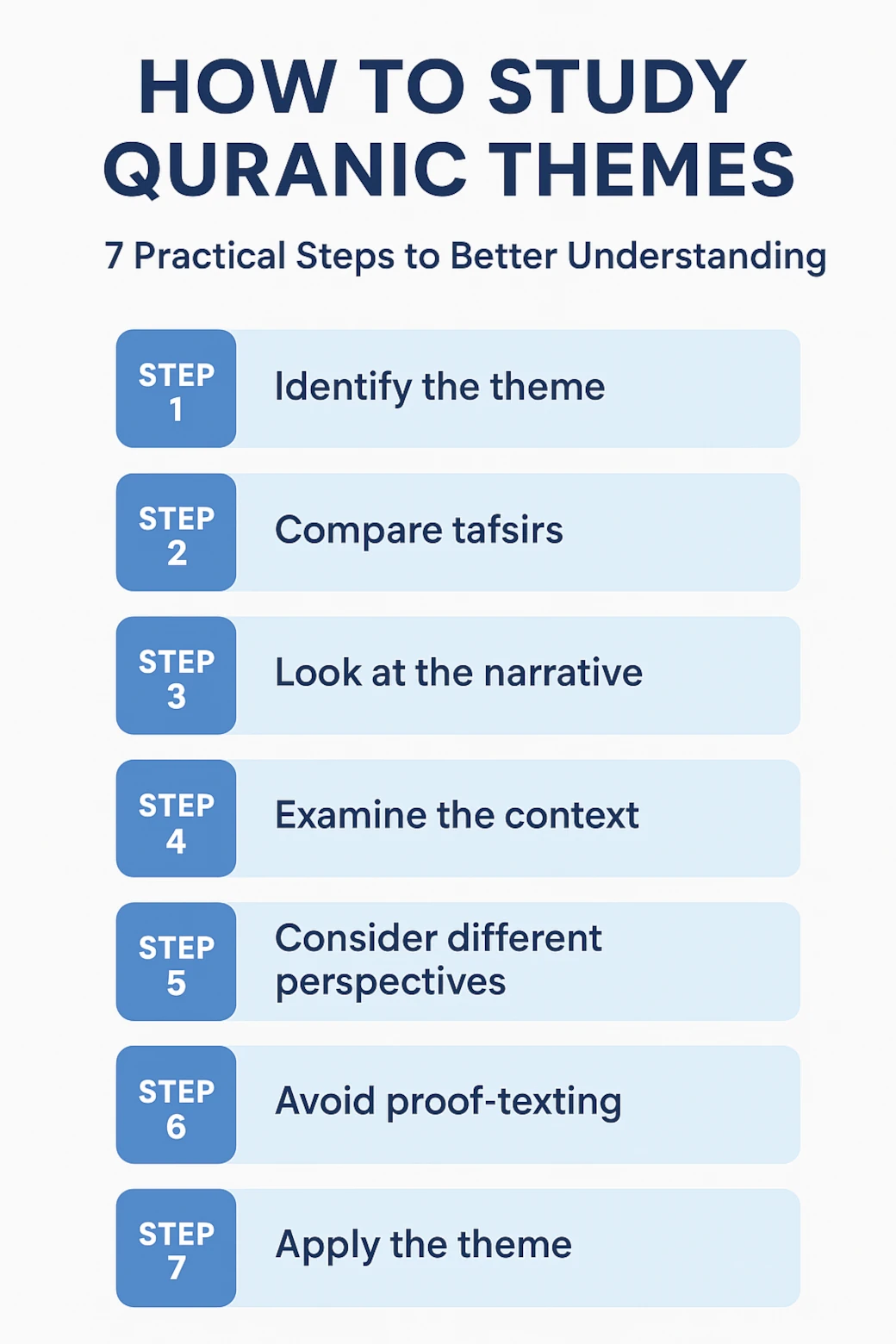
How to Study Quranic Themes - The 7-step method
  1. Define the theme clearly — pick precise terms and limits. [2]
  2. Collect candidate verses (corpus building) — use concordances and searches. [3]
  3. Read each verse in its immediate context — surah flow and adjacent verses matter. [4]
  4. Analyze key words and grammar — roots, morphology, particle use. [5]
  5. Consult tafsir and scholarship — classical and modern sources, compare. [6]
  6. Assess historical/occasion context (asbāb al-nuzūl) carefully — corroborate reports. [7]
  7. Synthesize principles and propose careful applications — humility and plural readings. 8

Below I explain each step in practical detail and show a full worked example you can practice with your study group.

Step 1 – Define the theme clearly

“O My servants who have exceeded the limits against their souls! Do not lose hope in Allah’s mercy, for Allah certainly forgives all sins. He is indeed the All-Forgiving, Most Merciful.”
Surah Az-Zumar – aya {53}
Tweet

How to Study Quranic Themes, A theme must be specific enough to be tractable. “Mercy” is broad; “divine mercy toward sinners in surah 39–42” is narrower. Good theme definitions include: the main term, synonyms and antonyms to include/exclude, and any contextual limits (e.g., restricting to legal vs. ethical verses). [2]

Practical checklist:

  • Write a 1-sentence working definition of the theme. [2]
  • List 4–6 search terms (root words, synonyms, common phrases). [5]
  • Decide whether to include compound themes (e.g., “mercy + forgiveness”) or treat them separately.

Why this helps: fuzzy or sprawling themes lead to unfocused corpora and confirmation bias; precise definitions make the rest of the method manageable. [3]

Step 2 – Build the corpus: collect candidate verses

How to Study Quranic Themes, Use reputable concordances, digital searches in reliable translations, and root-based lookups to gather initial verses. Many modern Quran apps and academic concordances let you search by Arabic root, lemma, or English keyword — use multiple entry points to avoid missing critical verses. [3]

Practical checklist:

  • Start with a digital search for the root(s) and translation matches. [3]
  • Add verses suggested in tafsir entries for your seed verses (backwards citation growth). [6]
  • Keep a running spreadsheet: verse reference, short translation, key words, tafsir cross-refs. [1]

Tip: How to Study Quranic Themes, include ambiguous verses as “maybe” items and mark them for closer inspection; don’t throw them out early. [4]

Step 3 – Read each verse in immediate and surah context

How to Study Quranic Themes, For each candidate verse, read the immediate surrounding passage (at least 3–7 verses before and after), then scan the surah to see the larger thematic arcs. The Quran arranges rhetoric at multiple scales; a verse can be part of narrative, exhortation, legal instruction, or poetic imagery — context determines how it functions. [4]

Practical checklist:

  • Read the surrounding passage aloud or slowly (3 passes: tone, wording, questions). [3]
  • Note the surah’s major themes (e.g., covenant, afterlife, prophetic narrative). [4]
  • Ask if the verse is descriptive, prescriptive, conditional, or rhetorical. [5]

Why this helps: How to Study Quranic Themes, verses isolated from context often lose key referents (e.g., pronouns, antecedents) and can be misread as universal laws rather than occasion-specific guidance. [4]

Step 4 – Analyze language: roots, morphology, and grammar

How to Study Quranic Themes, Even when you rely on translations, a language-aware study yields better nuance. Arabic triliteral roots carry semantic fields; verb forms (e.g., form II vs. form V), particles (inna, la, ma), and grammatical mood (jussive, imperative) all shape meaning. If you do not read Arabic, consult lexicons and translators’ footnotes and flag verses for expert consultation. [5]

Practical checklist:

  • Note the Arabic root(s) and their semantic ranges in a short column. [5]
  • Identify key particles that modify scope (e.g., generalization vs. exception). [5]
  • Where ambiguity exists, list alternative translations and how each affects sense.

Toolbox: How to Study Quranic Themes, Lane’s lexicon (classic), Hans Wehr (learner), and modern bilingual lexicons help; digital tools can show root concordances quickly. [5]

Step 5 – Consult tafsir and modern scholarship (compare across traditions)

How to Study Quranic Themes, Read at least two classical tafsir and one modern commentary for each verse cluster. Classical tafsir like Ibn Kathir, Al-Tabari, and Al-Razi record early narrations and linguistic notes; modern tafsir (and academic commentaries) add philological, historical, and thematic readings. Comparing across these sources reduces reliance on a single interpretive lens. [6]

Practical checklist:

  • For each verse, record how 2–4 tafsir explain it, noting whether they cite asbāb reports, hadith, or grammatical arguments. [6]
  • For modern academic perspectives, check introductions and journal articles for thematic syntheses. [6] 9
  • Note where tafsir diverge, and add a brief rationale (history/language/legislation). [6]

Why this matters: tafsir differences often reveal whether a verse has settled communal meaning or remains contested; tracking these disagreements is itself informative. [6] 10

Step 6 – Weigh historical context and occasions of revelation cautiously

How to Study Quranic Themes, Asbāb al-nuzūl (occasions of revelation) can clarify why a verse was revealed, but reports vary in reliability. Use corroborated reports and emphasize triangulation: if several reputable early sources agree on an occasion, it may carry weight; if not, treat it as one hypothesis among several. How to Study Quranic Themes, Modern critical scholarship offers tools to evaluate report chains and historiography. [7]

Practical checklist:

  • Record any asbāb reports attached to a verse and note their sources. [7]
  • Check whether modern scholars accept, reject, or reframe the report. [7][9]
  • Ask: does the historical note narrow the verse’s application, or illustrate a broader principle?

Caution: How to Study Quranic Themes, over-reliance on single reports can falsely restrict a verse’s ethical scope; balance historical specificity against universal textual claims. [7]

Step 7 – Synthesize principles and propose measured applications

After careful analysis, synthesize findings into 2–4 principles that the corpus supports – be explicit about limits and contested readings. How to Study Quranic Themes, Good synthesis includes: statement of principle, supporting verses, alternate interpretations, and suggested applications (personal, communal, legal as appropriate). How to Study Quranic Themes, Always state degrees of confidence and invite correction. [8]

Practical checklist:

  • Create a one-paragraph synthesis for the theme: what core claims does the Quran make on this topic? [8]
  • Link each claim to 2–3 primary verses in your corpus. [6]
  • Suggest 3 cautious applications: personal practice, community norms, research questions. [8]

Why humility matters: How to Study Quranic Themes, readers differ; honorable scholarship lists disagreements and keeps normative claims proportionate to the evidence. [8]

A full worked example: Theme = “Mercy toward the wrongdoer” (step-by-step)
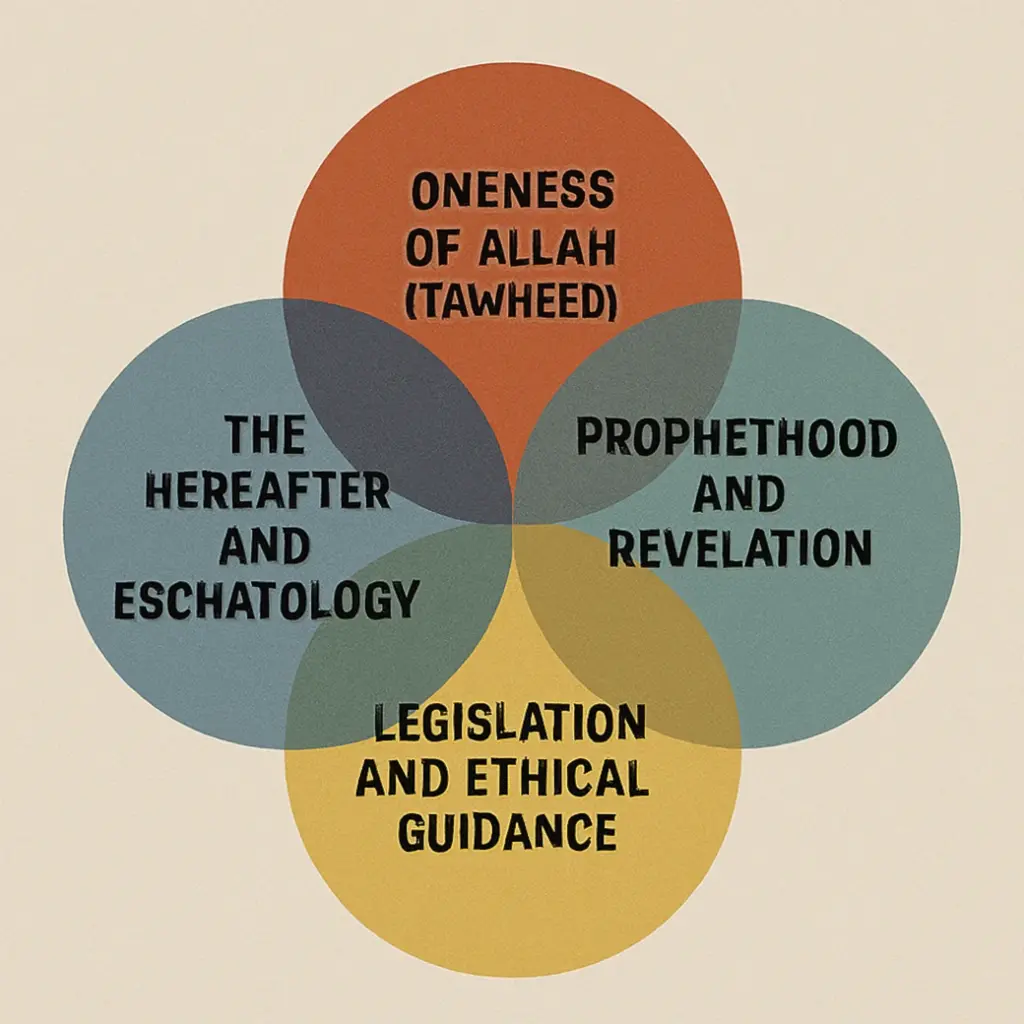
How to Study Quranic Themes - A full worked example

How to Study Quranic Themes, Below is an example showing how to apply each step. Use it as a model to practice in a study group.

Step 1 — Define the theme: “Divine mercy and human mercy toward wrongdoers (forgiveness, pardoning, reconciliation).” [2]

Step 2 — Build the corpus: search roots ر-ح-م (rahma), غ-ف-ر (ghafr), and words like عفو (afu) and ستِر (sitr). How to Study Quranic Themes, Collect verses: e.g., Qur’an 39:53, 42:25, 24:22, 3:134, 5:39, 4:149 (notes). Mark borderline verses for later. [3][5]

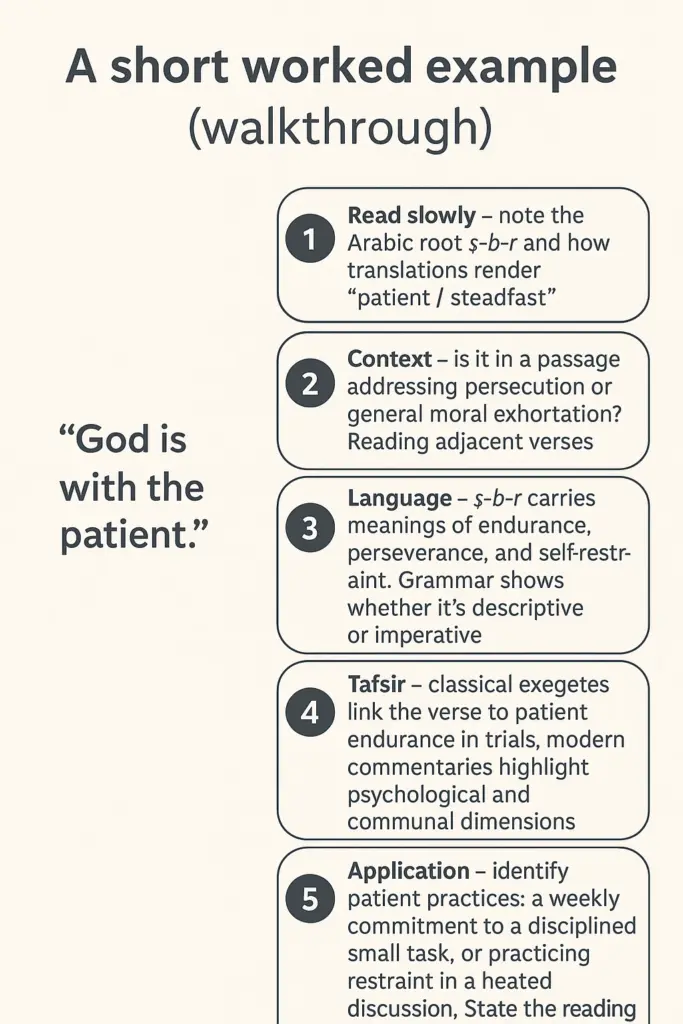
Step 3 — Context reading: read each verse’s surrounding passage; note narrative vs. legal context. Example: 39:53 (“say: O My servants who have transgressed against themselves…”) sits in a broader passage addressing God’s mercy and human despair — rhetorical, exhortative, not judicial. [4]

Step 4 — Language: check root رَحْم; note usages: mercy as an attribute of God vs. action toward others. How to Study Quranic Themes, Note grammatical particles that generalize or limit. Example: in 39:53 the verb form and direct address suggest open invitation rather than conditional waiver of justice. [5]

Step 5 — Tafsir: consult Ibn Kathir on 39:53 (emphases on repentance and divine pardon), Tabari’s variant narrations, and modern commentaries that stress psychological hope. Note divergences about whether divine pardon implies communal non-resistance to criminality (it does not necessarily do so). [6]

Step 6 — Historical reports: check if any asbāb links the verse to a particular event; many commentaries treat it as general exhortation. How to Study Quranic Themes, If reports exist, triangulate with multiple sources; in this case the verse reads broadly. [7]

Step 7 — Synthesis & application: How to Study Quranic Themes, Principle: the Quran emphasizes God’s mercy and invites repentance, but mercy does not nullify legal accountability in judicial contexts. Applications: pastoral care emphasizing hope; policies balancing justice and rehabilitation; educational programs that teach mercy as a moral aim while maintaining public safety. How to Study Quranic Themes, State confidence: high for theological emphasis on mercy; moderate for normative claims about law (requires jurisprudential consultation). [8]

A 12-week study plan you can run in a group

Weeks 1–2: Choose theme, build corpus, and pick 8–12 seed verses. [2][3]
Weeks 3–4: Context reading for each verse; prepare short context notes. [4]
Weeks 5–6: Language phase — analyze roots, particles, and alternative translations. Invite Arabic readers to present findings. [5]
Weeks 7–8: Tafsir week — assign 2–3 tafsir per verse and summarize differences. [6]
Weeks 9–10: Historical-critical week — review asbāb reports and modern scholarship. [7][9]
Weeks 11–12: Synthesis, write 2–3 principle statements, and present applications. Invite external expert feedback if possible. [8]

Group tips: How to Study Quranic Themes, keep sessions 60–90 minutes; rotate roles (reader, lexical analyst, tafsir summarizer); keep a shared spreadsheet for the corpus. [1]

Common pitfalls and how to avoid them

  1. Confirmation bias / cherry-picking — avoid selecting only verses that suit a preformed conclusion; keep an initial “maybe” list. [10]
  2. Proof-texting — don’t use single verses to settle complex modern issues; prefer principle + cross-corroboration. [4][8]
  3. Over-reliance on weak asbāb reports — always check multiple sources before treating a report as decisive. [7]
  4. Ignoring grammar — translations vary; grammatical particles often determine scope. [5]
  5. Neglecting plural interpretive traditions — present both classical and modern views when they differ. [6]

Tools and resources (practical toolbox)

  • Digital concordances / search tools: Quranic Arabic Corpus, established Quranic apps with root search. [3]
  • Lexicons: Lane (classic) for deep study; Hans Wehr for modern learners. [5]
  • Tafsir selections: Ibn Kathir (abridged), Al-Tabari (selections), Ibn Ashur (modernist), Sayyid Qutb and Fazlur Rahman with caution for ideological lenses. [6]
  • Academic introductions: Watt, Donner, and modern peer-reviewed articles for historical context. [9]
  • Study aids: spreadsheet templates (verse | translation | root | tafsir notes | asbāb notes | synthesis). [1]

FAQs

Do I need to know Arabic to do thematic tafsir?

No — you can get far with good translations and tafsir, but Arabic literacy improves precision and reduces reliance on translations. Aim to collaborate with Arabic readers as your confidence grows. [3][5]

How many tafsir are enough?

Start with 2–4 (one classical, one modern) per verse; expand when big disagreements appear. [6]

Will thematic study replace verse-by-verse reading?

No — they complement each other. Thematic reading helps see patterns; verse-by-verse ensures close reading and context. Use both together. [4][8]

Final reflections – humility, method, and practice

A careful method makes thematic reading both manageable and honest. The seven steps above are designed to reduce bias and increase clarity: define precisely, gather thoroughly, read contextually, analyze linguistically, consult widely, weigh history cautiously, and synthesize humbly. Practice this method with a small group, keep a shared corpus, and treat your conclusions as provisional and open to challenge. The Quran rewards patient reading; thematic tafsir done well reveals the text’s internal coherence and ethical depth for both Muslim and non-Muslim learners. [1][6][8]

References

  1. General methods & study design: James Clear — Atomic Habits (2018) and BJ Fogg — Tiny Habits (2019). These texts offer practical habit and study-design techniques (used here for the study-plan and group-work tips). ↩︎
  2. Why theme matters & definition: M. A. S. Abdel Haleem — The Qur’an: A New Translation (recommended for accessible comparative reading), and introductory articles on thematic approaches in Quranic studies. ↩︎
  3. Corpus building & digital tools: Quranic Arabic Corpus (online) and established concordances; also modern Quranic study apps with root search features (for building verse lists and root-based searches). ↩︎
  4. Contextual reading & surah structure: Works on Quranic rhetoric and coherence, notably studies by Amin Ahsan Islahi (Quranic coherence approaches) and modern articles on textual context in Quranic studies. ↩︎
  5. Language & lexicon references: E. W. Lane — An Arabic-English Lexicon; Hans Wehr — A Dictionary of Modern Written Arabic; and academic guides to triliteral root semantics in classical Arabic. ↩︎
  6. Selected tafsir & comparative commentary: Ibn Kathir (abridged translations), Al-Tabari (selected translations), Ibn Ashur (modern tafsir), and contemporary commentaries by M.A.S. Abdel Haleem and scholarly introductions by Watt and Donner. These provide both classical narrative and modern thematic readings. ↩︎
  7. Asbāb al-nuzūl and historiography: Works that treat occasions of revelation and their historiographical evaluation, including critical studies that examine the strength of reports and methods to assess chains of transmission. ↩︎
  8. Synthesis methodology & application ethics: Fazlur Rahman — Major Themes of the Qur’an and modern thematic exegesis that model how to draw principles responsibly from verse corpora. Also recent academic articles on hermeneutics and application. ↩︎
  9. Historical context & polity: Fred Donner — Muhammad and the Believers and Montgomery Watt — Muhammad: Prophet and Statesman for historical framing of themes within early community formation. ↩︎
  10. Bias and hermeneutical pitfalls: Methodological papers on confirmation bias in religious studies and best practices for avoiding cherry-picking in exegesis. ↩︎

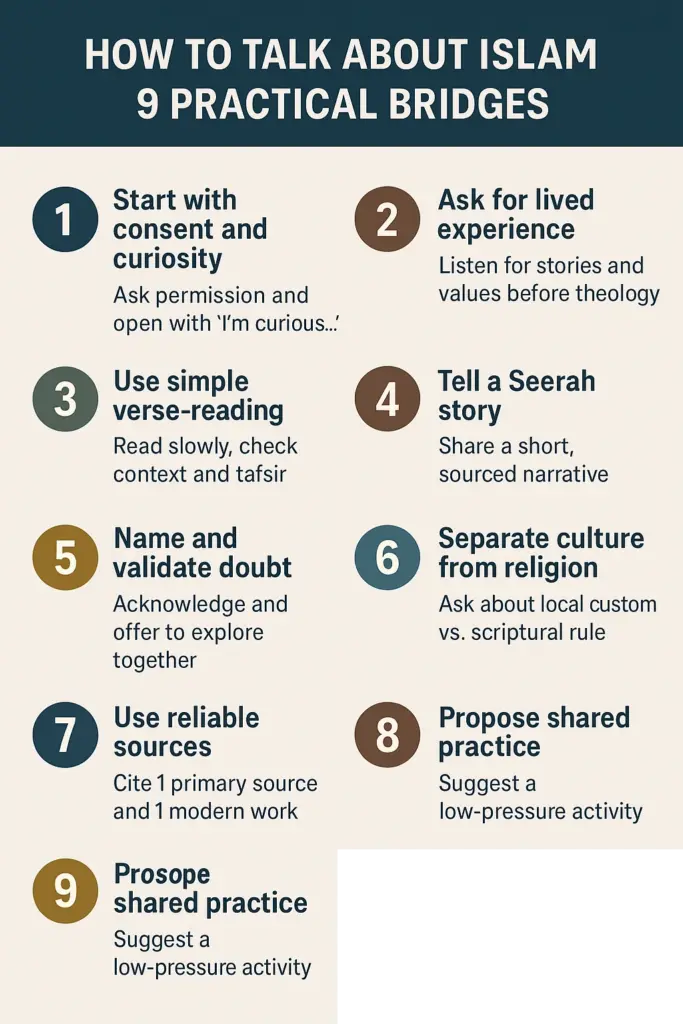
Want to learn how to talk about Islam in ways that connect Quranic study (tafsir), prophetic example (seerah), honest doubt, and steady faith? Use these 9 practical bridges: consent, lived experience, verse-reading method, seerah storytelling, compassionate doubt-handling, culture vs. religion distinctions, reliable sources, small shared practices, and long-term relationships. Each bridge includes concrete scripts, micro-practices. 1 2

How to Talk About Islam – who this is for and what it does

How to Talk About Islam - who this is for and what it does

Conversations about religion can easily be unhelpful: they become debates, monologues, or public spectacles. Yet the same conversations — when done well — become learning moments, relationship builders, and opportunities to reduce misunderstandings. This post explains how to talk about Islam in ways that bridge four common domains: careful reading of the Quran (tafsir), the Prophet’s life and history (seerah), honest atheism/doubt, and everyday conviction and spiritual practice. It’s for curious non-Muslims, reflective Muslims, facilitators, teachers, and friends who want tools to make conversations constructive rather than destructive. [1] 3

How to Talk About Islam, Two opening promises: (1) you’ll get scripts you can use right away, and (2) you’ll get reading practices and safety rules for complex topics. The goal is not to teach you every doctrine or historical detail—rather, it’s to give durable conversational tools grounded in scholarship and humane practice. [2] 4

Core principles before you speak

Use these basic rules as the foundation for every conversation.

  1. Ask permission first. Start with “Is it okay if I ask…?” — consent reduces defensiveness and signals respect. [3]
  2. Listen for story not slogans. People are living inside stories; invite those stories before you jump to arguments. [2]
  3. Context is the oxygen of meaning. Always ask “Which verse or story are you thinking of?” before concluding. Context prevents quick misreadings. 5 6
  4. Use neutral language. Avoid loaded terms; prefer “I’m curious about…” rather than “Why do you believe…?” — it keeps the tone exploratory. [4]
  5. Hold your uncertainty. If you don’t know, say so. Honest humility invites better answers. 7

How to Talk About Islam, Apply these principles and you’ll have far better outcomes than with an adversarial approach.

The 9 Practical Bridges (each is a small pattern you can use)

How to Talk About Islam - The 9 Practical Bridges

How to Talk About Islam, Below are the nine bridges — think of them as compact modules you can use depending on the flow of conversation. Each bridge includes: why it helps, how to do it, short sample phrasing.

Why: Consent creates safety; curiosity frames the encounter as learning rather than interrogation. How to Talk About Islam, Studies on dialogue show that permission-seeking reduces reactive defensiveness. [3][4]

How to do it: Use a short opener: “I’m curious — is it okay if I ask you about something related to your faith?” Pause and respect a “no.”

Sample phrasing: “I’m curious about something if you don’t mind sharing: what part of Islam matters most to you personally?”

Bridge 2 – Ask for lived experience before theology (the story-first approach)

Why: Lived stories reveal values and priorities; they humanize belief and avoid treating a person as a doctrine machine. How to Talk About Islam, Ethnographic work shows personal narratives shape public perceptions more than abstract arguments. 8

How to do it: Prompt with open questions: “Can you share a story that explains what this teaching means to you?”

Sample phrasing: “Was there an experience, a verse, or a moment that shaped your understanding of this?”

Bridge 3 – Use a simple verse-reading method (mini-tafsir at the table)

And We have certainly made the Qur’an easy for remembrance, so is there any who will remember?
surah Al Qamar – aya {32}
Tweet

Why: Many conflicts come from quoting verses out of context. A short method helps everyone read better and reduces misunderstandings. [2][5]

How to do it (6 quick steps for conversational tafsir):

  1. Read the verse slowly (use a good translation) [2].
  2. Ask: what’s the immediate context (surah + adjacent verses)? [5]
  3. Note key words (roots/phrases). 9
  4. Check 1–2 reputable tafsir or translator notes (Ibn Kathir/modern translation notes) [3][5].
  5. Ask whether there is an asbāb al-nuzūl (occasion) that clarifies the wording. [6]
  6. Consider a modest, principle-focused application rather than a single policy fix. 10

Sample phrasing: How to Talk About Islam, “Let’s read this verse together slowly and check the two verses before and after — that usually helps.”

Bridge 4 – Tell a Seerah story to illuminate context (narrative grounding)

Why: Historical moments from the Prophet’s life (seerah) often explain how a principle was lived and why a particular ruling appeared in context. How to Talk About Islam, Stories help listeners grasp nuance better than abstract rules. [4] 11

How to do it: Offer a short, sourced story (two–three sentences) and note its timeframe and social setting.

Sample phrasing: “For example, when the Prophet faced X in the Seerah, he did Y — that helps explain why the rule was expressed that way.”

Bridge 5 – Name and validate doubt (compassionate handling)

Why: Many conversations derail because doubt is treated as an attack. Validating doubt opens productive inquiry. How to Talk About Islam, Psychological research and pastoral practice show validation reduces shame and invites honest dialogue. [7] 12

How to do it: Name the doubt you hear and validate the feeling: “That’s a reasonable question; I’ve wondered about that too.”

Sample phrasing: “That’s an important question — I don’t have a pat answer, but I’d value looking at the evidence together.”

Bridge 6 – Separate culture from religion (reduce categorical errors)

Why: Many misunderstandings treat cultural practices (e.g., specific local customs) as religious doctrine. How to Talk About Islam, Clarifying the difference reduces stereotyping and fosters accurate conversation. 13

How to do it: Ask: “Is that cultural practice or a religious rule where you’re from?” Offer examples (dress, family norms).

Sample phrasing: “Are we talking about something local to your community or something grounded in the text?”

Bridge 7 – Use reliable sources & cite lightly (scholarship in small doses)

Why: Quoting poor sources escalates confusion. How to Talk About Islam, Instead, share 1–2 credible sources (one primary text, one accessible secondary). Researchers recommend “two-source triangulation” as a simple evaluation method. [5][9]

How to do it: Offer one classic source and one modern accessible work (e.g., a reliable translation, a short tafsir, or a scholarly introduction).

Sample phrasing: “If you like, I can recommend a short modern translation and a brief classical commentary that both address this.”

Bridge 8 – Propose small shared practices (micro-bridges of experience)

Why: Talking builds understanding, but doing together builds empathy. How to Talk About Islam, Small shared practices (reading one verse together, attending a community talk, trying a short meditation or remembrance) build relational capital and reduce abstract fear. Habit literature shows small shared rituals create durable bonds. [13] 14

How to do it: Suggest one low-pressure shared activity: read a verse together next week, attend an interfaith panel, or try a one-minute breathing practice with religious framing.

Sample phrasing: “Would you like to read one verse together next week and share what it means to each of us?”

Bridge 9 – Build long-term relationships, not one-off debates

Why: Reputation and trust are cumulative. Conversations over time let nuance and trust develop. How to Talk About Islam, Social-science shows attitude change often follows repeated, respectful contact. [4] 15

How to do it: Create a simple plan: one conversation per month, share resources, and check-in.

Sample phrasing: “Can we continue this over a coffee next month? I’d like to learn more about your perspective.”

Two short conversation scripts you can use now

Script A — Curious friend (low stakes)
You: “I’m curious — is it okay if I ask what being Muslim means to you?” [start with Bridge 1 & 2]
Friend: [answers about lived practice]
You: “Thanks — would you recommend one short reading that captures that for a newcomer?” [Bridge 7: recommend 1 translation/1 article]

Script B — When doubts surface (gentle validation)
You: “That’s an important concern — I don’t know fully, but I’d like to look at it with you. Would you be open to exploring one primary source and one commentary together?” [Bridge 5 & 7]

FAQs

How should I start a conversation about Islam if I’m not Muslim?

Ask permission, start light, ask about lived experience (what being Muslim means to that person), and avoid making them speak for all Muslims. Offer resources if they want to share more. [6]

Can you combine theology and personal questions?

Yes – but sequence matters. Start with personal stories or practice before moving to textual or theological debates; that sequence keeps conversations grounded and less combative. [2][3]

Where should I look for reliable sources?

Use a reputable modern translation of the Quran, a classical tafsir summary (e.g., abbreviated Ibn Kathir), and a modern scholarly introduction (Watt, Donner, or a university primer). For doubts, use balanced academic sources rather than polemical blogs. [3][4][5]

Final reflections – humility, curiosity, practice

How to Talk About Islam, Talking about Islam well is not a one-time skill; it’s a practice. Use the bridges above as repeatable, teachable moves — ask permission, listen to story, read text carefully, use seerah stories for context, treat doubt with care, separate culture from religion, cite reliable sources, do small shared practices, and commit to long-term dialogue. How to Talk About Islam, Over time these habits create communities with less fear and more honest learning — which is exactly what both Muslims and non-Muslims need in our plural world. [1][3][4]

References

  1. Pew Research Center, “The Future of World Religions: Population Growth Projections” — demographic background and global religious-lifecycle context; useful for why cross-cultural religious conversations matter. ↩︎
  2. M. A. S. Abdel Haleem, The Qur’an: A New Translation — a clear, modern translation recommended for comparative reading during mini-tafsir. ↩︎
  3. Interfaith America / facilitation guides — practical, field-tested methods for consent, ground rules, and safe interfaith conversation (useful for the opening/consent sections). ↩︎
  4. Robert Putnam, Bowling Alone (and related social capital research) — evidence that repeated civic contact strengthens trust and attitudes across difference. ↩︎
  5. Ibn Kathir, Tafsir Ibn Kathir (abridged translations) — classical exegesis frequently used as an accessible starting point for traditional tafsir reading. ↩︎
  6. Ibn Ishaq / Ibn Hisham, The Life of the Prophet (al-Sirah al-Nabawiyyah) — primary seerah narratives used to contextualize incidents and prophetic practice. ↩︎
  7. William James, The Varieties of Religious Experience — classic philosophical-psychological account of religious experience, conversion, and doubt. ↩︎
  8. John W. Pennebaker, research on expressive writing — supports using narrative and story to process religious experience and clarify belief. ↩︎
  9. James W. Fowler, Stages of Faith — theoretical grounding for why doubt and growth often co-occur and how faith evolves developmentally. ↩︎
  10. Marshall Rosenberg, Nonviolent Communication — practical listening and reflective techniques that reduce escalation and increase empathy. ↩︎
  11. Fred M. Donner, Muhammad and the Believers — scholarship on early Islamic polity and intergroup formation; helpful for historicizing seerah narratives. ↩︎
  12. Jon Kabat-Zinn, Full Catastrophe Living — mindfulness-based stress reduction principles that adapt well to short breathing practices suggested in the article. ↩︎
  13. Karen Armstrong, Muhammad: A Prophet for Our Time — readable background and accessible synthesis for general audiences. ↩︎
  14. James Clear, Atomic Habits — habit formation techniques supporting shared micro-practices (small habits that bind people together). ↩︎
  15. Sahih al-Bukhari & Sahih Muslim (select hadiths) — canonical reports often cited in Seerah and fiqh contexts; consult reputable translations and commentaries. ↩︎

Daily practices build resilience when they are small, consistent, and connected to purpose. This article gives 9 evidence-backed daily habits (practical how-tos + time estimates), a 30-day action plan, troubleshooting tips, a short script you can use for each practice, and guidance for Muslim and non-Muslim readers on integrating these habits into spiritual life and secular routines. Inline references point to books, studies, and sources that support the approach. 1 2 3

Why daily practices build resilience (short primer)

Daily Practices Build Resilience - why

Daily Practices Build Resilience, Resilience — the capacity to adapt, recover, and grow through stress — is not a fixed trait but a set of skills and habits anyone can cultivate. Repeated small actions change neural pathways, strengthen emotional regulation, and build social supports that act as buffers during hard times. Daily practices build psychological muscle in the same way short, – Daily Practices Build Resilience – regular exercises build physical strength: slow, cumulative, and reliable [1] 4 5 .

Importantly for faith and conviction – Daily Practices Build Resilience-, spiritual practices often double as resilience practices: prayer, reflection, ethical action, and community service increase meaning, social support, and emotional regulation simultaneously. This article gives daily practices – Daily Practices Build Resilience – that work whether a reader frames them theologically, philosophically, or secularly — and gives suggestions to adapt each practice for Muslim readers (prayer-centered) and non-Muslim readers (meditation, reflection, service) alike. 6 7

The nine daily practices (how to do them, why they work, quick scripts)

Daily Practices Build Resilience, Each practice below includes: an easy “start” routine (time: 2–15 minutes), the evidence or rationale, a one-week habit-building tip, and a short script you can say or use mentally.

1) Morning 5-minute reflection (start: 5 minutes) – focus & intention

Why: A short pause each morning aligns goals, calms the nervous system, and primes the brain for intentional action [2] 8 .
How: Immediately after waking, sit for five minutes. Use this micro-routine: breathe for 1 minute, name one intention (“Today I will…”), note one concrete action (“I’ll call X / write 100 words”), and finish with a gratitude line.
Muslim framing: Begin with a short dhikr (remembrance) or a simple dua asking for steadiness.
Script: “Today I will listen more; my first action will be a five-minute walk at noon.”
Week 1 tip: Add a visible cue (put your prayer mat or notebook on top of your phone so you see it on waking).

2) One-minute grounding breath (start: 1–2 minutes) – regulate strong emotions

Why: Breath practice reduces physiological arousal and improves emotional regulation quickly 9 .
How: When stressed or before a difficult task—inhale for 4, hold 1, exhale 6 (or simple 4-4-6). Repeat for 1–3 cycles.
Muslim framing: Use a phrase like “Bismillah” silently on the inhale and “Alhamdulillah” on the exhale if that helps focus.
Script: “Breathe in — God/presence — breathe out — gratitude/grounding.”
Week 1 tip: Set hourly phone reminders labeled “1-minute reset.”

3) Micro-journaling (start: 6–8 minutes total) – clarity & narrative repair

Why: Writing about emotions and experiences improves processing, reduces rumination, and enhances meaning-making 10 .
How: Two short entries daily: morning (one intention, one gratitude) and evening (one learning, one small win). Keep it to 6–8 minutes.
Muslim framing: Use a short reflective prompt tied to a verse or hadith if desired, e.g., “What did I learn today from this verse?”
Script: “This morning I’m grateful for X; tonight I learned Y.”
Week 1 tip: Use a pocket notebook or a notes app to lower friction.

4) Small acts of service (start: 5–20 minutes weekly, tiny daily options) – social connection & purpose

Why: Acts of kindness increase positive affect and social bonds, improving resilience 11 .
How: Daily micro-service: send a supportive text, share a helpful link, or buy a coffee for someone. Weekly larger act: volunteer an hour.
Muslim framing: Charity (sadaqah) is a daily spiritual habit; combine intention with action.
Script: “Who needs a small kindness today? I will do X.”
Week 1 tip: Add “service” to your morning intention sheet.

5) Movement that resets (start: 10–20 minutes) – mood & energy

Why: Exercise increases neurotrophic factors, lifts mood, and improves stress resilience 12 .
How: Daily 10–20 minute movement—brisk walk, stretching, or short bodyweight routine. Prioritize consistency over intensity.
Muslim framing: Consider integrating post-prayer walking or using walking as dhikr time.
Script: “Ten minutes moving — I reset my energy.”
Week 1 tip: Keep shoes visible by the door as a visual cue.

6) Study & devotional practice (start: 10–20 minutes) – meaning & learning

Why: Focused study (sacred text, philosophy, psychology) increases sense of mastery and anchors belief with knowledge, reducing anxiety from shallow doubt [3] 13 .
How: Read a short passage, a commentary paragraph, or a five-minute audio lecture. Summarize one takeaway in your journal.
Muslim framing: Short tafsir reading, hadith reflection, or a verse study.
Script: “Today I’ll read one paragraph and write one line of insight.”
Week 1 tip: Use an audiobook/podcast for commute time.

7) Digital Sabbath or window (start: 30–60 minutes evening) – sleep & mental clarity

Why: Reducing screen time before bed improves sleep and reduces rumination, boosting resilience 14 .
How: Create a nightly tech-free window (first try 30 minutes before bed). Use that time for reading, light chores, or conversation.
Muslim framing: Use as a time for evening du’a or reflection.
Script: “From 9:30–10:00, screens off, read, reflect, rest.”
Week 1 tip: Place phone in another room or a specific charging basket.

8) Community check-in (start: 5–15 minutes weekly) – belonging & practical support

Why: Social connection is one of the strongest predictors of resilience and mental health 15 .
How: Weekly brief check-ins: call a friend, attend a small group, or have a community meal. Prioritize two meaningful contacts weekly.
Muslim framing: Attend a local halaqa or mosque circle when possible, or join an online study group.
Script: “I’ll call X for a 10-minute check-in on Wednesday.”
Week 1 tip: Schedule calls in calendar as appointments.

9) End-of-day micro-ritual (start: 5 minutes) – closure & integration

Why: A short closure ritual signals safety to the brain and helps consolidate learning from the day 16 .
How: Three quick steps: list 1 success, one thing to let go of, and one gratitude. Do this before bed.
Muslim framing: A short evening dhikr and dua of gratitude fits naturally.
Script: “Success: X. Release: Y. Thanks for Z.”
Week 1 tip: Make this the last thing before lights out for habit anchoring.

Building the habits: general principles & troubleshooting

Daily Practices Build Resilience - Building the habits

Daily Practices Build Resilience, The key is micro-habits: small, repeatable, friction-free activities. Use these design rules:

  1. Start tiny — pick one practice and commit to the smallest version (1 minute or one sentence). [1][4]
  2. Stack onto existing routines — after prayer, after breakfast, or after brushing teeth (habit stacking) [1].
  3. Make the cue obvious — visual reminders (notebooks, shoes, water bottle) reduce reliance on willpower.
  4. Make it satisfying — track your streak visually (calendar or app). Small wins fuel habit formation.
  5. Plan for failure — have a “reset” plan: miss one day, not two; use accountability with a friend.
  6. Be specific — “walk 10 minutes at noon” beats “exercise more.” [1] 17

Daily Practices Build Resilience, Troubleshooting common blocks

  • No time: shrink habit to 2 minutes. Tiny acts add up.
  • Resistance: use a “two-minute rule” to start; often starting is the hurdle.
  • Perfectionism: track consistency, not quality. Misses are expected; connection matters.
  • Spiritual dryness: rotate practices and ask a mentor or friend for new perspectives.

Measuring progress (simple KPIs)

  • Streak length: how many consecutive days you did the practice.
  • Satisfaction rating: daily 1–5 scale in your journal.
  • Stress check: weekly “how stressed am I?” 1–10. Look for downward trend.
  • Social connectedness: number of meaningful contacts per week.

Use simple tracking (paper calendar or habit app) for Daily Practices Build Resilience. Review every two weeks and adjust.

Integrating these practices into faith life (Muslim & non-Muslim adaptations)

Daily Practices Build Resilience - Integrating practices into faith life

Muslim readers: Anchor practices to the five daily prayers: use short reflection after Fajr, walking after Dhuhr, micro-journal after Isha. Charity (sadaqah) can be your micro-service. Daily Practices Build Resilience, Use Qur’anic verses and hadith as study seeds and integrate dhikr into breathing exercises.

Non-Muslim readers / secular framing: Daily Practices Build Resilience, Replace prayer with a morning intention or mantra; replace devotional study with philosophy, literature, or psychotherapy-informed material. The underlying mechanisms—meaning, social support, and regulation—are the same.

When daily practices are not enough – boundaries & help

Daily Practices Build Resilience, Daily practices are powerful but not always sufficient. If you notice prolonged functional decline (unable to work/sleep/eat), suicidal thoughts, or severe panic, seek professional mental-health help promptly — practices supplement care but do not replace clinical treatment [18]. If the challenge is religious trauma (e.g., abuse in religious contexts), combine clinical therapy with supportive community or trusted mentors.

A 30-day plan (practical schedule)

Week 1 — foundations: morning 5-minute reflection, one minute breath resets, micro-journal evenings.
Week 2 — movement & micro-service: add 10-minute walk daily; one small kindness per day.
Week 3 — study & community: 10 minutes daily of study/devotion + one weekly community check-in.
Week 4 — digital Sabbath & integration: implement tech window 30–60 minutes; end-of-day ritual nightly.
At the end of 30 days, review: which habits stuck? Keep those and drop or reconfigure others.

Scripts & tiny templates you can copy

  • Morning reflection: “Today I choose patience. My first small action: a five-minute walk.”
  • One-minute breath: “Inhale (4) — settle — exhale (6) — let go.”
  • Micro-journal evening: “Today I learned X. Small win: Y. Grateful for Z.”
  • Service prompt: “Who needs a small kindness today? I’ll do one thing.”
  • Community check: “Quick call? 10 minutes. How are things?”

Daily Practices Build Resilience, Use these exact sentences until they feel natural.

How to support someone else building resilience

  • Offer to practice with them — accountability doubles success.
  • Invite, don’t pressure: “Would you like to join me for a ten-minute walk?”
  • Notice and reinforce: “I saw you kept your twenty-minute walk this week — that’s steady.”
  • For spiritual seekers, avoid quick fixes: ask, listen, and offer resources gently.

Final reflections – small habits, large outcomes

Daily practices build resilience because they add small, repeatable wins to life’s ledger. Over time those wins compound into steadier attention, greater emotional regulation, stronger relationships, and deeper meaning. For people of faith, these practices often deepened devotion; for secular readers, they created a sturdier psychological platform for flourishing. The task is simple: start tiny, keep consistent, and connect the practice to something larger than yourself — whether that’s a community, a moral aim, or a sense of wonder. [1][6][11]

FAQs

How long before I notice resilience benefits from daily practices?

Daily Practices Build Resilience Small shifts often appear within 2–4 weeks (better sleep, slight mood lift); more stable changes in stress response usually take 6–12 weeks depending on consistency. [1][12]

Can these practices replace therapy or medication?

No — while helpful, daily practices are not substitutes for professional mental-health care when someone experiences severe depression, anxiety, or suicidal thoughts. Seek licensed help if symptoms impair functioning. 18

What if I miss days — does that break the habit?

Not at all. Habits build through repetition over time. Miss one day, restart the next. Use accountability and make the practice easier rather than harsher.

References

  1. James Clear — Atomic Habits (2018). Clear’s practical, research-backed approach to habit formation explains tiny habits, habit stacking, and environment design — core principles used throughout this post for micro-habits and streaks. (Accessible, practical manual.) ↩︎
  2. Kelly McGonigal — The Willpower Instinct (2012). Discusses self-regulation, motivation, and the role of small rituals in willpower renewal — informs breathing and micro-routines. ↩︎
  3. Tara Brach — Radical Acceptance & Radical Compassion (selected essays). Work on acceptance, mindfulness, and spiritual psychology used to shape study/devotion sections and emotional regulation approaches. ↩︎
  4. Martin E. P. Seligman — Learned Optimism & Positive Psychology research. Foundational research on resilience, learned optimism, and interventions that increase wellbeing; evidence underpins gratitude and positivity practices. ↩︎
  5. Richard Davidson — research on meditation and neuroplasticity. Davidson’s studies show how meditation and contemplative practices change affective circuitry and improve resilience. ↩︎
  6. Al-Ghazali — Ihya’ Ulum al-Din (The Revival of the Religious Sciences). Classical Islamic perspective emphasizing daily spiritual disciplines, self-examination, and small ritual practices as vehicles for inner transformation — used here to show faith-aligned adaptations. ↩︎
  7. Viktor E. Frankl — Man’s Search for Meaning (1946). Classic on meaning as a resilience factor; supports the article’s emphasis on purpose and service as pathways to steadiness. ↩︎
  8. Jon Kabat-Zinn — Full Catastrophe Living (1990). Evidence-based mindfulness program; supports brief breath practices and micro-mindfulness techniques. ↩︎
  9. Research articles on breathing and autonomic regulation (e.g., Brown & Gerbarg; recent psychophysiology reviews). These papers provide physiological rationale for breath exercises. ↩︎
  10. James W. Pennebaker — Expressive Writing research. Landmark studies on journaling and emotional processing show measurable benefits for health and mood, supporting micro-journaling. ↩︎
  11. Positive psychology & social support meta-analyses (e.g., Cohen & Wills). Meta-analytic work linking social support and acts of kindness to improved mental health and resilience. ↩︎
  12. Exercise and mood studies (e.g., John J. Ratey — Spark). Evidence that short, regular physical activity improves mood and cognitive resilience. ↩︎
  13. Introductory tafsir and devotional guides for contemporary readers (e.g., M. A. S. Abdel Haleem; accessible tafsir primers). These help Muslim readers translate a verse into a short daily reflection or study entry. ↩︎
  14. Digital wellbeing research (sleep & blue light studies; e.g., Harvard Medical School sleep education). Supports the “digital Sabbath” and pre-sleep practices. ↩︎
  15. Sociology of religion and social network studies (e.g., Robert Putnam & others on social capital). Anchor the importance of community check-ins. ↩︎
  16. Clinical psychology literature on ritual and closure (brief therapy models). These sources inform the end-of-day micro-ritual research base. ↩︎
  17. BJ Fogg — Tiny Habits methodology. Practical model that complements Atomic Habits, providing micro-start strategies that reduce friction. ↩︎
  18. World Health Organization / National clinical guidelines on mental health care and crisis referral. These are the basis for safety guidance and indications for when to seek professional care. ↩︎

Doubt is a natural and often constructive phase in many people’s spiritual journeys. This guide explains why doubts happen, maps common causes (intellectual, moral, emotional, social), gives compassionate, practical steps for seekers and supporters, and suggests safe next steps for study, conversation, and mental-health care. Inline references are included for readers who want to explore the sources.

Table of Contents

Introduction – normalizing the question: why doubts happen

Why Doubts Happen

If you are asking why doubts happen, you are far from alone. Questioning forms of belief — whether theological, ethical, or existential — is a widespread human experience. Doubt can surface during study, after a moral shock, during life transitions, or when new evidence seems to clash with previously held beliefs. The aim of this guide is not to push a single answer but to help you understand the common causes of doubt, how to respond compassionately, and which next steps tend to lead to clarity or renewed conviction for many people 1 2 .

Why Doubts Happen?, Doubt is not always an end point. For many, it is part of a deeper movement toward a more reflective, resilient faith or a well-considered non-belief. In other cases, persistent doubt may signal pain or mental health struggles that require support. This article maps both the intellectual and emotional landscape of doubt and offers practical, respectful pathways forward — for seekers themselves and those who wish to support someone in doubt. Read on for a structured, evidence-informed approach.

What doubt looks like – three common shapes

Why Doubts Happen, Doubt rarely looks the same from one person to the next. Still, we can roughly group typical experiences into three shapes: intellectual doubt, existential/moral doubt, and experiential or emotional doubt. Knowing which shape you (or someone you care about) is in helps pick the right response.

1. Intellectual doubt: questions about claims and evidence

Intellectual doubt arises when specific claims — historical, scientific, or logical — appear to conflict with previously accepted beliefs. Why Doubts Happen, A reader might encounter a historical claim, a scientific finding, or a philosophical argument that challenges an earlier simple explanation. For example, questions about the historicity of a text, discrepancies between different accounts, or apparent conflicts between empirical evidence and religious claims often trigger this form of doubt 3 4 .

Typical features:

  • Focus on facts, documents, or logical coherence.
  • Desire for better sources, clearer explanations, or a recheck of assumptions.

2. Existential or moral doubt: when life’s events feel incompatible with belief

Why Doubts Happen, Existential doubt often follows trauma, personal suffering, or encountering grave injustices. It’s the kind of doubt that asks: “If there is a caring God (or a moral universe), why did this happen?” This form of doubt is not primarily intellectual — it is moral and emotional: the world’s cruelty, injustice, or senseless suffering presses on the believer’s sense of meaning 5 6 .

Typical features:

  • Strong emotion (anger, grief, disillusionment).
  • Questions about meaning, justice, or divine character.

3. Experiential or spiritual doubt: absence of felt connection

Why Doubts Happen, Some doubt arises from a diffuse feeling of disconnection — prayer that feels empty, rituals that feel meaningless, or a slow erosion of the practices that once sustained someone spiritually. This kind of doubt can be gradual and hard to name: people may say they “feel different” or that “it no longer works” 7 .

Typical features:

  • Boredom, emptiness, or waning motivation for prior practices.
  • A sense of slowing or loss rather than a single intellectual objection.

Why doubts happen – root causes mapped

Why doubts happen - root causes mapped

Why Doubts Happen, Understanding probable causes helps turn anxiety into action. Here are common, evidence-informed reasons why doubts happen, with practical implications for how best to respond.

Cause 1 – Intellectual tension and new information

Why Doubts Happen, People regularly encounter new facts, historical analyses, or scientific findings that challenge established narratives. When new information is misaligned with prior belief, cognitive dissonance can produce discomfort and doubt. The healthy responses to this are investigation, source-checking, and intellectual humility — not immediate dismissal or forced certainty [3][4].

Practical response:

  • Gather reliable sources (primary texts, peer-reviewed articles, reputable historians).
  • Talk to knowledgeable, trustworthy interlocutors — teachers, scholars, or mentors who value evidence and nuance.

Cause 2 – Moral shock and emotional crises

Why Doubts Happen, Experiencing or learning about deep suffering, abuse, or widespread injustice can create a moral upset that makes prior beliefs feel inadequate or dishonest. Doubt here is an ethical protest: the inner moral sense rebels at what seems like an unjust world [5][6].

Practical response:

  • Honor the grief and anger; these are moral signals, not failures.
  • Seek compassionate listeners or counselors who attend to moral wound and can separate spiritual questions from moral pain.

Cause 3 – Social and cultural change

Why Doubts Happen, People surrounded by multiple worldviews (e.g., in migration, university, or multicultural workplaces) often start comparing narratives. As social networks change, exposure to alternative life stories or lifestyles can prompt doubt. This is often a normative, identity-level struggle: new contexts make prior assumptions less believable or less attractive 8 .

Practical response:

  • Explore comparative readings with intellectual charity. Learn about other perspectives without immediate pressure to decide.
  • Keep relationships open; identity transitions often need time and social support.

Cause 4 – Spiritual dryness or ritual fatigue

Why Doubts Happen, Routine without meaning causes erosion: when ritual or practice continues without felt connection, people can feel that belief is superficial. This can be reversed by changing practice, exploring new forms of spiritual engagement, or honest reflection on whether practices still serve one’s life [8].

Practical response:

  • Try small, intentional practice changes (short reflection, journaling, service).
  • Reconnect through community or new forms of spiritual expression (study groups, art, nature).

Cause 5 – Intellectual honesty and growth

Why Doubts Happen, For many thoughtful people, doubt is the byproduct of intellectual growth. As complexity increases, certainties may fall away — not because belief is false, but because a mature relationship to truth is more tentative and exploratory [1] 9 .

Practical response:

  • Treat doubt as a sign of seriousness, not defeat. Read deeply and cultivate dialogue with thoughtful mentors.

Practical next steps for seekers (a compassionate roadmap)

Why Doubts Happen, If you are experiencing doubt, the following practical steps are designed to offer clarity, care, and forward motion. They combine study, relational support, and practices that help both intellectual and emotional wounds heal.

Step A – Name the doubt precisely

Vague anxiety is harder to address than a clear question. Ask: “Is my doubt about a historical claim, an ethical problem, an emotional experience, or a combination?” Write it down in one sentence. If the doubt is a cluster, try to identify the single most pressing question first 10 .

Step B – Use a three-track approach: learn, feel, and practice

  • Learn (intellectual track): Gather 3–5 reputable sources that directly address your question. Prefer primary texts, scholarly introductions, and balanced overviews rather than polemic blog posts.
  • Feel (emotional track): Allow yourself to name what you feel — anger, loss, confusion. Speak to a listener with empathy (a friend, pastor/imam/mentor, or counselor).
  • Practice (spiritual track): Take a small habit that connects to your values (a five-minute reflection, a walk, an act of service). Ritual or ethical practice can reveal new meanings even while intellectual questions remain.

Step C – Build a reading list and timeline

To find Why Doubts Happen, Don’t try to fix everything at once. Assemble a modest reading list (3–6 items) and give yourself a timebox (a month or two) to read and reflect. Keep a short journal entry after each piece: “What moved me? What unsettled me? What are the unresolved questions?”

Step D – Seek honest dialogue, not debate

Find people who will listen and engage with curiosity. Avoid “debate” mode if you need processing; argue later if you must. Questioning in a non-hostile context tends to produce better learning and less defensive posturing [4] 11 .

Step E – Consider professional help if needed

If doubt is accompanied by severe anxiety, depressed mood, suicidal ideation, or functional decline (unable to work, sleep, or eat), seek a licensed mental health professional promptly. There’s no shame in receiving care; distress can mask or amplify doubts in ways that require clinical attention 12 .

How friends and communities can support someone in doubt

Why Doubts Happen How friends and communities can support someone in doubt

Why Doubts Happen, If you are supporting someone who’s doubting, your role is vital. Small actions often matter more than arguments.

Don’t rush to fix

Avoid rapid-fire apologetics or “conversion” attempts. The immediate need is often being heard and held in the confusion.

Provide a listening space

Use reflective listening: “It sounds like you’re feeling X because of Y.” Validate emotions without necessarily endorsing conclusions.

Offer resources, not ultimatums

Ask permission before recommending books or lectures. If they say yes, offer one or two balanced resources rather than a long reading list.

Keep relational ties strong

Doubt can be isolating. Maintain invitations to shared activities (a coffee, a walk, practical help) that preserve relationship while the person processes.

Watch for signs of crisis

If the person expresses hopelessness, self-harm, or severe withdrawal, help them access professional support immediately — this is a safety issue beyond theological debate.

Stories of doubt and renewal (short vignettes)

Why Doubts Happen, Human stories reveal patterns. Here are brief composite vignettes (blended from many real-life cases) showing how doubt can lead to different outcomes.

Vignette 1 – The academic skeptic who became a scholar

A university student encounters new historical-critical methods and experiences intellectual doubt. Rather than abandon the tradition, they enroll in a focused course, read primary sources, and found a mentor who modeled integrity. Over time, they regained a nuanced faith with an informed intellectual humility.

Vignette 2 – The moral doubter who pivoted to service

A person whose faith faltered after witnessing injustice found that practical service was the bridge back to meaning. Action helped resolve moral outrage into agency and renewed connection to ethical roots.

Vignette 3 – The person who left and found peace

For some, doubt leads to a sincere change in belief. Leaving a faith can be painful but honest. Over time, many former believers build authentic, value-driven lives and new communities that match their convictions.

These vignettes show there is no single “correct” endpoint; the ethical aim is personal integrity and flourishing.

FAQs

Q: Are there “dangerous” doubts that should make me leave community?

A: Doubts are not inherently dangerous. But if community or leaders respond with shaming or coercion, that is harmful. Healthy communities tolerate questioning and provide space for learning. [2][11]

Q: Will I lose my moral compass if I doubt?

A: Not necessarily. Many people who doubt maintain or deepen ethical commitment; doubt can sharpen moral reasoning when processed well. [6][8]

Q: How can I talk to family who fear my doubt?

A: Be patient, reassure them you value relationships, and set clear boundaries about what you will discuss. Offer to revisit conversations when emotions are calmer.

Practical exercises (for the next 30 days)

  1. Name it aloud once a day: write a one-sentence description of your doubt.
  2. Read 10 pages a day: pick one balanced book addressing your main question.
  3. Two-minute reflection: each evening, note one thing you are grateful for.
  4. One relational act weekly: invite a friend for coffee or help someone in a concrete way.

These small acts build steadiness even as questions remain.

If you’re supporting a young person who doubts

  • Create a safe space — avoid punishment for questions.
  • Encourage curiosity: suggest accessible resources, not polemic sources.
  • Help them find mentors who are both intellectually honest and compassionate.
  • Help them access counseling/support if mood or functioning decline occurs.

Final reflections – doubt as a doorway not a sentence

Why Doubts Happen, Doubt need not be an ending; it can be an invitation. When guided by careful study, compassionate listening, and small practices that reconnect us to community and meaning, doubt often leads to a more honest and durable life stance. Whether the outcome is renewed faith, transformed belief, or sincere non-belief, the ethical aim is integrity: living in a way that aligns belief, reason, and compassion. If you are in doubt today, know you are in good company — and that careful, compassionate steps can move you toward clarity and peace.

References

  1. William James — The Varieties of Religious Experience (1902).
    → “Classic, readable exploration of religious belief, conversion, and doubt — excellent for historical and philosophical perspective on why people doubt and how religion functions psychologically. & Jennifer Michael Hecht — Doubt: A History (2003). → A readable cultural history of skepticism and doubt across Western history; useful for background and narrative framing. ↩︎
  2. Scholarship on faith development and intellectual humility
    James W. Fowler — Stages of Faith: The Psychology of Human Development and the Quest for Meaning (1981).
    → Seminal book describing developmental stages of faith; helps explain how questioning can be part of growth. & Ian M. Church, Linda J. Griese (eds.) — Intellectual Humility: A Theory and Research Agenda (selected journal articles).
    → See recent psychology literature on intellectual humility (look for review articles by Maria C. (or Mark) Leary, Paul R. R. et al. if you want peer-reviewed summaries). ↩︎
  3. Historical-critical and apologetic literature (for intellectual doubts about texts and history)
    Bart D. Ehrman — Misquoting Jesus: The Story Behind Who Changed the Bible and Why (2005).
    → Clear introduction to textual-critical issues (useful where readers’ doubts come from manuscript/ transmission questions).
    Richard Carrier, Bart Ehrman, Daniel B. Wallace (select articles & debates).
    → Useful to present both critical and skeptical scholarly views when readers are investigating textual claims. ↩︎
  4. Cognitive science and belief-change studies
    Hugo Mercier & Dan Sperber — The Enigma of Reason (2017).
    → Explores why human reasoning is often argumentative and social rather than purely truth-seeking — helps explain why new evidence sometimes increases belief rather than reduces it.
    Select review articles on cognitive dissonance and motivated reasoning in social psychology (e.g., Festinger’s classic theory and modern experimental updates). ↩︎
  5. Moral injury, trauma, and existential doubt
    Jonathan Shay — Achilles in Vietnam: Combat Trauma and the Undoing of Character (1994).
    → Introduces moral injury and how trauma can shatter meaning — highly relevant for moral/existential doubt.
    Litz, Neria, et al. — work on moral injury (2009 onward) — look for Litz et al.’s key review papers on moral injury and clinical implications (useful for linking trauma → theological doubt). ↩︎
  6. Social and identity studies (how context & networks affect belief)
    Peter L. Berger & Thomas Luckmann — The Social Construction of Reality (1966).
    → Classic sociological account of how social world-shaping influences belief and identity transitions.
    Recent sociology-of-religion studies on secularization, migration, and religious switching (look for reviews in Sociology of Religion or Annual Review of Sociology). ↩︎
  7. Spiritual-practice manuals & habit-change research (practical steps)
    James Clear — Atomic Habits: An Easy & Proven Way to Build Good Habits & Break Bad Ones (2018).
    → Practical, evidence-backed habit formation techniques that work well for small spiritual practices and ritual repair.
    Books on spiritual practices (e.g., Richard Foster — Celebration of Discipline; Dallas Willard — The Spirit of the Disciplines). These show concrete spiritual exercises that restore felt meaning. ↩︎
  8. Comparative religion & introductory resources
    Huston Smith — The World’s Religions (1958; later editions).
    → Clear comparative overview of major religious traditions — helpful for seekers exploring other faith perspectives.
    John Bowker — The Oxford Dictionary of World Religions (or similar). Useful reference. ↩︎
  9. Case-study collections and personal narratives
    Graham Oppy / Michael Ruse (collections vary) or anthologies such as Leaving the Fold (ed. Marlene Winell et al.) — look for compilations of personal stories of doubt and religious change.
    Personal memoirs provide narrative context (e.g., works by well-known converts or deconverts depending on your target audience). ↩︎
  10. Practical counseling and pastoral-care resources
    Henri J. M. Nouwen — The Wounded Healer (1972).
    → Classic on pastoral presence and how caregivers accompany suffering people (useful for how to listen to someone in doubt).
    John Patton — Pastoral Care in Context: An Introduction to Pastoral Theology (2000s eds).
    → Practical frameworks for pastoral accompaniment and boundaries. ↩︎
  11. Communication, facilitation & listening guides
    Marshall B. Rosenberg — Nonviolent Communication: A Language of Life (1999).
    → Practical skills for listening and reflective responses — directly applicable to supporting someone in doubt.
    Priya Parker — The Art of Gathering: How We Meet and Why It Matters (2018).
    → Useful for structuring safe conversations and interfaith dialogues. ↩︎
  12. Mental health & crisis resources (when to refer to professionals)
    World Health Organization (WHO)Preventing Suicide: A Global Imperative (2014) and related WHO resources.
    American Psychiatric Association (APA) / National Institute for Health and Care Excellence (NICE) guidelines for assessment & referral in cases of severe depression or suicidal ideation.
    → Use these to justify the “seek professional help” guidance and for local referral standards. ↩︎

Introduction

The Treaty of Hudaybiyyah stands as a defining moment in the Seerah where diplomacy, faith, and polity converged. At first glance the agreement looked like a concession: a pilgrimage deferred, clauses that frustrated companions, and public sorrow. Yet when we unpack the politics, the tribal customs that shaped negotiation, the interplay of revelation and leadership, and the long-term outcomes, the episode becomes a study in strategic patience and statecraft.

This article lays out the background, the journey to Hudaybiyyah, and the negotiation dynamics that created the written covenant known to history as The Treaty of Hudaybiyyah.

The Treaty of Hudaybiyyah, Background and context

The Treaty of Hudaybiyyah, Background and context

The Treaty of Hudaybiyyah, After the Hijrah the Muslim community in Medina evolved quickly from a persecuted group into a polity with administrative and diplomatic responsibilities. Earlier confrontations — notably Badr and Uhud — had forged reputations and lingering resentments between the Muslim community and the Quraysh of Mecca.

By the sixth year after Hijrah the Prophet planned a peaceful Umrah to the Kaaba. The aim was devotional but also strategic: to assert a right to worship and to demonstrate the community’s non-belligerent posture. The caravan’s non-militarized appearance — ihram attire, sacrificial animals, and a conspicuous presence of women and children — signaled intentions that were religiously motivated and politically careful.

As the group approached Mecca, Qurayshi leaders feared the political consequences of such a gathering and refused access, prompting both parties to relocate to a neutral encampment at Hudaybiyyah 1 .

The journey and arrival at Hudaybiyyah

Before The Treaty of Hudaybiyyah, Approximately fourteen hundred men and women accompanied the Prophet toward Mecca. The selection of Hudaybiyyah as the negotiation site mattered: it was a neutral location where both parties could convene without immediate escalation. This was not merely a matter of geography; the decision to negotiate in a space where tribal honor and witnesses could be marshalled reflected the customary law of seventh-century Arabia.

On the Quraysh side Suhayl ibn Amr, an experienced jurist and orator, took the lead as negotiator; on the Muslim side several companions and the Prophet engaged in prolonged bargaining. The evolving diplomatic scene culminated in a written instrument — The Treaty of Hudaybiyyah — whose public recording signaled a new relational dynamic between the parties 2 .

Negotiation dynamics and diplomatic culture

The Treaty of Hudaybiyyah, Arabian diplomacy in this era rested on personalized honour, oath-taking, meticulous witness lists, and the social weight of writing when available. Although oral agreements were frequent, producing a written covenant with witnesses functioned as a political act that altered reputations and expectations.

Negotiations extended over days. The parties debated access to the Kaaba, the rights of those who sought asylum, mutual protections for allied tribes, and the duration of the pause in hostilities. The Treaty of Hudaybiyyah draft included clauses many companions found painful, particularly an asylum clause that seemed asymmetrical.

The Prophet accepted the written terms in spite of public disappointment, a choice later given theological validation by revelation and shown to be strategically prudent when viewed across years 3 .

The text of the treaty – main terms

Classical reports converge on a set of core stipulations that formed The Treaty of Hudaybiyyah:

  1. The Muslim party would return to Medina that year without performing Umrah and would be permitted to return the next year and stay three days.
  2. A truce lasting ten years would be observed between the parties.
  3. Tribes and individuals could ally themselves with either party and would enjoy the protection of that party.
  4. If a Meccan fled to Medina without guardian permission, they would be returned to Mecca; conversely, the Quraysh were not obliged to return a Medinan who migrated to Mecca.
  5. Parties agreed to respect property and to settle disputes through agreed mechanisms.
    This written record converted the contest into a covenant — a public bond that brought new diplomatic possibilities and constraints 4 .

Immediate reactions and the return to Medina

The Treaty of Hudaybiyyah - Immediate reactions and the return to Medina

The return to Medina without Umrah produced grief among many companions. Historical reports describe intense emotional responses, with Umar ibn al-Khattab’s vehemence often cited as an example of the communal angst. Into this atmosphere the Qur’anic revelation of Surah Al-Fath arrived: language referring to a “clear victory” reframed the The Treaty of Hudaybiyyah as a divinely sanctioned step, calming the community and reshaping public sentiment. This theological reframing was politically consequential, aligning devotional belief and communal strategy and validating the Prophet’s prudential stance in requesting and accepting written terms 5 .

Immediate aftermath, communications, and outreach

Following The Treaty of Hudaybiyyah, the Muslim leadership used the interval of peace to enlarge diplomatic horizons. The Prophet sent letters to rulers and delegations, conveying invitations and asserting the community’s presence in the regional political map. Freed from immediate hostilities, Medina could demonstrate legal practices, social norms, and the ethical comportment of its people to visiting delegations and trade caravans. This contact produced conversions and reconfigured alliances: through peaceful contact and argumentation the movement achieved social growth that would have been harder under constant warfare 6 .

Political recognition and legitimacy

The written accord represented a form of recognition: the Quraysh’s willingness to enter a covenant signalled the Muslim polity’s status as a political actor. In a society where formal agreements bore reputational consequences, such a document created diplomatic parity that enabled later alliances and negotiations. This recognition was not merely symbolic; it permitted the Prophet to engage future tribal interlocutors from a position of established legitimacy rather than a posture of insurgency 7 .

The spread of Islam and soft power gains

During the truce period the relative calm allowed traders, travelers, and tribal envoys to witness the social order in Medina firsthand. The conduct of the Muslim community, the Prophet’s measured leadership, and the persuasive clarity of the message drew conversion and affiliation that expanded the community’s social base. High-profile figures and whole tribes reconsidered their stances in light of the combined moral influence and administrative competence they observed. These soft-power gains — reputation, persuasive witness, and ethical example — complemented later military advantages 8 .

Strategic patience and the route to Mecca

One of The Treaty of Hudaybiyyah’s paradoxical outcomes was that it provided a strategic route to Mecca. Over time, shifts in alliance structures and the accrual of moral authority reduced the cost of opening political space in Mecca. When breaches of allied arrangements occurred, the Muslim polity was ready to respond; it entered Mecca in 630 CE in a manner that minimized bloodshed and maximized reconciliation. The prior diplomatic capital built around The Treaty of Hudaybiyyah helped create the conditions for a less violent resolution than many contemporaries had feared 9 .

Governance, moral authority, and reconciliation

A striking feature of the post-treaty period was the Prophet’s moral credibility. By honouring the covenant even when some terms seemed unfavourable, the Prophet strengthened his standing as a leader who adhered to principle. This moral capital proved decisive during the conquest of Mecca: clemency, measured policy, and the framing of reconciliation over vengeance enabled a smoother integration of social and religious change across the peninsula 10 .

Tactical considerations and the truce’s limits

Although designed for ten years, the truce was not indefinite: third-party actions and allied breaches eventually created circumstances that led to renewed hostilities and the eventual reconfiguration of power. Nonetheless, even a shorter period of peace delivered benefits that redounded to the Muslim polity’s advantage. The treaty’s clauses operated amid shifting social realities, and their practical enforcement depended on power dynamics — not simply on legalism — which reveals why the Prophet’s strategic patience mattered 11 .

Scholarly debates, textual traditions, and critical perspectives

Modern readers and scholars debate the meaning and fairness of particular The Treaty of Hudaybiyyah clauses. Some contemporary critiques conceive of The Treaty of Hudaybiyyah as an act of timidity; historians caution that such readings are anachronistic. Primary Arab sources — Ibn Ishaq, Ibn Hisham, Al-Tabari — present multiple narrations and variant details that require critical evaluation. Modern scholars (Watt, Donner, and others) read the event as a strategic maneuver that must be interpreted through tribal norms, the politics of reputation, and the interplay of narrative, scripture, and leadership 12 .

The asylum clause — requiring the return of Meccan runaways to Mecca while not obliging the reverse — seems asymmetrical and provoked contemporary distress. Legal historians argue the clause must be understood within the normative framework of guardianship and tribal custody that prevailed at the time. Its enforcement depended on shifting loyalties and the evolving weight of moral authority, illustrating how legal stipulations interact with social realities rather than working in a vacuum. In practice the clause’s harshness was mitigated by subsequent political developments and the spread of allegiance that altered how communities enforced or resisted the clause’s terms [1].

Practical lessons for negotiators, leaders, and communities

The Treaty of Hudaybiyyah - Practical lessons

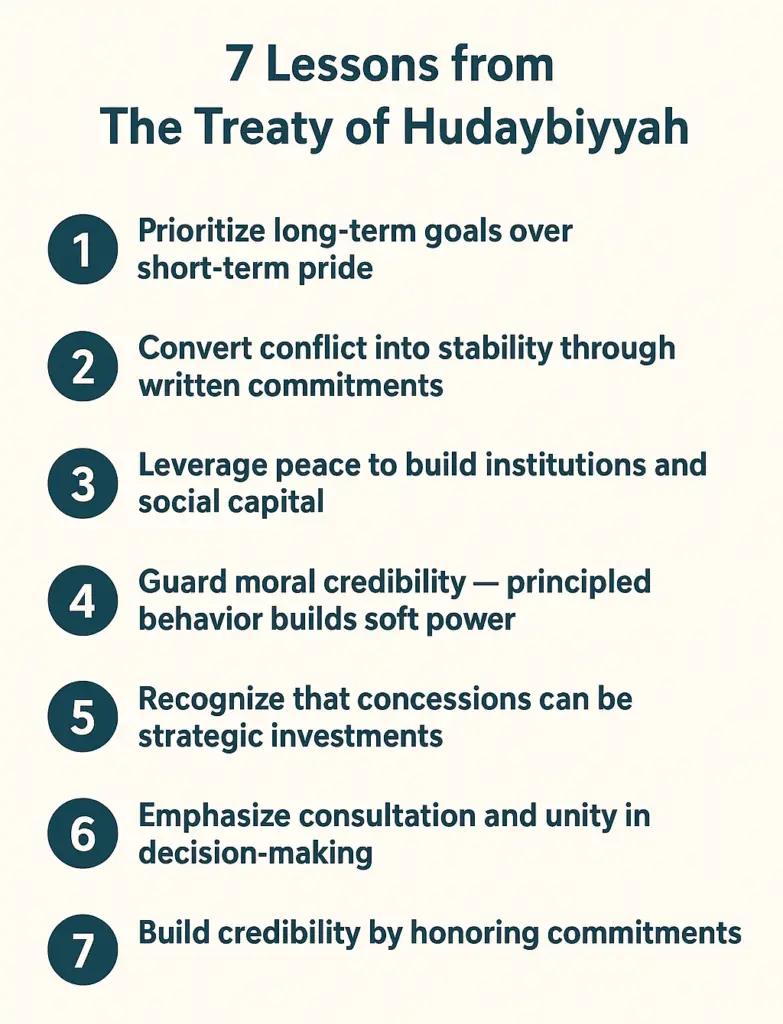
Lessons from the Seerah of Prophet Muhammad ﷺ – Leson from The Treaty of Hudaybiyyah, Practical Wisdom for Today:

  • Prioritize long-term goals over short-term pride
    The Prophet ﷺ accepted terms that seemed unfavorable in the moment, but they secured peace and opened the door for greater future victories.
  • Convert conflict into stability through written commitments
    Instead of endless cycles of hostility, the treaty formalized peace by writing and witnessing clear agreements — a model for sustainable conflict resolution.
  • Guard moral credibility — principled behavior builds soft power
    By acting ethically even under pressure, the Prophet ﷺ demonstrated integrity. This created trust, attracting allies and winning over skeptics.
  • Leverage peace to build institutions and social capital
    The pause in fighting allowed the Muslim community to strengthen education, governance, da‘wah, and social bonds, preparing them for future expansion.
  • Build credibility by honoring commitments
    The Prophet ﷺ fulfilled every clause of the treaty, even when difficult. This reinforced the Muslims’ reputation for reliability, which drew more people to Islam.
  • Emphasize consultation and unity in decision-making
    The companions initially struggled with the treaty terms, but through shūrā (consultation) and prophetic guidance, the community remained united.
  • Recognize that concessions can be strategic investments
    What looked like compromise was actually strategy: small sacrifices led to major gains, including wider recognition of the Muslim community.

These lessons from The Treaty of Hudaybiyyah, are relevant beyond late antique Arabia: diplomats, community leaders, and organizational strategists can apply the same logic of patient negotiation, legitimacy building, and institutional consolidation in modern settings.

FAQs

What was the Treaty of Hudaybiyyah and why did it matter?

The Treaty of Hudaybiyyah (628 CE) was a negotiated truce between the Prophet Muhammad ﷺ and the Quraysh of Mecca. Although its terms initially appeared to favor the Quraysh, the treaty granted diplomatic recognition, created a period of peace for outreach, and ultimately enabled the steady spread of Islam through dialogue and alliances.

Why did the Prophet accept terms that seemed unfavorable at first?

The Prophet prioritized long-term strategy and moral credibility over immediate gains. Accepting the treaty reduced the risk of war, demonstrated integrity by honoring commitments, and created the peace necessary for diplomatic engagement and social influence — outcomes that proved strategically advantageous in the following years.

What practical lessons can modern negotiators learn from Hudaybiyyah?

Key lessons include:
(1) value long-term objectives over short-term pride,
(2) use credible commitments and written agreements to build trust,
(3) convert pauses in conflict into opportunities to build institutions and reputation,
(4) preserve moral credibility — honoring agreements pays strategic dividends.

Chronology & Timeline – concise

  • 628 CE / 6 AH: Muslims approach Mecca and negotiations proceed at Hudaybiyyah.
  • Treaty signed; Muslims return to Medina without performing Umrah that year.
  • Shortly after: the Qur’anic revelation of Surah Al-Fath reframes the event as part of a larger divine strategy.
  • Circa 630 CE: changing alliances and breaches create circumstances that lead to a largely peaceful entry into Mecca.

Final reflections

The Treaty of Hudaybiyyah is a paradigmatic story of how leadership, law, and faith intersect to produce outcomes that are not immediately obvious. What appeared to be a concession at the time matured into a platform for stability, outreach, and moral reconciliation. For Muslims, it is a moment of prophetic wisdom reinforced by revelation; for non-Muslims it is an instructive case in negotiation, soft power, and the conversion of reputational capital into political advantage.

References

  1. Ibn Ishaq / Ibn Hisham, The Life of the Prophet (al-Sirah al-Nabawiyyah).
    The foundational early biography that compiles oral reports and early narratives about the Prophet’s life. Ibn Hisham’s redaction is commonly used by scholars and translators; consult critical notes and comparative editions to trace variant readings and chains of transmission. ↩︎
  2. Al-Tabari, Tarikh al-Rusul wa-l-Muluk (History of the Prophets and Kings).
    A major medieval chronicle preserving multiple narrations and viewpoints. Tabari’s compilation collects variant reports and isnads, making it important for assessing divergent traditions and the historiographical texture around Hudaybiyyah. ↩︎
  3. Ibn Kathir, Al-Bidaya wa-l-Nihaya and Seerah commentary.
    Classical narrative and exegetical work that ties Qur’anic verses to historical episodes. Ibn Kathir’s synthesis offers a traditional reading valuable for linking Surah Al-Fath to the treaty context. ↩︎
  4. Montgomery Watt, Muhammad: Prophet and Statesman.
    A modern scholarly treatment emphasizing the political and diplomatic strategies of the Prophet’s life. Watt situates Hudaybiyyah within broader statecraft and offers analytical frameworks useful for non-specialist readers. ↩︎
  5. Karen Armstrong, Muhammad: A Prophet for Our Time.
    A readable biography for general audiences that places events like Hudaybiyyah within moral and historical perspective, useful for making the episode accessible to non-Muslim readers. ↩︎
  6. Akram Diya al-Umari, Ar-Raheeq al-Makhtum (The Sealed Nectar).
    An award-winning modern seerah that compiles primary traditions into a clear and concise narrative, helpful for quickly locating the main events and conventional chronology. ↩︎
  7. Fred Donner, Muhammad and the Believers.
    Academic analysis of early community formation, showing how treaties and pacts functioned in the politics of group consolidation. Donner’s work is valuable for comparative and theoretical readings. ↩︎
  8. Reza Aslan, No God but God.
    A narrative history that helps readers trace broader transformations in early Islam and the sociopolitical currents that contextualize events like Hudaybiyyah. ↩︎
  9. Seyyed Hossein Nasr (ed.), The Study Quran.
    An annotated translation with essays and commentary; particularly useful for understanding Surah Al-Fath and its interpretive implications for the treaty. ↩︎
  10. Sahih al-Bukhari and Sahih Muslim — selected hadiths about Hudaybiyyah.
    Core hadith collections preserving many companion reports. For historical work, consult critical translations and scholarly commentary that examine isnad reliability and transmission. ↩︎
  11. Academic journal articles on Arabian tribal diplomacy and law.
    Peer-reviewed articles examine asylum clauses, guardianship norms, and the material conditions underpinning treaty clauses in the seventh century. These provide anthropological, legal, and comparative perspectives. ↩︎
  12. Encyclopaedia of Islam entries and modern peer-reviewed syntheses.
    Authoritative summaries that point toward primary editions, variant traditions, and up-to-date bibliographic leads in several languages for further reading. ↩︎

Use a disciplined, six-step method to reflect on a Quranic verse: How to Read a Verse? read slowly, check immediate context, study key words and grammar, consult classical tafsir, consider historical context cautiously, and reflect on contemporary application with humility. This approach helps both Muslim and non-Muslim readers avoid common mistakes while learning responsibly 1 2 .

Introduction – why a method matters

How to Read a Verse - why a method matters

The Quran is read as scripture, law, poetry, and spiritual guidance across many languages and cultures. That wealth of meanings is a strength, but it also makes quick readings risky: verses taken out of context, used as proof-texts, or translated without attention to language nuance can easily mislead readers and listeners [1] 3 . A short, repeatable method helps readers slow down, check their assumptions, and draw more balanced conclusions. The six-step approach below synthesizes classical exegetical practice and modern reading principles so you can approach verses respectfully and with intellectual humility [2] 4 .

How to Read a Verse? Who this guide is for (and when to consult experts)

This guide is for curious readers — Muslim and non-Muslim — who want a principled process for approaching a verse; for students beginning Quranic study; and for facilitators who wish to model careful exegesis in public conversations. It is not a substitute for formal scholarly training or for consulting qualified jurists when a verse touches legal rulings or complex doctrinal questions [2] 5 . When a verse intersects with communal policy or law, seek multiple qualified scholarly opinions rather than issuing a final judgment on your own [2] 6 .

Overview – the 6 practical steps

  1. Read slowly — original Arabic if possible and at least two reputable translations. [3]
  2. Check immediate literary context — surrounding verses and surah structure. [4]
  3. Study key words and grammar — roots, morphology, and rhetorical devices. [5]
  4. Consult classical tafsir — compare a few reputable commentators. [2][6]
  5. Consider historical context (asbāb al-nuzūl) cautiously — corroborate reports. [7]
  6. Reflect on contemporary application — extract principles, act with humility. [8]

Step 1 – Read slowly: multiple passes, multiple translations

How to Read a Verse, Start by slowing down. Read the verse three times: first for general sense, second for wording and cadence, third for what emotionally or rhetorically stands out. If you can read Arabic, hear the verse aloud to sense rhetorical devices; if you read translation only, compare at least two reputable translations to notice differences in word choice [3].

Actionable tips:

  • Read the verse in the original Arabic when possible; if not, read two translations (one literal-ish, one idiomatic) to notice translator choices. [3]
  • Mark words or phrases that feel ambiguous, emphatic, or repeated; you’ll analyze them in Step 3.
  • Note whether the language reads as command, narrative, parable, or exhortation — tone matters.

Why this helps: many misreadings come from skimming. Slow, repeated reading reveals grammatical cues, rhetorical rhythm, and the emotional weight of words that a cursory glance misses [3][5].

Step 2 – Check immediate literary context

How to Read a Verse, A verse rarely stands isolated. Pronouns, narrative subjects, and rhetorical flows often depend on the preceding and following lines [4]. Always ask: what is the immediate passage doing? Is this a part of a story, a legal section, a moral exhortation, or a parable?

Actionable tips:

  • Read at least the surrounding 6–12 verses and summarize that short passage in one sentence. [4]
  • Identify referents (who is “they,” “you,” or “we” in this passage?).
  • Note shifts in subject or audience — is the divine address singular, plural, or rhetorical?

Why this helps: context clarifies whether a verse was situational (addressing a moment) or offering a general principle. Removing context can invert meaning or strip nuance [4] 7 .

Step 3 – Study key words and grammar (language matters)

How to Read a Verse, Arabic words carry semantic fields shaped by triliteral roots; verb forms and particles carry important nuance. A literal-looking translation may hide a richer semantic range.

Actionable tips:

  • Identify 3–5 core words in the verse and check root meanings and common usages. Use a reliable lexicon or translators’ notes if you don’t read Arabic. [5]
  • Note verb forms (imperative vs. jussive), particles (e.g., inna, laʾ, ma), and pronoun attachments.
  • Record alternative translations and what each choice implies.

Why this helps: a single word’s grammatical form or root can change whether a verse reads as descriptive, prescriptive, general, or conditional. Language study reduces oversimplified readings [5].

Step 4 – Consult classical tafsir (2–4 sources)

How to Read a Verse - Consult classical tafsir

How to Read a Verse, Tafsir literature collects early readings, narrations, linguistic arguments, and legal inferences. Consulting tafsir situates your reading within a tradition and reveals how different communities understood the verse [2][6].

Actionable tips:

  • Start with one or two classical tafsir (e.g., Ibn Kathir, Al-Tabari summaries) and one modern commentary or academic primer to balance perspectives. [2][6]
  • Summarize each tafsir’s main point in one sentence and note whether it uses historical reports, hadith, or grammatical argument.
  • Where tafsir disagree, note the grounds: history, language, jurisprudence, or moral emphasis.

Why this helps: tafsir shows interpretive history and stabilized readings; differences among commentators tell you which elements are settled and which remain debated 8 9 .

Step 5 — Consider historical context (asbāb al-nuzūl) cautiously

How to Read a Verse, Occasions of revelation can explain why a verse uses certain words or addresses particular people, but not every verse has a robust single-cause report, and some reports are weak or contested [7].

Actionable tips:

  • If an asbāb report is cited in tafsir, check whether it is widely attested and whether modern scholarship treats it as reliable. [7]
  • Use historical context to clarify referents, not to force a narrow reading when broader principles are plausible.
  • Be cautious with single-chain reports; corroboration strengthens historical claims.

Why this helps: historical reports, when reliable, prevent categorical misapplications of a verse; but over-reliance on doubtful reports can unduly narrow ethical implications [7][9].

Step 6 — Reflect on contemporary application with humility

How to Read a Verse, After careful reading, ask: what core principles emerge, and how might they apply in present circumstances? Avoid forcing a political or legal program onto a single verse. Instead, extract ethical or spiritual principles and propose modest, practical applications [8].

Actionable tips:

  • Identify 1–3 principles (e.g., mercy, justice, patience). For each, suggest one concrete practice a reader can try this week. [8]
  • When sharing your reading publicly, state limits: “This is my reading; other scholars read differently.” Invite correction and dialogue.
  • For community policy or law, consult qualified scholars across traditions before acting.

Why this helps: humility keeps interpretation open to correction and reduces dogmatism. Good applications respect the text’s complexity and the community’s interpretive traditions [2][8].

A short worked example (walkthrough)

How to Read a Verse - A short worked example (walkthrough)

How to Read a Verse, Take a familiar, short verse (paraphrased): “God is with the patient.” Apply the steps quickly:

  1. Read slowly — notice the Arabic root ṣ-b-r and how translations render “patient / steadfast.” [5]
  2. Context — is it in a passage addressing persecution or general moral exhortation? Reading adjacent verses clarifies the tone. [4]
  3. Language — ṣ-b-r carries meanings of endurance, perseverance, and self-restraint. Grammar shows whether it’s descriptive or imperative. [5]
  4. Tafsir — classical exegesis link the verse to patient endurance in trials; modern commentaries highlight psychological and communal dimensions. [6]
  5. Historical context — if tied to an episode, the occasion enriches meaning but does not eliminate its general moral force. [7]
  6. Application — identify patient practices: a weekly commitment to a disciplined small task, or practicing restraint in a heated discussion. State the reading as one helpful perspective, not the only one. [8]

Common pitfalls and how to avoid them

  • Proof-texting: Don’t use a single verse as a final answer to complex modern legal or political questions. Consult a range of sources and experts. [2][9]
  • Selective quoting: Avoid removing verses from surrounding text; doing so can invert meaning. [4]
  • Over-reliance on weak reports: Check the strength and corroboration of historical reports before building major claims on them. [7]
  • Ignoring interpretive plurality: Recognize that multiple, well-grounded interpretations can coexist; note disagreements rather than erase them. [6][9]

An 8-week study plan to build skill and humility

Week 1–2: Daily short readings — pick 8 concise verses and apply Steps 1–3; keep a small journal. [3][5]
Week 3–4: Add tafsir — for four verses consult 2–3 tafsir and record differences in a table. [2][6]
Week 5–6: Explore asbāb al-nuzūl for two verses and assess the reliability of reports. [7]
Week 7: Draft short application notes (one paragraph each) that translate meaning into a daily practice. [8]
Week 8: Share one reflection in a study group or online forum, invite corrections, and revise accordingly. This iterative public feedback builds both scholarship and humility. [2][8]

Responsible online research & tools

  • Prefer academically reputable translations and printed tafsir with editorial introductions; library and university resources are reliable starting points. [3][6]
  • Use lexicons and language tools to check root fields; for non-Arabic readers, translators’ notes and academic summaries are invaluable. [5]
  • Treat social media posts and forum claims as opinions until primary sources or peer-reviewed scholarship confirm them. [9]

FAQs

Do I need Arabic to reflect on a verse?

No. You can begin with reliable translations and commentaries. Learning Arabic deepens study but is not required for reflective engagement. [3][5]

How many tafsir should I consult for a balanced reading?

At least two — one classical and one modern or accessible academic commentary — then widen reading when tafsir diverge. [2][6]

What if tafsir disagree sharply?

Record the grounds of disagreement (history, grammar, legal method) and present multiple readings; divergence often reveals interpretive richness rather than error. [6][9]

References & Further Reading

  1. Pew Research Center — global religious demography and analyses on Muslim population growth and diversity; background for why careful reading across audiences matters. ↩︎
  2. Classical and modern tafsir introductions — overviews explaining tafsir methods and the role of exegetical traditions in interpretation. Good introductory works and course notes offer methodological grounding. ↩︎
  3. Reliable translations with notes: M. A. S. Abdel Haleem (“The Qur’an: A New Translation”), Muhammad Asad (“The Message of the Qur’an”), Mustafa Khattab (The Clear Quran) — recommended for comparative reading and translation notes. ↩︎
  4. Studies on literary context and Quranic structure — analyses showing how immediate context affects verse meaning and the problems with isolated quotations. ↩︎
  5. Arabic lexical and grammatical sources — Lane’s Lexicon (classic) and modern learner lexicons; resources that explain triliteral root semantics and grammatical forms. ↩︎
  6. Selected tafsir sources (classical & modern): Ibn Kathir (abridged translations), Al-Tabari (selections), and accessible modern commentaries that balance historical reports with linguistic analysis. ↩︎
  7. Scholarship on asbāb al-nuzūl (occasions of revelation) — works that outline the strengths and limits of using reported occasions for interpretation, and how to evaluate report reliability. ↩︎
  8. Ethical and practical applications literature: thematic readings (e.g., Fazlur Rahman’s thematic studies) and guides on applying scriptural principles to modern life responsibly. ↩︎
  9. Academic primers and critical studies — articles and textbooks that present modern scholarly debates about Quranic interpretation, historical-critical approaches, and methodological cautions. ↩︎

Curious about Islam or a Muslim friend’s experience? Asking respectful, consent-based questions opens doors. This guide gives 10 carefully worded Respectful Questions to Ask a Muslim Friend, explains why each works, offers follow-ups and sample scripts, and includes practical facilitation tips — with numbered references for claims and advice. Use the questions to listen and learn, not to debate.

Introduction – why respectful questions matter

Respectful Questions to Ask a Muslim Friend - why respectful questions matter

Conversations about religion are often charged because they touch identity, history, and deep emotion. When questions come from genuine curiosity rather than confrontation, people tend to respond more openly and honestly. Learning someone’s personal story is usually far more illuminating than debating abstract doctrines or reacting to media stereotypes. The global Muslim population has grown in recent decades, increasing the importance of accurate understanding and respectful exchange across communities 1 . At the same time, practical guides for interfaith conversation and facilitation show that simple ground rules — asking permission, using open questions, and setting a tone of listening — measurably improve outcomes in sensitive discussions 2 3 4 .

Before asking anything, pause and check context: is this a private moment or a public setting? Have you built enough rapport? A quick opener such as “I’m curious and would like to learn — is it okay if I ask a few questions?” signals respect and gives the other person agency over the conversation. That consent step is one of the simplest but most powerful ways to avoid putting someone on the spot [2][3] .

How to use these questions — brief primer

These ten questions are intentionally open, personal, and non-confrontational. They prioritize lived experience over abstract theology, and they give the respondent control over how much to share. In a one-on-one setting, keep questions short and listen more than you speak. In a public or facilitated setting, follow basic rules: clarify the purpose, set ground rules, and use a neutral facilitator so that everyone can speak safely.

When collecting or asking sensitive questions in research or group settings, the literature on survey methods recommends neutral wording, explicit consent, and a clear option to decline — practices that reduce defensiveness and improve data quality 5 .

The 10 Respectful Questions to Ask a Muslim Friend – phrasing, why each works, and follow-ups

Respectful Questions to Ask a Muslim Friend - questions

Respectful Questions to Ask a Muslim Friend, For each question I provide: why it helps, sample follow-ups, and a natural phrasing you can reuse.

1) “What does being Muslim mean to you personally?”

Why it works: This shifts conversation from stereotypes or textbook definitions to an individual’s lived identity. People typically respond with values, habits, or short stories — which reveal more than abstract arguments 6 .
Follow-ups: “How did you arrive at that?” / “Has that meaning changed over time?”
Sample phrasing: “If you don’t mind sharing, what does being Muslim mean to you personally?”

2) “Is there a story, verse, or teaching that shaped you?”

Why it works: Stories and specific teachings are memorable and reveal practical effects of belief in daily life. When people tell a story, they often reveal values, struggles, and turning points that convey more than theory [6].
Follow-ups: “Why did that stick with you?” / “Did it change a choice you made?”
Sample phrasing: “Is there a verse, hadith, or story from your faith that really shaped how you see things?”

3) “How do you usually practice your faith day-to-day?”

Why it works: This focuses on routines and practices rather than on external markers. Answers may include prayer, community service, family routines, or ethical habits — which help outsiders understand ordinary religious life.
Follow-ups: “Which part feels most meaningful?” / “Do you practice with family or community?”
Sample phrasing: “What does ‘practicing Islam’ look like for you during a normal week?”

4) “What common misconceptions about Islam do you wish people would stop repeating?”

Why it works: Giving someone the chance to name misconceptions empowers them to correct stereotypes and steer the conversation toward nuance. It’s also a constructive way to address misinformation without putting the person on the defensive [6].
Follow-ups: “Why do you think that misconception exists?” / “How could someone learn a better view?”
Sample phrasing: “From your experience, what are misconceptions people often repeat that aren’t true?”

5) “If I want to learn more, which books, podcasts, or articles would you recommend?”

Why it works: Asking for recommended resources demonstrates genuine intent to learn and gives the respondent control over what materials represent them. Resource-based learning is a practical step for anyone who wants informed, sustained understanding [6].
Follow-ups: “Any specific chapter or episode to start with?” / “Are there online teachers you trust?”
Sample phrasing: “Can you recommend one book or podcast that gives a good introduction from your perspective?”

6) “How do you handle disagreements about religion with family or friends?”

Why it works: This reveals conflict-resolution styles, cultural contexts, and relational norms. Understanding these dynamics helps outsiders appreciate how belief is negotiated in daily life.
Follow-ups: “Can you share an example that went well?” / “What do you wish people knew about those conversations?”
Sample phrasing: “How do conversations about religion usually happen with your family or friends?”

7) “What part of your faith brings you the most comfort during hard times?”

Why it works: This humanizes belief. People’s answers — whether prayer, community, trust in God, or rituals — give insight into spiritual resources that sustain them. Such personal details build empathy and connection.
Follow-ups: “Could you share a time it helped?” / “Was that comfort something you learned early or later?”
Sample phrasing: “When life is hard, what part of your faith do you lean on?”

8) “How do you see the difference between cultural practices and religious requirements?”

Why it works: Culture and religion are often conflated in public discourse; this question invites clarification and shows you respect local nuance. Answers help distinguish local customs from theological obligations, reducing stereotyping 7 .
Follow-ups: “Can you give an example from your community?” / “How would you suggest outsiders tell the difference?”
Sample phrasing: “In your experience, what parts of practice around you are cultural and which are religious?”

9) “Has your understanding of Islam changed since you were younger? If so, how?”

Why it works: This captures personal growth, generational differences, or intellectual development. People often appreciate the chance to explain their journey rather than be labeled by one moment in time.
Follow-ups: “What prompted that change?” / “Was there a pivotal event or a book?”
Sample phrasing: “Have your beliefs or practices changed since childhood? I’m curious how that happened.”

10) “What do you wish non-Muslims knew before making judgments?”

Why it works: This gives the person the last word — an opportunity to correct priorities and share what matters most to them. It’s an empathetic closing that invites the asker to reflect and possibly change behavior.
Follow-ups: “How could I start learning that?” / “What’s one small thing I could do differently tomorrow?”
Sample phrasing: “Before I form opinions, what would you want me to know or understand?”

Short conversation scripts – practical examples

Script A — casual coffee
You: “Hey — I’m curious about something. Is it okay if I ask you one question about Islam?”
Friend: “Sure.”
You: “Thanks. What does being Muslim mean to you personally?”
Friend: [shares]
You: “Thanks — that helps me understand.”

Script B — deeper, with vulnerability
You: “I noticed you mentioned prayer earlier. When life is hard, what part of your faith do you lean on?”
Friend: [shares a verse or practice]
You: “That’s powerful. If you don’t mind, could you tell me the verse or recommend where I can read more?”
Friend: [recommends a resource]
You: “I’ll check that out — thank you.”

Respectful Questions to Ask a Muslim Friend, These short scripts show permission-seeking, simple questions, and gratitude – basic moves that keep conversation respectful and meaningful [2][3].

Do’s & Don’ts – quick reference

Respectful Questions to Ask a Muslim Friend - Do Donts

Respectful Questions to Ask a Muslim Friend, Do

  • Ask consent first. A brief invitation decreases defensiveness and signals respect.
  • Use open questions and listen actively. Paraphrase to confirm you understood.
  • Accept “I’d rather not answer” without pressing.
  • Ask for resources rather than rely on media soundbites.

Respectful Questions to Ask a Muslim Friend, Don’t

  • Treat one person as a spokesperson for all Muslims.
  • Conflate culture or nationality with religion.
  • Open with highly charged terms or political accusations unless they invite that topic.
  • Interrupt to correct — wait and ask a clarifying question if needed.

Respectful Questions to Ask a Muslim Friend, These rules reflect standard facilitation and interfaith practice: consent, respectful tone, and neutral phrasing consistently produce safer conversations and better learning outcomes [2][3][4].

Handling tense or emotional moments

If someone becomes upset or the topic turns to injustice or trauma, follow these steps:

  1. Acknowledge emotion: “I hear that brought up strong feelings — thank you for sharing.”
  2. Pause the content: Offer to switch topics if they want.
  3. Ask how to be helpful: “Would you like advice, a listener, or resources?”
  4. Avoid debating theology in emotional moments: Return to intellectual questions later if both parties want that.
  5. If public/facilitated: implement a short break and offer a private follow-up for those who need it.

Respectful Questions to Ask a Muslim Friend, These steps mirror best practices used by interfaith facilitators and community mediators to keep conversations safe and productive [2][3][4].

Practical tips for public or facilitated conversations

When organizing a group conversation, set clear ground rules (speaking time, no interruptions, confidentiality, and consent for recording). Use a neutral moderator and invite participants to set community norms at the start. Provide resource lists and a debrief at the end. Evidence from facilitation guides and university discussion tips shows that structure leads to clearer, less defensive dialogue and better retention of learning [2][3][4].

Respectful Questions to Ask a Muslim Friend, If you plan to collect data or run a study about attitudes, follow standard survey guidelines for sensitive questions: use neutral wording, give explicit skip options, and explain how responses will be used [5].

  • Read one recommended book or listen to a suggested podcast by people your friend actually recommends — that shows respect for their perspective and gives you reliable, grounded information [6].
  • Attend an interfaith event or panel run by reputable organizations with clear facilitation norms; that structured environment often yields deeper understanding [2][4].
  • Follow a diverse set of voices on social platforms — scholars, community leaders, and practitioners — so you hear multiple lived perspectives rather than a single narrative [6].
  • Practice the questions in low-stakes conversations first, and gradually use them in deeper ones as trust grows.

FAQs

Are these questions okay to ask a stranger?

Start with lighter questions and always ask permission. Strangers may prefer shorter exchanges or resource recommendations rather than personal stories.

What if my friend becomes defensive?

Pause, validate their feelings, and offer to change topics. You can follow up later with an apology if needed.

Can these questions be used in public forums?

Yes, but public settings need stricter ground rules and facilitation to protect participants’ safety and dignity [2][3].

References

  1. Pew Research Center — Global religious demography and Muslim population change (2010–2020). Reports and analyses showing growth patterns and the global diversity of Muslim communities, used here to explain why learning about Muslim experience has growing global relevance. ↩︎
  2. Interfaith America — Shared Values Facilitation Guide and practical pointers for interfaith dialogue. Practical guidelines for consent, ground rules, and facilitation that informed the “how to use” and facilitation advice. ↩︎
  3. University of Nebraska–Lincoln — “Ten Tips for Facilitating Discussions on Sensitive Topics.” A concise set of facilitation best practices (clarify purpose, set ground rules, paraphrase, reflect) referenced for handling sensitive or public conversations. ↩︎
  4. Interfaith UK — “Let’s Talk: Practical Pointers for Interfaith Dialogue.” A community-facing PDF guide with do’s and don’ts and practical suggestions for safe, respectful interfaith exchange. ↩︎
  5. CINT and survey-methods literature on asking sensitive questions: articles and guidance on neutral wording, consent, skip logic, and reducing defensiveness in survey and interview contexts. These informed the short section on phrasing and consent for sensitive topics. ↩︎
  6. Community and media sources used for phrasing inspiration: selected editorials, community Q&A (forums) and educational pieces that provide realistic question wording and examples for respectful conversation. These were used to shape sample phrasing and scripts. ↩︎
  7. VisualCapitalist and related population reference material: summaries and charts showing where largest Muslim populations are located globally, used to support discussion on cultural variation and why one person’s answers reflect local culture as much as religion. ↩︎

Introduction — why this conversation matters

Questions about God, meaning, and evidence are as old as philosophy itself. Why doubt happen? In the 21st century these questions circulate about Atheism and Doubts in Islam, more widely and more publicly than before — in podcasts, comment threads, university seminars, and intimate conversations. For many people the stakes are personal: what they believe affects how they parent, vote, work, and care for others. For communities the stakes are civic: how do we live together across deep disagreement?

This article offers seven carefully framed insights into atheism and doubts in Islam, drawing on Qur’anic patterns of engagement, philosophical clarity, and contemporary psychology. The tone is academic yet conversational: we aim to inform and to equip readers — Muslim and non-Muslim alike — with tools for honest conversation, compassionate care, and constructive practice.

1 – First things first: define your terms

Atheism and Doubts in Islam Debates collapse quickly when people mean different things by the same words. Begin by clarifying.

Atheism is not one thing. Useful distinctions:

  • Metaphysical atheism: the claim that no deity exists. This is an ontological position — a statement about what exists.
  • Methodological naturalism: the working assumption of much contemporary science that natural processes suffice to explain observable phenomena. Adopting this method does not always imply metaphysical atheism, though it sometimes leads there.
  • Practical or cultural atheism: living as though God makes no difference — not necessarily an explicit doctrine, but a lifestyle.

Doubt likewise appears in different registers:

  • Intellectual doubt: arises from felt gaps in argument, perceived lack of evidence, or philosophical puzzles.
  • Emotional doubt: follows trauma, disillusionment with religious institutions, or personal suffering.
  • Existential doubt: questions about meaning, purpose and value.

Why does this matter? – Atheism and Doubts in Islam -, Because the appropriate response depends on the kind of doubt. A forensic rebuttal suits the intellectual skeptic; pastoral listening and therapeutic resources suit the wounded. Confusing categories turns conversation into fruitless combat.

2 – What are the common objections that underlie atheism?

Atheism and Doubts in Islam - What are the common objections that underlie atheism

Atheism and Doubts in Islam Public debate often recycles a handful of core objections. Understanding their shape helps interlocutors address the real concern rather than a rhetorical caricature.

The problem of evil. Why would an omnipotent, benevolent God permit gratuitous suffering? For many doubters this is not an abstract logical puzzle but a moral wound: “How could God allow X to happen to someone I love?” Philosophical theodicies try to answer, but pastoral responses must begin with empathy 1 .

Evidential demands. Some ask: “Why believe without the sort of empirical proof we expect in science?” This presses epistemology — what counts as evidence and how different domains of inquiry (science, history, metaphysics) set different standards 2 .

Moral autonomy. Critics contend that morality can be grounded secularly, and that religions sometimes constrain moral reasoning. This raises metaethical questions about objectivity, grounding, and motivation for moral action 3 .

Religious pluralism. Competing truth claims among religions lead some to conclude that all are human constructs. Others ask for criteria by which to adjudicate competing claims.

Science and natural explanation. Advances in cosmology, biology, and neuroscience have displaced some earlier theological claims; some readers infer that natural explanations entirely supplant theistic ones.

Atheism and Doubts in Islam, Each objection contains variations — sometimes mixed moral, sometimes cognitive, sometimes social. The right move is to identify which variation you face.

3 – How the Qur’an models engagement with skeptics

Atheism and Doubts in Islam - How the Qur’an models engagement with skeptics

Atheism and Doubts in Islam, A striking feature of the Qur’an is its dialogical and rhetorical method. Three guidelines stand out:

1. Questioning as an invitation. Instead of issuing bare assertions, many Qur’anic passages answer skepticism with questions: “Were they created by nothing?” or “Who sustains you in the heavens and earth?” This method nudges the interlocutor to examine basic assumptions and to notice the contingency of existence 4 .

2. Signs (āyāt) as cumulative pointers. The Qur’an repeatedly points to natural order, human disposition, and history as signs that invite inference to a transcendent source. These are not proofs in the modern, mathematical sense; they aim to reframe perception and to open the heart to wonder 5 .

3. Dialogue and patience. Prophetic narratives model patient discourse and moral challenge rather than rhetorical shaming. The Prophet’s interactions often combine evidence, moral exhortation, and empathetic address — an approach useful in our polarized debates 6 .

Atheism and Doubts in Islam, These features suggest a posture: take doubts seriously, ask clarifying questions, and pair argument with lived moral credibility.

4 – Philosophy helps: up to a point

Philosophical reasoning clarifies concepts and can change the force of the conversation, but it rarely forces conversion.

Philosophy’s constructive roles:

  • Conceptual clarity. Philosophy refines terms — “cause,” “explanation,” “necessity” — dissolving some apparent contradictions.
  • Probative balance. Cosmological, teleological, and moral arguments can shift probability assessments; they provide reasons that may be cumulative.
  • Epistemic humility. Contemporary philosophy also highlights the limits of reason — where empirical evidence is decisive versus where metaphysical inference is in play.

Examples:

  • Cosmological reasoning asks why there is something rather than nothing. It can show that a purely contingent series needs an explanation, but it does not automatically identify a particular religious tradition.
  • Fine-tuning arguments note the apparent delicacy of physical constants and suggest that naturalistic accounts (multiverse, deeper physical laws) are alternatives. None yields certainty but each reshapes probabilistic reasoning 7 .
  • Moral arguments probe whether objective moral values require theism; secular accounts (constructivist, evolutionary, contractual) offer rival explanations.

Atheism and Doubts in Islam, Good interlocutors present such arguments honestly and circumspectly: they show strength where present and limits where warranted. Overclaiming destroys credibility.

5 – Psychology matters: how belief and unbelief form

how belief and unbelief form - Atheism and Doubts in Islam

Atheism and Doubts in Islam, Belief and its loss are not purely intellectual. Psychology shows three influential factors:

Cognitive style. Individuals differ in epistemic openness, tolerance for ambiguity, and need for evidence. Some people are natural sceptics and demand high evidentiary thresholds; others are more trustful. Dialogue should match the cognitive style to avoid frustration 8 .

Social and relational causes. Many who leave faith cite personal betrayal, institutional abuse, or moral hypocrisy. Addressing such harm — with acknowledgement, accountability, and therapeutic resources — is a prerequisite to any meaningful philosophical engagement 9 .

Existential and narrative identity. Humans constitute their lives through stories. If a person’s life narrative fractures — by loss, migration, or trauma — assumptions about meaning can collapse. Rebuilding coherent narrative identity often requires communal practices and time 10 .

These findings suggest a practical priority: attend to wounds and relationships before pressing purely intellectual rebuttals.

6 – Practical strategies for compassionate engagement

Atheism and Doubts in Islam, Whether you’re responding to your own doubt or caring for someone else, these practical steps are evidence-informed and relationally wise.

  1. Listen first. Begin by hearing the story — the concrete events, feelings, and arguments that led to doubt. People who feel heard are more open to dialogue.
  2. Classify the doubt. Is it intellectual? Emotional? Existential? This determines the next step.
  3. Clarify evidence standards. Ask what would count as evidence for the other person; this helps avoid talking past one another.
  4. Share resources, not slogans. Offer a short reading list: primary texts, balanced critiques, and accessible philosophical works. Encourage primary-source reading.
  5. Model vulnerability and testimony. A brief personal narrative about a time you wrestled with doubt and how you processed it is often more persuasive than abstract argument.
  6. Repair harm where present. If the person was hurt by a community or leader, prioritize restoration and counseling.
  7. Propose experiments in practice. Suggest time-limited practices (e.g., 30 days of communal worship or service) and evaluate outcomes together. Embodied practice often reorients the will and the mind 11 .

Atheism and Doubts in Islam Framing conversations as joint exploration reduces antagonism and invites trust.

7 – When disagreement persists: integrity, cooperation, and shared projects

Atheism and Doubts in Islam, Not all conversations end with agreement. The goal should be a sustainable civic ecology that honors conscience while enabling cooperation.

  • Respect conscientious dissent. Allow friends or colleagues to live according to honest conviction, whether religious or non-religious. Coercion or shaming deepens division.
  • Pursue shared moral projects. Work together on poverty, refugee support, or environmental resilience — areas where different worldviews converge on common action. Cooperative projects model the moral quality of belief.
  • Witness rather than wage war. A consistent life of ethical action and open charity often persuades more than polemic.

Atheism and Doubts in Islam, In short: disagreement need not preclude cooperation, dignity, or civic friendship.

FAQs

Does doubt mean I’m a bad Muslim?

No. Islamic tradition includes prophets and companions who questioned and sought clarification. Sincere inquiry is honored; when doubt produces distress, seek counsel and community.

Can science disprove God?

Science assesses empirical claims about the natural world. It does not, by itself, settle metaphysical questions about ultimate reality. Many thoughtful people find science and faith compatible; honest assessment recognizes the limits and strengths of both [2][7].

How do I talk to a friend who says they’ve “become atheist”?

Begin with listening. Ask about their reasons. Offer to read together. Keep the relationship primary; avoid trying to “win” the conversation. Repair trust and build common ground before elaborate argumentation.

Conclusion – doubt as doorway, not a dead end

Atheism and doubt confront us with difficult questions — about suffering, evidence, and meaning — that deserve careful, humane attention. The Qur’anic practice of dialogical questioning, philosophically informed argument, and psychologically wise pastoral care together offer a robust approach: clarify terms, listen for wound and reason, respond with humility, and invite tested practices.

Whether a person moves toward renewed conviction, settles into honest unbelief, or remains in reflective searching, the healthiest responses combine intellectual integrity, moral seriousness, and relational repair. In a plural public square, that posture preserves human dignity and the possibility of ongoing mutual transformation.

References

  1. The Noble Qur’an. Translation referenced: Muhammad Abdel-Haleem, The Qur’an: A New Translation (Oxford University Press). The Qur’an’s rhetorical mode — question, sign, and dialogue — informs the article’s engagement model [Qur’an 2:164; 29:20; 13:28]. ↩︎
  2. Karl Popper; Philosophy of Science. Works introducing methodological naturalism, demarcation, and the limits of scientific proof are essential for distinguishing scientific method from metaphysical claims (see Popper’s writings on falsifiability). ↩︎
  3. J. L. Mackie, “Evil and Omnipotence,” Mind (1955). A classic articulation of the problem of evil that anchors much contemporary critique and subsequent theodicy responses. ↩︎
  4. Tafsir literature – selected classical references. Ibn Kathir, al-Tabari and modern accessible tafsir collections illuminate how classical exegetes responded to skeptical challenges and contextualized verses addressing unbelief. ↩︎
  5. William Lane Craig, Reasonable Faith. An accessible analytic defence of cosmological and moral arguments; useful for readers wanting a rigorous apologetic resource. ↩︎
  6. Al-Ghazālī, Iḥyā’ ʿUlūm al-Dīn. Classical resources on spiritual formation, doubt, and the role of practice in cultivating conviction. Al-Ghazālī’s blend of reason and practice remains influential for pastoral strategy. ↩︎
  7. Fine-tuning literature. Overviews of the fine-tuning debate and multiverse responses appear in contemporary philosophy and cosmology literature (e.g., works by John Leslie, Robin Collins). These texts map probabilistic reasoning about cosmological constants. ↩︎
  8. Kenneth I. Pargament, The Psychology of Religion and Coping. A scholarly treatment of religious coping, cognitive styles, and how people use belief systems to manage stress and meaning. ↩︎
  9. Religious trauma and pastoral counseling. Sources on religious abuse, moral injury, and recovery, including Marlene Winell’s work on Religious Trauma Syndrome and clinical literature on faith-sensitive therapy. Addressing harm is crucial before intellectual engagement. ↩︎
  10. Charles Taylor, A Secular Age. A sweeping study of secularization that situates contemporary unbelief in historical and social context — valuable for understanding cultural shifts in belief and doubt. ↩︎
  11. James K. A. Smith, You Are What You Love. Explores how practices and habits form desire and identity — supports the recommendation to “experiment” with embodied practices as a test of conviction. ↩︎

Introduction – why tafsir matters today

The Qur’an is at once a sacred scripture, a linguistic masterpiece, and a living guide for ethical life. Reading it well requires more than literacy: it requires context, method, and humility. Practical Principles of Tafsir & Quranic Studies, Tafsir – literally “uncovering” or “explanation” – is the scholarly and devotional discipline that aims to explain Qur’anic language, occasion, meaning, and application.

Practical Principles of Tafsir, For both Muslim and non-Muslim readers, tafsir and broader Qur’anic studies offer tools to read the text carefully, avoid simplistic readings, and connect the Qur’an’s messages to contemporary questions: pluralism, science and faith, social justice, and personal spirituality. This guide is practical and scholarly: it surveys methods and history, discusses modern hermeneutical issues, gives concrete techniques for careful reading, and offers a 90-day study plan to cultivate informed engagement with the Qur’an. Inline references like [1], [2], etc., point to key classical and modern sources listed at the end.

1. What is tafsir? Basic definitions

Historically, tafsir answered questions raised by the Qur’an’s language, legal rulings, moral teachings, narratives, and ambiguous expressions. Scholars typically define tafsir as the science of explaining the meaning of the Qur’an using language, contextual knowledge, and transmitted explanations (tafsir bi’l-ma’thur) as well as reasoned reflection (tafsir bi’l-ray). The field overlaps with related disciplines: hadith studies (to understand prophetic explanations), Arabic grammar and rhetoric (to parse meaning and style), history (asbāb al-nuzūl — reasons/circumstances of revelation), and fiqh (jurisprudence) when the Qur’an addresses law 1 2 .

Practical Principles of Tafsir, Two key methodological poles appear across tafsir literature:

  • Tafsir bi’l-ma’thur (textual/ transmitted): relies on Qur’anic cross-references, hadith, sayings of the Companions, and early exegetes.
  • Tafsir bi’l-ray (rational/interpretive): uses linguistic competence, contextual logic, and reasoned deduction (with caution about speculative theology).
    A mature tafsir practice often integrates both, guided by rules that protect sound inference (e.g., not contradicting clear prophetic explanation) 3 4 .

2. Historical overview: major stages in Qur’anic interpretation

Practical Principles of tafsir: major stages in Qur’anic interpretation

Practical Principles of Tafsir, Tafsir evolved through recognizable stages:

  • Early exegetical stage (7th–9th centuries): Companion reports and immediate contextualization dominated. Companions and early tabi‘un explained verses using lived circumstances and Arabic linguistic expertise 5 .
  • Classical synthesis (9th–12th centuries): Scholars such as al-Tabari produced broad, citation-heavy tafsirs; others emphasized legal implications (e.g., Ibn Jarir al-Tabari), language and rhetoric (e.g., al-Zamakhshari), or spiritual meanings (e.g., al-Qushayri, later al-Ghazali’s mystical readings).
  • Medieval specialization (12th–18th c.): Works focused on jurisprudential exegesis, linguistic analysis, and variant Qur’anic readings (qirā’āt).
  • Modern engagements (19th century onward): Responses to colonialism, modernity, science, and historical criticism spurred reformist and contextual tafsir approaches—some emphasizing moral universals, others foregrounding historical context 6 7 .

Practical Principles of Tafsir, Practical Principles of Tafsir, Awareness of these stages helps readers place any tafsir in intellectual and political history.

3. Practical Principles of Tafsir: Core methods & tools of tafsir (a practical checklist)

When you read a verse carefully – Practical Principles of Tafsir -, the following tools and methods help avoid common errors:

  1. Language & grammar: parse the Arabic morphology, syntax, and rhetorical devices; many ambiguities are resolved at this level. Knowledge of classical Arabic and semantic fields is indispensable 8 .
  2. Intertextual reading: compare the verse with other Qur’anic passages that discuss the same topic (qur’anic coherence) 9 .
  3. Hadith & Companion reports: check authenticated prophetic explanations and Companion practice where available—these often clarify ambiguous terms or legal import 10 .
  4. Asbāb al-nuzūl (circumstances of revelation): understanding historical trigger events can secure a reading that respects context without reducing eternal meaning to mere context 11 .
  5. Qirā’āt (variant recitations): different canonical readings may slightly shift nuance—learn when variant pronunciation matters for meaning 12 .
  6. Legal & theological frameworks: for verses with juridical content, refer to classical jurists’ discussions; avoid construing legal conclusions without solid methodology 13 .
  7. Rhetorical & literary analysis: observe metaphors, parallelism, chiasm, and maqāma (discursive structures) to grasp the verse’s emphasis 14 .
  8. Modern hermeneutics & historical criticism (cautiously): use historical-critical methods to ask productive questions about development of interpretation while respecting textual integrity 15 .

Practical Principles of Tafsir, A disciplined reader cycles through these tools rather than privileging any single one.

4. Major interpretive approaches today

Contemporary tafsir divides into several broad approaches, each with strengths and limits:

  • Traditionalist tafsir: Continuity with transmitted reports and classical commentary. Strength: rootedness in generational transmission; Limit: can be conservative about novel questions.
  • Legal/jurisprudential tafsir: Focuses on deriving rulings. Strength: operational clarity for law; Limit: may narrow moral breadth.
  • Linguistic and literary tafsir: Emphasizes Arabic rhetoric and literary unity. Strength: reveals aesthetic layers; Limit: may underplay socio-historical factors.
  • Mystical / spiritual tafsir: Seeks inner, symbolic meanings. Strength: spiritual depth; Limit: risk of subjective speculation if uncoupled from discipline.
  • Contextual / reformist tafsir: Engages modern contexts—gender, democracy, human rights, science. Strength: contemporary relevance; Limit: critics fear over-contextualization or importation of external values 16 17 .

A balanced study recognizes what each approach contributes and where its blind spots lie.

5. Two short model readings (how methods change results)

Practical Principles of Tafsir: how methods change results

Practical Principles of Tafsir, Below are brief demonstrations of how different methodologies illuminate the same short passage. We’ll use a compact verse cluster that is often discussed in tafsir: Qur’an 13:28 — “Verily, in the remembrance of Allah do hearts find rest.” 18

  • Linguistic reading: examines dhikr’s semantic range (remembrance, invocation, recollection), showing the verb’s nominal and verbal usages in classical Arabic; stresses the verse’s syntactic emphasis on internal experience.
  • Traditional transmitted reading: cites prophetic traditions that connect dhikr to prescribed liturgical acts (prayer, tasbih); places the verse within devotional practice.
  • Contextual ethical reading: relates the verse to modern mental-health research—ritualized remembrance can reduce rumination and anchor attention—while cautioning against simplistic therapeuticization.
  • Mystical reading: sees the verse as an ontological claim: remembrance aligns the heart with divine reality, shifting identity beyond ego.

Practical Principles of Tafsir, Each reading illuminates different dimensions: none exhausts the verse’s meaning. Responsible tafsir collects these dimensions into a coherent interpretive stance 19 20 .

6. Common pitfalls & ethical rules for readers

  • Cherry-picking verses: Avoid isolating a verse from its contexts (immediate qur’anic context, prophetic explanations, and classical readings).
  • Overliteralism vs. over-allegorization: Balance the apparent (zāhir) and inner (bāṭin) meanings responsibly; both can be valid under discipline.
  • Anachronistic readings: Be cautious imposing modern categories (e.g., “science”) without methodological justification.
  • Authority vs. inquiry: Respect classical authority while retaining critical scholarship; avoid appeals that shut down learning.
  • Transparency of method: Always state which method you’re using—textual, juridical, literary, or contextual—so readers can judge suitability.

Practical Principles of Tafsir, These ethical rules protect tafsir from ideological misuse and keep it honest.

7. Practical study techniques – how to read tafsir yourself (a hands-on toolkit)

How to read a verse, If you want to move from reading occasional verses to doing disciplined tafsir-informed study, use this toolkit:

  1. Start small: choose 1–3 verses per session rather than whole surahs.
  2. Language check: consult interlinear translations and a reliable Arabic lexicon for key terms (Lane, Wehr). Note semantic ranges.
  3. Context mapping: read the preceding and following passages (10–20 verses) and consult asbāb al-nuzūl notes.
  4. Compare tafsir sources: read a traditional tafsir (e.g., al-Tabari or Ibn Kathir) and a modern commentary (e.g., Mawdudi, Fazlur Rahman, or contemporary academic commentaries). Note convergences and divergences.
  5. Bring in tools: use digital Qur’an concordances, online hadith databases, and academic articles for historical or linguistic points.
  6. Write a min-tafsir paragraph: synthesize findings in 150–300 words, citing your sources and stating your method.
  7. Peer review: discuss with a study circle, teacher, or an online forum that values scholarly method. Critique and refine.

Practical Principles of Tafsir, Repeat routinely, interpretation skill grows through disciplined practice.

8. Manuscripts, textual history, and qirā’āt – why they matter

Qur’anic studies include text history and variant recitation (qirā’āt). Manuscript studies (paleography) show how early codices were written and transmitted; qirā’āt scholarship explains slight phonetic and morphological variants that can affect nuance. For serious tafsir, awareness of how the text was preserved and read over time is essential: it prevents naive assumptions about uniform reception and helps unpack why certain readings prevailed in specific regions or schools 21 22 .

9. Tafsir and interfaith / comparative perspectives

Practical Principles of Tafsir: Tafsir and interfaith

Tafsir need not be insular. Comparative scriptural studies (reading Qur’an alongside Bible, Torah, or philosophical texts) can enrich understanding on shared themes—prophethood, justice, mercy—while preserving distinctive commitments. For non-Muslim readers, tafsir offers a methodological doorway: learn the discipline so you can engage textually rather than polemically. Likewise, contemporary hermeneutics (e.g., feminist or contextualist approaches) can dialogue with tafsir to address ethical and social questions 23 24 .

A 90-day practical reading plan (apply the methods)

Goal: Build disciplined, tafsir-informed reading habits to study three short surahs and selected passages over 90 days. Weekly rhythm: 3 sessions/week, 45–75 minutes per session.

  • Weeks 1–4 (Foundations): Learn key tools—Arabic lexical checking, basic asbāb al-nuzūl, and one traditional tafsir. Apply to Surah al-Fatiha and short surahs (al-Ikhlās, al-Falaq, an-Nas).
  • Weeks 5–8 (Intertextual practice): Study thematic clusters (mercy, guidance, law) across the Qur’an; practice intertextual reading and min-tafsir writing.
  • Weeks 9–12 (Context & application): Bring modern hermeneutical questions—gender, science, civic ethics—and test readings with a juristic and ethical lens. Publish or present one 800–1200 word short commentary as a capstone.

Keep a study journal; revise your min-tafsir after peer feedback.

Teaching tafsir responsibly: a short pedagogy

Teachers should:

  • Make method explicit from the first session.
  • Integrate classical and modern voices.
  • Encourage critical thinking and cautious humility regarding claims.
  • Provide graded texts, glossary sheets, and short exercises (translation, context mapping, mini-tafsir).

Assessment should reward clarity of method and textual fidelity more than ideological conformity.

Conclusion — tafsir as lifelong craft

Tafsir and Qur’anic studies are not merely academic disciplines but lifelong crafts. They train attention to language, teach historical empathy, and install humility: texts have depth, and human readers have limits. Whether you are a Muslim seeking rounded religious literacy or a non-Muslim scholar or reader seeking fair understanding, tafsir offers a method to read the Qur’an responsibly—historically informed, linguistically attentive, and ethically conscious. Begin small, use the tools in this guide, and commit to a disciplined, charitable practice of reading that privileges clarity over dogma and understanding over polemics.

FAQs

What’s the difference between tafsir and translation?

Translation renders words into another language. Tafsir explains meanings, contexts, linguistic nuances and legal or theological implications that a translation alone cannot convey.

Can non-Muslims study tafsir?

Yes. Non-Muslim scholars and readers can study tafsir responsibly, provided they learn the methods (language, hadith authentication, classical context) and avoid polemical shortcuts.

How do I choose a good tafsir to read?

Choose one traditional tafsir and one modern, contextual commentary. Look for reputable publishers, theologians/scholars with transparent methods, and reviews from academic or community sources.

References

  1. Al-Tabari, Muhammad ibn Jarir, Jamiʿ al-Bayan fi Tafsir al-Qur’an (selected volumes). Classical, citation-heavy tafsir that preserves early exegetical reports. Essential for transmitted explanations and Companion reports. ↩︎
  2. Ibn Kathir, Tafsir Ibn Kathir (abridged/trans.). Widely used traditional commentary that organizes hadith and reports for many verses; useful for beginners as a primary transmitted source. ↩︎
  3. Al-Ghazālī, Abu Hamid, Ihyaʼ Ulum al-Din (selected chapters). For spiritual and ethical readings of Qur’anic themes; modern abridgments available in English. ↩︎
  4. Fazlur Rahman, Major Themes of the Qur’an. A modern, thematic hermeneutic that asks how Qur’anic themes cohere and how to read them in modern contexts. Important for contextualist approaches. ↩︎
  5. Mawdudi, Sayyid Abul A’la, Tafhim al-Qur’an (selected excerpts in English). Modern, socio-political commentary that influenced 20th-century revivalist tafsir; read critically for ideological positions. ↩︎
  6. Angelika Neuwirth, Scripture, Poetry and the Making of a Community: Reading the Qur’an as a Literary Text. Academic study focusing on literary coherence and historical formation of the Qur’anic text; a key academic voice. ↩︎
  7. Seyyed Hossein Nasr, The Study Qur’an (General Editor). A recent annotated English translation with extensive commentary drawn from multiple classical sources; useful for comparative reading. ↩︎
  8. Lane, E. W., Arabic-English Lexicon. Classical lexicon essential for in-depth word studies and semantic ranges. ↩︎
  9. Wehr, Hans, A Dictionary of Modern Written Arabic. Practical for modern usages and semantic comparison. ↩︎
  10. John Wansbrough, Quranic Studies: Sources and Methods of Scriptural Interpretation. A controversial but influential work in textual history and academic Qur’an studies—read as part of historical-critical conversation. ↩︎
  11. Aisha Bewley (trans.), The Meaning of the Glorious Qur’an. Accessible English translation with notes—useful for general readers paired with tafsir. ↩︎
  12. Walid Saleh, The Formation of the Classical Tafsir Tradition. Academic history tracing early tafsir formation and intellectual contexts. ↩︎
  13. Andrew Rippin, The Islamic World. Surveys of intellectual history, helpful for contextual background on tafsir schools. ↩︎
  14. Jane Dammen McAuliffe (ed.), Encyclopaedia of the Qur’an. Scholarly reference for topics across Qur’anic studies (concepts, persons, technical terms). ↩︎
  15. Michael Cook, The Koran: A Very Short Introduction. Brief academic guide that orients readers to major scholarly debates and approaches. ↩︎
  16. Amina Wadud, Qur’an and Woman: Rereading the Sacred Text from a Woman’s Perspective. Example of feminist and contextual hermeneutics engaging tafsir for ethical application. ↩︎
  17. Muhammad Abdel Haleem (trans.), The Qur’an: A New Translation. Modern, readable translation with helpful notes for non-Arabic readers. ↩︎
  18. Richard Bell, The Qur’an: Translations and Commentary. Early 20th-century literary approach—read with awareness of dated methodologies. ↩︎
  19. Mustafa Shah, “Qirā’āt and the Canonization of the Qur’an,” Journal of Qur’anic Studies. Article on recitation variants and their interpretive significance. ↩︎
  20. Graham E. Fuller & Yusuf al-Qaradawi (selected essays), on modernist and revivalist tafsir. Provides context for contemporary movements shaping tafsir today. ↩︎
  21. John Kaltner, “Mental Health and Religious Coping,” Journal of Religion and Health. For readers interested in psychological implications of devotional practices (see model reading section). ↩︎
  22. Academic reviews and museum catalogues on early Qur’anic manuscripts (e.g., Sanaa palimpsest studies). For textual history and manuscript evidence—consult current museum and academic publications. ↩︎
  23. Comparative scriptural hermeneutics: works by Paul Ricoeur and modern interfaith commentators (for method in comparative sections). ↩︎
  24. Pedagogical resources: selected syllabi from university courses in Qur’anic Studies (e.g., Cambridge, SOAS)—useful models for teachers. ↩︎

Introduction – why faith and conviction matter now

Across cultures and generations, people search for anchors: enduring meanings that steady judgment, soften loss, and orient action. Recent interest in practical spirituality and wellbeing shows that faith is not simply an abstract belief but often a lived resource for coping, decision-making and civic responsibility 1 . Faith and Conviction in Islam, In Islamic vocabulary two terms stand out: īmān (faith) and yaqīn (conviction). While īmān names the movement of belief, yaqīn names the deep inner certainty that sustains consistent ethical action and resilient meaning in crisis. This article explains both concepts clearly, connects them to classical sources and contemporary evidence, and gives practical, trend-aligned exercises any reader can apply.

1. What īmān and yaqīn actually mean

Faith and Conviction in Islam conviction that shapes tomorrow

Faith and Conviction in Islam, The Qur’an repeatedly links belief and practice: faith is described both as inner assent and as a set of dispositions that issue in action and responsibility [2]. Yaqīn appears in scriptural language as an endpoint of spiritual striving (“Worship your Lord until there comes to you certainty / yaqīn”) and as a state of settled inner knowledge 2 . Hadith literature likewise emphasises that genuine faith shows itself in conduct and tested loyalty under hardship 3 4 .

Classical scholars situated these terms on a developmental spectrum: īmān can increase or decrease with practice, environment and discipline, Faith and Conviction in Islam, whereas yaqīn is a maturer station of the heart, acquired through knowledge, disciplined practice, and tested experience — the kind of conviction that remains when emotions fluctuate 5 6 . Practically: īmān orients, yaqīn steadies.

2. Why conviction is a practical compass today

Faith and Conviction in Islam: Why conviction is a practical compass today

Faith and Conviction in Islam, We should stop treating faith as solely a private label and instead see it as a navigational instrument. In contemporary life this has four concrete implications:

  • Decision integrity. Deep conviction helps one resist short-term gains that conflict with long-term moral values, whether in business deals or digital behaviour 7 8 .
  • Psychological resilience. A body of research links religious involvement and spiritual resources to better coping with stress and lower rates of certain types of distress, especially when combined with social support and professional care when needed 9 10 .
  • Social action. Faith converts private meaning into public projects — charity, advocacy, and sustainable living — when conviction is coupled to ethical frameworks 11 .
  • Civic identity. Faith offers a value-based identity which can function positively in plural societies, enabling cooperation rather than xenophobia when taught with principles of justice and mercy 12 .

Faith and Conviction in Islam, Seen this way, īmān and yaqīn are not relics; they’re instruments for moral navigation in complexity.

3. How people are approaching “faith” online – implications for content

Contemporary readers about Faith and Conviction in Islam often arrive at articles with concrete problems: improving mental health without abandoning faith, managing attention in an always-on environment, or translating belief into meaningful civic action. Content that succeeds combines narrative hooks, short actionable steps (micro-practices), and empirical signposts. That’s why the practices below are short, repeatable, and shareable.

4. Scriptural and classical anchors (brief)

Faith and Conviction in Islam, Islamic sources root conviction both in reflection (tafakkur) and in praxis. The Qur’an repeatedly invites reflection and ties steadfastness (ṣabr) and remembrance (dhikr) to inner peace 13. The Prophet’s teachings emphasize a faith that is manifest in ethics and tested by trials [4]. Al-Ghazālī and later thinkers described a developmental path from knowledge to love to certainty — a model easily reframed for modern psychological interventions and community practice 14 .

5. Seven modern practices to strengthen faith and conviction (each with a 7-day micro-challenge)

Seven modern practices to strengthen faith and conviction

Faith and Conviction in Islam, – Beside Daily Practices Build Resilience – Below are seven practices for Faith and Conviction in Islam translated for a busy, connected life. Each practice includes a practical 7-day micro-challenge readers can implement immediately.

1) Micro-rituals for attention

Practice: Replace two habitual phone checks (upon waking and before sleep) with 3 minutes of breathing + short dhikr or a single short verse of the Qur’an.
7-day challenge: Do this morning and night; log one sentence about the felt change.

Why it works: Faith and Conviction in Islam, brief embodied rituals regulate attention and create a habit link between belief and bodily routine 15 16 .

2) Question-friendly learning

Practice: Dedicate 30–60 minutes weekly to research one honest question — intellectual, ethical or historical.
7-day challenge: Pick one question and read a reliable article or listen to a short lecture.

Why it works: curiosity channelled through vetted sources converts anxious doubt into productive inquiry 17 .

3) The ethical audit

Practice: Monthly audit of a single domain (spending, news consumption, wardrobe) for alignment with values.
7-day challenge: Track three purchases or three hours of screen time and choose one concrete change.

Why it works: decision science shows that auditing behaviour is the first step toward ethical redesign.

4) Community micro-projects

Practice: Small, repeatable acts — tutoring, food distribution, neighborhood cleanups.
7-day challenge: Volunteer two hours or coordinate a small local effort.

Why it works: service transforms private conviction into visible social capital that reinforces faith 18 .

5) Narrative mapping

Practice: Journal a weekly “faith story”: one short moment where belief guided your choice.
7-day challenge: Write one 150-word story and, if you wish, share it with a trusted circle.

Why it works: narrative solidifies identity and converts episodic memory into steady disposition 19 .

6) Evidence-informed spiritual care

Practice: Integrate professional counseling with spiritual practices when facing emotional distress.
7-day challenge: Try a guided mindfulness practice (3–10 minutes) and, if needed, book a consultation.

Why it works: clinical research supports complementary care models where faith and therapy collaborate 20 .

7) Public theology in action

Practice: Translate conviction into civic engagement: support policies for the poor, refugees, or climate resilience.
7-day challenge: Attend a local meeting, sign a petition, or donate time to a trusted initiative.

Why it works: public action tests and deepens conviction, preventing faith from becoming purely introspective 21 .

6. Dealing with doubt – turning shak into yaqīn

Faith and Conviction in Islam, Why Doubt Happen? Doubt is normal and often epistemically useful. The scriptural tradition contains numerous instances of questioning that lead to strengthened certainty 22 . A short practical protocol for doubt:

  1. Categorize it (intellectual, emotional, social).
  2. Pause and name it — articulating doubt reduces urgency.
  3. Take a small epistemic step — read one reputable source, ask a knowledgeable person, or perform a small act of worship.
  4. Seek support — a study circle, counsellor, or mentor.

Faith and Conviction in Islam, This experimental, evidence-informed approach treats doubt as a doorway rather than a threat 23 .

7. Designing a faithful digital diet

Because social platforms shape affect—and therefore belief—curate your feed:

  • Unfollow or mute repeatedly toxic accounts.
  • Follow three buckets: knowledge (trusted teachers), practice (daily reminders, recitations), action (charities and civic groups).
  • Set rituals: a brief dhikr before opening news apps; a hard limit on late-night browsing.

Faith and Conviction in Islam, Small changes in platform habits yield large psychological effects over time 24 .

8. A practical 30–60–90 day roadmap

  • Days 1–30: Establish micro-rituals and the weekly question session.
  • Days 31–60: Complete one ethical audit and join a community micro-project.
  • Days 61–90: Lead or co-organize a small initiative, publish a faith story, and commit to one sustained civic action.

Faith and Conviction in Islam, This incremental approach turns abstract conviction into embodied habit.

9. FAQs

Is faith a feeling or a decision?

Both. Emotions ebb; conviction grows through deliberate practice, study and tested choices.

How do I respond when friends openly challenge my beliefs?

Listen, ask clarifying questions, and share a short personal story rather than a long argument — stories travel across differences 25 .

Can faith help with anxiety?

Faith offers meaning, ritual and social support, which can reduce anxiety when paired with evidence-based care.

Conclusion – conviction that shapes tomorrow

Faith and conviction in Islam are not nostalgia for the past but practical resources for contemporary life. When translated into short, accountable practices—micro-rituals, audits, community service and public engagement—they become tools for personal resilience and collective flourishing. Start with one 7-day challenge today, journal the outcome, and invite a friend to try it. Over time, small repeated acts answer the question: is belief an idea or a living conviction? The proof lies in practice.

References

  1. Aggregated cultural and search-interest analyses showing renewed interest in practical spirituality and wellbeing (2019–2024). ↩︎
  2. Qur’an 15:99 “Worship your Lord until there comes to you certainty (yaqīn)”; exegetical traditions on the term. ↩︎
  3. Qur’an 18:107 on belief paired with righteous deeds and their outcomes. ↩︎
  4. Qur’an 13:28 on remembrance and hearts finding tranquillity. ↩︎
  5. Al-Ghazālī, Iḥyāʾ ʿUlūm al-Dīn: stages from knowledge to certainty; classical spiritual psychology. ↩︎
  6. Ibn Taymiyyah and related classical discussions on tested faith and steadfastness. ↩︎
  7. Kamali and modern Islamic ethics on decision integrity in commerce and public life. ↩︎
  8. Contemporary discussions linking faith to ethical behavior in digital contexts. ↩︎
  9. Koenig, H. G., reviews on religion/spirituality and health outcomes; summary of empirical evidence. ↩︎
  10. Pargament, K. I., The Psychology of Religion and Coping — frameworks for religious coping and mental health. ↩︎
  11. Esposito and applied studies on faith communities and social action. ↩︎
  12. Ramadan and modern thinkers on faith in plural public spheres. ↩︎
  13. Tafsir literature and Qur’anic exegetes on patience (ṣabr) and actionable faith. ↩︎
  14. Modern abridgements and studies of al-Ghazālī’s spiritual methodology. ↩︎
  15. Kabat-Zinn and mindfulness literature adapted in interfaith contexts for attention regulation. ↩︎
  16. Kahneman, D., Thinking, Fast and Slow, and literature on decision fatigue and habit formation. ↩︎
  17. Pedagogical models for question-driven religious learning in mosque and university settings. ↩︎
  18. NGO toolkits and community guides for small-scale volunteer projects and civic engagement. ↩︎
  19. Park, C. L., research on narrative identity and meaning-making in coping literature. ↩︎
  20. Clinical reviews on integrating spirituality and psychotherapy; recommendations for complementary care. ↩︎
  21. Esack, F., Qur’an, Liberation, and Pluralism: faith and public ethics. ↩︎
  22. Qur’an 2:260 and exegetical accounts of prophetic tests and demonstrations of faith. ↩︎
  23. Contemporary pastoral resources and academic studies on managing religious doubt constructively. ↩︎
  24. Communication and psychology reviews on social media curation strategies and wellbeing. ↩︎
  25. Heath, C. & Heath, D., Made to Stick — storytelling theory and persuasive communication for cross-audience engagement. ↩︎

Introduction: Why the Seerah still teaches us how to live and lead

When people hear Seerah they often imagine chronology, battles, and dates. That is important, but it misses the core: practical lessons from the Seerah, the Seerah is a concentrated record of social repair, institution-building, negotiation, and ethical leadership that transformed a fractured society into a resilient community. The practices recorded in those biographies are not merely historical curiosities; they are templates for human interaction that still work today 1 2.

This article extracts seven practical lessons from the Seerah and converts them into actionable habits for modern life — workplace leadership, community organizing, family life, and personal growth. Each section contains a short Seerah example and a concrete modern action step so you can use these lessons this week, not some vague time in the future.

1) Start with a Clear Vision: purpose beats tactics

Practical Life Lessons from the Seerah

From the earliest warnings in Makkah to the structured polity of Medina, the Prophet communicated a consistent purpose that wove private morality and public policy together . 3 That vision made law, education, charity, and governance point in one direction rather than pulling at random.

Modern takeaway: Organizations and families that succeed long-term anchor decisions in a short, memorable purpose statement. When every policy and hire is judged against that purpose, choices become coherent and compounding.

Practical step from practical lessons from the Seerah: Write a one-sentence purpose for your team or household. Post it. When a big decision arrives, ask: “Does this serve our purpose?”

2) Lead with Empathy: emotional intelligence in action

The Seerah contains repeated scenes of the Prophet listening, consoling, and behaving with emotional nuance: he comforted grieving companions, welcomed children, and forgave opponents when appropriate 4. These actions built trust and social capital.

Modern takeaway: Emotional intelligence (EQ) is measurable and linked to engagement, retention, and creative problem solving. Empathy is not just “nice”; it is strategic.

Practical step from practical lessons from the Seerah: In your next meeting, begin with one minute of open floor: “What’s one concern I should know about?” Reflect back before responding.

3) Resilience with adaptive persistence: steady patience, not stubbornness

For years the early community endured mocking, boycotts, and threats. The Prophet’s response combined endurance with practical adaptation: migration when necessary, negotiation when wise, and resistance when forced — all while conserving the long-term objective.

Modern takeaway: Resilience equals persistence plus adaptive thinking. Successful leaders prepare for stress and adjust tactics without losing the mission.

Practical step from practical lessons from the Seerah: Create three scenarios for your key project (optimistic, realistic, adverse) and identify one small adaptive move for each.

4) Diplomacy and strategic patience: Hudaybiyyah as a negotiation masterclass

Practical Life Lessons from the Seerah: Hudaybiyyah as a negotiation masterclass

The Treaty of Hudaybiyyah initially looked like a setback to many early Muslims, but accepting the treaty opened opportunities for wider engagement and growth that direct confrontation would not have produced [8]. The Prophet chose the long game over immediate emotional satisfaction.

Modern takeaway: Negotiation sometimes means accepting a short-term concession to secure sustainable advantages later.

Practical step from practical lessons from the Seerah: Before entering negotiations, list three long-term objectives; avoid trades that undermine those objectives for a quick win.

5) Inclusivity as a resilience strategy: build diverse teams

The Prophet deliberately included people from different tribes and backgrounds, elevating those previously marginalized and assigning roles that used their strengths 5 . This diversity created problem-solving power and social stability.

Modern takeaway: Diversity is an operational advantage, not merely a compliance box. Diverse inputs reduce blind spots and increase innovation.

Practical step from practical lessons from the Seerah: Add one non-obvious voice to your decision process (a junior member, an outsider, or someone from another department) and rotate who facilitates.

6) Humility and servant leadership: authority through service

Countless small details from the Seerah show the Prophet performing humble tasks, sharing food, and repairing clothing — actions that signaled that leadership is service, not show 6 . Serving first legitimized authority.

Modern takeaway: Leaders who display humility and do practical work build loyalty and psychological safety.

Practical step from practical lessons from the Seerah: Reserve one hour weekly to do ground-level work or to have uninterrupted one-on-one listening with a junior team member.

7) Moderation and stewardship: sustainability before it had a name

Prophetic guidance contained repeated cautions against waste and encouraged responsible consumption and resource care 7 . Such norms supported long-term survival in fragile environments.

Modern takeaway: Stewardship and sustainability are leadership responsibilities. Short-term extraction harms institutional longevity.

Practical step from practical lessons from the Seerah: Pick one resource your team uses heavily (energy, travel, paper). Aim to reduce it by 10% in six months using concrete process changes.

From lesson to habit: V.E.R.D.I.S.S. framework

practical lessons from the Seerah, From lesson to habit: V.E.R.D.I.S.S. framework

To operationalize these seven principles, use a short checklist before major decisions:

  • V — Vision: Is this aligned with our purpose?
  • E — Empathy: Who benefits and who might be harmed?
  • R — Resilience: Can this decision survive stress?
  • D — Diplomacy: Does this preserve future leverage? 8
  • I — Inclusion: Who is missing at the table?
  • S — Service: Are our leaders modeling the behavior?
  • S — Stewardship: Are we respecting resources and future generations? 9

Run the checklist aloud before final decisions. Minor course corrections compound.

Practical examples for different audiences

Managers: Replace one monthly top-down memo with a “listening forum” where staff set the agenda; measure responses to “I feel heard” in engagement surveys.

Educators: Use short, neutral case studies from the Seerah (e.g., Hudaybiyyah) in civics or ethics classes to analyze negotiation and long-term strategy.

Families: Rotate decision-making roles and model servant leadership by sharing household chores openly.

Civic leaders/activists: Consider strategic pauses that preserve future leverage instead of maximalist standoffs that burn bridges.

Addressing objections: sacred biography and secular lessons

Some readers may worry that extracting practical lessons reduces sacred meaning. That’s understandable. The Seerah is spiritual and juridical as well as social. Presenting ethical and operational lessons alongside spiritual reverence is not secularizing; it is showing how moral grammar shaped effective social structures. The multi-layered nature of the Seerah allows both devotional reading and civic application without diminishing either approach.

Final reflection: leadership as moral service

The Seerah’s central contribution to leadership thinking is its insistence that authority is bound to moral service. The Prophet’s legitimacy depended on consistent moral conduct and a vision that connected daily choices to public welfare. That is the lesson we can apply: leadership grounded in service, guided by empathy, and oriented to future generations builds communities and organizations that last.

Try one small action this week: run the V.E.R.D.I.S.S. checklist for one decision and observe the difference.

The central message of the Seerah isn’t charisma or conquest; it is moral service. The Prophet’s authority rested on a consistent moral grammar that connected daily behavior with public policy. That’s the essence we can borrow: leadership grounded in service, sustained by empathy, and oriented toward future generations.

If we apply even a few of these practices — listening before deciding, valuing marginalized voices, practicing service — we build organizations and societies that last.

Pick one lesson: tell us your first step

Which of the seven lessons challenges you most? Try the practical step linked to that lesson this week and share results in the comments.

References

  1. Ibn Hishām, Al-Sīrah al-Nabawiyyah — Classical redaction of prophetic biography; foundational narrative source used by historians and later biographers to reconstruct life episodes and social contexts. ↩︎
  2. Ibn Kathir, Al-Bidāyah wa al-Nihāyah (selected Seerah sections) — Medieval synthesis offering narrative detail and contextual chronology for key events referenced above. ↩︎
  3. Safî al-Dīn al-Mubārakfūrī, Ar-Rāhiq al-Makhtūm (The Sealed Nectar) — A modern, structured biography widely used for accessible Seerah summaries and reliable episode sequencing. ↩︎
  4. Sahīh al-Bukhārī and Sahīh Muslim (selected narrations) — Primary hadith collections containing many of the Prophet’s sayings and actions that illustrate empathy, humility, and everyday conduct. ↩︎
  5. John Adair, The Leadership of Muhammad — A modern leadership analysis that explicitly maps management concepts (vision, team-building, servant leadership) onto the Prophet’s example for contemporary readers. ↩︎
  6. Karen Armstrong, Muhammad: A Prophet for Our Time — Balanced modern biography that situates the Prophet historically and ethically; useful for non-Muslim readers seeking context and humane interpretation. ↩︎
  7. Organizational behavior research on emotional intelligence and servant leadership — Numerous peer-reviewed studies link empathy, inclusion, and servant leadership patterns to improved engagement, retention, and innovation in organizations. ↩︎
  8. Specialized studies on Hudaybiyyah and early Islamic diplomacy — Scholarly articles and monographs analyze the Treaty of Hudaybiyyah as a case of strategic patience and long-term diplomatic planning with measurable societal effects. ↩︎
  9. Works on environmental ethics and stewardship in Islamic teachings — Recent scholarship examines prophetic norms against waste and for moderation, connecting classical injunctions to modern sustainability frameworks. ↩︎

Introduction: A Mental Crisis or a Bridge to New Understanding

“Evolution is killing me.” With these poignant words, one young person expressed the inner turmoil between his faith in God and the scientific evidence for evolution. 1 This struggle is not uncommon. Many Muslims find themselves in a difficult position, caught between what appears to be a contradiction between Islam and Evolution, religious texts and modern scientific knowledge. Must we choose between our minds and our hearts? Does science inevitably lead to atheism, or is there a path to reconciliation? 2

This article is not designed to provide a final answer but to serve as an intellectual guide for readers who are new to the topic. Our goal is to build a bridge of understanding, relying on the latest scientific insights and diverse theological perspectives. The true dialogue is not a conflict between “science and the Quran,” but a discussion between evolving human hypotheses and divine revelation that offers us timeless guidance and dignity.

1. Evolution: From “Hunch” to “Scientific Fact”

One of the greatest sources of misunderstanding is the confusion between the everyday meaning of the word “theory” and its meaning in a scientific context.

  • Theory in everyday use: Refers to a mere idea, hunch, or unproven speculation.
  • Theory in a scientific context: A comprehensive, well-substantiated explanation of a natural phenomenon, supported by a vast body of evidence from fields as diverse as molecular biology, paleontology, comparative anatomy, and genetics.

Based on this definition, the scientific community considers evolution to be both a fact and a theory. The “fact” of evolution is that the process of biological change has occurred and continues to occur. The “theory” of evolution is the explanatory framework that explains “how” this change happened through mechanisms like natural selection, mutation, and genetic drift.

The common distinction between “microevolution” and “macroevolution” is also a source of confusion. Microevolution refers to small-scale changes within a single species (like bacterial resistance to antibiotics), while macroevolution refers to large-scale changes that lead to the emergence of new species. Scientists assert that both levels rely on the same established mechanisms, and the difference between them is one of scale, not of mechanism or certainty. 3

2. Scientific Evidence: Answers to Common Questions

Between Islam and Evolution, While it may seem that the theory of evolution faces significant scientific challenges, most of the criticisms raised in public discourse have already been addressed by scientists. Understanding the available scientific evidence allows us to place the debate in its proper context. 4

The Fossil Record: Life’s Story in Stone

Islam and Evolution: Life's Story in Stone

It was once claimed that the fossil record suffered from major “gaps” that failed to support gradual transitions between species. This is an outdated argument. While the fossil record is inherently incomplete—as only a tiny fraction of ancient organisms are ever preserved as fossils—it is rich with transitional fossils that clearly illustrate the links between different groups of living things. 5

Some prominent examples include:

  • Tiktaalik: A 375-million-year-old fossil that represents a transitional link between fish and four-limbed vertebrates. 6
  • Ambulocetus natans: A fossil of an amphibious mammal that lived about 49 million years ago, considered a transitional phase between land mammals and whales. 7

The existence of these fossils refutes the idea of fundamental gaps and affirms that the fossil record provides strong evidence for evolutionary transitions.

Irreducible Complexity: A Rejected Concept

Between Islam and Evolution, The concept of “irreducible complexity” is a central argument used by opponents of evolution, particularly within the Intelligent Design movement, which the scientific community considers pseudoscience. 8 This argument claims that certain biological systems, such as the bacterial flagellum, are so complex that they would cease to function if a single part were removed, thus making their gradual evolution impossible.

Bacterial flagellum structure

However, this claim has been decisively refuted by the scientific community. Research has shown that the basal body of the bacterial flagellum shares core components with the “Type III secretion system” (TTSS), a simpler, functional system found in some bacteria. 9 This similarity demonstrates how a complex system can evolve from simpler components that once served a different function, proving that evolution does not rely solely on improving existing functions but can co-opt parts from other systems to create new ones.

The Appendix: Function Does Not Negate Origin

Between Islam and Evolution, The human appendix was once considered a classic example of a “vestigial organ” that had lost its original function. However, recent research has revealed that it plays a vital role in the immune system and serves as a “safe house” for beneficial gut bacteria, helping to replenish them after illnesses. 10

While some might use this discovery to argue that the appendix is not evidence for evolution, this conclusion is flawed. Between Islam and Evolution, The presence of a current function does not negate an organ’s evolutionary history. 11 In fact, the independent evolution of the appendix in different mammalian species, such as rodents and primates, provides additional evidence that it offers a selective advantage, thereby supporting the evolutionary framework. The discovery of its new function enriches our understanding of the complexity of evolution; it does not disprove it.

3. Adam’s Origins in the Quran and Sunnah: The Case for an Exceptional Creation

Between Islam and Evolution, The position held by most mainstream Muslim scholars is that the creation of Adam was a unique and direct event. This belief is not merely a personal opinion but a foundational tenet of Islamic faith, supported by clear evidence from the Quran and Sunnah.

5 Essential Facts About Islam and Evolution - The Case for an Exceptional Creation
  • Direct Creation from Clay: The Quran asserts that God created Adam from dust or clay, a direct process distinct from typical human procreation. The Quran states: {Indeed, the example of Jesus to Allah is like that of Adam. He created him from dust; then He said to him, “Be,” and he was.} 12 This verse explicitly compares Adam’s creation to the miraculous birth of Jesus, emphasizing its extraordinary and non-biological nature.
  • The Infusion of the Soul: The Quran emphasizes that what distinguishes humanity is the soul infused into Adam by God. {And when I have proportioned him and breathed into him of My [created] soul, then fall down to him in prostration.} 13 This divine act of breathing the soul gives humanity a special dignity and a unique status in creation.
  • Textual Silence on Human Evolution: Proponents of this view argue that the Quran and Sunnah do not contain any references to a gradual human evolution from a lesser species. On the contrary, the texts are explicit that all humans are direct descendants of Adam and Eve. 14
  • The Scope of Science vs. Revelation: For scholars who hold this view, science can explain the evolution of other living things, but it cannot account for the direct creation of Adam. This highlights a boundary for science, which is concerned with the natural world, while the realm of the unseen and miraculous remains the domain of revelation and faith. 15

This evidence forms a solid basis for the “Human-Exception Creationism” view, which is widely accepted among Muslims: that evolution may explain the diversity of life on Earth, but the creation of the first human was a unique event, independent of that biological process.

4. The Intellectual Diversity in Islamic Thought

Between Islam and Evolution, The debate over evolution is not new to Islamic intellectual history. Ancient and modern Muslim scholars have offered a spectrum of views, demonstrating that the discussion is a continuous, dynamic process.

  • Literal Creationism: This view rejects evolution entirely and holds that all species were created in their current form, with a direct creation for Adam. This is the predominant view among mainstream scholars in the post-colonial Muslim world.
  • Theistic Evolution: This position sees evolution as the process willed and guided by God to create all forms of life, including humans. Proponents argue that Quranic verses describing creation from water or clay in “stages” (Quran 71:13-14) can be interpreted as metaphors for a gradual, organic process directed by God.
  • Historical Voices:
    • Al-Jahiz (9th Century): Observed what can be seen as an early reference to the “struggle for existence” and “food chains,” noting how environmental factors influence organisms to develop new traits. 16
    • Ibn Khaldun (14th Century): Wrote in his Muqaddimah about a natural hierarchy from minerals to plants, animals, and finally humans. He even suggested that humans evolved from “the world of the monkeys,” highlighting the human capacity for reason as the key distinguishing factor. 17

These views show that the dialogue between science and religion in Islam is not a modern invention but has deep historical roots.

5. Ethical and Social Implications: Beyond Biological Science

Between Islam and Evolution, One of the greatest fears about accepting evolution is that it might lead to a loss of human dignity and a breakdown of social morality. Some mistakenly believe that “survival of the fittest” is an ethical principle to be applied to human society.

However, this is a profound misunderstanding.

  • Science Doesn’t Dictate Morality: Science describes “how” things work in the natural world, but it cannot tell us “what” we ought to do. Morality cannot be derived from scientific theory alone.
  • Morality Transcends Nature: Thomas Henry Huxley, a prominent proponent of Darwin, strongly opposed applying the principles of biological evolution to human society. He argued that human ethics often contradict natural processes. While competition may be beneficial for survival in nature, cooperation and compassion are the foundations of human society. 18
  • Morality in Islam: For Muslims, the source of ethics and social responsibility is divine revelation. Human dignity is not dependent on our physical form but on the soul God breathed into us. Humans are endowed with intellect and the capacity to choose between right and wrong, a quality not found in other beings. Islam places the responsibility on humanity to work for social progress within the framework of its moral and ethical code.

Conclusion: Science Reveals, Faith Gives Meaning

Between Islam and Evolution, The crisis of faith that many face regarding evolution is an opportunity to re-examine the relationship between science and religion. There is no inherent conflict between science, which describes “how” the world works, and faith, which provides answers to the ultimate question of “why.”

The challenge is not to deny science but to develop our understanding of sacred texts in a way that aligns with the truths revealed to us by God in the natural world. Accepting evolution as a biological mechanism does not diminish God’s greatness; it enhances it by revealing the incredible wisdom of a Creator who designed a system that continues to change and adapt.

Ultimately, the more we learn about the mysteries of the universe, the more awe we feel before the Creator who perfected everything He created. Between Islam and Evolution, This dialogue is a call for intellectual openness and the belief that intellect and revelation, science and faith, are not in opposition but are two complementary forces that lead humanity to a deeper understanding of the world and our purpose within it.

References

  1. creationism vs evolution is killing me. ↩︎
  2. Islam and Evolution: A Religious Perspective on the Theory of Evolution. ↩︎
  3. Evolution at different scales: micro to macro. ↩︎
  4. The Quran and Biological Evolution: Towards a Theistic Evolutionary Model. ↩︎
  5. Taxonomy, Transitional Forms, and the Fossil Record. ↩︎
  6. Transitional fossil. ↩︎
  7. Transitional fossil. ↩︎
  8. Irreducible complexity. ↩︎
  9. Irreducible complexity. ↩︎
  10. The functional landscape of the appendix microbiome under conditions of health and disease. ↩︎
  11. The functional landscape of the appendix microbiome under conditions of health and disease. ↩︎
  12. The Noble Quran. ↩︎
  13. Islamic views on evolution. ↩︎
  14. Islamic views on evolution. ↩︎
  15. Islamic views on evolution. ↩︎
  16. Islamic views on evolution. ↩︎
  17. Islamic views on evolution. ↩︎
  18. T. H. Huxley’s Evolution and Ethics: Struggle for Survival and Society. ↩︎