
Bridges Not Traps: Respectful Questions to Ask About Islam That Invite Real Answers, If you want practical, evidence-informed ways to ask about Islam without shutting people down, this guide gives a clear framework, 12 tested phrasings with exact scripts and follow-ups, sequencing advice for different settings (family, workplace, online), troubleshooting moves for common breakdowns, a short practice workshop, and simple KPIs to measure progress. Use these patterns to create curiosity, preserve dignity, and learn-whether you’re Muslim, non-Muslim, a teacher, a manager, or a friend.
Table of Contents
Introduction – why phrasing matters (and how this piece is different)

Respectful Questions to Ask About Islam, Words shape whether a conversation becomes a bridge or a battlefield. The same content, framed differently, widely changes emotional responses, willingness to continue, and the quality of information exchanged. This article focuses narrowly on respectful questions to ask about Islam – not as a generic “how to be polite” list, but as a tested toolkit: specific phrasings, why they work (psychology + social science), how to sequence them, and what to do when things go wrong. It’s intentionally practical and different from your typical FAQ: every suggested question comes with a follow-up, a script for a real moment, and a short note on when to use it. 1 2 3
This Article -Respectful Questions to Ask About Islam- emphasizes phrasing mechanics, relational sequencing, ways to talk about islam, interfaith conversation tips, and measurable practice-so you can use it in workshops, classrooms, family dinners, and online spaces. 4
The short model: G.R.A.C.E. – a pre-conversation checklist
Respectful Questions to Ask About Islam, Before you ask anything, run this checklist in your head.
- G — Goodwill check: Are you genuinely curious or trying to score a point? Honest curiosity lands better. 5
- R — Right context: Is this the right time/place? Public ambush vs private ask matters hugely. 6
- A — Ask consent: “Would you be open to a question?” reduces defensiveness and signals respect. 7
- C — Calibrate standard: Name what kind of claim you’re interrogating (historical, theological, experiential). This avoids category errors. 8
- E — Exit plan: Know how you’ll close (thank, reflect summary, share a resource, or pause). Planning exits preserves the relationship. 9
Respectful Questions to Ask About Islam, If any of the five flags aren’t green, delay the question and create better conditions. These five elements substantially improve outcomes across many studies on intergroup contact and civil dialogue. 10
Why good phrasing works: three short reasons (science in one paragraph)
Careful phrasing matters because it (1) reduces identity threat by avoiding language that implies moral inferiority, (2) activates curiosity frames rather than defense frames (people respond better when asked to explain vs. defend), and (3) establishes epistemic norms quickly (what counts as evidence in this chat). Respectful Questions to Ask About Islam, These mechanisms are well documented in social psychology—phrases that ask for explanation, specify standards, and invite story reduce reactance and increase learning. 11 12
12 tested phrasing patterns (exact scripts + best follow-ups)
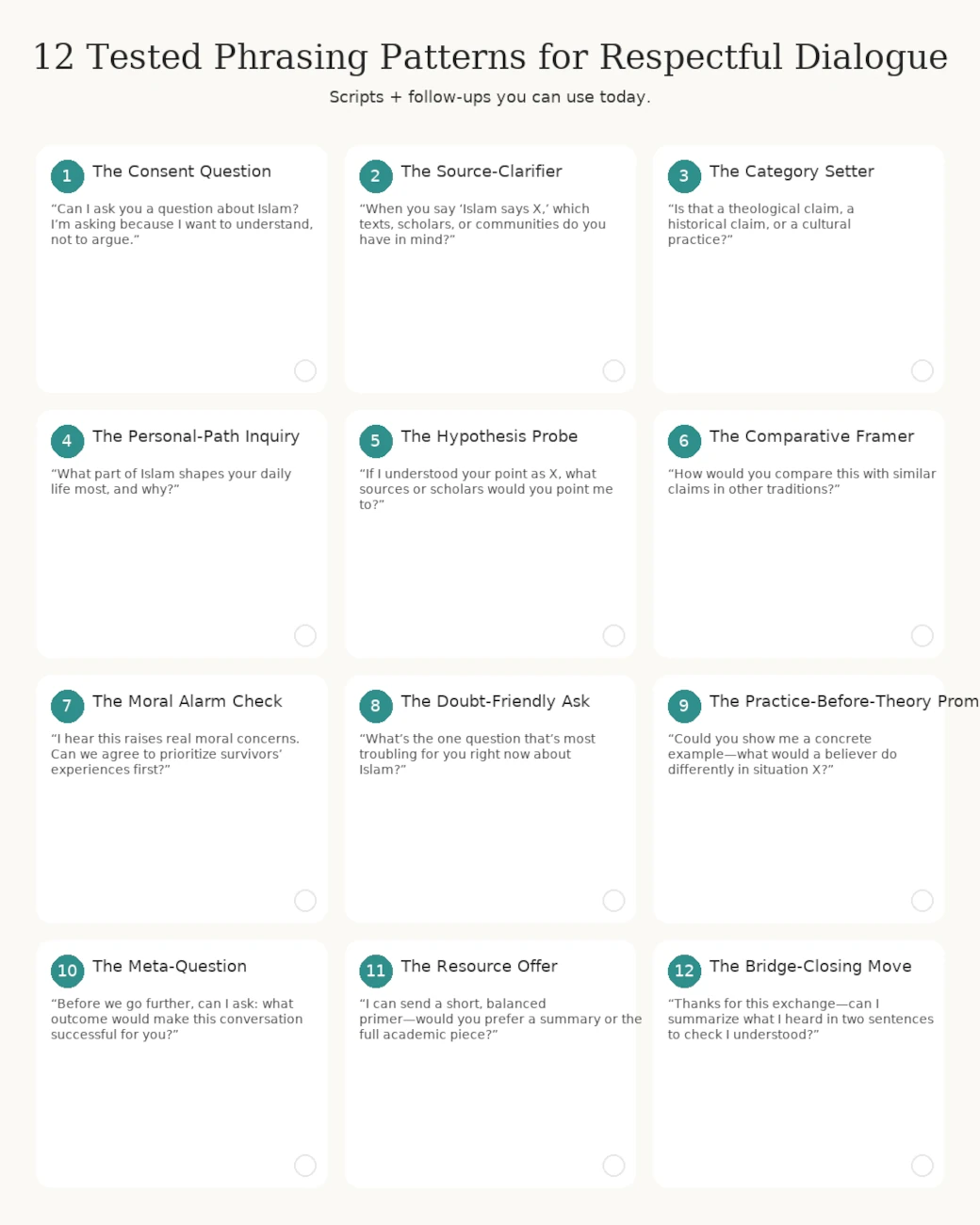
Below are 12 pragmatic ways to ask Respectful Questions to Ask About Islam. Each pattern includes: when to use it, an exact script you can say, and a short follow-up to keep the exchange productive.
1) The Consent Question – use before anything sensitive
When: Always before personal or potentially loaded questions.
Script: “Can I ask you a question about Islam? I’m asking because I want to understand, not to argue.”
Follow-up: If “yes”: “Thanks—what’s one thing you wish people understood?” If “no”: thank them and offer a later time.
Why it works: Respectful Questions to Ask About Islam, Consent reduces perceived coercion and increases openness. [7]
2) The Source-Clarifier – use to avoid slippery generalizations
When: When someone says “Islam says X” broadly.
Script: “When you say ‘Islam says X,’ which texts, scholars, or communities do you have in mind?”
Follow-up: “Are you referring to a classical interpretation or a contemporary reading?”
Why it works: Respectful Questions to Ask About Islam, It forces specificity rather than treating Islam as monolith. 13
3) The Category Setter – use to avoid category mistakes
When: When claims mix theology, history, and practice.
Script: “Is that a theological claim (about what God intends), a historical claim (about what happened), or a cultural practice?”
Follow-up: “Depending on which it is, different evidence would matter—what kind of evidence would you find convincing?”
Why it works: Respectful Questions to Ask About Islam, Aligns method to question and prevents talking past each other. [8]
4) The Personal-Path Inquiry – use to invite testimony (best in one-on-one)
When: When you want to learn about lived faith.
Script: “What part of Islam shapes your daily life most, and why?”
Follow-up: “How did you come to that practice?”
Why it works: Respectful Questions to Ask About Islam, Shifts from abstract dispute to narrative, which increases empathy and learning. 14
5) The Hypothesis Probe – use for contentious intellectual claims
When: When debating evidence or history (e.g., claims about scripture).
Script: “If I understood your point as X, what primary sources or scholars would you point me to so I can see the basis for that claim?”
Follow-up: “Would you be willing to point me to one accessible primer so I can read it first and then ask a clarifying question?”
Why it works: Respectful Questions to Ask About Islam, Moves conversation toward shared sources and away from assertion battles. [6]
6) The Comparative Framer – use to neutralize exceptionalism
When: When someone treats Islam as uniquely problematic or uniquely virtuous.
Script: “How would you compare this with similar claims in other traditions? Do you see parallels?”
Follow-up: “Where are the real differences in practice or ideology, in your view?”
Why it works: Respectful Questions to Ask About Islam, Normalizes Islam as part of religious diversity and reduces exoticism. 15
7) The Moral Alarm Check – use when suffering or harms are discussed
When: Conversations touch on abuse, extremism, or injustice.
Script: “I hear this raises real moral concerns. Can we first agree to prioritize survivors’ experiences while we talk about causes?”
Follow-up: “What concrete steps would justice require here?”
Why it works: Respectful Questions to Ask About Islam, Places priority on ethics and care rather than abstract defense. 16
8) The Doubt-Friendly Ask – use with inquirers and seekers
When: Someone voices doubt or curiosity about the faith.
Script: “What’s the one question that’s most troubling for you right now about Islam?”
Follow-up: “If you wanted one short, reliable source to start with, what format helps you — book, article, or conversation?”
Why it works: Respectful Questions to Ask About Islam, Validates doubt and channels it into a focused inquiry. 17
9) The Practice-Before-Theory prompt – use when conversation stalls on abstractions
When: When debate freezes on metaphysical issues.
Script: “Could you show me a concrete example—what would a believer do differently in situation X?”
Follow-up: “How does that practice express the underlying belief?”
Why it works: Respectful Questions to Ask About Islam, Grounding in behavior clarifies abstract claims and reveals interpretive variety. [14]
10) The Meta-Question – use to slow down and reflect on the exchange
When: The conversation heats up or derails.
Script: “Before we go further, can I ask: what outcome would make this conversation successful for you?”
Follow-up: “Mine would be to leave with a clearer picture of where we agree and disagree.”
Why it works: Respectful Questions to Ask About Islam, Reorients toward shared goals and reduces escalation. [9]
11) The Resource Offer – use when someone asks for evidence now
When: The other party wants sources immediately.
Script: “I can send a short, balanced primer—would you prefer a brief summary or the full academic piece?”
Follow-up: “If you read the summary, can we set a time to talk it through?”
Why it works: Respectful Questions to Ask About Islam, Meets hunger for info while preventing one-sided lecture. [6]
12) The Bridge-Closing Move – use at the end of a conversation
When: You want to preserve the relationship regardless of outcome.
Script: “Thanks for this exchange—can I summarize what I heard in two sentences to check I understood?”
Follow-up: “Would you like a short follow-up resource or should we leave it there?”
Why it works: Respectful Questions to Ask About Islam, Validates the person, ensures mutual understanding, and sets next steps. [7]
Sequencing: how to build a conversation that deepens rather than escalates
Respectful Questions to Ask About Islam,Not every question belongs at the start. Use a scaffold:
- Permission & rapport: Consent Question → Personal-Path Inquiry. [7][14]
- Calibrate & align: Source-Clarifier → Category Setter. [13][8]
- Dive carefully: Hypothesis Probe → Practice-Before-Theory. [6][14]
- Address tough matters: Moral Alarm Check → Comparative Framer. [16][15]
- Close well: Meta-Question → Resource Offer → Bridge-Closing. [9][6][7]
Respectful Questions to Ask About Islam, This order moves from relational to evidential, reducing the chance that people feel ambushed. In high-stakes contexts (public forum, family dinner), slow down and commit to the first two steps before proceeding. [10]
Listening moves to pair with questions (do these, not talk more)
- Paraphrase: “If I heard you right, you’re saying…” then pause. Paraphrase reduces misinterpretation. [5]
- Invite story: “Can you tell me about a time that made you feel this was important?” Story increases trust. [14]
- Ask for clarification of terms: “When you say ‘sharia’ what do you mean exactly?” Reduces equivocation. [8]
- Name emotional tone: “It sounds like this is painful/frustrating—do you want to focus on that first?” Validates affect. [16]
Respectful Questions to Ask About Islam, Good questions + poor listening still fail. Combine both. [5]
Special settings: quick adaptation recipes
Family (high emotion / long relationship): Respectful Questions to Ask About Islam, Use Consent Question, Personal-Path, and Bridge-Closing. Avoid public correction and use “we” language. Offer breaks. [7][17]
Workplace (professional stakes): Use Category Setter and Source-Clarifier quickly. Keep email follow-ups and avoid long public debates. If the topic affects policy, suggest an objective review. [6]
Online / social media (low context, high exposure): Respectful Questions to Ask About Islam, Use brief Consent in DMs; in public threads avoid prolonged back-and-forth. If moderating, enforce turn-taking and add a resource. For high-traffic debates, offer to move to a structured AMA or Q&A. [8]
Interfaith events or classrooms: Use the Sequencing scaffold; pre-share materials and use time-boxed Q&A to keep the event educational. [10]
Pitfalls and how to avoid them

- Trap: “But Islam…” openers that generalize.
Fix: Use Source-Clarifier and Comparative Framer to avoid stereotyping. [13][15] - Trap: Overloading with books/articles in a single exchange.
Fix: Use Resource Offer with a one-page summary first. [6] - Trap: Turning personal testimony into universal proof.
Fix: Ask Practice-Before-Theory; respect testimony but don’t generalize without evidence. [14] - Trap: Public shaming (pile-on).
Fix: De-escalate with Meta-Question, suggest offline follow-up. Protect vulnerable participants. [8][16]
Short 4-week practice workshop (run this with friends or a community group)
Goal: Respectful Questions to Ask About Islam, Learn 6 phrasing patterns and practice sequencing.
- Week 1 (90 min): Intro to G.R.A.C.E., practice Consent & Personal-Path in pairs (15 min each). [7][14]
- Week 2 (90 min): Source-Clarifier + Category Setter drills with roleplay; small groups produce a one-page resource list. [13][8]
- Week 3 (90 min): Practice Hypothesis Probe and Moral Alarm Check with difficult scenarios; facilitator models de-escalation. [6][16]
- Week 4 (90 min): Public simulation: 3 short mock panels with timeboxing; group feedback using a simple rubric (respect, clarity, evidence). [10]
Respectful Questions to Ask About Islam, Use real cases (prepared in advance) rather than surprise ambushes. Track progress with the KPIs below. 18
Simple KPIs to measure better conversations
Respectful Questions to Ask About Islam, Track weekly and reflect monthly.
- Listening ratio: Minutes listening : minutes speaking (aim > 2:1). [5]
- Consent rate: % of times you asked consent before sensitive questions (aim > 80%). [7]
- Follow-up conversion: % of times a promised resource was read/acknowledged within a week (aim > 50%). [6]
- Relationship score: Self-rated 1–5 whether the exchange strengthened, left neutral, or weakened relationship (track trend). [9]
Measure to improve habits, not to judge every conversation as a success/failure. [18]
Handling bad-faith actors & public attacks
Respectful Questions to Ask About Islam, If someone is clearly baiting or using the conversation to harass:
- Disengage quickly and publicly restate norms: “We’re here to learn; if your aim is not that, this isn’t the right space.” [8]
- Moderate: remove comments, switch to pre-screened Q&A, and have escalation contacts for abuse. [8]
- Support targets: privately check in with anyone attacked; offer resources and a follow-up panel if needed. [16]
Protect safety first—information exchange second. [8][16]
Short annotated list: 12 respectful questions
- “Can I ask a question about Islam? I want to understand.” [consent] [7]
- “When you say ‘Islam teaches X,’ which texts or scholars do you mean?” [source] [13]
- “Is that a historical claim, a theological claim, or a cultural practice?” [category] [8]
- “What part of Islam shapes your everyday life most, and why?” [personal] [14]
- “Which books or articles would you recommend to learn more about that?” [resource] [6]
- “How would you compare this teaching to similar ideas in other traditions?” [comparative] [15]
- “I’m concerned about harms here—whose experience should we prioritize?” [moral] [16]
- “What would count as convincing evidence for you on this point?” [epistemic] [11]
- “Can you give a concrete example of this belief in practice?” [practice] [14]
- “What outcome would make this conversation useful for you?” [meta] [9]
- “Would you prefer a short summary now or the full source to read later?” [resource offer] [6]
- “May I summarize what I heard to check I understood?” [bridge close] [7]
Respectful Questions to Ask About Islam, Use these as fridge magnets—memorize a few and rotate them. They scale across contexts. [10]
FAQs
What’s the single most important step before asking a sensitive question about Islam?
Ask permission first — e.g., “Can I ask you a question about Islam? I’m asking because I want to understand.” Consent lowers defensiveness and signals respect.
How do I avoid treating “Islam” as one single thing?
Use the Source-Clarifier: ask “When you say ‘Islam says X,’ which texts, scholars, or communities do you mean?” This forces specificity and reveals intra-Muslim diversity.
Should I use scientific evidence when discussing religion?
Yes — but only when the claim is scientific. First separate scientific questions (method, data) from theological ones (meaning, purpose), then agree together on what evidence counts.
What if the conversation becomes emotional or heated?
Pause and re-center with a Meta-Question: “What outcome would make this conversation useful for you?” Or suggest a short break. Re-stating goals usually de-escalates quickly.
How can I move from abstract debate to real understanding?
Use the Practice-Before-Theory prompt: “Could you give a concrete example — what would a believer do differently in situation X?” Grounding in practice clarifies abstract claims and reveals interpretive variety.
How can I ask about sensitive topics (e.g., women, Sharia, extremism) without causing harm?
Pre-label the topic and prioritize ethics: ask “Can we set norms? I’d like to focus first on survivors’ experiences and concrete harms.” Keep the focus on care and facts.
How should I respond to someone who refuses to discuss religion?
Respect their boundary. Thank them and offer a later time. Preserving the relationship is more important than winning a point.
Can these phrasing patterns be used in public or online discussions?
Yes, but adapt: prefer brief Consent in DMs, use time-boxed Q&A in public forums, and enforce moderation to prevent pile-ons.
How do I follow up after promising to send a resource?
Offer a short summary first, then the full source. Ask if you can set a time to discuss the summary – this increases follow-through and learning.
Will asking respectful questions actually change minds?
Sometimes – respectful questions more often clarify disagreements and preserve relationships. Changing deeply held views usually takes time and repeated respectful engagement.
Final reflections – curiosity with care
If your aim is learning and relationship-care, the questions above will serve you well. The secret is not a single perfect phrase but the combination: consent, clarity about what kind of claim is at issue, a willingness to listen to story, and a plan to follow up. Practice the phrasing patterns, run short workshops, measure the small KPIs, and treat awkward exchanges as data for improvement, not moral failure. The result: conversations that teach, connect, and-sometimes-transform. [2][18]
References
- Allport, G. W. — The Nature of Prejudice. Foundational social-psychology text establishing contact theory and conditions under which intergroup contact reduces prejudice; informs the need for structured, consensual conversation conditions. ↩︎
- Isaacs, William — Dialogue and the Art of Thinking Together. Practical guidance on listening practices and the design of conversations that cultivate mutual intelligence; useful for workshop design and listening moves. ↩︎
- Kahneman, Daniel & Tversky, Amos — Framing & cognitive biases research. Work on framing effects and cognitive heuristics that explains why phrasing changes responses; practical implications for question design. ↩︎
- Facilitation handbooks (university chaplaincy and NGO toolkits). Applied resources used by campus interfaith programs; these emphasize consent, safety, and time-boxing that the G.R.A.C.E. model adopts. ↩︎
- Rosenberg, Marshall B. — Nonviolent Communication. Techniques for paraphrase, “I” statements, and empathy that underpin the listening moves and scripts suggested. ↩︎
- Methodology primers: history, science, and testimony (university syllabi & public primers). These short introductions help interlocutors distinguish kinds of claims (historical vs scientific vs experiential) and choose appropriate evidence. ↩︎
- Applied consent & relational preservation research (restorative justice, mediation briefs). Documents showing that asking permission to discuss sensitive topics lowers defensiveness and protects relationships. ↩︎
- Platform moderation and anti-pile-on studies (civic tech & communications journals). Evidence-based practices for moderating public conversation and preventing online harassment. ↩︎
- Negotiation & de-escalation literature (Fisher & Ury and modern mediation research). Guidance on exit planning, summarizing, and preserving agreements that inform bridge-closing moves. ↩︎
- Adult education & facilitation research on deliberate practice. Empirical work showing skill workshops (roleplay + feedback) transfer to real conversational competence. ↩︎
- Social-psychological studies on epistemic norms and intellectual humility. Research demonstrating the benefits of explicitly naming standards of evidence and modeling curiosity to reduce reactance. ↩︎
- Public engagement and science communication literature. Guidance on separating methodological questions (science) from metaphysical ones and on communicating consensus without condescension. ↩︎
- Works on intra-Muslim diversity and primary sources (introductory readers). Short primers explaining schools, tafsir traditions, and how “Islam says X” often masks diversity. ↩︎
- Narrative & testimony studies (religion & sociology). Scholarship showing that personal narrative increases empathy and learning in intergroup conversations. ↩︎
- Comparative religion primers & reframing work (Haidt and others). How comparative framing reduces exoticization and situates traditions in broader contexts. ↩︎
- Trauma-informed pastoral care resources. Clinical and pastoral guidelines on prioritizing survivors, avoiding retraumatization, and centering ethics in heated dialogues. ↩︎
- Studies on doubt and seekers (psychology of religion). Research on how inquisitive, doubt-friendly spaces encourage honest inquiry and sustained engagement. ↩︎
- Measurement and evaluation guides for civic programs. Practical frameworks for designing simple KPIs (listening ratios, consent rates) and tracking program improvement over time. ↩︎
Discover more from Ahmed Alshamsy
Subscribe to get the latest posts sent to your email.