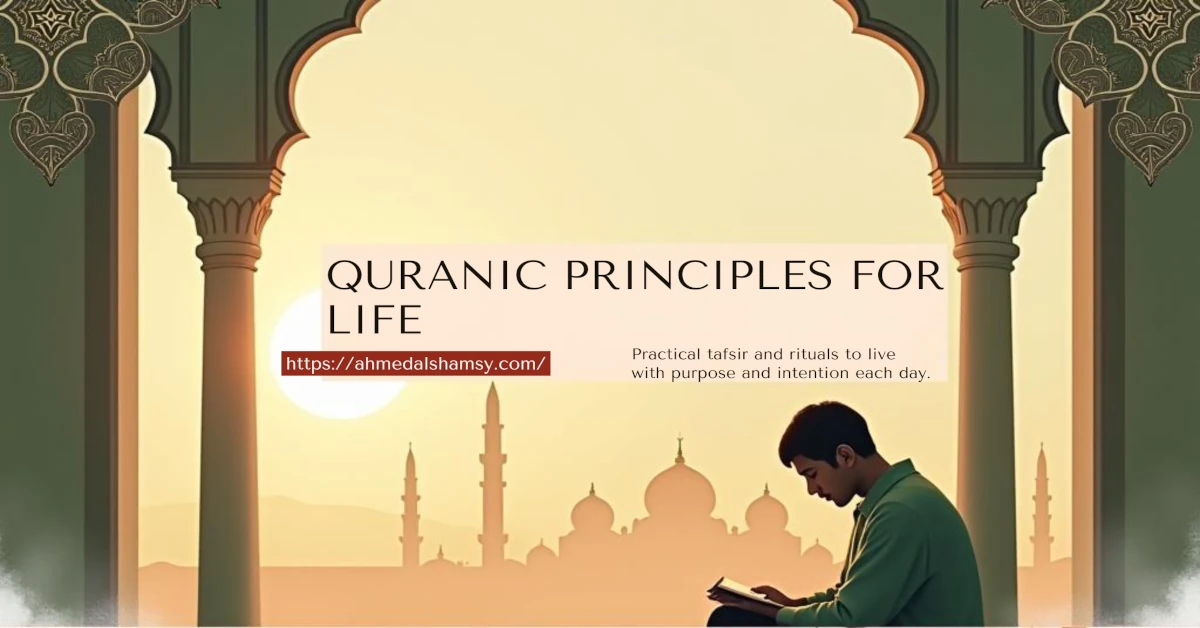

Human beings ask for guidance – Like islamic instruction manual for living – that is at once principled and practical. The phrase Quranic principles for life names a project of translation: turning the Qur’an’s recurrent moral and spiritual directives into decision heuristics that work in the home, workplace, and public square. This article reads the Qur’an with tafsir (classical interpretation) and modern behavioral evidence so each principle becomes a short, testable strategy. – Read More In : Practical Tafsir Lessons -.
Exclusive Summary — Compact Playbook for Quranic Principles
Discover a practical, energizing roadmap that turns Quranic wisdom into everyday action. Quranic Principles For Life distills eight core teachings — tawḥīd, justice, stewardship, reason, balance, gratitude, consultation, and hope — into concrete, testable rituals and decision heuristics. Packed with concise tafsir, Seerah examples, and behavioral-science links,
this guide gives you micro-scripts and a 30/60/90 pathway to convert belief into measurable habits. Try one micro-ritual — a two-breath pause or one-sentence morning alignment — run a 30-day n=1 test, track one simple metric, and scale what works. Embrace these daily moral algorithms to sharpen focus, deepen character, and build resilient, community-rooted purpose. Share progress in a weekly shūrā, invite an accountability partner, and prioritize moderation so rituals grow without burnout and transform lives.
When your day fragments into urgent demands and noisy opinions, a clear instruction can be an act of mercy. The Qur’an supplies such instructions — compact, repeated, and morally ambitious — and tafsir traces how generations converted them into lived norms as an Instruction Manual For Living. Below we unpack those principles and give practical scripts you can test in 30–90 day cycles. 1 2
Table of Contents
Quranic principles for life:
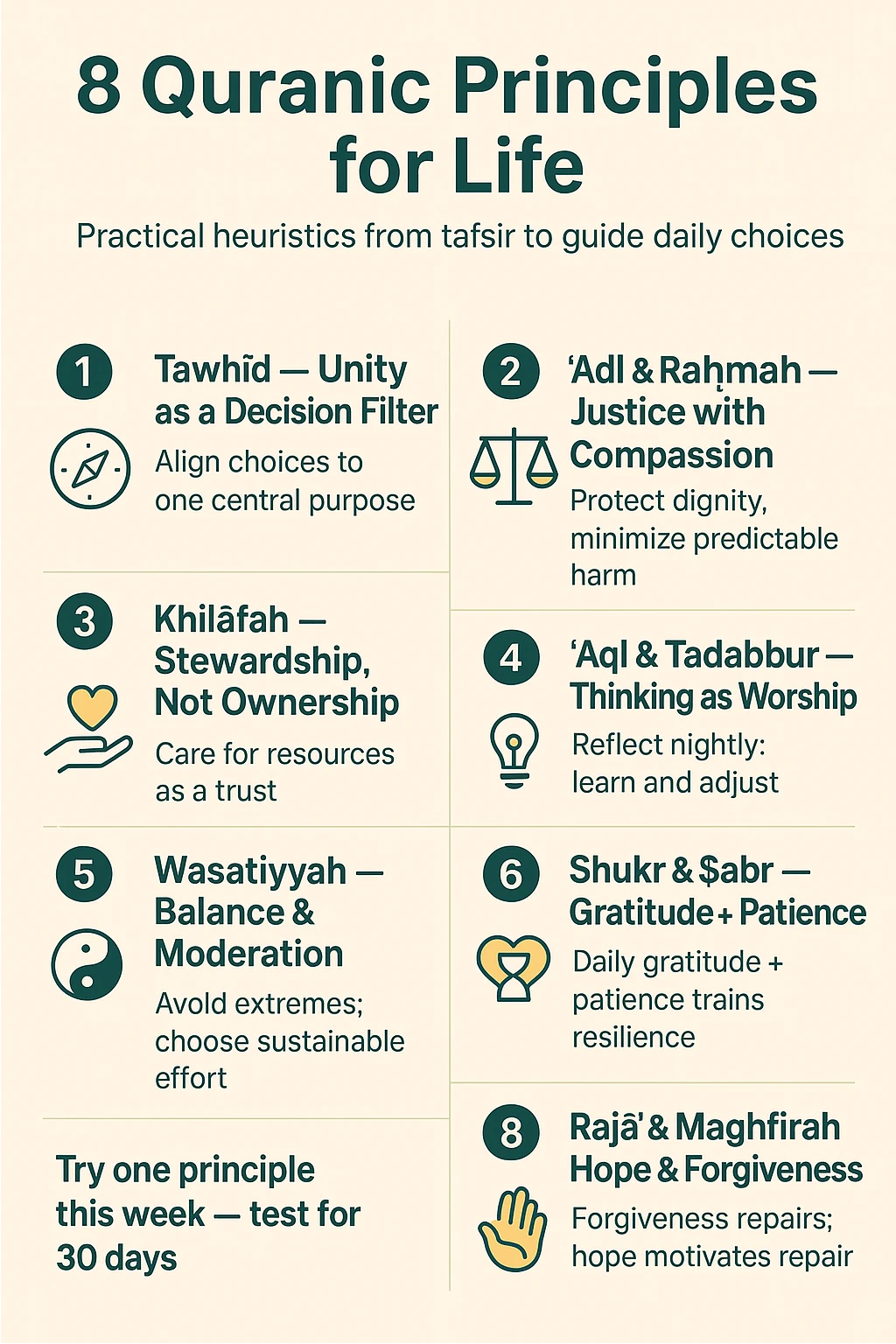
1. Tawḥīd (Oneness) — Unity as a Decision Filter
“Actions are (judged) by intentions.”
(Sahih al-Bukhari). [2]
When life splits you into roles and urgencies, tawḥīd calls you back to a single orienting center. It is not abstract metaphysics only; it is a practical default that reduces conflict among competing aims. – Read More In : prophetic leadership lessons and In: Seerah Life Lessons -.
Tafsir insight. Classical commentators (e.g., Ibn Kathīr, al-Ṭabarī) treat tawḥīd as the root of moral coherence: if God’s oneness is accepted, then loyalties align and ethical priorities become less scattered. 3
Heuristic (one-line). Each morning, test major choices with a single sentence: “Does this choice reflect my core orientation toward God and moral responsibility?” If not, defer.
Applied script. Before accepting a task that consumes family time, speak the sentence aloud, hold it for ten seconds, then answer. This ritual converts metaphysical belief into a decision rule.
Why it works (modern evidence). Psychological research on value-based choice finds that a salient organizing value reduces decision fatigue and supports consistent behavior over months. 4 5 – Read More in : Quranic principles for life.
2. ‘Adl (Justice) & Raḥmah (Compassion) — The Two-Handed Law
“Whoever is not merciful to people, Allah will not be merciful to him.”
(Sahih Muslim). 6
Justice without mercy wounds; mercy without justice may enable wrongdoing. The Qur’an insists both must operate together to sustain dignified societies.
Tafsir insight. Exegetes show verses on justice are often followed by contexts calling for forbearance; classical tafsir frames ihsān (excellence/compassion) as the ethical completion of legal justice. 7
Heuristic (two-question). For consequential acts ask: (1) Does this preserve human dignity? (2) Does this minimize foreseeable harm? If either fails, pause and redesign.
Applied script. In disputes, start with an opening line: “Let dignity guide our solution.” Use the two questions as a facilitative checklist before proposing remedies.
Why it works (modern evidence). Organizational ethics literature demonstrates that coupling fairness with empathetic leadership increases trust and reduces recidivism in institutional settings. 8
3. Khilāfah (Stewardship) — Responsibility over Possession
“The earth is green and beautiful, and Allah has appointed you as His stewards over it.”
(Sunan Ibn Mājah / similar chains; classical corpus). 9
Viewing ourselves as stewards lightens the burden of ownership and introduces accountability into daily consumption and leadership decisions.
Tafsir insight. Tafsir writers interpret khilāfah as a trust (amāna): resources are entrusted to humans, who will answer for their use. This theological posture underwrites charity and moderation in classical practice. 10
Heuristic (weekly act). Select one concrete stewardship action per week—reduce single-use items, mentor a junior colleague, share surplus—and log its effects.
Applied script. After each shopping trip, perform one stewardship check: what will be stewarded, shared, or repaired? Record the small change.
Why it works (modern evidence). Environmental psychology shows that adopting a “caretaker” identity predicts sustained pro-environmental behaviors and long-term planning. 11
4. ‘Aql (Reason) & Tadabbur (Reflection) — Thinking as Worship
“Seeking knowledge is an obligation upon every Muslim.”
(Sunan Ibn Mājah; widespread canonical backing). 12
Reflection enlarges faith into wisdom; thinking becomes an act of devotion rather than suspicion. The Qur’an repeatedly invites discernment, not blind conformity.
Tafsir insight. Tafsir tradition places a premium on tadabbur (deep reflection), which classical exegetes connect to ijtihād (informed reasoning) and adaptive jurisprudence. 13
Heuristic (nightly reflection). Two questions before sleep: “What did I learn?” and “What will I do different tomorrow?” Keep entries under 25 words.
Applied script. After a heated exchange, note one assumption you held and one factual step to test next time. This practice converts emotion into calibrated learning.
Why it works (modern evidence). Cognitive science indicates that reflective practice mitigates bias and improves judgment in complex tasks. 14
5. Wasatiyyah (Moderation) — Balance as Integrity

“Religion is easy; do not make it difficult for yourselves.”
(Sahih al-Bukhari). 15
Modest, consistent effort outlives spectacular but unsustainable zeal. The middle way preserves joy and capacity for service.
Tafsir insight. Classical commentators interpret wasatiyyah as a societal and personal equilibrium—avoiding extremes while keeping to principled action. 16
Heuristic (sustainability cap). If an activity consumes more than ~30% of your energy/resources for a sustained period, reassess and re-balance.
Applied script. For new projects cap initial commitments (fewer meetings, smaller deliverables). Re-evaluate at 60 days to scale up.
Why it works (modern evidence). Habit and self-regulation research show attenuation of intensity and focus on low-friction routines produce higher long-term adherence. 17 18
6. Shukr (Gratitude) & Ṣabr (Patience) — The Resilience Pair
“Wondrous is the affair of the believer, for there is good for him in every matter — and this is not the case with anyone except the believer. If he is content and thankful, there is good for him; and if he is patient and forbearing, there is good for him.”
(Ṣaḥīḥ Muslim, Kitāb al-Zuhd wa al-Raqāʾiq (The Book of Asceticism), Hadith no. 2999.)
Seerah Life Lesson:
Prophetic traditions consistently pair thankfulness with forbearance (see classical collections). [13]
Gratitude makes joy fuller; patience makes suffering bearable. Together they forge character that endures friction without collapse.
Tafsir insight. Exegetes frame shukr and ṣabr as complementary: gratitude attunes attention to blessings, patience trains the soul for delayed flourishing. [13]
Heuristic (daily log). End each day with two lines: one gratitude item and one patient act (a restraint exercised). Track for 30 days.
Applied script. When disappointed, write one sentence naming a specific blessing and one sentence describing a patient response.
Why it works (modern evidence). Experimental trials on gratitude show increases in wellbeing; studies on patience link to improved stress tolerance and goal persistence. 19
7. Shūrā (Consultation) & Ummah (Community) — Distributed Wisdom
Carrying burdens alone fractures resolve; shared counsel lightens choice and brings diverse insight. Consultation is humility in practice.
Seerah Life Lesson:
The Prophet ﷺ consulted his companions on strategic decisions (seerah narratives). [3]
Examples of Consultation (Shura):
Battle of Uhud:
The Prophet ﷺ consulted his companions on whether to confront the Quraysh inside or outside Medina, a key strategic decision.
Treaty of Hudaybiyyah:
He sought the opinion of Abu Bakr on confronting those who blocked their path to the Kaaba, which influenced the eventual decision to seek peace.
Personal Matters:
The Prophet ﷺ also consulted his companions on more personal matters, such as the incident of the slander against his wife, Aisha, demonstrating the broad scope of consultation in his life.
Tafsir insight. Tafsir literature treats shūrā as a mechanism for collective governance and family management: decisions attended by consultation are more legitimate and resilient. 20
Heuristic (weekly shūrā). A 15-minute group check-in: each person gives one priority and one concrete need. Close with one micro-commitment.
Applied script. Use a fixed agenda: (1) one priority; (2) one obstacle; (3) one measurable action. Rotate facilitation.
Why it works (modern evidence). Group decision frameworks that structure inputs and rotate leadership reduce groupthink and improve outcomes. 21
8. Rajāʾ (Hope) & Maghfirah (Forgiveness) — The Ethics of Renewal
Ayah: “Do not despair of the mercy of Allah…” (Qur’an 39:53).
Hadith: The Prophet ﷺ described Divine mercy as vast and inviting repentance (canonical collections).
Hope prevents paralysis from failure; forgiveness restores agency to the penitent. Together they keep moral life forward-moving.
Tafsir insight. Classical tafsir reads verses of mercy as practical safeguards: believers are urged to act, repent, and reform rather than sink in despair. 22
Heuristic (monthly restoration). Draft an unsent forgiveness letter: one paragraph admitting a mistake, one paragraph of learning, one paragraph of restitution steps.
Applied script. After a lapse, enact one reparative action within 72 hours (apology, restitution, corrective behavior).
Why it works (modern evidence). Clinical studies show self-forgiveness reduces depression and increases motivation for reparative change. 23
Script to Strategy — Tafsir Applied to Modern Dilemmas
Tafsir is not antiquarian footnotes; it is a living method for translating text into choices. The following mappings show how exegetical logic becomes practical rules in work, family, public ethics, and technology.
- Work (contracts): Tafsir on trade emphasizes clarity; require a one-line fairness clause in contracts. [10]
- Family (relational duty): Tafsir balances rights with tenderness; institute a weekly family shūrā for planning and care. [15]
- Public ethics: Tafsir’s stress on accountability supports whistleblower channels and transparent audits. [7]
- Digital life: Apply niyyah (intention) as a three-second posting filter: does this forward dignity?
A 90-Day Translational Pathway (30/60/90) — From Principle to Habit
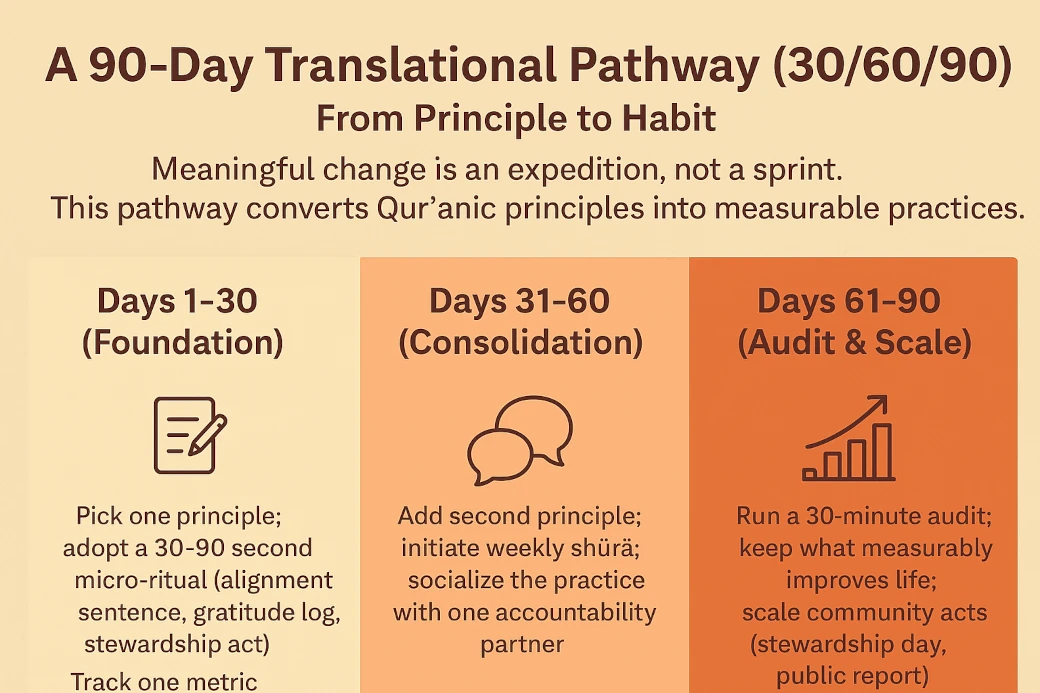
Meaningful change is an expedition, not a sprint. This pathway converts Qur’anic principles into measurable practices.
- Days 1–30 (Foundation): Pick one principle; adopt a 30–90 second micro-ritual (alignment sentence, gratitude log, stewardship act). Track one metric (calm, sleep, or one performance indicator).
- Days 31–60 (Consolidation): Add second principle; initiate weekly shūrā; socialize the practice with one accountability partner.
- Days 61–90 (Audit & Scale): Run a 30-minute audit; keep what measurably improves life; scale community acts (stewardship day, public report).
Conclusion — The Qur’an as a Practical Manual
When we translate the Quranic principles for life into precise heuristics—one-sentence tests, stewardship acts, short consultations—the text ceases to be merely read and begins to be lived. Test one principle this week; measure one small outcome. Over months the manual in the text can become the manual of a humane, resilient, and purposeful life.
FAQs
1. What are the Quranic principles for life?
The Quranic principles for life are foundational teachings such as belief in one God (tawḥīd), justice, stewardship, reason, and compassion. They provide timeless guidance for making ethical decisions and building a purposeful life.
2. How can Quranic principles for life guide daily decisions?
Quranic principles for life offer moral algorithms that help in daily decision-making, such as fairness in work, kindness in family interactions, honesty in business, and mindful stewardship of the environment.
3. Why are Quranic principles for life relevant today?
Despite being revealed over 1,400 years ago, Quranic principles for life remain relevant because they address universal human needs like justice, balance, accountability, and community — issues still central in the modern world.
4. Can non-Muslims benefit from Quranic principles for life?
Yes. Quranic principles for life are rooted in universal values — such as honesty, compassion, and justice — which non-Muslims can also apply in personal growth, leadership, and ethical decision-making.
5. What is the connection between Quranic principles for life and purpose?
Quranic principles for life emphasize living with intention, aligning everyday choices with a higher purpose, and ensuring that actions reflect moral responsibility and awareness of God.
6. How do Quranic principles for life promote justice?
Justice is a central Quranic principle for life. The Quran urges fairness in dealings, equality before God, and protecting the vulnerable, shaping a society where dignity and accountability are preserved.
7. Are Quranic principles for life compatible with modern science and psychology?
Yes. Many Quranic principles for life — such as gratitude, self-control, and mindfulness — align with modern psychological research showing their benefits for mental health, resilience, and well-being.
8. How can families apply Quranic principles for life?
Families can practice Quranic principles for life by fostering love, respect, patience, and honesty in their homes, while teaching children responsibility, gratitude, and justice as everyday habits.
9. What role does stewardship play in Quranic principles for life?
Stewardship (khilāfah) is a key Quranic principle for life. It means humans are trustees of the earth, responsible for protecting nature, using resources wisely, and caring for all creation.
10. How can I start applying Quranic principles for life today?
You can begin applying Quranic principles for life by choosing one principle — such as gratitude, justice, or honesty — and practicing it daily for 30 days. Over time, these small rituals create long-term positive habits.
References
- Abdel Haleem, M. A. S. (2004). The Qur’an: A New Translation. Oxford University Press. ISBN: 978-0199535958. ↩︎
- Al-Bukhārī, Muḥammad ibn Ismā‘īl. (c. 9th cent.). Sahih al-Bukhari (English trans. by Muhsin Khan / available at Sunnah.com). ↩︎
- Ibn Kathīr, Ismā‘īl. (1999). Tafsīr al-Qur’ān al-‘Aẓīm (selected vols.). Dār al-Ḥadīth. ↩︎
- Steger, M. F., Kashdan, T. B., & Oishi, S. (2008). “Being good by doing good: Purpose in life and wellbeing.” Journal of Research in Personality, 42(1), 130–135. doi:10.1016/j.jrp.2007.02.003. ↩︎
- Emmons, R. A., & McCullough, M. E. (2003). “Counting blessings versus burdens: An experimental investigation of gratitude and subjective well-being.” Journal of Personality and Social Psychology, 84(2), 377–389. doi:10.1037/0022-3514.84.2.377. ↩︎
- Muslim ibn al-Ḥajjāj. Sahih Muslim (canonical hadith collection; English trans. available). ↩︎
- Nasr, S. H. (Ed.). (2002). The Study Quran: A New Translation and Commentary. HarperOne. ISBN: 978-0061125865. ↩︎
- Bazerman, M. H., & Tenbrunsel, A. E. (2011). Blind Spots: Why We Fail to Do What’s Right and What to Do About It. Princeton University Press. ISBN: 978-0691153933. ↩︎
- Sunan Ibn Mājah (traditions on stewardship; canonical collections and classical citations). ↩︎
- Ibn Kathīr, Tafsīr (on verses related to khilāfah and economic practice). ↩︎
- Steg, L., & Vlek, C. (2009). “Encouraging pro-environmental behaviour: An integrative review and research agenda.” Journal of Environmental Psychology, 29(3), 309–317. doi:10.1016/j.jenvp.2008.10.004. ↩︎
- Classical hadith corpus on knowledge — e.g., Sunan Ibn Mājah; multiple chains. ↩︎
- Al-Ṭabarī, Muhammad ibn Jarīr. Jāmi‘ al-Bayān fī Ta’wīl al-Qur’an (classical tafsir). ↩︎
- Kahneman, D. (2011). Thinking, Fast and Slow. Farrar, Straus and Giroux. ISBN: 978-0374275631. ↩︎
- Sahih al-Bukhari (hadith: “Religion is easy”). ↩︎
- Sardar, Z., & Davies, M. W. (Eds.). (2001). The Blackwell Companion to Modern Islamic Thought. Blackwell Publishers. ISBN: 978-0631217988. ↩︎
- Clear, J. (2018). Atomic Habits: An Easy & Proven Way to Build Good Habits & Break Bad Ones. Avery. ISBN: 978-0735211292. ↩︎
- Baumeister, R. F., & Tierney, J. (2011). Willpower: Rediscovering the Greatest Human Strength. Penguin Press. ISBN: 978-1594203078. ↩︎
- Emmons & McCullough (2003) — see [5] above (gratitude evidence). ↩︎
- Al-Ṭabarī, Jāmi‘ al-Bayān (on shūrā passages). ↩︎
- Surowiecki, J. (2005). The Wisdom of Crowds. Anchor Books. ISBN: 978-0385721707. ↩︎
- Tafsir discussions on mercy and repentance: Ibn Kathīr and al-Ṭabarī. ↩︎
- Wohl, M. J. A., Pychyl, T. A., & Bennett, S. H. (2010). “I forgive myself, now I can study: How self-forgiveness for procrastinating can reduce future procrastination.” Personality and Individual Differences, 48(7), 803–808. doi:10.1016/j.paid.2010.01.029. ↩︎
Discover more from Ahmed Alshamsy
Subscribe to get the latest posts sent to your email.