
In contested cultural environments the heart’s attention is scarce; this collection of spiritual resilience practices offers short, science-linked micro-practices designed to protect moral attention, steady the nervous system, and increase social steadiness. These spiritual resilience practices are designed to be brief, repeatable, and intentionally measurable for daily use — particularly for Muslims living in Western cultural environments where sustained attention and moral clarity face daily pressure.
Executive Summary: 8 Rapid Rituals to Guard Your Heart and Attention
This concise field guide introduces eight immediately usable, science-linked micro-practices — Spiritual behavioral framework — crafted to protect moral attention in contested cultural spaces. Each ritual pairs a clear neuroscience rationale with a spiritually inspired analogue, then gives 3–5 steps that take under ten minutes, a one-line invitation to practice with someone, and a CSV-ready metric for daily logging.
The guide includes actionable 30/90-day habit plans, quick troubleshooting, and visual briefs for feature and infographic artwork. Start with two complementary rituals, log simple pre/post scores, and review weekly. With modest, consistent practice you should see reduced reactivity, healthier relational tone, and improved nightly recovery within thirty to ninety days — all documented by compact, repeatable data.
Table of Contents
The Bio-Theology of Attention: Why We Need Spiritual Resilience Practices
In the current age, our attention is not merely being “distracted”—it is being harvested. From a theological perspective, the heart (qalb) is the seat of moral discernment. When the nervous system is kept in a state of perpetual high-arousal (sympathetic dominance) by a contested culture, the capacity for Sakinah (tranquility) is physically and spiritually eroded.
Use these spiritual resilience practices as paired physiological and cognitive tools during a short, focused pilot. These spiritual resilience practices are not just self-help; they are acts of resistance against the fragmentation of the self. By anchoring our physiology through Centered Breath and our cognition through Scripted Notation, we reclaim the “soil” of the heart. Research into neuroplasticity confirms that what we attend to, we become. Therefore, protecting moral attention through spiritual resilience practices is the primary duty of the modern believer.
This erosion of attention is not accidental but systematic, operating through what I have described elsewhere as a cultural persuasion framework designed to shape perception, emotion, and moral response before conscious choice even occurs. Framing these methods explicitly as spiritual resilience practices clarifies the link between neural habit formation and devotional discipline.
The Adversarial Strategy: How Iblis Targets the Prefrontal Cortex
To understand the necessity of spiritual resilience practices, one must look through the eyes of the adversary. Iblis does not always require a grand fall from grace; he thrives on the “death of a thousand pings.” By keeping the human heart in a state of chronic sympathetic arousal—through outrage, envy, and fear—the adversary bypasses the prefrontal cortex, the biological seat of “Will.”
When we are in a state of survival-oriented stress, our capacity for Ihsan (excellence) vanishes. We become reactive animals rather than intentional vicegerents. These resilience practices are designed to disrupt the adversarial loop by re-establishing the “Gap” where the soul makes its choice. By lowering the heart rate and clarifying the intention, we render the “whisperings” (waswasa) audible and thus, dismissible.
Read this way, the Qur’an functions less as abstract theology and more as an islamic instruction manual for living, training the believer to preserve agency precisely where adversarial pressure is highest.
Why Ritual, Why Now
Rituals create predictable cognitive cues that support sustained attention and reduce impulsive reactivity. When culture is contested, personal rituals function as boundaries for attention and action. This set of spiritual resilience practices is designed to be short, repeatable, and measurable so that neural pathways for regulation and habit can be strengthened with minimal time investment [1][2][3]. Combining autonomic resets with simple moral retrieval cues reduces the chance that attention is captured by adversarial dynamics.
How To Use This Set
“The wise man is the one who takes account of himself and works for what comes after death, and the helpless man is the one who follows his desires and then places his hope in Allah.”
Jami’ at-Tirmidhi, (The Book on the Description of the Day of Judgment, Hadith Number 2459)
Choose two rituals to start: one physiological and one cognitive or social. Begin by selecting complementary spiritual resilience practices—one body-focused and one mind/social-focused—for the 30-day pilot. Track daily with the CSV templates supplied below. Use the combined tracker weekly to spot trends and use the 30/90-day plan for habit tests. The aim of these spiritual resilience practices is to create durable micro-habits that transfer into everyday choice architecture without requiring long sessions or specialized equipment.
These practices function as the core modules for the Iblis’s Strategies series, providing the behavioral evidence needed to move from abstract belief to measurable daily habit. Each practice is structured through the AIM 4-layer framework — translating classical Islamic texts into auditable behavioral protocols across the IMTF, IMVF, IMPF, and AIBF layers.
Where to start: For immediate results, begin with the Centered Breath Pause (physiological) and the Intention Anchor (cognitive).
Theological vs. Behavioral Mapping
| Spiritual Ailment | Cultural Trigger | Recommended Practice | Short Theological Note | Neuro-Mechanism |
|---|---|---|---|---|
| Ghaflah (Heedlessness) | Algorithmic choice architecture / constant pings | Intention Anchor; Scripted Notation | Reorients niyyah (intention) and restores deliberate attention to moral ends. | Associative Priming |
| Ghadab (Reactive Anger) | Digital outrage cycles and provocation | Reframing Pause; Centered Breath | Creates a moral pause in which restraint (sabr) can reassert right action over impulse. | Amygdala Regulation |
| Qaswat al-Qalb (Hardness) | Social polarization; compassion fatigue | Micro-Charity Gesture; Brief Metacognitive Check | Small, consistent charity and self-audit soften the heart and reopen compassion toward others. | Striatum Activation |
| Wahm (Anxiety) | Threat narratives and contested future stories | Centered Breath Pause; Evening Reconciliation | Clears daily residue so sleep-dependent consolidation can process and reduce anxious salience. | Vagal Tone Enhancement |
| Hiqd (Resentment) | Relational friction and unresolved slights | Evening Reconciliation | Timely repair and apology restore relational bonds and prevent corrosive grudges from hardening the heart. | REM Consolidation / Emotional Processing |
The practices below are the operational layer of this framework — each preregistered, CSV-tracked, and ready to run as a 30-day pilot. Members access the full interactive ledger, CSV bundle, and implementation memos.
The 8 Spiritual Resilience Practices
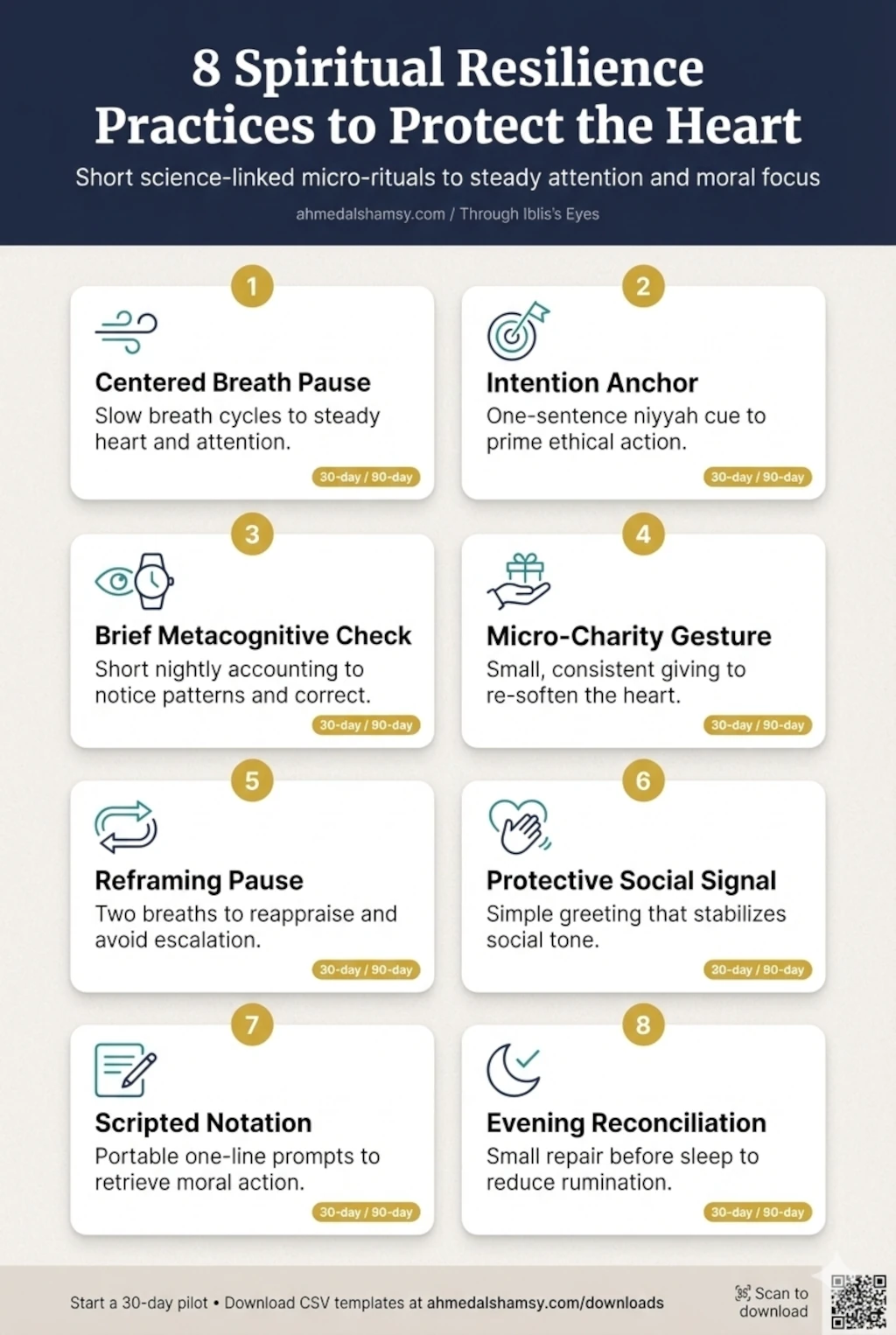
Each of the following spiritual resilience practices includes a neuroscience rationale, a short practice, and a CSV template for tracking.
1. Centered Breath Pause
IMTF — Islamic Methodological Translation Framework
Text citation:
Classical reading
The Surah’s consolation (hardship → ease) is read as a prophetic pedagogy that trains the believer to interrupt escalation and re-anchor the qalb toward tawakkul (trust) before action.
Why other readings excluded
This reading privileges the moral-psychological function of consolation rather than a purely eschatological or rhetorical reading, because the practice explicitly targets momentary autonomic states.
IMVF — Islamic Meaning & Values Framework
Value map
Sakinah (tranquility) → attention stewardship → compassionate intentionality (acts vs automatic reactivity).
Practical vignette
Before joining a heated thread, Fatima used the two-minute centered breath each morning for three weeks. Where she used to reply immediately, she began pausing to act from intention — fewer defensive messages, clearer follow-ups, and an increased sense of agency.
IMPF — Islamic Moral-Psychological Framework
Target nafs state
Sympathetic arousal / threat-driven reactivity.
This is one of the foundational spiritual resilience practices for rapid autonomic down-regulation. The “Centered Breath Pause” serves as the foundational physiological gatekeeper among our spiritual resilience practices. When we engage in 4-1-6 breathing, we are not just “calming down”; we are signaling to the brain’s executive centers that the “threat” of the contested culture is not immediate. This allows the prefrontal cortex to remain online, ensuring that our reactions remain aligned with our values rather than our impulses.
Neuroscience rationale: Slow, paced respiration increases vagal tone and heart-rate variability (HRV), supporting autonomic regulation and reducing reactivity [4][5]. HRV-based protocols improve prefrontal regulation and reduce physiological arousal during social stress. For a concise overview of why paced respiration supports vagal tone and social engagement, see Porges (2007). https://doi.org/10.1016/j.biopsycho.2006.06.009
6-column mapping table
Protocol Specification Mapping
| Text Citation | Hermeneutic Move | Behavioral Mechanism | CSV Header | Pilot Window | Ethical Tier |
|---|---|---|---|---|---|
| Surah Ash-Sharh 94:5-6 | Read consolation as an instruction to interrupt escalation and create a moral pause. | Vagal tone ↑ → Prefrontal engagement | centered-breath-pause.csv | 30 days (daily AM) | Low — reversible, non-medical |
AIBF — Applied Islamic Behavioral Framework
Prophetic practice analogue: Brief centering before action echoes prophetic moments of stillness and attention, modeled here as an accessible two- to five-minute breath anchor.
N=1 Runbook
Step-by-step micro-practice (≤10 minutes):
- Sit upright, feet grounded, hand on abdomen.
- Inhale 4 counts, hold 1, exhale 6 — repeat 6–10 cycles (~2–4 min).
- On the final exhale name one feeling and set one micro-intention (one small action).
- Log pre_score / post_score in the CSV; reflect weekly.
- Stopping rules / consent: Stop if lightheaded; reduce cycle length. If you have a cardiac condition, consult clinician before paced-breath protocols.
One-line script: “Two minutes — steady breath, steady heart.”
Metrics & CSV:
| timestamp | ritual | completed | duration_sec | pre_score | post_score | context | note |
|---|---|---|---|---|---|---|---|
| 2026-01-03T07:12:00Z | centered_breath_pause | 1 | 150 | 5 | 8 | morning | two minute cycle, steadier |
30/90-day plan:
- 30-day: practice each morning; track pre/post calm scores. Expect a modest improvement in post_score with consistent practice [4][5].
- 90-day: invite a peer for weekly shared pauses; measure days with shared practice and average calm scores.
Implementation notes: Use this as a physiological reset before difficult conversations. If time is limited, shorten to three cycles and still log pre/post scores.
CSV header + example row (machine-ready)
timestamp,ritual,completed,duration_sec,pre_score,post_score,context,note
2026-03-06T07:12:00Z,centered_breath_pause,1,150,4,7,morning,"two-minute cycle, steadier"
Pre-registration
Protocol preregistered on the Open Science Framework (OSF):
Institutional note & governance checkpoints
For group rollouts, require informed consent, anonymize logs, track adverse events (dizziness, panic); governance checkpoint: pilot lead sign-off weekly on adherence and any flagged events.
2. Intention Anchor (The Niyyah Protocol)
IMTF — Islamic Methodological Translation Framework
Text citation:
The Prophet Muhammad {ﷺ} used to say when he reached the morning: “O Allah, I ask You for the good of this day: its victory, its support, its light, its blessings, and its guidance. And I seek refuge in You from the evil of what is in it and the evil of what comes after it.”
Sunan Abi Dawud, (The Book of General Behavior, Hadith Number 5084)
Classical reading
The prophetic morning setting of intention is treated as a practical template for binding action to conscience (niyyah), compressing prophetic counsel into a daily cue
Why other readings excluded
The operational reading (intention → behaviour) is chosen over allegorical or exclusively ritual readings because the aim is behavioural cueing in daily life.
IMVF — Islamic Meaning & Values Framework
Value map
Ikhlas/niyyah → alignment of means with ends → moral friction reduction.
Practical vignette
A teacher set “ask one clarifying question” as her daily lock-screen intention. After two weeks she found meetings needed fewer follow-ups and she experienced less frustration.
IMPF — Islamic Moral-Psychological Framework
Target nafs state
Automatic, cue-driven default responses; low reflective activation.
In a culture that constantly “nudges” us toward consumption, the “Intention Anchor” acts as a counter-nudge. By pairing a specific spiritual resilience practices anchor—like a phone lock screen—with a moral intent, we utilize “Associative Priming.” We are essentially “hacking” the same systems advertisers use, but for the sake of the soul. The Intention Anchor shows how spiritual resilience practices can use simple cues to automate ethical behavior.
Neuroscience rationale: Implementation intentions (if-then plans) automate cue-response links and increase goal-directed action; meta-analyses show reliable effects across contexts for concise planning [6][7]. Clear intentions prime attention and reduce decision friction when social inputs are noisy.
6-column mapping table
Protocol Specification Mapping
| Text Citation | Hermeneutic Move | Behavioral Mechanism | CSV Header | Pilot Window | Ethical Tier |
|---|---|---|---|---|---|
| Sunan Abi Dawud (Morning Du’a) | Treat setting intent as a devotional anchor that primes moral attention. | Implementation Intentions | intention-anchor.csv | 30 days (daily) | Low — privacy considerations |
AIBF — Applied Islamic Behavioral Framework
Prophetic practice analogue: The morning setting of intention mirrors prophetic counsel to begin acts with clear aim; here it is compressed into a single sentence anchor.
N=1 Runbook
Step-by-step micro-practice (≤10 minutes):
- Write one sentence intention for the day (action-focused).
- Attach a visible cue (phone lock screen, small sticker).
- When the cue appears, silently repeat the sentence + 1 centering breath, then act.
- Stopping rules / consent: Keep intention non-intrusive and non-harmful; avoid sharing private intentions publicly without consent.
One-line script: “A sentence to guide the next hour.”
Metrics & CSV:
| date | intention | trigger_cue | instances_triggered | completed | perceived_alignment |
|---|---|---|---|---|---|
| 2026-01-03 | Listen first | phone_lockscreen | 4 | 1 | 7 |
30/90-day plan:
- 30-day: daily use; record instances_triggered and perceived alignment.
- 90-day: measure spontaneous un-cued aligned responses and weekly counts.
Implementation notes: Keep intentions specific and observable; revise weekly to maintain relevance.
CSV header + example row (machine-ready)
date,intention,trigger_cue,instances_triggered,completed,perceived_alignment
2026-03-06,ask one clarifying question,phone_lockscreen,3,1,8
Pre-registration
Protocol preregistered on the Open Science Framework (OSF):
Institutional note & governance checkpoints
In teams, make intentions optional; aggregate anonymized alignment scores for leadership review only.
3. Brief Metacognitive Check (Muraqaba)
IMTF — Islamic Methodological Translation Framework
Text citation
Classical reading
The Qur’anic exhortation to account for what one sends ahead is read as a canonical instruction to cultivate habitual self-audit (muhasaba) as a moral technology.
Why other readings excluded
Preference for procedural, practice-oriented reading because the practice operationalizes nightly accounting rather than metaphysical exegesis.
IMVF — Islamic Meaning & Values Framework
Value map
Muhasaba (self-examination) → anticipatory moral recalibration → reduced repeated harms.
Practical vignette
After nightly two-minute checks, a teacher noticed repeated triggers and intentionally redesigned one workflow that previously caused frequent irritation.
IMPF — Islamic Moral-Psychological Framework
Target nafs state
Habitual inattention; repetitive reactive loops.
Metacognition is the ability to think about one’s thinking. In classical terms, this is a form of Muraqaba (watchfulness). These spiritual resilience practices help us identify when our “Heart’s Operating System” has been hijacked by external anger or pride. By asking “What did I notice?”, we create the “Gap” between stimulus and response. The Brief Metacognitive Check is a compact spiritual resilience practices that builds the gap between stimulus and response.
Neuroscience rationale: Short reflective checks activate prefrontal control and reduce automaticity; brief journaling or structured reflection has measurable effects on emotion regulation and cognitive control [8][9]. This kind of structured self-observation mirrors classical approaches to coping with doubt in Islam, where uncertainty is met with clarity-seeking rather than suppression.
6-column mapping table
Protocol Specification Mapping
| Text Citation | Hermeneutic Move | Behavioral Mechanism | CSV Header | Pilot Window | Ethical Tier |
|---|---|---|---|---|---|
| Surah Al-Hashr 59:18 | Treat exhortation to account as a daily micro-audit prescription. |
Prefrontal Monitoring ↑ Short reflection → fewer repeated errors | brief-metacognitive-check.csv | 30 nights (daily) | Low — confidentiality of journal entries |
AIBF — Applied Islamic Behavioral Framework
Prophetic practice analogue: Compressed nightly self-accounting echoes devotional traditions of reflection; the ritual prioritizes brevity and actionable correction.
N=1 Runbook
Step-by-step micro-practice (≤10 minutes):
- Pause 90–180 seconds; ask: What did I notice? What went well? What will I change?
- Write one sentence for each question.
- Convert one correction into a single, testable action for the next day.
- Stopping rules / consent: Keep journal private or anonymize before sharing; stop if reflection triggers distress — refer to a counsellor if needed.
One-line script: “Two minutes: notice, note, change.”
Metrics & CSV:
| date | check_time | positive_observation | correction | completed | score_regulation |
|---|---|---|---|---|---|
| 2026-01-03 | 21:45 | listened more | pause before replying | 1 | 6 |
30/90-day plan:
- 30-day: nightly checks; track score_regulation and correction themes.
- 90-day: expect decreased repetition of identical corrections and more anticipatory adjustments.
Implementation notes: Keep entries concise to avoid fatigue; limit to one small behavior change per day.
CSV header + example row (machine-ready)
date,check_time,positive_observation,correction,completed,score_regulation
2026-03-06,21:45,listened more,pause before replying,1,7
Pre-registration
Protocol preregistered on the Open Science Framework (OSF):
Institutional note & governance checkpoints
For group pilots, require anonymization and opt-in; leadership should only observe aggregated regulation trends.
4. Micro-Charity Gesture (The Social Glue)
IMTF — Islamic Methodological Translation Framework
Text citation
“The most beloved of deeds to Allah are those that are most consistent, even if they are small.”
Sahih al-Bukhari, (The Book of Softening the Hearts, Hadith Number 6464)
Classical reading
Frequent small acts of charity are read as the prophetic ethic of continual softening of the heart (tadamur al-qalb), privileging consistency (istimrar) over sporadic largesse.
Why other readings excluded
Selected for its direct prescriptive value for repeated low-cost moral acts rather than one-off grand gestures.
IMVF — Islamic Meaning & Values Framework
Value map
Sadaqah consistency → reorientation from defensive scarcity to prosocial generosity → increased relational trust.
Practical vignette
A volunteer sent short appreciative messages daily; recipients frequently replied, producing a small network effect of improved morale.
IMPF — Islamic Moral-Psychological Framework
Target nafs state
Defensive scarcity, compassion fatigue.
Contested cultures thrive on “Us vs. Them” dynamics. The “Micro-Charity Gesture” breaks this cycle by forcing the brain to recognize the “Other” as a recipient of grace. This is one of the most outward-facing spiritual resilience practices, moving the practitioner from a defensive posture to a generative one. The Micro-Charity Gesture is a social spiritual resilience practices that shifts reward circuits toward generosity.
Neuroscience rationale: Small acts of giving engage reward circuitry and strengthen prosocial orientation; neuroeconomic studies link voluntary giving with ventral striatum activation and increased positive affect, which buffer stress [10][11].
6-column mapping table
Protocol Specification Mapping
| Text Citation | Hermeneutic Move | Behavioral Mechanism | CSV Header | Pilot Window | Ethical Tier |
|---|---|---|---|---|---|
| Sahih al-Bukhari (Hadith Number 6464) | Read recurring charity as habit-forming moral education. |
Striatum Activation Reward circuit activation → increased prosocial orientation | micro-charity-gesture.csv | 30 days (daily) | Low — privacy when beneficiaries are identifiable |
AIBF — Applied Islamic Behavioral Framework
Prophetic practice analogue: Consistent small charity in prophetic tradition models low-cost, recurrent generosity that reshapes social tone.
N=1 Runbook
Step-by-step micro-practice (≤10 minutes):
- Choose a micro-gesture (short encouraging message, small donation, practical help).
- Execute privately without announcing it.
- Record recipient_type and perceived impact.
- Stopping rules / consent: Respect privacy and do not pressure recipients; stop if gesture causes harm/unwanted attention.
One-line script: “One small kindness — two minutes, no fanfare.”
Metrics & CSV:
| date | gesture | recipient_type | completed | perceived_impact | note |
|---|---|---|---|---|---|
| 2026-01-03 | sent uplifting text | friend | 1 | 8 | they replied gratefully |
30/90-day plan:
- 30-day: daily micro-gesture; track perceived_impact and mood baseline.
- 90-day: measure diffusion and reciprocal behaviors in the immediate network.
Implementation notes: Keep gestures culturally appropriate and sustainable.
CSV header + example row (machine-ready)
date,gesture,recipient_type,completed,perceived_impact,note
2026-03-06,short_uplifting_text,friend,1,8,"they replied gratefully"
Pre-registration
Protocol preregistered on the Open Science Framework (OSF):
Institutional note & governance checkpoints
For institutional pilots, ensure budget transparency and avoid using charity for reputational advertising.
5. Reframing Pause (Cognitive Hijacking Prevention)
IMTF — Islamic Methodological Translation Framework
Text citation
Classical reading
The Qur’anic injunction against jeering is approached as an ethic of speech-governance: before speaking, one must test interpretations and restrain harmful labels.
Why other readings excluded
This reading is adopted because the practice operationalizes the verse’s social ethics into micro-level speech control rather than macro-legal adjudication.
IMVF — Islamic Meaning & Values Framework
Value map
Adab (proper conduct) → speech discipline → social harmony and moral credibility.
Practical vignette
After rehearsing two alternative interpretations, a journalist converted an initially reactive email into a clarifying question, preventing escalation.
IMPF — Islamic Moral-Psychological Framework
Target nafs state
Rapid cognitive framing (automatic threat attribution).
In a contested culture, the adversarial strategy is to make us see every interaction through the lens of threat or ego. The “Reframing Pause” is an essential defensive tool among our spiritual resilience practices, allowing us to reclaim the narrative of our own lives. By offering alternative interpretations, we starve the amygdala of the “fuel” it needs to initiate a conflict cycle. The Reframing Pause is a cognitive spiritual resilience practices aimed specifically at preventing escalation in high-arousal moments.
Neuroscience rationale: Cognitive reappraisal decreases amygdala reactivity and engages prefrontal regulatory networks; brief reappraisal interventions lower physiological arousal and reduce overt conflict [8][12].
6-column mapping table
Protocol Specification Mapping
| Text Citation | Hermeneutic Move | Behavioral Mechanism | CSV Header | Pilot Window | Ethical Tier |
|---|---|---|---|---|---|
| Surah Al-Hujurat 49:11 | Treat verse as directive for speech restraint and perspective checking. |
Cognitive Reappraisal Lowered amygdala reactivity → reduction of escalation | reframing-pause.csv | 30 days (on triggers) | Low — ensure reframes don’t gaslight victims |
AIBF — Applied Islamic Behavioral Framework
Prophetic practice analogue: Pausing to check motives and perspective before speaking parallels instructive spiritual exercises in controlling speech.
N=1 Runbook
Step-by-step micro-practice (≤10 minutes):
- Label the initial reactive thought aloud.
- Offer two plausible alternative interpretations.
- Delay action for two minutes and choose a balanced response.
- Stopping rules / consent: If the alternative interpretations minimize genuine harm (e.g., in cases of abuse), prioritize safety and protective action.
One-line script: “Pause — see another side for two breaths.”
Metrics & CSV:
| timestamp | trigger | initial_label | reframe_statement | action_delayed_sec | completed |
|---|---|---|---|---|---|
| 2026-01-03T14:22:00Z | email criticism | taken personally | assume ambiguity | 120 | 1 |
30/90-day plan:
- 30-day: apply in reactive moments and log misses vs successful reframes.
- 90-day: record frequency of conflict escalations and show decreases if reframing has become habitual.
Implementation notes: Rehearse scripted reframes for typical triggers to increase fluency.
CSV header + example row (machine-ready)
timestamp,trigger,initial_label,reframe_statement,action_delayed_sec,completed
2026-03-06T14:22:00Z,email criticism,"took it personally","assume ambiguity",120,1
Pre-registration
Protocol preregistered on the Open Science Framework (OSF):
Institutional note & governance checkpoints
Provide decision rules for when to escalate vs. reframe; leadership should monitor for misuse (e.g., reframing that excuses bullying).
6. Protective Social Signal (Affiliative Anchoring)
IMTF — Islamic Methodological Translation Framework
Text citation
“You will not enter Paradise until you believe, and you will not believe until you love one another. Shall I not tell you of something which, if you do it, you will love one another? Spread the greeting of peace {Salam} among yourselves.”
Sahih Muslim, (The Book of Faith, Hadith Number 54)
Classical reading
The prophetic counsel to “spread the greeting of peace” is read as an instruction to maintain predictable affiliative cues that stabilize communal trust and reduce social threat.
Why other readings excluded
We emphasize pragmatic communal anchoring (micro-signals) rather than purely ritualistic forms; the practice targets social neurodynamics.
IMVF — Islamic Meaning & Values Framework
Value map
Ukhuwwah (brotherhood) → predictable affiliative cues → less social ambiguity and safer moral attention.
Practical vignette
A team lead introduced a brief salutation before meetings; interruptions fell and psychological safety indicators rose.
IMPF — Islamic Moral-Psychological Framework
Target nafs state
Social hypervigilance / perceived threat in interactions.
Social isolation is a primary risk factor in a contested culture. The “Protective Social Signal” functions as one of our spiritual resilience practices that stabilizes the community environment. By providing consistent, non-threatening social cues, we reduce the “background noise” of social threat, creating a safer space for moral attention to flourish. A Protective Social Signal is a communal spiritual resilience practices that stabilizes tone and reduces social ambiguity.
Neuroscience rationale: Consistent affiliative signals reduce social ambiguity and promote trust by engaging oxytocin-linked and social neural pathways; short signals can shift interaction tone rapidly [11][13].
6-column mapping table
Protocol Specification Mapping
| Text Citation | Hermeneutic Move | Behavioral Mechanism | CSV Header | Pilot Window | Ethical Tier |
|---|---|---|---|---|---|
| Ṣaḥīḥ Muslim (Hadith Number 54) | Read hadith as prescriptive communal signal-work. |
Oxytocin / Attunement Pathways Affiliative signals → reduced social threat | protective-social-signal.csv | 30 days (transitions) | Low — cultural sensitivity required |
AIBF — Applied Islamic Behavioral Framework
Prophetic practice analogue: Regular salutations and habitual greetings model consistent social signals that create predictable interactions within communities.
N=1 Runbook
Step-by-step micro-practice (≤10 minutes):
- Select a brief signal (nod, short greeting, hand-over-heart).
- Use it at transitions (arrivals, before meetings).
- Note received_response and perceived boundary clarity.
- Stopping rules / consent: Ensure signal is not coerced; stop if signal is misinterpreted in cross-cultural contexts.
One-line script: “A brief greeting — sets the tone.”
Metrics & CSV:
| date | signal_type | context | received_response | completed | note |
|---|---|---|---|---|---|
| 2026-01-03 | hand-on-heart | team-meeting | yes | 1 | smoother opening |
30/90-day plan:
- 30-day: use at transitions and track reciprocity.
- 90-day: evaluate whether the signal is reciprocated and whether interaction tone improves.
Implementation notes: Ensure cultural appropriateness and avoid performative displays.
CSV header + example row (machine-ready)
date,signal_type,context,received_response,completed,note
2026-03-06,hand-on-heart,team-meeting,yes,1,"smoother opening"
Pre-registration
Protocol preregistered on the Open Science Framework (OSF):
Institutional note & governance checkpoints
For organizations, run a cultural-appropriateness review and maintain opt-in; monitor for performative use.
7. Scripted Notation (Associative Retrieval)
IMTF — Islamic Methodological Translation Framework
Text citation
Classical reading
The command to remember the Lord inwardly is read as warrant for portable, frequent moral prompts — short textual anchors that prime retrieval of virtue across transitions.
Why other readings excluded
This operational reading prioritizes mnemonic deployment rather than abstract contemplative exegesis because the practice is explicitly mnemonic.
IMVF — Islamic Meaning & Values Framework
Value map
Dhikr (remembrance) → associative retrieval → moral cueing at transitions.
Practical vignette
A student placed a weekly phrase on their notebook; at transition points they recalled the phrase and performed small aligned actions (e.g., gentler replies).
IMPF — Islamic Moral-Psychological Framework
Target nafs state
Memory drift and contextual distraction.
When the culture is loud, we forget our own names—or rather, our true purpose. “Scripted Notation” serves as the “GPS” for the heart within our spiritual resilience practices. By keeping a physical or digital anchor of truth, we ensure that our retrieval systems are primed for virtue rather than vanity. Scripted Notation is a mnemonic spiritual resilience practices that primes moral retrieval at transitions.
Neuroscience rationale: Compact textual cues paired with action act as retrieval aids and reduce cognitive load; contemplative repetition can enhance attention networks and support moral action [3][13].
6-column mapping table
Protocol Specification Mapping
| Text Citation | Hermeneutic Move | Behavioral Mechanism | CSV Header | Pilot Window | Ethical Tier |
|---|---|---|---|---|---|
| Surah Al-A’raf 7:205 | Treat inward remembrance as a cue for portable prompts. |
Retrieval Cues Increased aligned action at transitions | scripted-notation.csv | 30 days (daily reads) | Low — rotate phrases to avoid habituation |
AIBF — Applied Islamic Behavioral Framework
Prophetic practice analogue: Carrying a brief moral prompt resembles historical practices of portable reminders.
N=1 Runbook
Step-by-step micro-practice (≤10 minutes):
- Choose a one-line phrase.
- Place it on a card or phone note and read at transitions.
- Commit to one small aligned action immediately after reading.
- Stopping rules / consent: Avoid phrases that trigger guilt or rumination; stop if phrase produces distress.
One-line script: “Read the line; choose one aligned action.”
Metrics & CSV:
| date | phrase | action_linked | completed | perceived_alignment | note |
|---|---|---|---|---|---|
| 2026-01-03 | act with gentleness | reply gently to email | 1 | 8 | worked well |
30/90-day plan:
- 30-day: daily reads; track perceived_alignment.
- 90-day: measure spontaneous recall without the card.
Implementation notes: Rotate phrases weekly to avoid habituation.
CSV header + example row (machine-ready)
date,phrase,action_linked,completed,perceived_alignment,note
2026-03-06,"act with gentleness",reply gently to email,1,8,"worked well"
Pre-registration
Protocol preregistered on the Open Science Framework (OSF):
Institutional note & governance checkpoints
For teams, encourage voluntary sharing of phrases and anonymized summary of alignment trends.
8. Evening Reconciliation (The Reset Protocol)
IMTF — Islamic Methodological Translation Framework
Text citation
The Prophet Muhammad {ﷺ} taught that when one goes to bed, they should say: “O Allah, I have submitted my soul to You, and I have turned my face to You, and I have entrusted my affairs to You… I believe in Your Book which You have revealed and in Your Prophet whom You have sent.”
Sahih al-Bukhari, (The Book of Ablution, Hadith Number 247)
Classical reading
End-of-day devotional self-surrender and repair is read as a codified routine for cleansing relational residues and preparing sleep-dependent emotional consolidation.
Why other readings excluded
This reading foregrounds the ritual’s remedial function over liturgical completeness because the practice’s aim is psychological reset.
IMVF — Islamic Meaning & Values Framework
Value map
Istighfar / reconciliation → relational repair → moral restoration and improved sleep.
Practical vignette
A professional noted fewer night ruminations after nightly reconciliation and reported better sleep and fewer escalating conflicts.
IMPF — Islamic Moral-Psychological Framework
Target nafs state
Rumination and unresolved interpersonal tension.
Iblis loves a heart that carries the “residue” of the day into sleep. Rumination is the enemy of recovery. “Evening Reconciliation” is the final, essential step in our daily cycle of spiritual resilience practices. By resolving interpersonal and internal tensions before sleep, we ensure that our “Sleep-dependent Consolidation” works for our growth, not our bitterness. Evening Reconciliation is a closing spiritual resilience practices that reduces rumination before sleep.
Neuroscience rationale: Nightly reconciliation supports emotional consolidation and reduces rumination; sleep-dependent processes help clear emotional salience and improve recovery [14][15].
6-column mapping table
Protocol Specification Mapping
| Text Citation | Hermeneutic Move | Behavioral Mechanism | CSV Header | Pilot Window | Ethical Tier |
|---|---|---|---|---|---|
| Sahih al-Bukhari (Hadith Number 247) | Read bedtime supplication as instruction to reconcile and release before sleep. |
Emotional Consolidation Reduced rumination during sleep → improved recovery | evening-reconciliation.csv | 30 nights (daily) | Low — privacy in repairs, avoid coerced apologies |
AIBF — Applied Islamic Behavioral Framework
Prophetic practice analogue: End-of-day self-accounting and small repairs mirror long-standing devotional habits of reconciliation.
N=1 Runbook
Step-by-step micro-practice (≤10 minutes):
- List one interaction to repair and one success.
- Send a brief repair within 24 hours.
- End with two slow breaths and a one-line affirmation before bed.
- Stopping rules / consent: Do not force apologies that put you at risk; prioritize safety. If the repair could cause harm, seek mediated repair instead.
One-line script: “Two minutes at night: correct one thing, affirm one thing.”
Metrics & CSV:
| date | interaction_recalled | repair_action_sent | completed | sleep_quality | note |
|---|---|---|---|---|---|
| 2026-01-03 | sharp reply to colleague | sent clarifying apology | 1 | 7 | slept better |
30/90-day plan:
- 30-day: nightly practice; track sleep_quality and repairs.
- 90-day: expect fewer repairs required and improved sleep stability.
Implementation notes: Keep repairs small and timely.
CSV header + example row (machine-ready)
date,interaction_recalled,repair_action_sent,completed,sleep_quality,note
2026-03-06,sharp reply to colleague,sent clarifying apology,1,7,"slept better"
Pre-registration
Protocol preregistered on the Open Science Framework (OSF):
Institutional note & governance checkpoints
In group contexts, anonymize logs; provide guidance on mediated repair when power imbalances exist.
CSV Templates
Download the experiment tracker: CSV + Google Sheet template. Make a copy, log one row per day, and publish a 30-day findings post. Example rows are shown below to help you get started. Each experiment below is chosen to operationalize the cultural persuasion framework at the individual and group level.
The full CSV bundle is available here — all individual trackers plus the combined all_rituals_tracker.csv, pre-filled with sample rows and a Google Sheets template. Members download everything in one click.
Combined trackers and filenames
Use the single-file all_rituals_tracker.csv with header:date,ritual,filename_entry,completed,duration_sec,pre_score,post_score,note
| date | ritual | filename_entry | completed | duration_sec | pre_score | post_score | context | note |
|---|---|---|---|---|---|---|---|---|
| 2026-01-03 | centered_breath_pause | centered-breath-pause.csv | 1 | 150 | 5 | 8 | morning | two minute cycle, steadier |
| 2026-01-03 | intention_anchor | intention-anchor.csv | 1 | 60 | 4 | 6 | work_start | Listen first |
| 2026-01-03 | brief_metacognitive_check | brief-metacognitive-check.csv | 1 | 180 | 5 | 6 | evening | noticed recurring irritation |
| 2026-01-03 | micro_charity_gesture | micro-charity-gesture.csv | 1 | 120 | 6 | 8 | midday | sent uplifting text |
| 2026-01-03 | reframing_pause | reframing-pause.csv | 1 | 120 | 4 | 6 | afternoon | assume ambiguity |
| 2026-01-03 | protective_social_signal | protective-social-signal.csv | 1 | 30 | 5 | 6 | meeting_entry | hand-on-heart used |
| 2026-01-03 | scripted_notation | scripted-notation.csv | 1 | 60 | 4 | 7 | transition | read phrase, acted gently |
| 2026-01-03 | evening_reconciliation | evening-reconciliation.csv | 1 | 300 | 4 | 7 | night | sent clarifying apology |
Individual CSV filenames: centered-breath-pause.csv, intention-anchor.csv, brief-metacognitive-check.csv, micro-charity-gesture.csv, reframing-pause.csv, protective-social-signal.csv, scripted-notation.csv, evening-reconciliation.csv.
Practical rollout and measurement
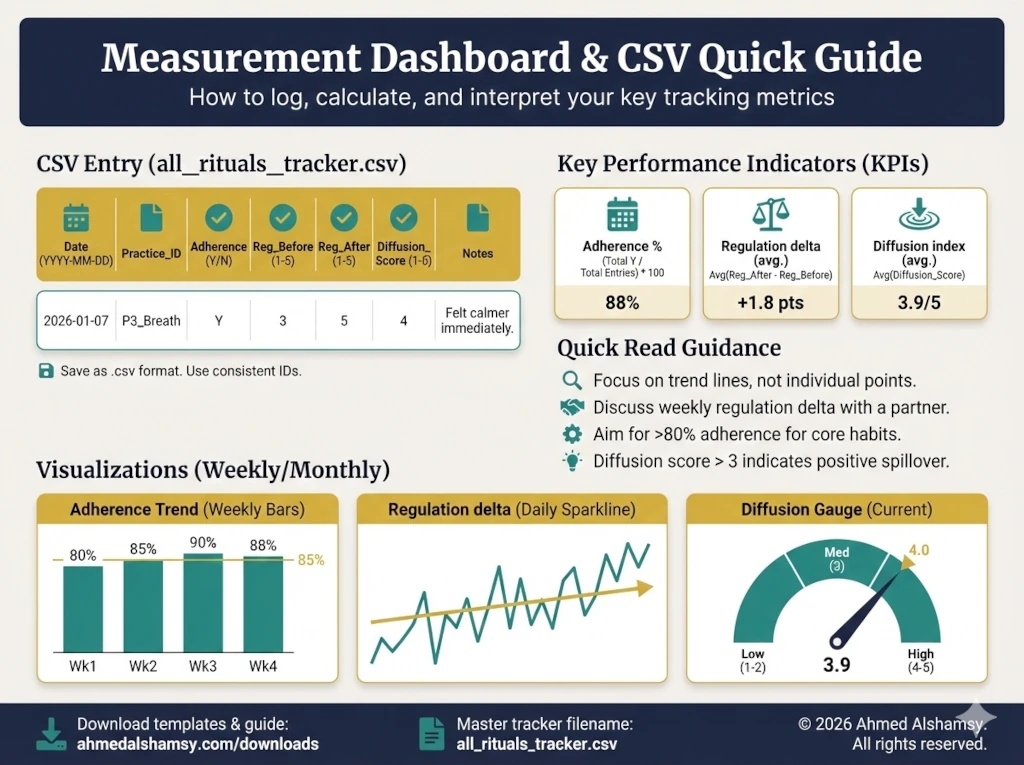
A simple pilot works best. Choose two spiritual resilience practices to adopt for a two-week pilot. Record baseline subjective regulation (1–10) and baseline completion frequency. For each day, log whether the ritual was completed and a one-line outcome. After two weeks compute mean changes and ask three pragmatic questions: Did the practice feel feasible? Did subjective regulation improve? Did social tone change?
Resilience Gap
The ‘Resilience Gap’ is the critical cognitive window between a cultural trigger and our behavioral response. In a contested culture, this gap is intentionally narrowed by rapid-fire stimuli designed to provoke immediate, reactive states. By utilizing these spiritual resilience practices, we artificially widen this window, allowing the Prefrontal Cortex to re-engage and the soul to choose a response aligned with Ihsan rather than impulse.
Your Resilience Gap: The Resilience Gap is the measurable distance between your current regulation baseline and your 30-day target state — the core progress metric of the AIM framework. Calculate it as:
Gap = Target score − Mean(pre_score across all logged sessions)
A closing Gap is the primary signal that the pilot is working. If your baseline pre_score is 4 and your target is 7, your starting Gap is 3. At 30 days, re-measure your mean pre_score; if it has risen to 5.5, your Gap has closed by 1.5 points. Use this single number in your weekly review to decide whether to continue, adjust, or substitute a practice.
For scaled measurement use the combined CSV to produce weekly summaries: percent days completed, mean pre/post scores, and short qualitative highlights. These spiritual resilience practices are intentionally minimal so that measurement burden remains low and signal-to-noise is high. Log all chosen spiritual resilience practices in the combined tracker to compare regulation deltas and adherence across rituals.
Group adaptation and diffusion
In teams or study circles, anonymize logs and focus on the percentage of participants completing rituals at least three days per week. Share one positive anecdote per week. Encouraging one peer to adopt a spiritual resilience practices ritual for a week increases the odds of durable adoption via social proof.
Leadership can model practices publicly (demonstration, not performance) and invite voluntary participation. For religiously diverse groups, frame the practices as shared attention methods and avoid doctrinal language; the label “spiritual resilience practices” communicates function rather than creed.
Common obstacles and troubleshooting
- Time: Compress to 60 seconds if needed; consistency is the key.
- Measurement fatigue: Use sampling (three days per week) for short pilots.
- Cultural fit: Replace gestures and phrases with locally appropriate variants.
- Resistance to tracking: Use binary completed/not-completed logs and brief notes.
Sample week schedule (practical)
Monday — Centered Breath Pause (morning), Intention Anchor (start of work).
Tuesday — Brief Metacognitive Check (evening), Micro-Charity Gesture (midday).
Wednesday — Reframing Pause (during conflicts), Protective Social Signal (enter meeting).
Thursday — Scripted Notation (before calls), Centered Breath Pause (midday).
Friday — Micro-Charity Gesture (community), Evening Reconciliation (night).
Weekend — Review tracker, adjust intentions, choose next week’s phrases.
This sample illustrates how spiritual resilience practices integrate without significant schedule disruption.
Glossary of Terms: Moral Systems Under Stress
What to Expect at 30 and 90 Days
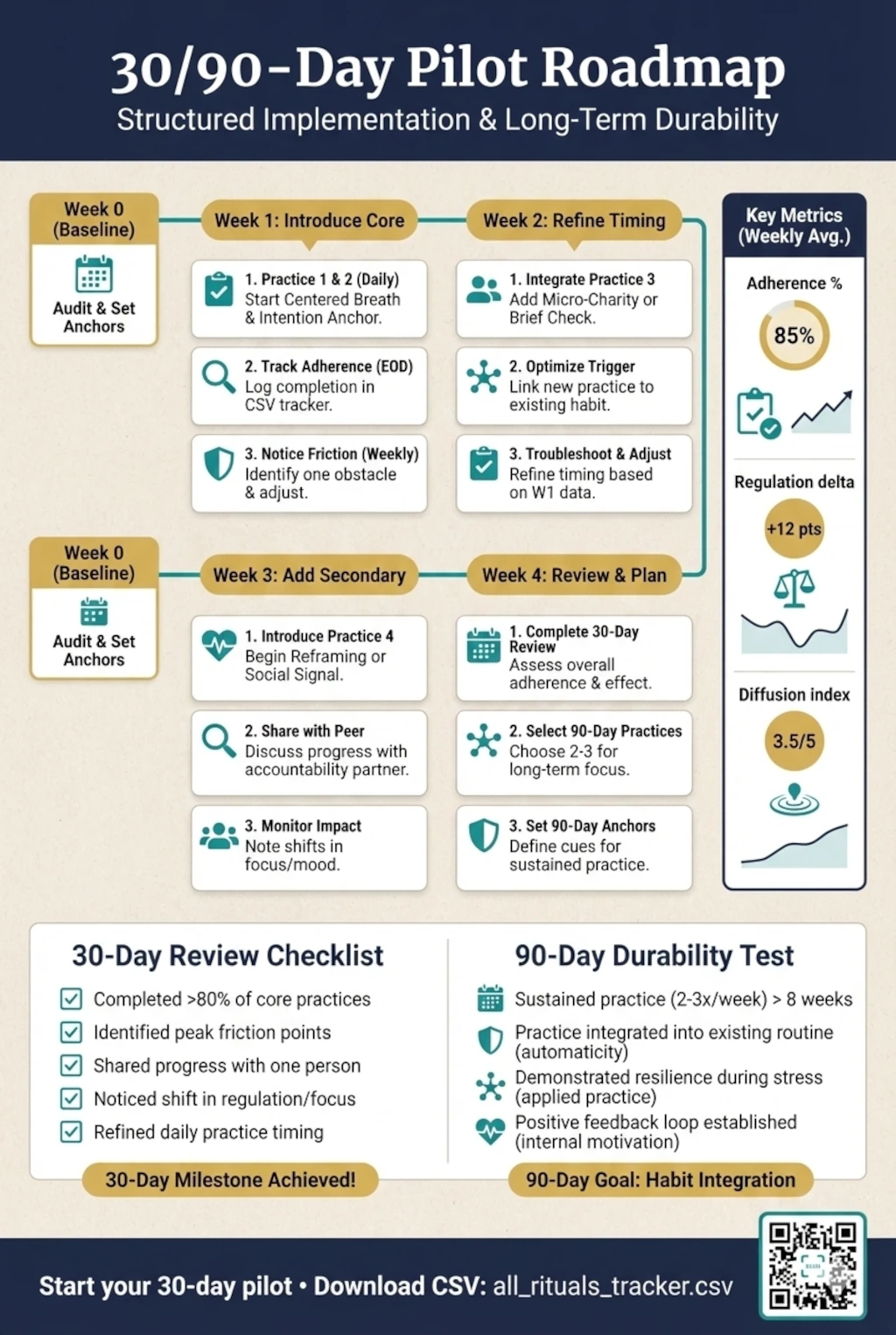
- 30 Days: Early physiological benefits (easier breath regulation, small calm increases) and the start of habit consolidation. Mean regulation delta +0.5 to +1.5.
- 90 Days: Greater automaticity and social diffusion. Durable adoption shows spontaneous practice without external cues. If no progress is visible by day 30, substitute one ritual.
Over time, this data-driven stability becomes especially valuable for readers Dealing with doubts in Islam, as it replaces abstract anxiety with observable patterns of regulation and recovery. During the 30-day pilot, treat these spiritual resilience practices as experiments—record fidelity, perceived alignment, and small behavioral outcomes.
Teaching the practices
Demonstrate each ritual in sixty seconds and have learners practice briefly. Use paired practice and immediate logging; encourage habit stacking (anchor to existing habits). Short demonstrations and peer practice increase the odds that the practices from the spiritual resilience practices set will be adopted.
Ethical considerations
Offer these practices as supportive routines for attention and regulation; they are not theological prescriptions. Religious language used here is inspirational and not prescriptive; adapt language to audience sensitivity when sharing in diverse groups.
Extended measurement notes
For teams wanting granular data, add a timestamped log of context variables: current physical state (rested/tired), social context (private/public), and a two-word trigger note. Aggregate weekly and visualize as a heatmap: days on the x-axis, rituals on the y-axis, and completion as colored tiles. Present three concise metrics to stakeholders: adherence percentage, mean change in regulation score, and a representative qualitative highlight. Keep reporting short to preserve participation.
Next Steps
Begin small and prioritize consistency. Track progress with the simplest metric that still informs change. If one ritual consistently fails to stick, replace it rather than abandoning the experiment. Over weeks small adjustments compound into meaningful shifts in attention, relational tone, and personal regulation. Keep the practice approachable and humane; the purpose is to sustain capacity for moral attention during sustained social stress.
Begin with two complementary rituals (Centered Breath Pause + Intention Anchor), run a 30-day pilot using the supplied CSV templates, and review weekly. Track adherence and regulation delta; adjust one ritual if adoption stalls. These spiritual resilience practices are small, testable interventions designed to protect moral attention; begin today and invite one trusted peer to try a week with you.
Limitations & Clinical Safeguards
These practices are preventative, not clinical treatments. For severe anxiety, panic, dissociation, or trauma-related symptoms, refer to licensed mental-health professionals. In group diffusion efforts, prioritize safety, confidentiality, and professional oversight.
Conclusion: Making Resilience Sustainable
The goal of these spiritual resilience practices is not to escape the world, but to be “in it but not of it.” By steadying our nervous systems and sharpening our moral attention, we become the “calm centers” that others can rely on. Start your 30-day pilot today, use the CSV templates, and reclaim your heart. Sustainable. Begin today; iterate kindly and steadily.
FAQs
1. What are spiritual resilience practices and how do they work?
Spiritual resilience practices are short, repeatable micro-rituals that combine simple neuroscience-based techniques (breath, attention cues, brief reflection) with spiritually-informed habits. They support autonomic regulation, strengthen attention networks, and create reliable cues for ethical behavior within a contested cultural environment. For readers approaching these practices from curiosity rather than conviction, beginning with Respectful Questions to Ask About Islam can provide a grounded, non-confrontational entry point.
2. Which two practices should I start with for fastest results?
Start with the Centered Breath Pause for immediate physiological regulation and the Intention Anchor to prime goal-directed attention. Together, these two practices lower reactive (whisperings) and make deliberate, moral choices significantly easier to execute.
3. How long before I see measurable benefits from these rituals?
Physiological benefits like calmer breath and small HRV improvements are often visible within days of starting the rituals. Consistent behavioral changes and neuroplastic habit consolidation typically appear across a window of 21–30 days when logged daily in the provided tracking files.
4. How do I measure whether the practices are working?
Track three simple metrics weekly: Adherence % (days completed ÷ days scheduled), Regulation delta (mean post_score − pre_score), and Diffusion index (peers adopted ÷ peers invited). Use the combined all_rituals_tracker.csv to compute these scores and identify which habits are yielding the highest spiritual return.
5. Can these practices help with anxiety and sleep problems?
Yes—practices like Centered Breath and Evening Reconciliation reduce nighttime rumination and support sleep-dependent emotional consolidation. However, while they are excellent for moral hygiene, they are supportive measures and not substitutes for clinical psychiatric care.
6. Are these practices tied to a particular religion?
The rituals are inspired by prophetic analogues but the behavioral and neuroscientific mechanisms like breathing, implementation intentions, and reflection are universal. They can be utilized by readers of any or no faith to reclaim their moral attention and mental clarity.
7. How do I run a 30-day pilot without getting overwhelmed?
Choose two complementary rituals, run them once daily, log pre/post scores, do a weekly review, and aim for ≥70% adherence. If progress stalls or the “friction” feels too high by day 30, simply substitute one ritual for another rather than abandoning the entire protocol.
8. What if I miss days—does it ruin the experiment?
No—log the misses, avoid perfectionism, and use the rule “never miss twice” to maintain momentum. Short, frequent practice and honest logging of your state are far more important for long-term resilience than maintaining a perfect, faked streak.
9. Can I do these rituals with my team or family?
Yes—protective social signals and micro-charity gestures are especially suitable for groups and shared environments. You can begin with a small, invited pilot and use the diffusion index to track how these sovereign habits spread through your immediate community.
10. Where can I download the CSV templates and infographic resources?
Download the CSV templates and infographic assets from the resources page linked in the post and use the all_rituals_tracker.csv as your combined log file. These tools are designed to move the reader from passive consumption to active, data-driven spiritual growth.

Ahmed Alshamsy
Ahmed Alshamsy serves as a Senior Teacher and Instructional Designer for the Ministry of Education and is the Principal Investigator of the Applied Islamic Methodology (AIM) Framework. His work focuses on translating classical Islamic insight into operational, empirical frameworks for modern cognitive development and ethical self-regulation.
References
- Lally, P., van Jaarsveld, C. H. M., Potts, H. W. W., & Wardle, J. (2010). How are habits formed: Modelling habit formation in the real world. European Journal of Social Psychology, 40(6), 998–1009. https://doi.org/10.1002/ejsp.674 ↩︎
- Porges, S. W. (2007). The polyvagal perspective. Biological Psychology, 74(2), 116–143. https://doi.org/10.1016/j.biopsycho.2006.06.009 ↩︎
- Tang, Y.-Y., Ma, Y., Wang, J., Fan, Y., Feng, S., Lu, Q., … & Posner, M. I. (2007). Short-term meditation training improves attention and self-regulation. Proceedings of the National Academy of Sciences, 104(43), 17152–17156. https://doi.org/10.1073/pnas.0707678104 ↩︎
- Lehrer, P. M., & Gevirtz, R. (2014). Heart rate variability biofeedback: How and why does it work? Frontiers in Psychology, 5, 756. https://doi.org/10.3389/fpsyg.2014.00756 ↩︎
- Song, H. S., & Lehrer, P. M. (2003). Effects of specific respiratory rates on heart rate and heart rate variability. Applied Psychophysiology and Biofeedback, 28(1), 13–23. https://doi.org/10.1023/A:1022312815649 ↩︎
- Gollwitzer, P. M. (1999). Implementation intentions: Strong effects of simple plans. American Psychologist, 54(7), 493–503. https://doi.org/10.1037/0003-066X.54.7.493 ↩︎
- Gollwitzer, P. M., & Sheeran, P. (2006). Implementation intentions and goal achievement: A meta-analysis of effects and processes. Advances in Experimental Social Psychology, 38, 69–119. https://doi.org/10.1016/S0065-2601(06)38002-1 ↩︎
- Ochsner, K. N., & Gross, J. J. (2005). The cognitive control of emotion. Trends in Cognitive Sciences, 9(5), 242–249. https://doi.org/10.1016/j.tics.2005.03.010 ↩︎
- Koole, S. L. (2009). The psychology of emotion regulation: An integrative review. Psychological Bulletin, 135(4), 638–671. https://doi.org/10.1080/02699930802619031 ↩︎
- Harbaugh, W. T., Mayr, U., & Burghart, D. R. (2007). Neural responses to taxation and voluntary giving reveal motives for charitable donations. Science, 316(5831), 1622–1625. https://doi.org/10.1126/science.1140738 ↩︎
- Kosfeld, M., Heinrichs, M., Zak, P. J., Fischbacher, U., & Fehr, E. (2005). Oxytocin increases trust in humans. Nature, 435(7042), 673–676. https://doi.org/10.1038/nature03701 ↩︎
- Hariri, A. R., & Dolan, R. J. (2012). Neural responses to social threat and reward. Annual Review of Psychology, 63, 23–48. https://doi.org/10.1186/2045-5380-2-19 ↩︎
- Tang, Y.-Y., Lu, Q., Geng, X., Stein, E. A., Yang, Y., & Posner, M. I. (2012). Short-term meditation induces white matter changes in the anterior cingulate. Proceedings of the National Academy of Sciences, 109(35), 13969–13973. https://doi.org/10.1073/pnas.1011043107 ↩︎
- Walker, M. P., & van der Helm, E. (2009). Overnight therapy? The role of sleep in emotional brain processing. Trends in Cognitive Sciences, 13(3), 129–138. https://doi.org/10.1016/j.tics.2009.01.006 ↩︎
- Emmons, R. A., & McCullough, M. E. (2003). Counting blessings versus burdens: An experimental investigation of gratitude and subjective well-being in daily life. Journal of Personality and Social Psychology, 84(2), 377–389. https://doi.org/10.1037/0022-3514.84.2.377 ↩︎
Members commit to a practice pair here — naming their baseline score, their target Resilience Gap, and their start date. This is your signed pilot record.
Discover more from Ahmed Alshamsy
Subscribe to get the latest posts sent to your email.