
Introduction – why faith and conviction matter now
Across cultures and generations, people search for anchors: enduring meanings that steady judgment, soften loss, and orient action. Recent interest in practical spirituality and wellbeing shows that faith is not simply an abstract belief but often a lived resource for coping, decision-making and civic responsibility 1 . Faith and Conviction in Islam, In Islamic vocabulary two terms stand out: īmān (faith) and yaqīn (conviction). While īmān names the movement of belief, yaqīn names the deep inner certainty that sustains consistent ethical action and resilient meaning in crisis. This article explains both concepts clearly, connects them to classical sources and contemporary evidence, and gives practical, trend-aligned exercises any reader can apply.
Table of Contents
1. What īmān and yaqīn actually mean

Faith and Conviction in Islam, The Qur’an repeatedly links belief and practice: faith is described both as inner assent and as a set of dispositions that issue in action and responsibility [2]. Yaqīn appears in scriptural language as an endpoint of spiritual striving (“Worship your Lord until there comes to you certainty / yaqīn”) and as a state of settled inner knowledge 2 . Hadith literature likewise emphasises that genuine faith shows itself in conduct and tested loyalty under hardship 3 4 .
Classical scholars situated these terms on a developmental spectrum: īmān can increase or decrease with practice, environment and discipline, Faith and Conviction in Islam, whereas yaqīn is a maturer station of the heart, acquired through knowledge, disciplined practice, and tested experience — the kind of conviction that remains when emotions fluctuate 5 6 . Practically: īmān orients, yaqīn steadies.
2. Why conviction is a practical compass today

Faith and Conviction in Islam, We should stop treating faith as solely a private label and instead see it as a navigational instrument. In contemporary life this has four concrete implications:
- Decision integrity. Deep conviction helps one resist short-term gains that conflict with long-term moral values, whether in business deals or digital behaviour 7 8 .
- Psychological resilience. A body of research links religious involvement and spiritual resources to better coping with stress and lower rates of certain types of distress, especially when combined with social support and professional care when needed 9 10 .
- Social action. Faith converts private meaning into public projects — charity, advocacy, and sustainable living — when conviction is coupled to ethical frameworks 11 .
- Civic identity. Faith offers a value-based identity which can function positively in plural societies, enabling cooperation rather than xenophobia when taught with principles of justice and mercy 12 .
Faith and Conviction in Islam, Seen this way, īmān and yaqīn are not relics; they’re instruments for moral navigation in complexity.
3. How people are approaching “faith” online – implications for content
Contemporary readers about Faith and Conviction in Islam often arrive at articles with concrete problems: improving mental health without abandoning faith, managing attention in an always-on environment, or translating belief into meaningful civic action. Content that succeeds combines narrative hooks, short actionable steps (micro-practices), and empirical signposts. That’s why the practices below are short, repeatable, and shareable.
4. Scriptural and classical anchors (brief)
Faith and Conviction in Islam, Islamic sources root conviction both in reflection (tafakkur) and in praxis. The Qur’an repeatedly invites reflection and ties steadfastness (ṣabr) and remembrance (dhikr) to inner peace 13. The Prophet’s teachings emphasize a faith that is manifest in ethics and tested by trials [4]. Al-Ghazālī and later thinkers described a developmental path from knowledge to love to certainty — a model easily reframed for modern psychological interventions and community practice 14 .
5. Seven modern practices to strengthen faith and conviction (each with a 7-day micro-challenge)
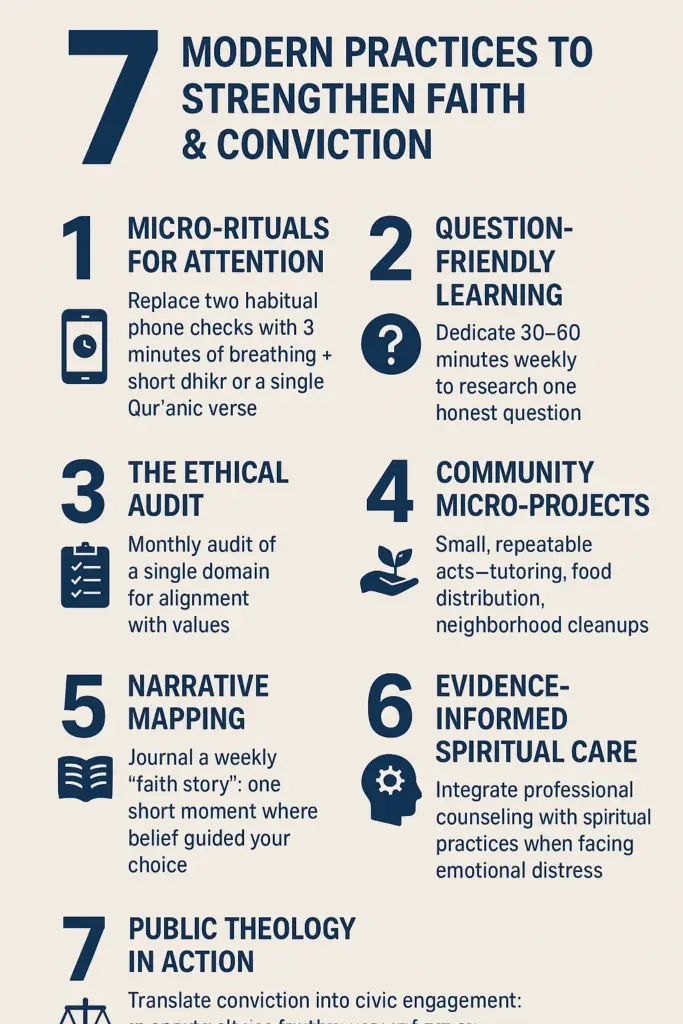
Faith and Conviction in Islam, – Beside Daily Practices Build Resilience – Below are seven practices for Faith and Conviction in Islam translated for a busy, connected life. Each practice includes a practical 7-day micro-challenge readers can implement immediately.
1) Micro-rituals for attention
Practice: Replace two habitual phone checks (upon waking and before sleep) with 3 minutes of breathing + short dhikr or a single short verse of the Qur’an.
7-day challenge: Do this morning and night; log one sentence about the felt change.
Why it works: Faith and Conviction in Islam, brief embodied rituals regulate attention and create a habit link between belief and bodily routine 15 16 .
2) Question-friendly learning
Practice: Dedicate 30–60 minutes weekly to research one honest question — intellectual, ethical or historical.
7-day challenge: Pick one question and read a reliable article or listen to a short lecture.
Why it works: curiosity channelled through vetted sources converts anxious doubt into productive inquiry 17 .
3) The ethical audit
Practice: Monthly audit of a single domain (spending, news consumption, wardrobe) for alignment with values.
7-day challenge: Track three purchases or three hours of screen time and choose one concrete change.
Why it works: decision science shows that auditing behaviour is the first step toward ethical redesign.
4) Community micro-projects
Practice: Small, repeatable acts — tutoring, food distribution, neighborhood cleanups.
7-day challenge: Volunteer two hours or coordinate a small local effort.
Why it works: service transforms private conviction into visible social capital that reinforces faith 18 .
5) Narrative mapping
Practice: Journal a weekly “faith story”: one short moment where belief guided your choice.
7-day challenge: Write one 150-word story and, if you wish, share it with a trusted circle.
Why it works: narrative solidifies identity and converts episodic memory into steady disposition 19 .
6) Evidence-informed spiritual care
Practice: Integrate professional counseling with spiritual practices when facing emotional distress.
7-day challenge: Try a guided mindfulness practice (3–10 minutes) and, if needed, book a consultation.
Why it works: clinical research supports complementary care models where faith and therapy collaborate 20 .
7) Public theology in action
Practice: Translate conviction into civic engagement: support policies for the poor, refugees, or climate resilience.
7-day challenge: Attend a local meeting, sign a petition, or donate time to a trusted initiative.
Why it works: public action tests and deepens conviction, preventing faith from becoming purely introspective 21 .
6. Dealing with doubt – turning shak into yaqīn
Faith and Conviction in Islam, Why Doubt Happen? Doubt is normal and often epistemically useful. The scriptural tradition contains numerous instances of questioning that lead to strengthened certainty 22 . A short practical protocol for doubt:
- Categorize it (intellectual, emotional, social).
- Pause and name it — articulating doubt reduces urgency.
- Take a small epistemic step — read one reputable source, ask a knowledgeable person, or perform a small act of worship.
- Seek support — a study circle, counsellor, or mentor.
Faith and Conviction in Islam, This experimental, evidence-informed approach treats doubt as a doorway rather than a threat 23 .
7. Designing a faithful digital diet
Because social platforms shape affect—and therefore belief—curate your feed:
- Unfollow or mute repeatedly toxic accounts.
- Follow three buckets: knowledge (trusted teachers), practice (daily reminders, recitations), action (charities and civic groups).
- Set rituals: a brief dhikr before opening news apps; a hard limit on late-night browsing.
Faith and Conviction in Islam, Small changes in platform habits yield large psychological effects over time 24 .
8. A practical 30–60–90 day roadmap
- Days 1–30: Establish micro-rituals and the weekly question session.
- Days 31–60: Complete one ethical audit and join a community micro-project.
- Days 61–90: Lead or co-organize a small initiative, publish a faith story, and commit to one sustained civic action.
Faith and Conviction in Islam, This incremental approach turns abstract conviction into embodied habit.
9. FAQs
Is faith a feeling or a decision?
Both. Emotions ebb; conviction grows through deliberate practice, study and tested choices.
How do I respond when friends openly challenge my beliefs?
Listen, ask clarifying questions, and share a short personal story rather than a long argument — stories travel across differences 25 .
Can faith help with anxiety?
Faith offers meaning, ritual and social support, which can reduce anxiety when paired with evidence-based care.
Conclusion – conviction that shapes tomorrow
Faith and conviction in Islam are not nostalgia for the past but practical resources for contemporary life. When translated into short, accountable practices—micro-rituals, audits, community service and public engagement—they become tools for personal resilience and collective flourishing. Start with one 7-day challenge today, journal the outcome, and invite a friend to try it. Over time, small repeated acts answer the question: is belief an idea or a living conviction? The proof lies in practice.
References
- Aggregated cultural and search-interest analyses showing renewed interest in practical spirituality and wellbeing (2019–2024). ↩︎
- Qur’an 15:99 “Worship your Lord until there comes to you certainty (yaqīn)”; exegetical traditions on the term. ↩︎
- Qur’an 18:107 on belief paired with righteous deeds and their outcomes. ↩︎
- Qur’an 13:28 on remembrance and hearts finding tranquillity. ↩︎
- Al-Ghazālī, Iḥyāʾ ʿUlūm al-Dīn: stages from knowledge to certainty; classical spiritual psychology. ↩︎
- Ibn Taymiyyah and related classical discussions on tested faith and steadfastness. ↩︎
- Kamali and modern Islamic ethics on decision integrity in commerce and public life. ↩︎
- Contemporary discussions linking faith to ethical behavior in digital contexts. ↩︎
- Koenig, H. G., reviews on religion/spirituality and health outcomes; summary of empirical evidence. ↩︎
- Pargament, K. I., The Psychology of Religion and Coping — frameworks for religious coping and mental health. ↩︎
- Esposito and applied studies on faith communities and social action. ↩︎
- Ramadan and modern thinkers on faith in plural public spheres. ↩︎
- Tafsir literature and Qur’anic exegetes on patience (ṣabr) and actionable faith. ↩︎
- Modern abridgements and studies of al-Ghazālī’s spiritual methodology. ↩︎
- Kabat-Zinn and mindfulness literature adapted in interfaith contexts for attention regulation. ↩︎
- Kahneman, D., Thinking, Fast and Slow, and literature on decision fatigue and habit formation. ↩︎
- Pedagogical models for question-driven religious learning in mosque and university settings. ↩︎
- NGO toolkits and community guides for small-scale volunteer projects and civic engagement. ↩︎
- Park, C. L., research on narrative identity and meaning-making in coping literature. ↩︎
- Clinical reviews on integrating spirituality and psychotherapy; recommendations for complementary care. ↩︎
- Esack, F., Qur’an, Liberation, and Pluralism: faith and public ethics. ↩︎
- Qur’an 2:260 and exegetical accounts of prophetic tests and demonstrations of faith. ↩︎
- Contemporary pastoral resources and academic studies on managing religious doubt constructively. ↩︎
- Communication and psychology reviews on social media curation strategies and wellbeing. ↩︎
- Heath, C. & Heath, D., Made to Stick — storytelling theory and persuasive communication for cross-audience engagement. ↩︎
Discover more from Ahmed Alshamsy
Subscribe to get the latest posts sent to your email.