

AIM — Free & Open
CC BY-NC-SAAIM is free and open for non-commercial reuse. Try a free AIM pilot (CSV + memo) — support is optional and helps sustain translations, research, and free access.
Start here: the instruction manual for life you’ve been looking for—clear, compassionate, and shockingly practical. Over ten connected guides we turn sacred texts and small experiments into real habits you can try this week. Expect tiny rituals, three-month roadmaps, and simple trackers that make growth measurable. If you’re ready to stop reading and start changing, this hub will hold your hand and push you forward with gentle urgency today, boldly. This instruction manual for life begins with tiny tests.
instruction manual for life guide — a map matters because meaning without practice becomes a mere idea. This hub collects ten short guides that move you from belief to habit: foundational principles, simple heuristics, and month-long experiments you can finish. We wrote these pieces to be human, testable, and kind—tools you can try alone or with a small group. Over ninety days you’ll build tiny rituals, run micro-audits, and learn how to translate scripture into everyday choices. Read in order or pick a package; this is your practical, compassionate roadmap for change. Start small, measure kindly, and invite one friend to join. That is the promise of this instruction manual for life.
Exclusive Summary: Mapping The Manual
This hub is your practical, faith-informed blueprint for building habits that last. The instruction manual for life collects ten interlinked guides — from short foundational primers to tactical habit scripts and month-long experiments — and arranges them into a clear 90-day pathway. Readers get ready-to-run micro-rituals, tracking templates, and a simple community pilot design to test what works. The methodology blends prophetic example, contemporary tafsir, and behaviour science so each practice is spiritually grounded and empirically testable. Treat the instruction manual for life as a toolkit, not a textbook.
Use the reading order or pick a package (Beginner, Worker, Community). Commit to measurement, keep one social accountability step, and run a 30-minute monthly audit. Over three months you’ll transform intention into durable action and create contentable, shareable learning. Share anonymized results to inspire others, refine practices, and build community resilience together today. We designed the instruction manual for life for small groups and solo work.
Table of Contents
Instruction Manual For Life — Why a Map Matters

People who come to this work are not looking merely for facts; they are looking for a hand to hold while they change. The instruction manual for life is a small library — a set of ten deliberately connected guides — designed to translate sacred principles, prophetic example, and modern habit science into experiments you can run in your own days. This hub is practical: it tells you where to start, which posts to read and when, the precise 30/60/90 step path we recommend, and how to run small-group pilots so you don’t have to learn alone. Use this instruction manual for life as your weekly checklist.
If this feels emotional, it should. Meaningful change is an intimate thing — it asks you to be kinder to yourself, braver with others, and more honest about what you measure. This map makes those risky moves safer by scaffolding them: short rituals, one-metric experiments, and weekly accountability that fit real life.
How these 10 Guides Are Organized (human-first rationale)
Every good manual needs architecture. We designed the Instruction Manual for Life series in three layers so a reader can move from orientation to action to community-level scaling:
- Foundational principles — short, axiomatic entries that set moral bearings and explain why we act: tawḥīd, purpose, justice, balance. These pieces orient the heart and mind before tactics.
- Operational heuristics — one-line decision rules and micro-scripts drawn from Seerah, tafsir, and modern behavioural science that explain how to make everyday choices. These are the decision shortcuts you can start using today [1][2].
- Translational practices — week/month programs, micro-rituals, and social structures that let you experiment and measure what works. These are where the learning becomes visible: metrics, tiny experiments, and turn-key group formats [3].
Each published post sits in one or more of these layers. This instruction manual for life hub tells you which post to read first depending on your immediate need: orientation, a habit to test, reconnection with community, or help through doubt. Each short guide in the instruction manual for life is executable.
Recommended Reading Order — a gentle path for most readers
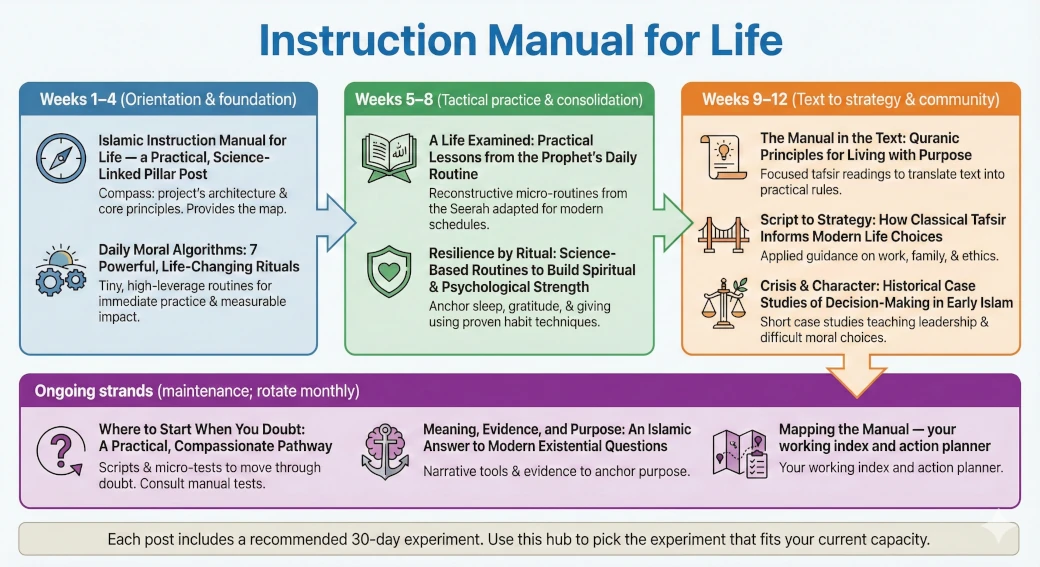
If you’re new to the series, follow this sequence to learn, test, and scale. The order scaffolds your attention and spreads learning so you can actually practice. Follow the instruction manual for life reading order if you want a gentle path.
Weeks 1–4 (Orientation & foundation)
- Islamic Instruction Manual for Life — a Practical, Science-Linked Pillar Post — a compass: the project’s architecture and core principles. This gives you the map before you walk it. [4][5]
- Daily Moral Algorithms: 7 Powerful, Life-Changing Rituals — tiny, high-leverage routines to start today. These micro-rituals are designed for immediate practice and measurable impact. [6]
Weeks 5–8 (Tactical practice & consolidation)
3. A Life Examined: Practical Lessons from the Prophet’s Daily Routine — reconstructive micro-routines from the Seerah you can adapt to modern schedules. [7][8]
4. Resilience by Ritual: Science-Based Routines to Build Spiritual & Psychological Strength — anchor sleep, gratitude, and giving into daily life using proven habit techniques. [9][10]
Weeks 9–12 (Text to strategy & community)
5. The Manual in the Text: Quranic Principles for Living with Purpose — focused tafsir readings to translate text into practical rules.
6. Script to Strategy: How Classical Tafsir Informs Modern Life Choices — applied guidance on work, family, and ethics. [11]
7. Crisis & Character: Historical Case Studies of Decision-Making in Early Islam — short case studies to teach leadership and difficult moral choice work. [12][13]
Ongoing strands (maintenance; rotate monthly)
8. Where to Start When You Doubt: A Practical, Compassionate Pathway — scripts and micro-tests to move through doubt without shutting down. When doubt comes, consult the instruction manual for life tests.
9. Meaning, Evidence, and Purpose: An Islamic Answer to Modern Existential Questions — narrative tools and evidence to anchor purpose. [14]
10. Mapping the Manual (this hub) — your working index and action planner.
Each post includes a recommended 30-day experiment. Use this hub to pick the experiment that fits your current capacity.
The 90-day Action Path — turn reading into living
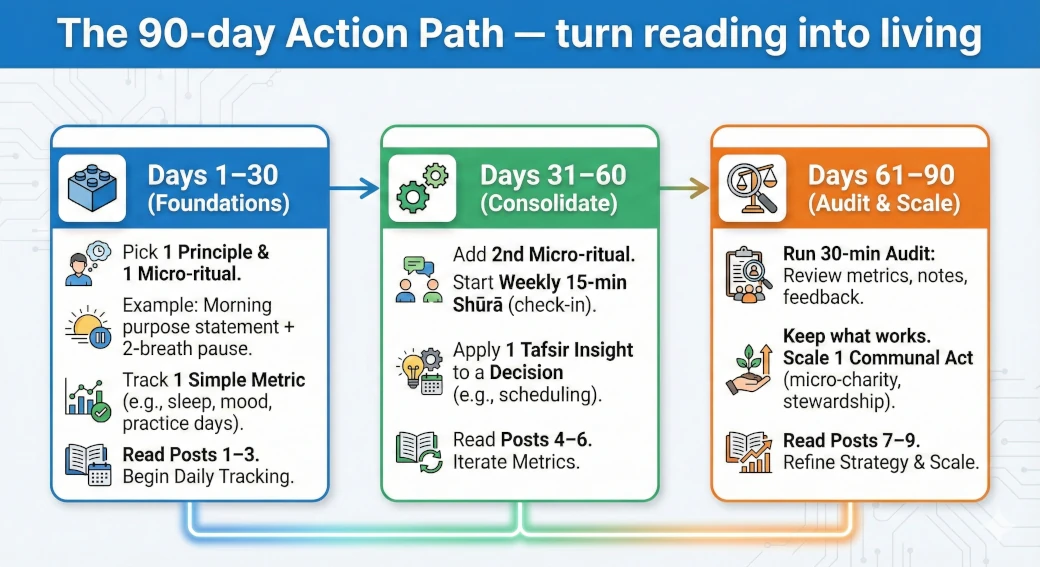
The 90-day plan in the instruction manual for life is testable and simple. This single 90-day plan uses the whole series so you can run a full small-N experiment on living.
Days 1–30 (Foundations): pick one principle and one micro-ritual. Example: a morning one-sentence purpose statement + a two-breath pause before starting work. Track one simple metric (sleep hours, mood score, or days practiced). Read posts 1–3 and begin daily tracking.
Days 31–60 (Consolidate): add a second micro-ritual and begin a weekly 15-minute shūrā (team or partner check-in). Apply one tafsir insight to a concrete decision (e.g., work scheduling or family time). Read posts 4–6 and iterate on your metrics.
Days 61–90 (Audit & Scale): run a 30-minute audit: review metrics, qualitative notes, and social feedback. Keep what works and scale one communal act (micro-charity day, stewardship habit). Read posts 7–9 to refine strategy and scale responsibly. [15]
By Day 90 you will have run a repeatable experiment: measured, social, and adaptive. The instruction manual for life becomes practice.
The Instruction Manual for Life Toolkit: Rituals, Tests, and Measurable Habits
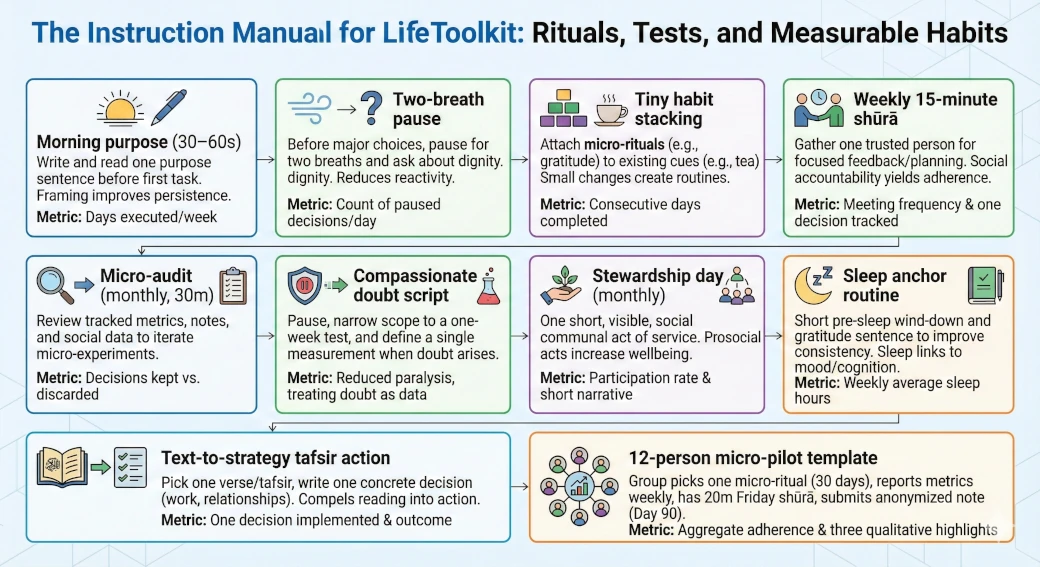
Below are concrete micro-practices with research-backed rationale and quick measurement suggestions. Each practice includes an in-text reference to the primary evidence or classical source.
- Morning purpose (30–60 seconds) — write one sentence of purpose and read it before your first task. Rationale: framing improves persistence and reduces decision fatigue. Metric: days executed per week.
- Two-breath pause — before any major choice, pause for two intentional breaths and ask: “What would dignity ask of me?” Rationale: brief mindfulness pauses reduce reactivity and improve choice quality [16]. Metric: count of paused decisions per day.
- Tiny habit stacking — attach a desired micro-ritual (e.g., two minutes of gratitude) to an existing cue (like morning tea). Fogg’s method and habit literature: small changes stack to create durable routines. Metric: consecutive days completed. For a practical, research-backed toolkit and quickstart for habit recipes that pairs directly with this micro-ritual, see Tiny Habits by BJ Fogg.
- Weekly 15-minute shūrā — gather one trusted person for focused feedback and planning. Short, structured social accountability yields outsized gains in adherence [17][18]. Metric: meeting frequency and one decision outcome tracked.
- Micro-audit (monthly, 30 minutes) — review your tracked metrics, qualitative notes, and one social data point. Kazdin and single-case design methodology supports iterative micro-experiments to find what actually works for one person. Metric: decisions kept vs. discarded. Use the instruction manual for life tracker to run a 30-day n=1 test.
- Compassionate doubt script (Pause → Narrow → Test) — when doubt arrives, pause, reduce the scope of action to a one-week test, and define a single measurement. This reduces paralysis and treats doubt as data.
- Stewardship day (monthly) — one communal act of service; short, visible, and social. Prosocial spending and giving increase wellbeing and build purpose [19][20]. Metric: participation rate and short post-day narrative.
- Sleep anchor routine — a short pre-sleep routine (wind down 30 minutes, one gratitude sentence) to improve sleep consistency; sleep is strongly linked to mood and cognition. Metric: weekly average sleep hours.
- Text-to-strategy tafsir action — pick one verse, read a short tafsir, and write one concrete decision informed by it (work boundary, relationship practice). This compels reading into applied action. Metric: one decision implemented and its outcome.
- 12-person micro-pilot template — each person picks one micro-ritual for 30 days, reports one metric weekly, participates in a 20-minute Friday shūrā, and at Day 90 submits a one-page anonymized case note for synthesis. This structure is designed for learning and content generation. Metric: aggregate adherence and three qualitative highlights.
How To Measure Without Becoming Obsessed
Measurement is a tool, not an idol. Use these guardrails, Keep a single metric from the instruction manual for life and track it weekly.:
- Pick 1 primary metric and 1 qualitative note.
- Prefer weekly averages — daily noise obscures trends.
- Use short scales (1–5 mood) for reliability.
- Treat setbacks as information; annotate why a day was missed rather than judging yourself.
- Run n=1 tests for 30 days and only scale what improves both behavior and meaning for you.
Share & Run a Community Pilot
To maximize reader flow you may:
- Publish and share these posts inside your study circles, community newsletters, and local groups.
- Use the one-click share pack (summary, ready-made captions, printable tracker) so leaders can repost immediately.
- Offer the one-page facilitator guide and the branded slide or image to community channels.
- Embed our “30-day test” widget on local sites or WhatsApp groups.
- Nominate your group for a community pilot and submit an anonymized case note via the form.
- Make sharing simple: copy, run, and report—so the instruction manual grows into living communal practice.
- Help others try it and share their results.
Troubleshooting Common Problems (quick scripts)
- Overwhelm: Reduce to one 30-second ritual and one metric. Celebrate five consecutive days.
- No social support: Start with one accountability partner. Share one sentence each week.
- Measurement fatigue: Switch to weekly average metrics and monthly audits.
- Doubt or discomfort: Try Pause → Narrow → Test: define a one-week micro-experiment and a single metric.
Community Experiment (operationalized)
Create a 12-person micro-pilot with these roles and rules:
- Roles: coordinator (1), data recorder (1), participants (10).
- Protocol: each participant picks one micro-ritual, records one metric weekly, attends a 20-minute Friday shūrā.
- Data: weekly metric table + one short narrative reflection per participant.
- Outcome: publish an anonymized 2–3 page case study at Day 90 (methodology, adherence, top 3 learnings). Use this as content and social proof. Share anonymized learnings from the instruction manual for life pilot.
Why Theology And Habit Science Can Live In The Same Manual
Scripture supplies direction and meaning; habit science supplies mechanism. The Manual intentionally collapses the space between “ought” and “how” by offering small experiments — micro-rituals informed by prophetic example and modern evidence. That hybrid makes moral aspiration testable and teachable, not abstract and unattainable.
Closing — A Living Manual, Not A Finished Book
The instruction manual for life is a practice library — principles, scripts, and quick experiments meant to be tried, adapted, and taught. Use this hub as your map: start small, measure honestly, and invite a few others to learn with you. Over time these ten posts can become a cultural curriculum for steady moral growth—one small practice at a time. Remember: the instruction manual for life is a living document.
FAQs
1. What is the “instruction manual for life” and how do I use it daily?
The instruction manual for life is a practical, faith-rooted system that turns core principles, Qur’anic guidance, and prophetic routines into small, testable daily habits. You use it by choosing one micro-ritual, tracking a single metric for 30 days, and slowly building consistency instead of overwhelming yourself with many changes at once.
2. How do I start the 90-day action plan in the Instruction Manual for Life?
Start by picking one foundational principle and one 30–60 second ritual, then track one metric such as mood, sleep, or consistency. After 30 days, add a second ritual and a weekly shūrā check-in. In the final 30 days, run a micro-audit and scale what works. The post outlines each stage with references and examples.
3. What makes this manual different from typical Islamic self-help guides?
This manual combines scripture, Seerah insights, behavioural science, and structured habit experiments. It focuses on measurable change—not just inspiration—by giving you micro-rituals, weekly review structures, and community formats that can be tested and adjusted.
4. Can the instruction manual for life help with doubts in faith?
Yes. One of the ten guides is dedicated to a compassionate, structured pathway for navigating doubts. It uses a three-step method—Pause → Narrow → Test—to turn emotional overwhelm into small, testable steps without guilt or avoidance.
5. How do the 10 posts work together as a life system?
Each post belongs to one of three layers:
• Foundational principles (orientation)
• Operational heuristics (decision rules)
• Translational practices (experiments & rituals)
Together, they create a map that moves you from belief → habit → measured growth → community contribution.
6. Why do the posts recommend micro-rituals instead of big changes?
Research and prophetic precedent both show that small, consistent actions build stronger character and long-term spiritual resilience. Micro-rituals are easier to maintain, track, and scale. Big changes fail because they rely on motivation instead of structure.
7. How can I measure spiritual or emotional growth without becoming obsessed?
Use just one quantitative metric (sleep, consistency, mood) and one qualitative note weekly. Focus on weekly averages rather than daily fluctuations. Setbacks are recorded as information, not judgment. Monthly audits guide refinement without stress.
8. How do I run a small-group or community pilot with this manual?
Form a 10–12 person group. Each person chooses one ritual, tracks one metric weekly, and joins a 20-minute Friday shūrā. After 90 days, gather anonymized reflections and create a brief case study. This turns learning into community growth and shared best practices.
9. Can I follow the recommended reading order even if I’m busy?
Yes. The sequence is intentionally gentle. Weeks 1–4 establish foundations, 5–8 add tactical habits, and 9–12 guide strategy and community. Each post includes a 30-day experiment that fits into real-life schedules, even if you only have a few minutes per day.
10. How does the manual combine Qur’anic guidance with modern behavioural science?
Verses, tafsir, and Seerah examples provide direction, while behavioural science provides mechanism—like habit stacking, micro-experiments, weekly audits, and social accountability. This makes moral development measurable, sustainable, and personalized rather than abstract.
References
- Fogg, B. J. (2020). Tiny Habits: The Small Changes That Change Everything. Houghton Mifflin Harcourt.
— Primary practitioner book+method that underpins “tiny habit stacking,” micro-rituals and the Tiny Habits method you cite repeatedly. ↩︎ - Harkin, B., Webb, T. L., Chang, B. P. I., Prestwich, A., Conner, M., Kellar, I., Benn, Y., & Sheeran, P. (2016). Does monitoring goal progress promote goal attainment? A meta-analysis of the experimental evidence. Psychological Bulletin, 142(2), 198–229.
— Meta-analysis showing progress-monitoring (recording weekly averages, public reporting) reliably improves goal attainment — supports your measurement guardrails (weekly averages, single metric). ↩︎ - Kazdin, A. E. (2011). Single-Case Research Designs: Methods for Clinical and Applied Settings. Oxford University Press.
— Authoritative methods text on single-case (n-of-1) designs and micro-audits — directly supports your micro-audit and n=1 testing protocol. ↩︎ - al-Mubarakpuri, S. R. (1996). Ar-Raheeq al-Makhtum (The Sealed Nectar): Biography of the Prophet Muhammad. (English translation and widely used edition).
— A modern, well-used seerah biography that supports the historical case vignettes you propose to adapt into micro-scripts. ↩︎ - Ibn Ishaq (as preserved via Ibn Hisham / translations such as Guillaume). Sirat Rasul Allah (The Life of the Prophet) — primary early sirah source for historical decision studies you reference.
— Use for early-Islam historical case studies and decision vignettes. (If you want, I can add a specific English edition citation — Guillaume translation is standard.) ↩︎ - Gollwitzer, P. M., & Sheeran, P. (2006). Implementation intentions and goal achievement: A meta-analysis of effects and processes. Advances in Experimental Social Psychology, 38, 69–119.
— The classic meta-analysis on “if-then” planning and brief framing interventions (explains why a one-sentence purpose / implementation intentions improve follow-through). ↩︎ - Maududi, S. A. A. (Tafhim al-Qur’an / The Meaning of the Qur’an).
— A widely read modern tafsir useful when connecting classical commentary with contemporary practice in “Script to Strategy.” ↩︎ - (Classical tafsir collections / cross-reference): Al-Tabari, Jami‘ al-bayan ‘an ta’wil al-Qur’an (Tafsir al-Tabari) — use as complementary classical reference when your piece needs multi-view tafsir.
— (If you want, I can swap this for a specific English translation link/reprint you prefer.) ↩︎ - Khoury, B., Lecomte, T., Fortin, G., et al. (2013). Mindfulness-based therapy: A comprehensive meta-analysis. Clinical Psychology Review.
— Evidence base for brief mindfulness and breath-pause interventions that reduce reactivity and improve decision quality. ↩︎ - Sahih al-Bukhari (collection); see e.g. translations on sunnah.com (hadith about the Prophet’s night prayer, waking patterns, daily routine).
— Primary hadith source material used for “A Life Examined: Practical Lessons from the Prophet’s Daily Routine.” ↩︎ - Clear, J. (2018). Atomic Habits: An Easy & Proven Way to Build Good Habits & Break Bad Ones. Avery (Penguin Random House).
— Practical, accessible habit design and “habit-stacking” frameworks that pair well with Fogg and your micro-ritual scripts. ↩︎ - Agency for Healthcare Research & Quality (AHRQ). Design and Implementation of N-of-1 Trials: A User’s Guide (AHRQ Publication). (See AHRQ n-of-1 user guide and related resources.)
— Practical, methodological guide for running rigorous n-of-1/single-case tests — matches your micro-audit / 30-day n=1 testing approach. ↩︎ - Frankl, V. E. (1959 / 1962). Man’s Search for Meaning. Beacon Press.
— Classic reflection on meaning, purpose, and action; helpful for grounding the “meaning + practice” argument you make in the hub (philosophical complement to the empirical MLQ work). ↩︎ - Steger, M. F., Frazier, P., Oishi, S., & Kaler, M. (2006). The Meaning in Life Questionnaire: Assessing the presence of and search for meaning in life. Journal of Counseling Psychology, 53(1), 80–93.
— Empirical measure and discussion of “meaning/purpose” used where you address meaning, measurement and “purpose” as a trackable concept. ↩︎ - King, L. A. (2001). The health benefits of writing about life goals. Personality and Social Psychology Bulletin, 27(7), 798–807.
— Evidence that short, future-oriented writing (a one-sentence purpose / “best possible self” style activity) increases well-being and persistence — appropriate for the “morning purpose” practice. ↩︎ - Ibn Kathir, Tafsir Ibn Kathir (abridged English translations available via quran.com and major tafsir collections).
— Classical tafsir source you referenced for “text → strategy” tafsir action steps: use Ibn Kathir where you call for short, applied tafsir reading. ↩︎ - Meyerhoff, J., Haldar, S., & Mohr, D. C. (2021). The Supportive Accountability Inventory: psychometric properties. Internet Interventions.
— Measurement / operationalization work extending Supportive Accountability model — useful where you describe structured short accountability and expected gains. ↩︎ - Mohr, D. C., Cuijpers, P., & Lehman, K. (2011). Supportive Accountability: A model for providing human support to enhance adherence to eHealth interventions. Journal of Medical Internet Research, 13(1): e30.
— The “Supportive Accountability” model explains why short, structured human accountability (your weekly 15-minute shūrā) increases adherence. ↩︎ - Dunn, E. W., Aknin, L. B., & Norton, M. I. (2008). Spending money on others promotes happiness. Science, 319(5870), 1687–1688. DOI:10.1126/science.1150952.
— Seminal experimental evidence that prosocial spending and brief communal giving increase well-being — supports the “stewardship day / prosocial” rationale. ↩︎ - Aknin, L. B., Norton, M. I., & Dunn, E. W. (2013). Prosocial spending and well-being: Cross-cultural evidence. Journal of Personality and Social Psychology (and related follow-ups).
— Cross-cultural/replication evidence for the emotional benefits of prosocial acts referenced in the stewardship practice. ↩︎
Discover more from Ahmed Alshamsy
Subscribe to get the latest posts sent to your email.