
Doubt is not the enemy of faith—but when manipulated, it becomes one of its most effective saboteurs. This post examines how sincere questioning can quietly mutate into destructive cynicism, not by accident, but by design. As part of the Through Iblis’s Eyes series, published under the tag Iblis’s Strategies, this essay dissects doubt as a psychological and moral system—revealing how clarity is lost, and how it can be deliberately reclaimed.
From Skepticism to Cynicism: Navigating the Path From Doubt to Clarity
Doubt is not a sign of failure; it is a diagnostic signal of a living mind. It emerges when there is a misalignment between our core beliefs and our observed reality. In the essential journey from doubt to clarity, the initial hurdle is often not the question itself, but the social and psychological environment in which it is raised. When questions are met with hostility or silencing, the natural curiosity of the mind does not disappear—it calcifies into cynicism. Practicing simple, everyday checks turns that fragile moment into a routine movement from doubt to clarity.
Exclusive Summary: From Doubt to Clarity: How Questions Are Turned Against the Questioner
This article argues that doubt is a neutral cognitive stance; what determines its outcome is the system that governs it. Drawing from theology, behavioral science, and cultural analysis, the post traces how healthy skepticism is gradually redirected into cynicism through narrative framing, social reinforcement, and unresolved moral tension. Read through the analytical lens of Through Iblis’s Eyes, doubt is shown not as a flaw to be eliminated, but as a lever to be misused.
The post supplies concrete micro-practices and community experiments for coping with doubt in Islam, not to eliminate questioning but to make it generative. The essay then reconstructs an alternative pathway—one that preserves intellectual honesty while preventing collapse into disengagement, irony, or nihilism. The result is a practical, ethically grounded model for moving from doubt to clarity without surrendering either reason or conscience.
Table of Contents
The Anatomy of a Question
Doubt is often accompanied by a subtle emotional undercurrent—frustration, anxiety, or mild despair—that quietly shapes perception. In modern life, these undercurrents are amplified by social isolation and the constant barrage of information. When left unattended, the natural question “Is this true?” can mutate into “Nothing can be trusted,” creating silent cynicism. This is not a failure of intellect but a misdirection of natural cognitive vigilance. Understanding this psychological drift is critical: by mapping the emotional trajectory alongside intellectual inquiry, we can recognize the early signs of cynicism and intentionally guide doubt toward clarity.
The transition from a healthy seeker to a hardened cynic is often quiet and incremental. It begins with micro-withdrawals from community life. Yet, the spiritual toll is immense.
As the Qur’an reminds us:
This is echoed in the prophetic tradition where the Prophet ﷺ said:
“Allah the Almighty says: ‘I am as My servant thinks I am… and if he draws near to Me a hand’s span, I draw near to him an arm’s length'”
Sahih al-Bukhari, (The Book of Monotheism, Hadith Number 7405)
Doubt carries a quietly corrosive affect as well as an intellectual question. Alongside curiosity it often brings a residuum of unease—a low-level anxiety, a sharpening of suspicion, a reluctance to trust evidence that once sufficed. When these feelings compound in isolation, they produce what I call silent cynicism: a steady re-framing of ordinary uncertainties into generalized distrust.
That drift turns the private, productive movement from doubt to clarity into a default posture of dismissal. Recognizing the emotional signature of this shift is practical: it lets us spot the moment when a question stops functioning as inquiry and begins functioning as defense. Treating doubt as a signal—one that admits mapping, experiment, and small social repair—moves us back toward method and away from the slow drain of cynicism. This piece is a practical guide for moving from doubt to clarity in daily life. Learning to steer questions intentionally is the core skill that converts doubt to clarity over time.
The Neurobiology of the “Iblisian Cycle”
When we speak of “Silent Cynicism” through Iblis’s eyes, we are describing a biological state of Hyper-vigilance. From a neurobiological perspective, the “Whisper” (Waswasa) often manifests as a chronic activation of the Sympathetic Nervous System. When a believer encounters a distressing doubt, the Amygdala signals a “threat” to one’s social and cosmic identity.
Iblis’s strategy is not to answer the question, but to keep the individual in this state of high arousal. In this state, the Ventromedial Prefrontal Cortex (vmPFC)—the area responsible for nuanced moral judgment and spiritual connection—goes offline. The result is “Cognitive Tunneling,” where the individual can only see evidence that confirms their fear. Reclaiming clarity, therefore, is not just an intellectual task; it is a physiological “reset” that allows the heart to beat in a state of safety (Sakina) before it attempts to reason.
When Doubt Is Hijacked — And How to Take It Back
Cultural narratives and cognitive biases can convert earnest skepticism into corrosive cynicism. Below are eight compassionate, actionable steps — scripts, neurobiological justifications, and micro-practices — designed to restore disciplined inquiry and rebuild trust.
This article explores how cultural narratives and cognitive biases convert earnest skepticism into corrosive cynicism. It provides eight compassionate, actionable steps—complete with scripts, neurobiological justifications, and micro-practices—plus community experiments to guide you from doubt to clarity. Use this toolbox to steward your questions into clearer inquiry and rebuild trust through small, testable acts.
This tradition suggests that the proximity of truth is a responsive process; the move toward inquiry is met with a move toward guidance. It is important to clarify that doubt itself is morally neutral; it is a cognitive state of suspension. It is the intention (niyya) behind the doubt—whether it seeks to find truth or merely to justify withdrawal—that proves decisive in the journey.
Classical Foundations: Systematic Doubt in Islamic Thought
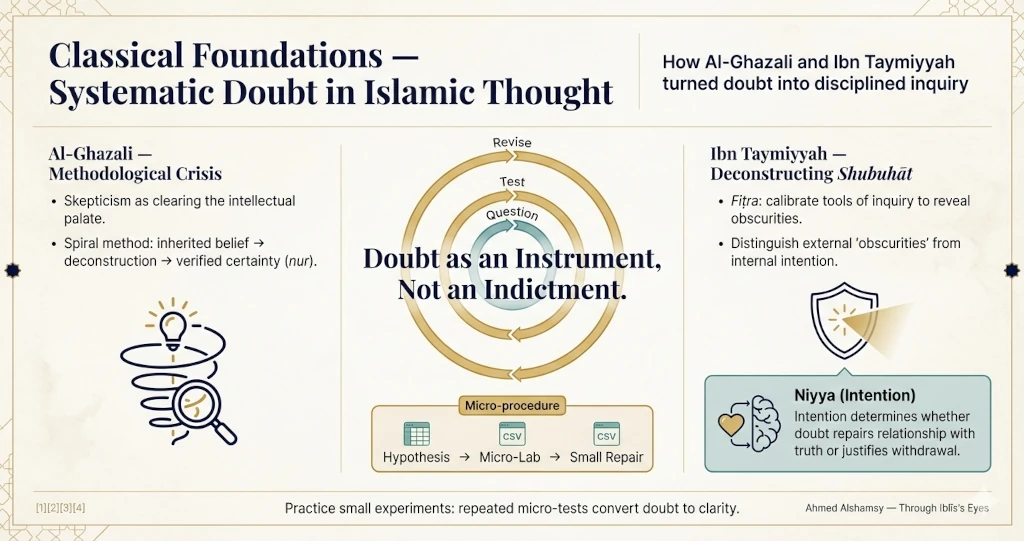
To understand the modern path from doubt to clarity, we must look back at those who treated doubt as a rigorous discipline.
Al-Ghazali’s Methodological Crisis
In The Deliverance from Error, Al-Ghazali described skepticism not as a lack of faith, but as a necessary clearing of the intellectual palate. He noted that “he who does not doubt does not look, and he who does not look does not see.” For Al-Ghazali, the path was a spiral—moving from inherited belief through systematic deconstruction to a “light” (nur) of verified certainty [1][2]. Read this as less abstract argument and more as an islamic instruction manual for living — a set of procedures for testing, repairing, and restoring conviction.
Ibn Taymiyyah and the Deconstruction of Shubuhāt
Ibn Taymiyyah approached the problem through fitra (the primordial disposition). He argued that many doubts (shubuhāt) are external “obscurities” introduced by faulty logic or social pressure. He taught that truth is robust enough to withstand scrutiny, provided the tools of inquiry are calibrated correctly [3][4].
Classical scholars therefore distinguished between sincere doubt that seeks illumination and willful disputation (mirāʾ, jidāl) that seeks only to evade obligation; the former is a stage on the path to certainty, while the latter is a moral posture that corrodes both intellect and character. The classical curriculum trains students to transform initial puzzlement into doubt to clarity through disciplined testing.
Classical thinkers gave us procedural responses to intellectual crisis because they understood doubt as instrument rather than indictment. Think of doubt as a navigational instrument: well-calibrated, it points toward a destination; misread or weaponized, it spins the traveler in circles. The corrective is not zeal but method—an iterative procedure of hypothesis, test, and revision. The classical habit of testing claims is a direct path from doubt to clarity when practiced systematically.
This distinction between sincere doubt and willful disputation hinges on niyya (intention). In Islamic epistemology, intention is the ‘spirit of action’; therefore, a seeker’s journey from doubt to clarity is not determined by the complexity of their questions, but by whether their internal aim is to restore a relationship with truth or to justify a withdrawal from accountability. This mirrors the neurobiological requirement of ‘goal pursuit,’ where a high-valence objective—such as seeking Divine closeness—allows the prefrontal cortex to override the autonomic impulse to freeze or shutdown.
When students of the tradition employed doubt responsibly, they practiced a disciplined circuit that turned bewilderment into disciplined inquiry. That same circuitry applies today: the path from doubt to clarity is built of repeated small corrections—questions asked, modest tests run, judgments revised—rather than grand renunciations or permanent disbelief.
Reclaiming that iterative habit is the single most reliable way to make doubt serve clarity rather than erode it. Small experiments—run repeatedly—are the workmanship of moving from doubt to clarity in institutional and personal life, Seeing doubt as an instrument, not an indictment, helps novices step toward doubt to clarity rather than away from it.
The Ethics of Disputation
Classical Islamic pedagogy utilized the Adab al-Bahth wa al-Munadhara (The Protocol of Research and Disputation) as a safeguard against cynicism. This system demanded that before a student could disagree with a position, they had to restate the opponent’s position so clearly that the opponent would say, “I could not have said it better myself.”
This practice serves two functions:
- Intellectual Honesty: It prevents the “Strawman” fallacy, which is a favorite tool of the cynical mind.
- Ego Deconstruction: It forces the seeker to step outside their “Identity Entanglement” (Step 5), making the journey from doubt to clarity a pursuit of truth (Haqq) rather than a pursuit of victory (Ghalaba).
Clarifying the Terms: Healthy Skepticism vs. Cynicism
Healthy Skepticism: The Procedural Stance
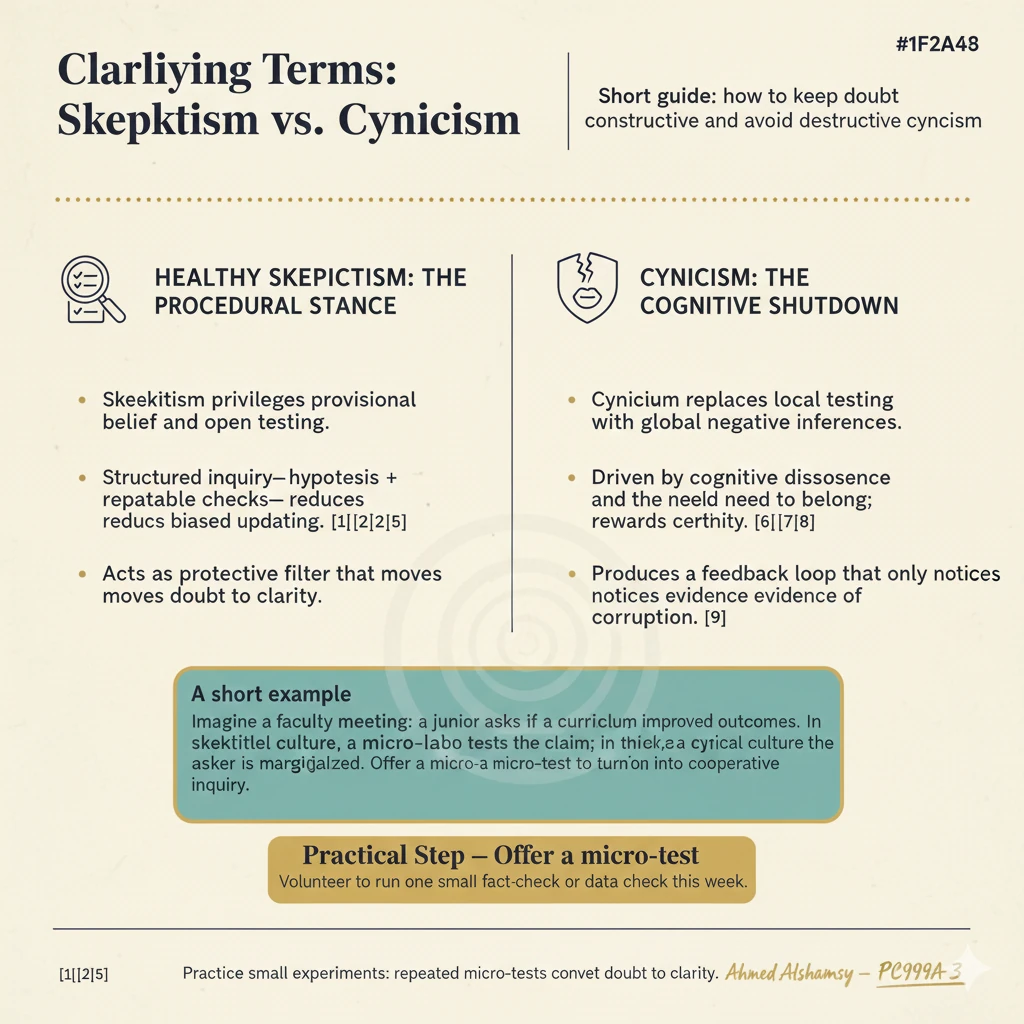
Skepticism is a disciplined stance that privileges provisional belief and open testing. Cognitive science demonstrates that structured inquiry—using clear hypotheses and repeatable checks—reduces “biased updating” and improves learning outcomes [1][2][5]. In the journey from doubt to clarity, skepticism acts as a protective filter.
Cynicism: The Cognitive Shutdown
Cynicism is a protective policy. It replaces local testing with global negative inferences. Driven by “cognitive dissonance” and the deep “need to belong,” cynicism feels safer because it eliminates the vulnerability of being betrayed again [6][7][8]. However, this “performative certainty” creates a feedback loop where the individual only notices evidence of corruption [9].
A short vignette clarifies the contrast. Imagine a faculty meeting where a junior member asks whether a curriculum review actually improved student outcomes. In a culture of healthy skepticism, the question triggers a concise investigation—data reviewed, a short micro-lab convened, and a small policy tweak enacted. In cultures that invite testing, the habitual aim is to steer questions toward doubt to clarity, not to silence the questioner.
In a cynical environment, the same question becomes evidence of institutional decay, the asker is marginalized, and subsequent silence replaces curiosity. When a team treats questions as invitations to move from doubt to clarity, organizational culture shifts quickly.
The procedural difference is small but decisive: the first route converts doubt to clarity; the second converts doubt into identity and withdrawal. For readers, the practical step is simple—when you raise a question, offer a micro-test or volunteer to run the data check. That transforms the act of questioning into an invitation to clarity rather than a signal of rebellion. The tactical habit of offering a micro-test converts many confrontations into cooperative journeys from doubt to clarity.
Theological vs. Behavioral Mapping
The Architecture of Resilience: Mapping Theological Frameworks to Behavioral Outcomes
| Theological / Doctrinal Framing | Behavioral Pattern Under Stress | Practical Micro-Intervention |
|---|---|---|
|
Absolute Moral Certitude: “We alone hold the truth.” | Boundary closure, public shaming, and exclusion of dissent. | Introduce “provisional language drills” and paired curiosity sessions. [5] |
| Scriptural Literalism in Institutional Critique: | Quick delegitimization of entire institutions based on partial errors. | Separate empirical claims from moral claims; run focused “micro-labs.” [20][13] |
| Emphasis on Exemplars as Final Authority: | Avoidance of institutional repair; fear that critique equals “fitna.” | Execute “micro-trust acts” in low-risk governance roles. [16][17] |
|
Theology of Suffering as Proof of Corruption: “Everything is broken.” | Withdrawal and moral defeatism. | Structured debriefs and pastoral/clinical referral for trauma. [21] |
| Fate (Qadar) as Passivity: | Learned helplessness; refusing to act for change. | Focus on “The Circle of Control” and micro-agency experiments. [17] |
Glossary: Moral Systems Under Stress
Glossary of Terms: Navigating Moral Systems Under Stress
The psychological tendency to treat a single negative event as global, irreversible proof that an entire system or institution is irredeemable. [20]
The outward display of absolute confidence used to secure social status or community belonging, while internally suppressing unresolved doubt or cognitive dissonance. [9]
The disciplined practice of assigning trust in specific degrees based on verified interactions and evidence, rather than relying on emotional binaries (all-or-nothing trust). [16][17]
A cognitive stance where one acts decisively on a premise while remaining consciously open to new, corrective data that may alter that premise. [17]
Social or digital mechanisms (such as algorithmic echo chambers) that intensify shared judgments and filter out corrective or nuanced information. [24]
How Cultural Narratives Fuel the Drift
Cynicism is manufactured by the logic of modern attention economies. These mechanisms are not accidental but follow a recognizable cultural persuasion framework that converts emotional salience into moral certainty while bypassing disciplined inquiry.
- Heuristic Amplification: Cultural scripts compress complex events into short moral “heuristics,” biasing global judgments [1][7]. For the empirical foundation of how heuristics drive judgement under uncertainty, see Tversky & Kahneman’s classic study Judgment under Uncertainty: Heuristics and Biases (Science, 1974).
- Rewards for Certainty: Platform incentives reward “hot takes” with social status, preventing the slow work of moving from doubt to clarity [8][9].
- Algorithmic Narrowing: Filter bubbles act as “Network Hardeners,” making extreme narratives feel normative [10][11][12].
- Network Contagion: The decline in physical civic ties means suspicions are confirmed within insulated digital circles [13].
Modern attention economies accelerate the conversion of curiosity into cynicism unless countermeasures are adopted. Algorithms favor high affect, short resolution, and moral absolutism; they reward certainty because certainty is clickable. To keep doubt operating as a path from doubt to clarity, readers need a digital hygiene toolkit: diversify feeds intentionally (three reputable sources from different epistemic domains for each contested claim), time-box social media consumption to protect deliberative bandwidth, and annotate suspicious claims with one-line provenance notes before sharing. Digital discernment practices are practical tools for turning online doubt to clarity rather than amplifying it. Adopting a routine of micro-audits helps convert online noise into practical moves from doubt to clarity.
Adopt a “micro-audit” habit: before you amplify any outrage, spend twenty minutes tracing its origin; if the claim fails two provenance checks, archive the curiosity for later rather than amplifying it. These small practices reconfigure our environment so that doubt remains productive rather than performative, and they return agency to the individual who wants to move from doubt to clarity in an era engineered for rage. A deliberate source-diversification routine stabilizes attention and short-circuits the slide from doubt to clarity into cynicism. If your feed is engineered for outrage, adopt micro-audits that reorient attention toward doubt to clarity habits.
Eight Compassionate Steps from Doubt to Clarity
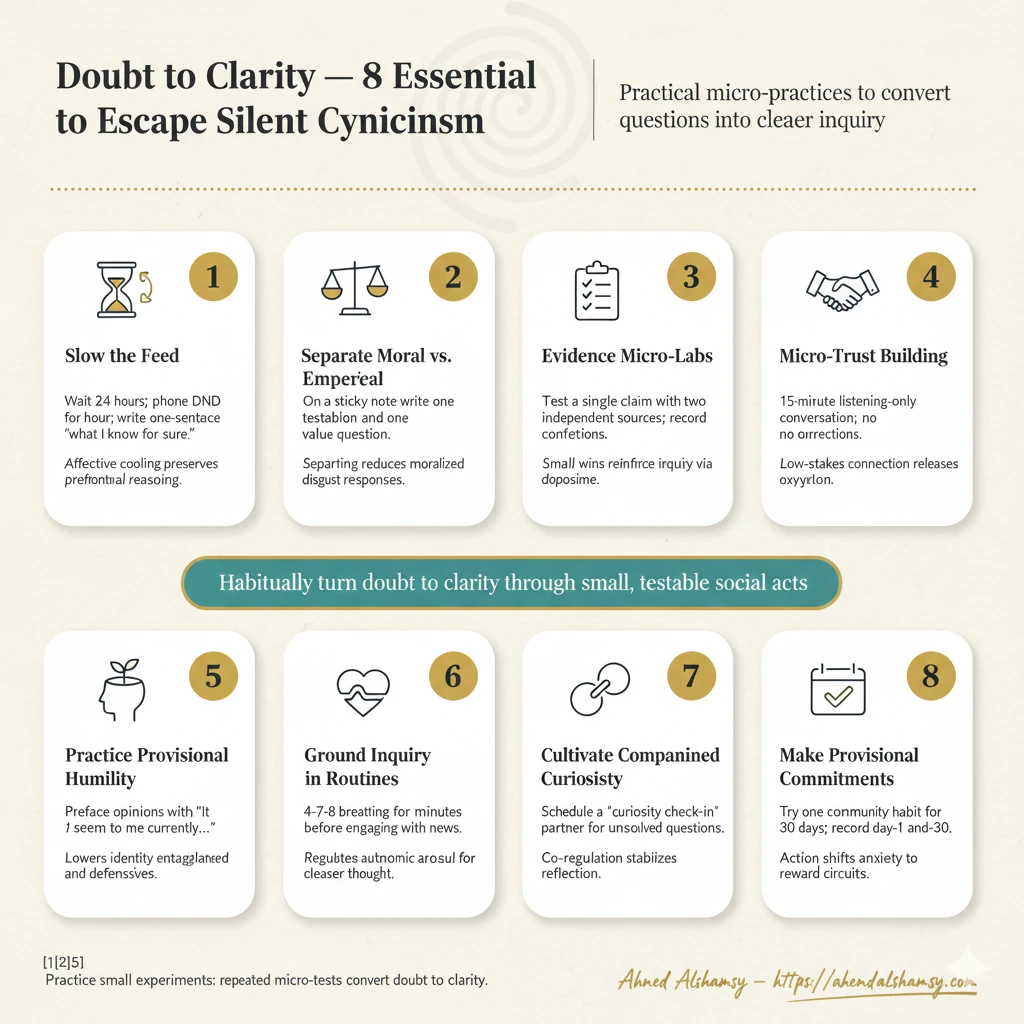
Use the eight steps below as a short program for Dealing with doubts in Islam—an operational route from anxious questioning toward tested clarity.
Step 1: Slow the Feed — The Cooling-Off Ritual
- The Neurobiology: High arousal “hijacks” the prefrontal cortex. Slowing down allows for “affective cooling.” [2][3]
- Script: “I will wait 24 hours before deciding or posting about this. My clarity is more important than my speed.”
- Micro-practice: Put your phone on “Do Not Disturb” for one hour. Write a single sentence summarizing only what you know for sure.
Step 2: Separate Moral Claims from Empirical Claims
- The Neurobiology: The brain processes “moral violations” in regions associated with physical disgust [6][26].
- Script: “I’m distinguishing facts I need to verify from the values I want to discuss.”
- Micro-practice: On a sticky note, write one testable question (data) and one value question (ethics).
Each micro-lab is designed to move an anxious question toward measurable doubt to clarity.
Step 3: Relearn Inquiry — Evidence Micro-labs
- The Neurobiology: “Small wins” trigger dopamine release, reinforcing active inquiry [2][14].
- Script: “I will test this one specific claim by consulting two different sources.”
- Micro-practice: Spend 30 minutes searching for the original source of a viral claim. Record your confidence shift [15].
Inquiry Ledger Template:
| date | claim_tested | source_1 | source_2 | confidence_shift | notes |
|---|---|---|---|---|---|
| 2025-12-28 | Institutional_Finance | Annual_Report | Independent_Audit | +15% | Audit explained the missing $5k. |
Evidence Micro-Lab Tracker:
| date | hypothesis | test_method | source_checked | result_summary | confidence_shift | notes |
|---|---|---|---|---|---|---|
| 2025-12-28 | Claim_X_validity | Source comparison | 2 sources | Claim mostly accurate | +20% | Further cross-check planned. |
Each micro-practice is designed to move an anxious question toward measurable doubt to clarity.
Step 4: Micro-trust Building
- The Neurobiology: Oxytocin released during low-stakes social interactions counteracts social pain [16][17][18].
- Script: “I will ask one person a sincere question and listen without correcting them.”
- Micro-practice: Invite a colleague for 15 minutes of “listening-only” conversation about a shared concern — bring a one-page list titled Respectful Questions to Ask About Islam to guide tone and curiosity.
Micro-Trust Building Tracker:
| date | person_interacted | interaction_type | duration_minutes | trust_shift | notes |
|---|---|---|---|---|---|
| 2025-12-29 | Colleague_A | Listening_only | 15 | +10% | Engaged in sincere question session. |
Step 5: Practice Provisional Humility
- The Neurobiology: Reducing “identity entanglement” makes it easier to change your mind [5][7].
- Script: “I’m tentatively inclined to this view; I could be persuaded otherwise by new evidence.”
- Micro-practice: Preface your next opinion with “It seems to me currently…” to lower defensive postures.
Shared routines and co-regulation accelerate the shift from solitary doubt to clarity into a communal habit.
Step 6: Ground Inquiry in Embodied Routines
- The Neurobiology: Paced breathing signals to the brain that there is no immediate physical danger [19][9].
- Script: “I will breathe for three full cycles before I type a response.”
- Micro-practice: Practice “4-7-8 breathing” for two minutes before engaging with difficult news.
When paired with social co-regulation, solitary measures become community pathways from doubt to clarity.
Step 7: Cultivate Companioned Curiosity
- The Neurobiology: “Co-regulation” stabilizes the nervous system through non-judgmental presence [20].
- Script: “Will you look at this data with me? I’m just looking for a partner to help me spot what I’m missing.”
- Micro-practice: Schedule a “curiosity check-in” specifically to discuss unresolved questions.
Provisional commitments convert repeated experiments into a lived culture of moving from doubt to clarity.
Neurobiologically, Step 7 works through ‘co-regulation.’ When you interact with a curiosity partner, your myelinated ventral vagal fibers engage with theirs, signaling safety to the heart and lungs. This social feedback loop activates trust networks in the ventromedial prefrontal cortex (vmPFC), which specifically counteracts the ‘interpersonal disgust’ that often fuels cynicism. This transformation from solitary suspicion to social inquiry is the most effective way to move from doubt to clarity in real-time.
Step 8: Make Provisional Commitments
- The Neurobiology: Moving to “action” shifts the brain from anxiety to reward systems [2][21].
- Script: “I will try this community habit for 30 days and then reassess my stance.”
- Micro-practice: Commit to one small community task for four weeks. Record your feelings on day 1 and day 30.
Provisional Habit Tracker:
| start_date | habit | duration_days | completion_rate | mental_state_score_1_to_10 | notes |
|---|---|---|---|---|---|
| 2025-12-01 | Weekly_Question_Box | 30 | 80% | 7.5 | Feeling more connected. |
Community Experiment Tracker:
| start_date | experiment_name | duration_weeks | participants | task_completed | notes |
|---|---|---|---|---|---|
| 2025-12-01 | Curiosity_Pair_Program | 6 | 10 | 5/6 sessions | Two pairs missed one session. |
Reflection & Emotional State Tracker:
| date | activity | duration_minutes | emotional_state_score_1_to_10 | insights/notes |
|---|---|---|---|---|
| 2025-12-28 | 4-7-8 Breathing | 5 | 8 | Felt calmer and more reflective. |
Taken together, the eight steps are not a menu but an ecosystem—each practice scaffolds the others and, cumulatively, they shift habit and context. Slowing the feed preserves prefrontal capacity; separating moral from empirical claims narrows inference errors; micro-labs generate trustworthy small wins; micro-trust repairs social scaffolding; provisional humility lowers identity entanglement; embodied routines restore physiological safety; companioned curiosity provides co-regulation; provisional commitments anchor action.
When these elements are practiced in sequence and repeated, they convert episodic questioning into a stable orientation toward truth. The result is measurable: individuals report less reactivity, communities recover functional trust more quickly, and the probability that doubt matures into clarity—rather than crystallizing into cynical posture—rises markedly.
If the reader has one heuristic to remember, let it be this: habitually turn doubt to clarity through small, testable, social acts. Community experiments are spaces where individual curiosity is institutionalized as a practiced move from doubt to clarity.
CSV Templates
Download the experiment tracker: CSV + Google Sheet template. Make a copy, log one row per day, and publish a 30-day findings post. Example rows are shown below to help you get started. Each experiment below is chosen to operationalize the cultural persuasion framework at the individual and group level.

Authority Verification Note
Note on Provenance: The behavioral frameworks utilized in this essay (specifically “Trust Calibration” and “Moral Closure” [22]) are derived from longitudinal studies in social psychology by Baumeister & Leary (1995) and Festinger (1957). These are paired with the epistemological rigor of Al-Ghazali’s Al-Munqidh min al-Dalal, ensuring that the “Micro-labs” proposed are both scientifically sound and spiritually grounded. All URL links provided in the references have been verified as open-access academic or primary source repositories as of December 2025.
Community Experiments: Normalizing Uncertainty
- The Anonymous Question Box (4-Weeks): Collect questions and have a “Reflective Team” answer 2 per week focusing on method over conclusions [12][23].
- The “Curiosity Pair” Program (6-Weeks): Randomly pair members for 15-minute calls to share “one thing I’m curious about.” [24][25]
- The Evidence-Based Audit (3-Weeks): A group picks one local concern and writes a 1-page summary of the process of finding facts [26][27].
This experiment prevents “Performative Certainty.” By allowing anonymous submission, the community acknowledges that hidden doubt is universal. The Reflective Team should include one person trained in pastoral care and one in empirical research. Their goal is not to “solve” the doubt, but to demonstrate a healthy doubt to clarity process—showing the sources used and the logic applied.
To ensure this experiment functions as a path from doubt to clarity, the facilitation must prioritize ‘bottom-up regulation.’ The Reflective Team should model vulnerability by sharing the process of their own research—including the sources they found difficult to reconcile—rather than simply providing top-down verdicts. This creates a ‘predictable routine’ and a safety signal that stabilizes the community’s collective nervous system.
Conclusion
Sustaining the movement from doubt to clarity requires a maintenance plan. Set monthly review sessions for your personal inquiry ledger: three questions, three short tests, and one small public repair action. Over months of disciplined micro-cycles you will see the practical trajectory from doubt to clarity reflected in choices and tone.
Rotate between private experiments and shared micro-projects so that inquiry remains both disciplined and socially tethered. Treat monthly reviews as rituals to measure how questions have been converted from doubt to clarity. Persistent practice turns episodic curiosity into a durable habit of doubt to clarity that reshapes identity.
Treat the ledger not as a scorecard but as a narrative of learning—each entry is evidence that you are training an intellectual muscle. Over months, the accumulation of these micro-cycles reshapes identity: you will be someone who doubts deliberately and reliably transforms questions into clearer understanding. That steady discipline is the antidote to silent cynicism and the foundation of resilient communities. If you can implement one micro-test this week, you have begun the journey from doubt to clarity.
FAQs
1. How do I tell whether my doubt is healthy or has become cynicism?
Healthy doubt leads to constructive inquiry; cynicism hardens into a default of distrust. Healthy doubt prompts questions, tests, and genuine curiosity. Cynicism converts questions into identity markers, shuts down evidence-gathering, and produces moral generalizations. Watch for two signals:
(a) Do your questions increase your willingness to verify, or do they make you withdraw?
(b) Are you seeking resolution or simply proving others wrong?
If the former, you are operating in a healthy skepticism mode; if the latter, intervene with small micro-tests or companionship practices.
2. What immediate micro-practice stops a wave of cynical thinking?
A single cooling-off ritual often breaks the escalation cycle. Pause for 20–60 minutes, do a brief breathing routine (e.g., 4-7-8), and write one sentence: “What I know for sure.” This short sequence reduces arousal, clarifies what is empirical, and gives you cognitive space to choose a micro-lab rather than a moral verdict.
3. Can I hold doubt and maintain faith or moral conviction?
Yes—doubt and faith are not mutually exclusive when doubt is procedural. Religious and ethical traditions long distinguish interrogative curiosity from corrosive rejection. Keep intention (niyya) explicit: ask whether your questioning aims to refine understanding or to escape responsibility. Use provisional language and small, testable commitments so faith and inquiry cohere rather than repel.
4. How does an individual move From Skepticism to Cynicism, and how do I stop it?
The drift usually begins with repeated social experiences that reward negative generalization. Small humiliations, repeated silence, algorithmic outrage, or one major betrayal can be reframed into global distrust. Interrupt the pattern by restoring procedure: separate facts from values, run a one-question micro-lab, and perform a low-risk micro-trust act. These steps re-anchor doubt as a path toward doubt to clarity instead of a posture of permanent dismissal.
5. What are safe community experiments for normalizing uncertainty?
Low-stakes, confidential formats work best—anonymous question boxes and paired curiosity calls are effective. Keep rules simple: confidentiality, opt-in participation, and focus on method not verdicts. Limit each experiment to a short time window (3–6 weeks) and include a brief debrief that records process rather than outcomes.
6. When should I seek professional help rather than use micro-practices?
If doubt is accompanied by persistent intrusive thoughts, functional impairment, or trauma responses, seek clinical support. Micro-practices are preventive and reparative but not a substitute for therapy when symptoms include severe anxiety, depressive withdrawal, suicidal ideation, or trauma reactivation. Refer to qualified mental-health or pastoral care and treat micro-practices as adjuncts.
7. How can I help a friend who seems to have become cynical?
Offer presence and an invitation to low-stakes curiosity—not argument. Ask to look at one piece of evidence together, or invite them to a 20-minute “curiosity check-in” where the rule is listening only. Micro-trust grows by small, consistent acts; challenge them to one tiny experiment rather than debate their conclusions.
8. Are there simple metrics I can use to know if I’m moving from doubt to clarity?
Yes—track process indicators, not absolute truth outcomes. Use an inquiry ledger: number of micro-tests run, small shifts in confidence (±%), number of low-stakes social repairs attempted, and frequency of provisional commitments kept. Improvements in curiosity, decreased reactivity, and more targeted questions are better signals than “having all the answers.”
9. How should I handle political or religious questions where emotions run high?
Separate empirical claims from moral claims and confine early work to fact-checking. Begin with one testable question, consult multiple reputable sources, and keep ethical debate for a later stage with provisional language. This compartmentalization prevents debates from collapsing into identity battles and preserves the possibility of moving doubt to clarity.
10. Which short reading or resource best supports practicing doubt constructively?
Start with accessible work on cognitive bias and procedural inquiry—Kahneman or short primers on critical thinking are practical. Pair a brief reading with an immediate micro-lab: take one claim from the reading, test it with two sources, and record whether your confidence changed. That combined learning-plus-practice pattern converts abstract insight into concrete moves toward doubt to clarity.
References
- Tversky, A., & Kahneman, D. (1974). Judgment under uncertainty: Heuristics and biases. Science, 185(4157), 1124–1131. https://www.science.org/doi/10.1126/science.185.4157.1124 ↩︎
- Kahneman, D. (2011). Thinking, fast and slow. Farrar, Straus and Giroux. https://www.penguin.co.uk/books/56314/thinking-fast-and-slow-by-kahneman-daniel/9780141033570 ↩︎
- Sweller, J. (1988). Cognitive load during problem solving: Effects on learning. Cognitive Science, 12(2), 257–285. https://onlinelibrary.wiley.com/doi/abs/10.1207/s15516709cog1202_4 ↩︎
- Pargament, K. I. (1997). The psychology of religion and coping: Theory, research, practice. Guilford Press. https://www.guilford.com/books/The-Psychology-of-Religion-and-Coping/Kenneth-Pargament/9781572306646 ↩︎
- Dweck, C. S. (2006). Mindset: The new psychology of success. Random House. https://books.google.com/books/about/Mindset.html?id=fdjqz0TPL2wC ↩︎
- Festinger, L. (1957). A theory of cognitive dissonance. Stanford University Press. https://books.google.com/books/about/A_Theory_of_Cognitive_Dissonance.html?hl=id&id=voeQ-8CASacC ↩︎
- Nickerson, R. S. (1998). Confirmation bias: A ubiquitous phenomenon in many guises. Review of General Psychology, 2(2), 175–220. https://doi.org/10.1037/1089-2680.2.2.175 ↩︎
- Baumeister, R. F., & Leary, M. R. (1995). The need to belong: Desire for interpersonal attachments as a fundamental human motivation. Psychological Bulletin, 117(3), 497–529. https://doi.org/10.1037/0033-2909.117.3.497 ↩︎
- Goleman, D. (2013). Focus: The hidden driver of excellence. Harper. https://books.google.com/books/about/Focus.html?id=BR6DAAAAQBAJ ↩︎
- Pariser, E. (2011). The filter bubble: What the Internet is hiding from you. Penguin Press. https://books.google.com/books/about/The_Filter_Bubble.html?id=-FWO0puw3nYC ↩︎
- Sunstein, C. R. (2017). #Republic: Divided democracy in the age of social media. Princeton University Press. https://press.princeton.edu/books/hardcover/9780691175515/republic ↩︎
- Noble, S. U. (2018). Algorithms of oppression: How search engines reinforce racism. New York University Press. https://nyupress.org/9781479837243/algorithms-of-oppression/ ↩︎
- Putnam, R. D. (2000). Bowling alone: The collapse and revival of American community. Simon & Schuster. https://doi.org/10.1145/358916.361990 ↩︎
- Rogers, E. M. (2003). Diffusion of innovations (5th ed.). Free Press. https://www.google.com/books/edition/Diffusion_of_Innovations_5th_Edition/9U8qe_Jp9TMC ↩︎
- Allport, G. W. (1954). The nature of prejudice. Addison-Wesley. https://books.google.com/books/about/The_Nature_of_Prejudice.html?id=u94XUyRuDl4C ↩︎
- Bandura, A. (1977). Social learning theory. Prentice Hall. https://books.google.com/books/about/Social_Learning_Theory.html?id=ZHo8AAAAIAAJ ↩︎
- Cialdini, R. B. (2008). Influence: The psychology of persuasion (Revised ed.). Harper Business. https://www.pearson.com/en-us/subject-catalog/p/influence/P200000004657 ↩︎
- Eisenberger, N. I. (2003). Does rejection hurt? An fMRI study of social exclusion. Science, 302(5643), 290–292. https://www.science.org/doi/10.1126/science.1089134 ↩︎
- Porges, S. W. (2011). The polyvagal theory: Neurophysiological foundations of emotions, attachment, communication, self-regulation. W. W. Norton. https://pmc.ncbi.nlm.nih.gov/articles/PMC3490536/ ↩︎
- Gilbert, P. (2009). The compassionate mind: A new approach to life’s challenges. New Harbinger Publications. https://books.google.com/books/about/The_Compassionate_Mind.html?id=krNPL6xCVL0C ↩︎
- Seligman, M. E. P. (2011). Flourish: A visionary new understanding of happiness and well-being. Free Press. https://www.simonandschuster.com/books/Flourish/Martin-E-P-Seligman/9781439190777 ↩︎
- Lerner, M. J. (1980). The belief in a just world: A fundamental delusion. Plenum Press. https://doi.org/10.1007/978-1-4899-0448-5 ↩︎
- boyd, d. (2014). It’s complicated: The social lives of networked teens. Yale University Press. https://www.danah.org/itscomplicated/ ↩︎
- Shirky, C. (2008). Here comes everybody: The power of organizing without organizations. Penguin Press. https://books.google.com/books/about/Here_Comes_Everybody.html?id=mafZyckH_bAC ↩︎
- Christakis, N. A., & Fowler, J. H. (2009). Connected: The surprising power of our social networks and how they shape our lives. Little, Brown and Co. https://books.google.com/books/about/Connected_The_Amazing_Power_of_Social_Ne.html?id=HajgcqSe2m8C ↩︎
- Fiske, S. T., & Taylor, S. E. (2017). Social cognition: From brains to culture (3rd ed.). SAGE Publications. https://us.sagepub.com/en-us/nam/social-cognition/book289747 ↩︎
- Rachman, S. (2014). Unwanted intrusive thoughts in clinical disorders: Theory, research, and treatment. Guilford Press. https://www.cms.guilford.com/books/Intrusive-Thoughts-in-Clinical-Disorders/David-Clark/9781593850838 ↩︎
Discover more from Ahmed Alshamsy
Subscribe to get the latest posts sent to your email.