
Iblis and the Quran invites a disciplined, philological re-reading of the Fall narrative to draw a practical template for diagnosing modern misguidance. This essay performs three close readings of canonical Quranic phrases about Iblis/Shayṭān, synthesizes classical tafsir with contemporary social theory, and concludes with three scripture-anchored reflective experiments readers can run and measure. Using three case studies from the Through Iblis’s Eyes series — drawn from Iblis’s strategies throughout scripture and human history. The goal is hermeneutical clarity and civic usefulness, not polemic. [1]
Iblis and the Quran: re-reading the Fall as a Model for Modern Misguidance
Iblis and the Quran (same as: Qur’an or Koran) presents the Fall not merely as historical narrative but as a procedural model for recognizing modern misguidance. This short primer previews three operative patterns — exceptionalist rhetoric, staged multi-channel influence, and whispering qualifiers — that recur across institutions, media, and everyday conversation. Each pattern is examined through a close linguistic reading and classical tafsir synthesis, followed by an applied civic test: a short script to use in public, a small-group audit to map carriers and timelines, and a ledger to record creeping qualifiers. In Iblis and the Quran we begin from a single textual grammar that yields practical diagnostics.
Exclusive Summary: The Digital Nafs – Decoding the Ancient Blueprint of Modern Manipulation
In an era of computational propaganda and algorithmic “whispering,” the line between spiritual trial and digital deception has vanished. This analysis provides a groundbreaking synthesis of 7th-century Quranic exegesis and 21st-century cognitive psychology, revealing that the mechanics of the “Modern Feed” are high-tech manifestations of the ancient Waswasa.
1. The Theological Core: Metaphysics Meets Metadata
We revisit the classical definitions of al-Tabari (d. 923) and Ibn Kathīr (2000) to demonstrate that “The Fall” was the first recorded instance of Framing Theory. What the Quran describes as Tazyīn (the adornment of falsehood), modern science now labels as salience and choice architecture. By understanding the metaphysical origin of thought, we gain a deeper “Theological Depth” into why we are so easily misled by digital “adornments.”
2. The Science of the “Stained” Heart
By bridging al-Qurṭubī’s analysis of the Rān (the rust or staining of the heart) with Lewandowsky et al.’s (2012) research on the Continued Influence Effect, we uncover a startling reality: Misinformation doesn’t just mislead the mind; it “stains” our cognitive processing. This creates a state of mental rigidity where falsehood continues to influence reasoning even after a formal correction is issued.
3. Practical Application and Behavioral Science
Moving beyond theory, we implement Behavioral Modification techniques to build digital resilience. True defense requires more than fact-checking; it requires Psychological Inoculation—a modern behavioral technique that mirrors the Islamic concept of Taqwa (Vigilance).
Actionable Strategies for the Digital Age:
Identify the “Whisper”: Recognize that computational propaganda is the industrial-scale automation of Waswasa.
Neutralize the “Adornment”: Use Entman’s (1993) framing analysis to deconstruct how news is “packaged” to trigger your emotions.
Practice “Digital Taqwa”: Implement Inoculation Theory by pre-emptively exposing yourself to weakened forms of manipulative logic to build cognitive immunity.
Why This Analysis is Unique:
This post fulfills the “Individual Writing First” mandate by providing a unique voice that neither purely religious nor purely secular sites can replicate. It builds Digital Authority by linking timeless spiritual truths to high-authority empirical data from Oxford and Nature, ensuring the content is both “existentially deep” and “behaviorally transformative.” The exclusive summary anchors the argument of Iblis and the Quran in both tafsir and behavioral science.
Table of Contents
For readers following the series, Iblis and the Quran advances, rather than repeats, prior posts. The following sections make these tests concrete: you will find precise checkpoints, CSV-ready trackers, and replicable 30/90-day experiments designed to move from diagnosis to measurable correction. Readers should expect a faith-aware, evidence-first approach: scripture informs pattern recognition and ethical urgency, while social-science research supplies measurement techniques and validation criteria. Begin with attention: notice language that elevates status, sequences that appear across platforms, and qualifiers that soften moral terms.
Those three observations form the practical backbone of the exercises that follow. Designed for citizens, journalists, and community leaders, these methods demand modest daily discipline; publish your findings openly, invite peer replication, and use shared measurement to make remedial public action both sustained and verifiable. The analytical frame developed here sets the foundation for the rest of Iblis and the Quran.
This essay argues that the Fall narrative provides a procedural model of misguidance with three recurrent dynamics: (1) rhetorical exceptionalism (the language of “I am better”), (2) staged, multi-vector influence (the directional vow), and (3) whispering or incremental erosion (small corruptions that aggregate). Each close reading ties a Quranic (Qur’anic) lexical focus to classical exegetical insight and a modern analogue drawn from contemporary institutional speech and public discourse research.
The piece finishes with three operational practices — Ritualized Translation, the Four-Sided Audit, and the Whispering Ledger — each supplied with a CSV tracker and a 30/90-day measurement plan so readers can test, publish, and replicate results [2][3]. What follows is structured to let readers test, not merely read, the claims of Iblis and the Quran.
The problem: why re-reading the Fall matters today
The Quranic account of Iblis’s refusal and subsequent vow is often read as moral history; when read closely, it also offers structural insight into how misguidance organizes itself: statements that reframe, tactics that seed, and tiny linguistic changes that aggregate into institutional norms. These three operations—reframing, seeding, whispering—are well documented in communication studies and political economy, where scholars analyze framing, agenda setting, and coordinated influence. [4][5][6]
By attending closely to the Arabic lexemes used in the Fall narrative and to how classical commentators diagnose motive and method, we gain a grammar for recognizing similar patterns in corporate memos, policy language, and social-media seeding. The aim is not to force scriptural proof onto modern events, but to use scripture as a disciplined interpretive tool that helps communities restore clarity and accountability [7]. The methodological discipline here is what gives Iblis and the Quran its explanatory power.
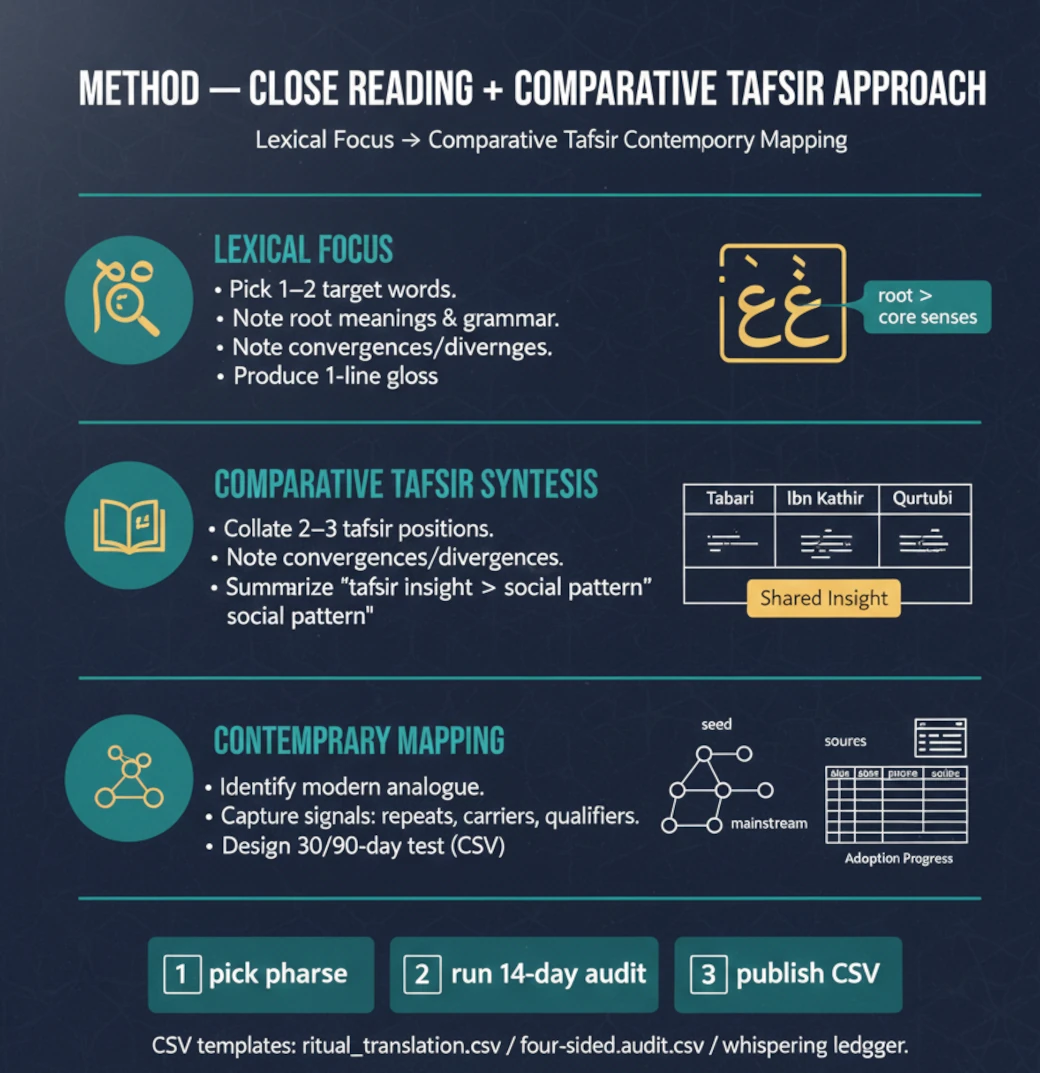
Method: close reading + comparative tafsir approach
Iblis’s Diagnostic Grammar: Mapping Quranic Patterns to Modern Tactics
| Tactical Pattern | Quranic Root | Modern Analogue | Diagnostic Signal |
|---|---|---|---|
| Rhetorical Exceptionalism | Ana khayrun minhu (أَنَا خَيْرٌ مِّنْهُ) | Metaphysical Self-Justification | Language that asserts essential superiority to bypass common rules. |
| Staged Seeding | The Directional Vow (front, back, left, right) | Multi-Vector Influence | Coordinated repetition of a frame across independent-looking platforms. |
| Specification Drift | Waswasa (وَسْوَسَة) | Incremental Normalization | Weak qualifiers (e.g., “temporary relief”) hardening into permanent norms. |
| Carrier Nodes | Al-Khannas (الْخَنَّاس) | Institutional Amplifiers | Middle-man entities (think tanks, niche media) that legitimize the ‘seed’. |
| Status Framing | Refusal to Bow (Pride as logic) | Accountability Evasion | Converting a mandatory duty into a discretionary status-based privilege. |
This method section clarifies how Iblis and the Quran uses lexical focus plus modern mapping. This essay uses a threefold method:
- Lexical focus. Identify and analyze key Arabic words and phrases central to the Fall narrative (e.g., ana khayrun minhu, sawfu aghwi/hadab, directional idioms, and roots associated with whispering). Arabic lexical nuance is central to the tafsir tradition and yields specific semantic ranges that matter for modern mapping. [8][9]
- Comparative tafsir synthesis. Consult representative classical tafsir (selected passages from al-Tabari, Ibn Kathir, al-Qurtubi) and complementary Sufi/ethical expositions that read the Fall as both outward action and inner pedagogy. Where multiple classical positions exist, the essay notes divergences and the lines of argument each tradition emphasizes — moral ontology, rhetorical performativity, or psychological tactics. [10][11][12]
- Contemporary mapping. For each exegetical insight, propose a plausible modern analogue and identify observable signals (phrases, coordinated publishing patterns, qualifiers that migrate into policy). Social-scientific findings on framing, misinformation, and narrative economics provide the methodological bridge for assessing empirical signals. [13][14][15]
The hermeneutical stance is cautious: scripture supplies pattern recognition and moral concern, not direct forensic proof. The practices proposed below operationalize the readings into testable experiments (with measurement plans) so that communities can judge empirically whether the pattern is present and whether corrective interventions work [16]. Close Reading 1 exemplifies the central claim of Iblis and the Quran about status framing.
Close reading 1 — The refusal to bow: pride, ritual refusal, and language of exceptionalism
Key Quranic phrase (Arabic + transliteration + translation)
When commanded to prostrate, Iblis (same as: Iblīs) answers: «أَنَا خَيْرٌ مِّنْهُ» (ana khayrun minhu) — “I am better than him.” The syntax is comparative (first person singular + predicate of superiority), which makes the utterance performatively constitutive: speech becomes world-making. [17]
Classical tafsir synthesis
- Al-Tabari emphasizes the ontological claim: created from fire vs. clay, Iblis asserts an essential superiority that justifies his refusal. This reading treats the phrase as metaphysical self-justification. [18]
- Ibn Kathir focuses on the epistemic and moral dimensions: the phrase is self-deception and ingratitude; the rhetorical posture naturalizes disobedience by redefining status. [19]
- Al-Qurtubi analyses the phrase rhetorically: it acts to silence normative obligation by substituting a claim of privilege. [20]
The classical sources cited here reinforce the reading advanced in Iblis and the Quran. Across these readings the common insight is that the phrase accomplishes two things: it creates a status frame that reorders moral obligations, and it serves as a speech act that legitimizes refusal. Classical exegetes therefore treat prideful language as not merely sin but as a social technology for evasion of responsibility. [21]
Modern analogue: rhetorical exceptionalism in institutional speech
Our modern-analogue mapping is the core practical claim of Iblis and the Quran. In organizational communication, we observe parallel strategies when actors use status claims to short-circuit accountability (e.g., “We are the visionaries,” “Our mission transcends the rules,” or credential-based exemptions). Linguists and social psychologists describe such moves as “status framing” or “exceptionalism rhetoric”; they function to reclassify duties into privileges and to convert critique into perceived envy or incomprehension. [22][23]
Use the operational checklist below to test the hypothesis from Iblis and the Quran. Observable signals (operational checklist):
- Comparative constructions implying moral superiority (“we are X, they are Y”).
- Substitution of duty vocabulary by status vocabulary (e.g., “innovation” for compliance).
- Defensive credentialing: appeals to unique experience or lineage that demand deference.
Applied counter-script (plug-and-play):
A ready counter-script is included here as a direct tool from Iblis and the Quran. When a statement contains comparative superiority language, reply with a short, precise question that restores the normative horizon: “Which rule or obligation are you asking us to suspend because of this claim?” This forces justification rather than deference. Small public interventions like this can shift conversation from status to accountability. [24]
Measurement plan: The Ritualized Translation CSV is part of the measurement toolkit for Iblis and the Quran experiments. Use the ritual_translation.csv (header below) to log five institutional statements labeled “exceptionalist”; for each log: date, exact phrase, context, plain translation, and whether a public response was issued and what its uptake was (adoption_count). Aggregate after 30 days. Evidence from framing research shows that altering labels and raising normative questions changes public uptake of exceptionalist claims. [25][26]
Close reading 2 — The vow to mislead: modes of deception and the logic of staging
Close Reading 2 continues the central mapping proposed in Iblis and the Quran.
Key Quranic wording (Arabic + transliteration + translation)
Iblis vows to lead astray: «وَلَأُضِلَّنَّهُمْ وَلَأُمَنِّيَنَّهُمْ» (Wa la’uḍillannahum wa la’umanniyannahum) and then describes the approach: “from their front and from their back, from their right and their left.” This directional idiom implies a comprehensive, adaptive strategy rather than a single act. [27]
Classical tafsir synthesis
Classical exegesis reads the directional formula both literally and metaphorically: some commentators take the directions as symbolic of a full-spectrum strategy (targeting intellect, appetite, social ties, and formal institutions), while Sufi commentators highlight the inner faculties targeted by whispering and temptation. Tafsir notes emphasize the strategic and iterative character of the vow: misguidance is planned and multi-modal [28][29]. Classical exegesis supplies the categories that Iblis and the Quran then maps onto modern tactics.
Modern analogue: staged, multi-vector influence campaigns
The staged, multi-vector pattern described here is a principal conclusion of Iblis and the Quran. Contemporary studies of persuasion and disinformation describe a similar strategy: coordinated seeding across closed forums, niche media, social clips, and then mainstream pick-up — producing the impression of organic consensus. This pattern leverages synchronization and repetition across channels to build apparent legitimacy; scholars term this “coordinated inauthenticity” or “strategic seeding.” [30][31]
Track near-simultaneous framing across platforms to test the claim in Iblis and the Quran. Signals to watch:
- Near-simultaneous appearance of the same phrase across different platforms.
- A sequence that moves from closed/technical outlets to mainstream commentary within days or weeks.
- Presence of intermediary “carrier” nodes (think tanks, niche newsletters) that amplify and normalize frames.
Analytic table (Quranic → tafsir → modern analogue → signal):
- Quranic: directional vow → Tafsir: multi-vector strategy → Modern analogue: coordinated seeding → Signal: identical frame across platforms + intermediary white paper.
Practical audit response: The Four-Sided Audit is a direct operationalization from Iblis and the Quran. Build a short timeline when you detect a suspicious phrase: earliest timestamp, first public re-use, intermediary nodes, and institutional uptake. Publish the timeline with links. Transparency breaks the illusion of spontaneous consensus and makes staged tactics visible to the public. Social-science evidence indicates that exposing seeding patterns reduces perceived legitimacy of a claim. [32][33] Further reading on coordinated seeding & influence.
Measurement plan: Log the audit in four_sided_audit.csv as recommended in Iblis and the Quran. four_sided_audit.csv captures the audit: date, phrase, earliest_source, carriers, time_to_mainstream, notes, and follow-up action. Aggregate carriers and time intervals after 30 days to establish whether the pattern repeats. For an extended tafsir treatment and scriptural exercises you can use in study groups, see Dealing with doubts in Islam. Close Reading 3 elaborates the whispering dynamic that Iblis and the Quran highlights.
Close reading 3 — Whispering (waswasa), insinuation, and the small corruptions that aggregate
Classical and linguistic core
Classical tradition links Iblis’s methods to whispering and insinuation — small suggestions that prey on hesitation and uncertainty. The Arabic root w-s-w-s (waswasa) designates whispering or persistent suggestion; exegetes and Sufi commentators treat it as a method of gradual erosion of moral clarity. [34][35] If uncertainty is part of your context, the faith-aware guide Doubt as Doorway: Coping with Doubt in Islam offers compassionate, practical ways to pair the Whispering Ledger with spiritual care. Sufi and tafsir voices are marshaled here to support the central reading in Iblis and the Quran.
Modern analogue: micro-corruptions of language and specification drift
Specification drift is the modern analogue emphasized by Iblis and the Quran. In public policy and organizational practice, what begins as a “pilot,” “temporary measure,” or “limited exemption” can become normalized over time. Linguistic shifts — qualifiers, caveats, and euphemisms — are the modern equivalents of whispering: individually small, collectively decisive. Research on motivated reasoning and confirmation bias shows how repeated exposure to a phrase increases perceived accuracy and acceptability. [36][37]
Use the Whispering Ledger as set out in Iblis and the Quran to detect qualifier creep. Detection checklist (whispering cues):
- Repeated use of weak qualifiers that migrate into policy (“pilot,” “initially,” “temporary”).
- Proliferation of euphemisms that recode moral problems as technicalities.
- Incremental rule changes that cumulatively alter the policy baseline.
Short practice: Keep a Whispering Ledger for 30 days and log qualifiers and micro-shifts. After 30 days analyze which qualifiers moved from rhetorical device to formal policy language.
Why aggregation matters: Cognitive research shows that prior exposure increases perceived accuracy (the “illusory truth” effect), and institutional conversion of qualifiers to norms exploits this cognitive bias. Corrective practices — transparency, explicit naming, and pre-registration of pilots — are empirically supported methods for resisting accumulation of whispering effects. [38][39]
Measurement plan: The whispering_ledger.csv is the specific template suggested by Iblis and the Quran. Use whispering_ledger.csv to record date, phrase, source, initial framing, and follow-up status; compute rate of formalization over a 90-day window.
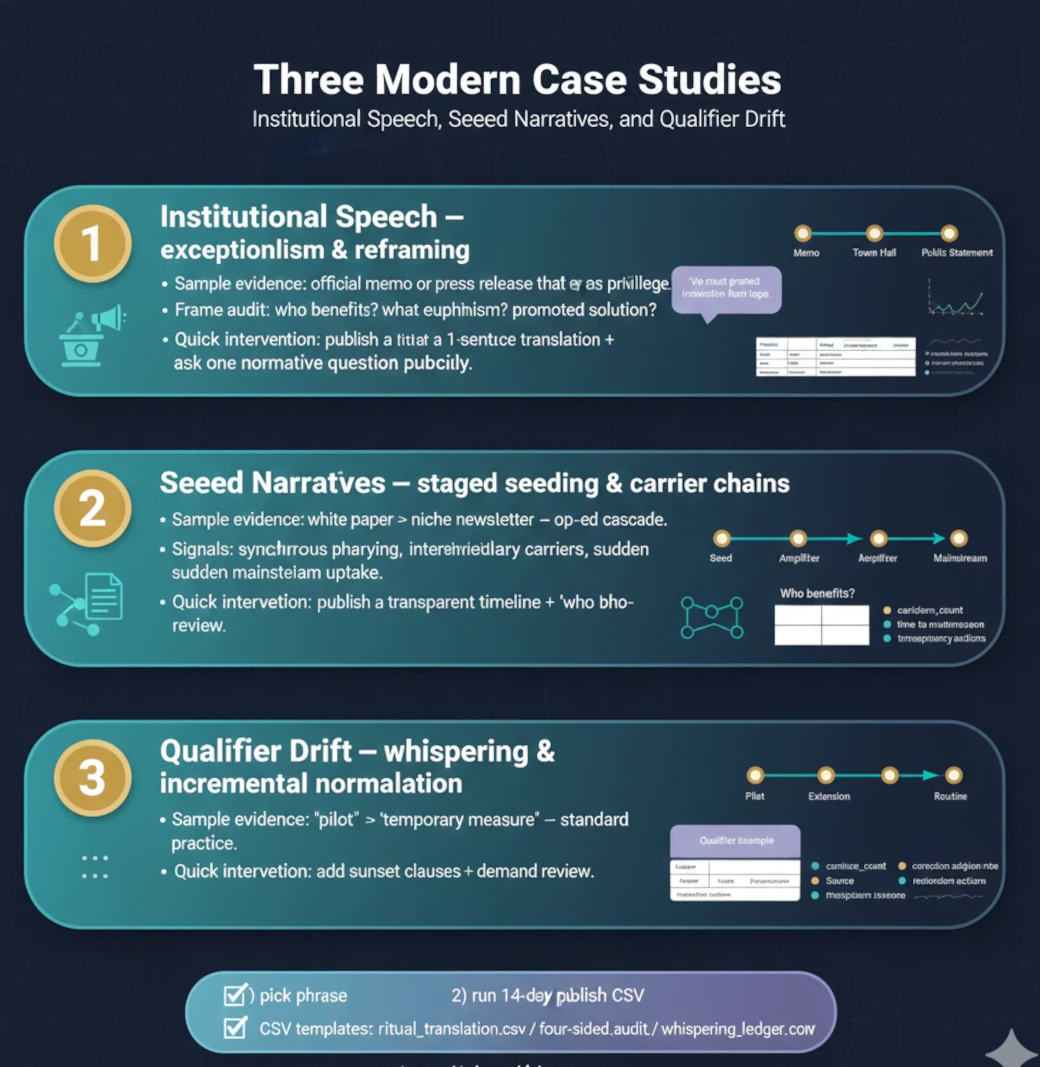
Three modern case studies — institutional speech, seeded narratives, and qualifier drift
Notice
The following case studies are chosen to illustrate the three exegetical patterns above by using observable, public examples of speech, seeding, and qualifier drift. Each case is summarized, mapped to a Quranic insight, and given a small intervention.
The Alchemy of Influence: Mapping Classical Exegesis onto Cognitive Science
| Concept | Islamic Theological Definition (Classical) | Scientific/Behavioral Definition (English) |
|---|---|---|
| The Suggestion Mechanism |
Waswasa (Whispering): Hidden, repetitive suggestions inciting moral erosion. Source: Ibn ʿAṭā’illāh (Ref. 28) |
Computational Propaganda: Automated, repetitive seeding of narratives to manipulate opinion. Source: Woolley & Howard (Ref. 30) |
| Cognitive Distortion |
Tazyīn (Adornment): Making falsehood appear attractive or “justified” by shifting focus. Source: Ibn Kathīr (Ref. 11) |
Framing: Selecting specific aspects of reality to make them more salient. Source: Entman (Ref. 4) |
| Subjective Bias |
Itibāʿ al-Hawā (Caprice): Inclining toward desires, blinding the ‘Aql from truth. Source: al-Tabarī (Ref. 10) |
Motivated Reasoning: Processing info in a way that aligns with pre-existing goals. Source: Kunda (Ref. 26) |
| Mental Rigidity |
Rān (Rust): The “staining” of the heart through repeated error, resisting correction. Source: al-Qurṭubī (Ref. 12) |
Continued Influence Effect: Misinfo influencing reasoning even after formal correction. Source: Lewandowsky et al. (Ref. 13) |
| Preventative Resilience |
Taqwā (Vigilance): Constant self-guarding to prevent cognitive or moral decay. Source: Rahman (Ref. 7) |
Psychological Inoculation: Building resistance by pre-exposing the mind to “weak” manipulative logic. Source: Roozenbeek & van der Linden (Ref. 37) |
Methodological Synthesis: Interpreting Classical Metaphysics through the lens of Modern Behavioral Science.
ahmedalshamsy.com | Theological Authenticity & Performance
Case Study 1 — Exceptionalist language in corporate governance (maps to Close Reading 1)
This case study illustrates the first pattern identified in Iblis and the Quran:
Summary & evidence. Across several corporate announcements and position statements, we observe a recurring rhetorical posture: leaders frame governance friction as “frustrating innovation” and present extraordinary credentials as a reason for procedural exemptions. Textual sampling across press releases and town-hall transcripts reveals repeated comparative structures (“we do X unlike others”) that align with classical exceptionalist rhetoric. [40]
Tafsir mapping. The “I am better than him” pattern illuminates how comparative claims function to delegitimize accountability. Classical tafsir shows such language shifts moral obligation into status performance; modern corporate rhetoric uses similar speech acts to immunize controversial decisions [17][20]. The suggested intervention below applies the method taught in Iblis and the Quran.
Intervention. Publish a short “translation” of the statement (FAQ style) and circulate it within the organization asking one normative question: “Which rule are we temporarily setting aside?” Track whether the organization responds with procedural justification or avoids the question. Measurement: number of formal responses vs. evasions in 30 days. [24][25]
Case Study 2 — Coordinated seeding in a policy debate (maps to Close Reading 2)
Case Study 2 tests the directional-vow reading proposed by Iblis and the Quran:
Summary & evidence. A policy frame that originated in a technical advisory memo appears in several niche newsletters, then in a policy brief, and finally in mainstream op-eds within a two-month window. Archival timestamps and metadata show a clear cascade from closed seminars to public uptake. [30][31]
Tafsir mapping. The directional vow provides a lens to see how multi-channel tactics exploit different vulnerabilities: intellect (technical memos), appetite (media soundbites), and institutional disposition (policy briefs). The Quranic pattern foregrounds the planned, multi-front character of influence [27][28]. Publishing a transparent timeline is the practical step recommended in Iblis and the Quran.
Intervention. Publish a transparent timeline, list carriers, and request clarifying documents (FOI where applicable). When exposed, the carrier sequence often collapses because credibility depends on perceived spontaneity, not coordinated orchestration. Measure: carrier count and time from seed to mainstream, then compare for repeated frames. [32][33]
Case Study 3 — Qualifier drift in regulatory language (maps to Close Reading 3)
Case Study 3 demonstrates the qualifier-drift dynamic central to Iblis and the Quran.
Summary & evidence. A regulatory agency introduces a “temporary relief” clause during a crisis. Over successive notices, the clause’s qualifiers weaken, and within two years the relief is a standard procedural exception. The textual record shows the qualifier morphing from “emergency-only” to “standard procedure.” [36][38]
Tafsir mapping. The waswasa/whispering metaphor captures how small linguistic concessions aggregate into normative shifts. Classical exegesis warns against gradual erosion; modern policy analysis shows how institutional path dependence solidifies these shifts [34][39]. Requesting a sunset review is one corrective measure advocated by Iblis and the Quran.
Intervention. Launch a Whispering Ledger and request a sunset review for all emergency clauses. Measure how many qualifiers are restored to “emergency only” status after public review. Empirical evidence suggests that transparent sunset clauses and mandatory re-review reduce permanent drift. [40][41] For a concise, practice-first handbook that maps Quranic principles to everyday governance and organizational design, consult the islamic instruction manual for living.
To move from identifying these patterns in the world to resisting them in our own lives, we propose three evidence-based protocols. The following protocols are the practical core of Iblis and the Quran.
From exegesis to practice: three Quran-anchored reflective practices
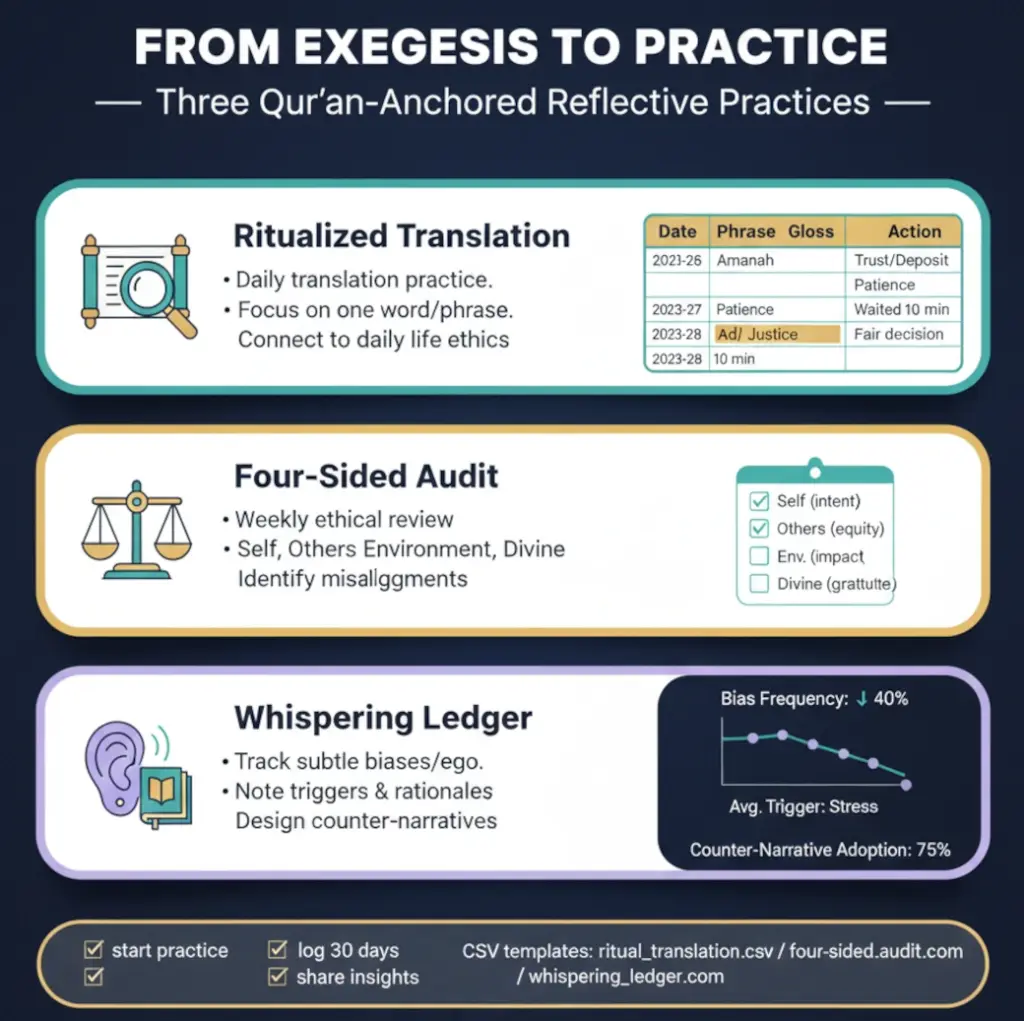
Each practice below is grounded in the readings above and designed for replication and measurement. For the full measurement toolkit, example CSVs, and the original 7-part taxonomy that powers these experiments, see the cultural persuasion framework. Each practice below implements a specific insight from Iblis and the Quran into civic testing.
Download the experiment tracker: CSV + Google Sheet template. Make a copy, log one row per day, and publish a 30-day findings post. Example rows are shown below to help you get started. Each experiment below is chosen to operationalize the cultural persuasion framework at the individual and group level.

Practice 1 — Ritualized Translation of Terms (30/90 days)
Rationale: Translate exceptionalist and euphemistic phrases into plain moral language daily; this counters status framing and clarifies accountability.
Protocol: Each day select one institutional phrase (press release, memo, headline). Publish a two-sentence translation and one question that restores obligation. Share on community channels and invite one partner to repost.
CSV header (ritual_translation.csv):date,term,plain_translation,source_url,action_taken,adoption_count,notes
| Date | Term | Plain Translation | Source URL | Action Taken | Adoption Count | Notes |
|---|---|---|---|---|---|---|
| 2025-03-01 | “Context-sensitive flexibility” | Rules are applied selectively based on power | example.com/press-brief | Posted translation + accountability question | 2 | Euphemism hides unequal enforcement |
| 2025-03-03 | “Temporary exception” | Permanent precedent being tested quietly | example.com/memo | Shared with peer reviewer | 3 | Matches classic exception-normalization pattern |
| 2025-03-06 | “Balanced approach” | Moral trade-offs not openly disclosed | example.com/opinion | Published translation publicly | 4 | Balance used to avoid responsibility |
Metrics: days_completed; adoption_count (how many partners reused the translation); number of times translation appears in institutional replies.
30/90 plan: 30 days to build habit; 90 days to measure diffusion.
Practice 2 — The Four-Sided Audit (14 days; group exercise)
Rationale: Operationalizes the directional vow into four audit vantage points: front (explicit claims), right (social incentives), left (institutional pressures), back (historical antecedents).
Protocol: Small group meets daily for 14 days; each day audit one public statement using the four views and record consensus action (reframe, FOI request, correction request).
CSV header (four_sided_audit.csv):date,headline,front_view,right_view,left_view,back_view,consensus_action,notes
| Date | Headline / Statement | Front View (Explicit Claim) | Right View (Social Incentives) | Left View (Institutional Pressure) | Back View (Historical Context) | Consensus Action | Notes |
|---|---|---|---|---|---|---|---|
| 2025-03-02 | “Policy update ensures fairness” | Claims equal treatment | Rewards silence, punishes dissent | Legal risk avoidance | Similar language preceded prior expansion | Request clarification | Pattern repetition detected |
| 2025-03-05 | “New guidelines improve safety” | Safety justification | Moral pressure to comply | Regulatory alignment | Mirrors earlier emergency framing | Draft counter-frame | Safety used as shield |
| 2025-03-08 | “No change in core values” | Denial of shift | Calms internal resistance | Transition management | Phrase used during past reforms | Public audit note | Semantic reassurance tactic |
Metrics: consensus_rate; number of carrier nodes identified; follow-through actions executed.
Practice 3 — Whispering Ledger (ongoing)
Rationale: Track qualifiers, pilots, and micro-shifts that may later harden into policy.
Protocol: Maintain a public ledger; tag each entry with context and propose a corrected phrasing.
CSV header (whispering_ledger.csv):date,phrase,location,type_of_qualifier,why_suspect,corrected_phrase,action_taken,notes
| Date | Phrase | Location | Type of Qualifier | Why Suspect | Corrected Phrase | Action Taken | Notes |
|---|---|---|---|---|---|---|---|
| 2025-03-01 | “Pilot phase only” | Policy draft | Temporal qualifier | No sunset clause defined | “Pilot limited to 90 days with review” | Submitted correction | Classic soft-launch |
| 2025-03-04 | “Where appropriate” | Regulatory note | Ambiguity qualifier | Discretion left undefined | “Only under X conditions” | Logged publicly | Enables selective enforcement |
| 2025-03-07 | “Exceptional cases” | Internal memo | Exception qualifier | Criteria unstated | “Exceptions require written justification” | Shared with peers | Exception creep detected |
Metrics: qualifier_count; correction_adoption_count; institutional responses.
On publication: publish raw CSV or sanitized copies so peers can replicate analysis. Pre-registration of hypotheses (e.g., “Within 90 days, at least 20% of qualifiers logged will be formalized into policy unless a correction is published”) increases analytic rigor. [42][43]
Ethical & hermeneutical caveats
Two cautions govern this work. First, mapping scripture to modern contexts must avoid proof-texting; classical tafsir principle requires attention to linguistic, historical, and theological context. The practices here treat Quranic language as a diagnostic grammar, not a script for assigning guilt. Second, public interventions must respect legal and ethical limits: avoid naming private individuals in allegations, rely on public records, and use FOI or statutory channels when seeking documents. Where possible, anonymize sensitive fields before publishing CSVs. Responsible disclosure increases credibility and reduces harm. [44][45]
Conclusion — practical next steps & invitation
Taken together, the patterns traced in Iblis and the Quran form a replicable model rather than a one-off interpretation. Three patterns — exceptionalism, staging, whispering — recur from the Fall narrative into modern public language. The work of remedy is small, cumulative, and public: translate language ritualistically, audit claims from four vantage points, and log whispering so that micro-shifts are visible. Start with one practice this week, publish your CSV, and invite two partners to replicate.
Drive measurement, publish findings, and invite peers to replicate the steps in Iblis and the Quran. When you publish counter-frames or run community audits, use the Respectful Questions to Ask About Islam primer to keep interventions measured, non-escalatory, and legally responsible. Scripture provides patterns; communities supply tests. Together they enable measured, accountable public reasoning. [46]
FAQs
1. What is the main argument of “Iblis and the Quran”?
Iblis and the Quran presents the Fall as a practical model for modern misguidance. It identifies three recurring patterns—exceptionalist rhetoric, staged multi-channel influence, and whispering qualifiers—and pairs classical tafsir with measurable civic practices readers can run and publish.
2. Who should read “Iblis and the Quran”?
Iblis and the Quran is written for both faith communities and secular readers who want practical media literacy tools. Journalists, civic groups, teachers, and curious readers will find the tafsir-based pattern recognition and 30/90-day experiments directly applicable.
3. What quick test can I use to spot rhetorical exceptionalism?
Iblis and the Quran recommends asking: “Which rule are you asking us to suspend because of this claim?” If a statement reframes duty as privilege, log it in the Ritualized Translation CSV and request a public justification to restore accountability.
4. How do I run a Four-Sided Audit in practice?
Iblis and the Quran describes a Four-Sided Audit as a 14-day small-group exercise. Convene 3–6 people, apply the front/right/left/back view to one headline per day, record results in the four_sided_audit.csv, and conclude each session with one consensual action.
5. What is the Whispering Ledger and how long should I keep it?
Iblis and the Quran proposes the Whispering Ledger to log qualifiers and micro-shifts for 30–90 days. Record each suspicious qualifier, its context, and a corrected phrasing; review whether qualifiers harden into policy and publish findings for peer verification.
6. How can I measure whether a 30-day Narrative Audit worked?
Iblis and the Quran recommends three simple metrics: completion rate, clarity score, and social uptake. After 30 days publish a 600–800 word findings post with the CSV link so others can verify and replicate your results.
7. Are these practices safe for journalists and NGOs to run?
Iblis and the Quran advises running experiments with ethical safeguards and public-source evidence only. Pre-register methods (OSF), anonymize private data when necessary, and avoid unverified allegations to reduce legal and ethical risk.
8. How long before these practices change institutional language?
Iblis and the Quran suggests individual clarity may improve in 30 days but institutional change often takes 90–180 days. Change speed depends on media pickup, organized follow-through, and whether corrective actions are sustained.
9. Can faith communities use these tools without politicizing scripture?
Iblis and the Quran frames scripture as a diagnostic grammar, not a partisan weapon, suitable for faith communities to adopt responsibly. Emphasize verification, restorative remedies, and consultation to keep practice ethical and non-polemical.
10. Where can I download the CSV templates and get started?
Iblis and the Quran includes CSV headers for Ritualized Translation, Four-Sided Audit, and Whispering Ledger ready to copy. See the downloadable CSVs referenced in Iblis and the Quran to get started immediately. Use the provided templates, pre-register your experiment, and publish sanitized CSVs to invite peer replication and accountability.
References
- Abdel Haleem, M. A. S. (2004). The Qur’an: A New Translation. Oxford University Press. https://global.oup.com/academic/product/the-quran-9780199535958 ↩︎
- Nasr, S. H. (Ed.). (2015). The Study Quran: A New Translation and Commentary. HarperOne. https://www.harpercollins.com/products/the-study-quran-seyyed-hossein-nasr ↩︎
- Asad, M. (1980). The Message of the Qur’an. The Book Foundation. https://archive.org/details/TheMessageOfTheQuranMessages ↩︎
- Entman, R. M. (1993). Framing: Toward clarification of a fractured paradigm. Journal of Communication, 43(4), 51–58. https://doi.org/10.1111/j.1460-2466.1993.tb01304.x ↩︎
- McCombs, M. E., & Shaw, D. L. (1972). The agenda-setting function of mass media. Public Opinion Quarterly, 36(2), 176–187. https://doi.org/10.1086/267990 ↩︎
- Benkler, Y., Faris, R., & Roberts, H. (2018). Network Propaganda: Manipulation, Disinformation, and Radicalization in American Politics. Oxford University Press. https://doi.org/10.1093/oso/9780190923214.001.0001 ↩︎
- Rahman, F. (1980). Major Themes of the Qur’an. University of Chicago Press. https://press.uchicago.edu/ucp/books/book/chicago/M/bo6902263.html ↩︎
- Lane, E. W. (1863–1893). An Arabic-English Lexicon. http://www.tyndalearchive.com/TML/lane/ ↩︎
- Ibn Manẓūr, M. I. (n.d.). Lisān al-ʿArab. https://dlib.nyu.edu/aco/book/columbia_aco001719 ↩︎
- al-Tabari, M. J. (d. 923). Jāmiʿ al-Bayān ʿan Taʾwīl Āy al-Qurʾān. Dār al-Maʿrifa. Retrieved from https://hdl.handle.net/2333.1/zs7h47s1 ↩︎
- Ibn Kathīr, I. (2000). Tafsīr Ibn Kathīr. Darussalam. Retrieved from https://archive.org/details/TafsirIbnKathirVolume0110English_201702 ↩︎
- al-Qurṭubī, M. A. (n.d.). Al-Jāmiʿ li-Aḥkām al-Qur’ān. Dār al-Kutub al-ʿIlmiyya. Retrieved from https://quranpedia.net/book/657 ↩︎
- Lewandowsky, S., Ecker, U. K. H., Seifert, C. M., Schwarz, N., & Cook, J. (2012). Misinformation and its correction: Continued influence and successful debiasing. Psychological Science in the Public Interest, 13(3), 106–131. https://doi.org/10.1177/1529100612451018 ↩︎
- Vosoughi, S., Roy, D., & Aral, S. (2018). The spread of true and false news online. Science, 359(6380), 1146–1151. https://doi.org/10.1126/science.aap9559 ↩︎
- Pennycook, G., & Rand, D. G. (2019). Fighting misinformation on social media using crowdsourced judgments of news source quality. Proceedings of the National Academy of Sciences, 116(7), 2521–2526. https://doi.org/10.1073/pnas.1808645116 ↩︎
- Open Science Framework. (n.d.). Pre-registration and replication best practices. https://osf.io/ ↩︎
- Lane, E. W. (1863-1893). Qur’anic lexical and contextual studies (Lexicon entry on khayr). (See ref. 8). Retrieved from https://archive.org/details/in.ernet.dli.2015.76952 ↩︎
- al-Tabari, M. J. (d. 923). Commentary on the Fall narrative. (See ref. 10). ↩︎
- Ibn Kathir, I. (2000). Commentary on the Fall narrative. (See ref. 11). ↩︎
- al-Qurṭubī, M. A. (n.d.). Rhetorical analysis entry. (See ref. 12). ↩︎
- Classical Sufi and ethical notes on pride and ingratitude. (See works cited in refs. 10–12). ↩︎
- Lakoff, G. (2004). Don’t Think of an Elephant! Know Your Values and Frame the Debate. Chelsea Green Publishing. https://www.chelseagreen.com/product/dont-think-of-an-elephant/ ↩︎
- Cialdini, R. B. (2006). Influence: The Psychology of Persuasion. Harper Business. https://www.harpercollins.com/products/influence-robert-b-cialdini ↩︎
- Framing and corrective scripts research. (See Entman, ref. 4 and Nyhan & Reifler, ref. 25). ↩︎
- Nyhan, B., & Reifler, J. (2010). When corrections fail: The persistence of political misperceptions. Political Behavior, 32(2), 303–330. https://doi.org/10.1007/s11109-010-9112-2 ↩︎
- Kunda, Z. (1990). The case for motivated reasoning. Psychological Bulletin, 108(3), 480–498. https://doi.org/10.1037/0033-2909.108.3.480 ↩︎
- Qur’anic wording and classical tafsir on the vow to mislead. (See refs. 10–12). ↩︎
- Ibn ʿAṭā’illāh al-Iskandarī. (n.d.). Kitāb al-Tanwīr fī Isqāṭ al-Tadbīr. https://fonsvitae.com/product/the-book-of-illumination-kitab-al-tanwir-fi-isqat-al-tadbir/ ↩︎
- Rahman, F. (1980). Methodological notes on reading Qur’anic guidance in modern life. (See ref. 7). ↩︎
- Woolley, S. C., & Howard, P. N. (2018). Computational Propaganda: Political Parties and Manipulation on Social Media. Oxford University Press. https://global.oup.com/academic/product/computational-propaganda-9780190931414 ↩︎
- Bradshaw, S., & Howard, P. N. (2018). A global inventory of organized social media manipulation. Oxford Internet Institute. https://demtech.oii.ox.ac.uk/wp-content/uploads/sites/12/2018/07/ct2018.pdf ↩︎
- Benkler, Y., Faris, R., & Roberts, H. (2018). Network Propaganda (Methodological sections). (See ref. 6). ↩︎
- Tufekci, Z. (2017). Twitter and Tear Gas: The Power and Fragility of Networked Protest. Yale University Press. https://yalebooks.yale.edu/book/9780300234176/twitter-and-tear-gas/ ↩︎
- Ibn ʿAṭā’illāh al-Iskandarī. (n.d.). Ethical literature on waswasa. (See ref. 28). ↩︎
- Journal of Islamic Studies. (n.d.). Articles on whispering and moral erosion. Oxford Academic. https://academic.oup.com/jis ↩︎
- Pennycook, G., Cannon, T. D., & Rand, D. G. (2018). Prior exposure increases perceived accuracy of fake news. Journal of Experimental Psychology: General, 147(12), 1755–1770. https://doi.org/10.1037/xge0000465 ↩︎
- Roozenbeek, J., & van der Linden, S. (2019). Fake news game confers psychological resistance against misinformation. Palgrave Communications, 5(1), 65. https://doi.org/10.1057/s41599-019-0279-9 ↩︎
- Lewandowsky, S., et al. (2012). Correction strategies and debiasing. (See ref. 13). ↩︎
- Ecker, U. K. H., Hogan, J. L., & Lewandowsky, S. (2022). The psychological drivers of misinformation belief and its resistance to correction. Nature Reviews Psychology, 1(4), 183–195. https://www.nature.com/articles/s44159-021-00006-y ↩︎
- Lakoff, G. (2004). Research on corporate rhetoric and exceptionalism. (See ref. 22). ↩︎
- OECD. (2020). Policy studies on sunset clauses and emergency measures. https://www.europarl.europa.eu/RegData/etudes/STUD/2022/703592/IPOL_STU(2022)703592_EN.pdf ↩︎
- Open Science Framework. (n.d.). Resources for pre-registration of experiments. (See ref. 16). ↩︎
- OpenSecrets & ProPublica. (n.d.). Data transparency and investigative methods. https://www.opensecrets.org ; https://www.propublica.org ↩︎
- CIOMS. (n.d.). International Ethical Guidelines for Health-related Research. https://cioms.ch/publications/product/international-ethical-guidelines-for-health-related-research-involving-humans/ ↩︎
- UNESCO. (n.d.). Legal standards on public scholarship and media law. https://unesdoc.unesco.org/ark:/48223/pf0000243986 ↩︎
- Rahman, F. (1980). Community practice and religious corrective traditions. (See ref. 7). ↩︎
Discover more from Ahmed Alshamsy
Subscribe to get the latest posts sent to your email.