

AIM — Free & Open
CC BY-NC-SAAIM is free and open for non-commercial reuse. Try a free AIM pilot (CSV + memo) — support is optional and helps sustain translations, research, and free access.
Subscribe for implementation packs (CSV/Memos), or become a Patron to support the independent propagation of the AIM Framework.
About The Platform, The Researcher & The AIM Framework
About — Ahmed Alshamsy
Educator, Writer & Behavioral Researcher
Developer of the AIM Framework & Protocol. Translating classical Islamic insight into operational frameworks for modern life through Applied Islamic Methodology (AIM) Framework.
Welcome to Ahmed Alshamsy (ahmedalshamsy.com) — the primary platform for the AIM Framework. where educator, writer, and behavioral researcher Ahmed Alshamsy translates classical Islamic insights into operational frameworks for modern life. Here you will find practical, fieldable guidance: stepwise diagnostics, downloadable AIM Protocol CSVs, micro-ritual checklists, and operational memos intended for individuals, community leaders, and institutions.
I’m excited to share how the AIM Framework, developed by Ahmed Alshamsy, bridges timeless theology with modern behavioral engineering to foster resilience in everyday challenges.
AIM Lead — Human Behavioural Resilience & Systems (Strictly Universal)
The Challenge: Accelerating Societal Fragility
Contemporary social ecologies face accelerating informational velocity and compressed decision windows. These dynamics privilege immediacy and salience over deliberation and continuity. Measurable outcomes are familiar: rapid churn in habits, attention polarization, erosion of proximate institutional trust, and brittle governance that amplifies small disturbances into systemic failures. Such patterns frustrate collective learning and increase recovery costs. Building resilience therefore requires clarifying three operational layers: motive architecture (why actors choose), routine encoding (how motives become low-friction practice), and repair protocols (how systems recover when routines fail) [1].
Executive Summary: What if ancient Islamic wisdom could be tested like a modern app update?
AIM converts classical textual commitments into tightly specified behavioral hypotheses and then into minimal, versioned Protocol assets (CSV headers, micro-ritual checklists, pilot memos) that can be pre-registered and piloted at N=1 (or small-N) scale. The platform requires transparent hermeneutic documentation, conservative analytic claims (single-case standards), and an independent audit mapped to the three editorial axes (theological method; behavioral science & ethics; digital performance & knowledge sovereignty). This hub is the canonical author and method repository; layer pages implement the operative detail for IMTF, IMVF and IMPF.
Table of Contents
Designing resilience therefore requires treating human behaviour as an engineered system composed of three layers: motive architecture, routine encoding, and repair protocols. Motive architecture clarifies why actors choose certain options; routine encoding converts motives into low-friction, repeatable practices; repair protocols restore function when routines fail. When any of these three layers is absent or weak, local shocks cascade into large-scale breakdowns.
The design task is to bind micro-level rituals (repeatable practices) to macro scaffolds (accountability partners, organizational backstops, governance processes) so positive feedback loops appear instead of runaway volatility. Small-N experiments (single-case or small-group pilots) convert normative recommendations into testable hypotheses via canonical CSV Protocols and a public Pilot Registry. This rapid iterate-audit cycle reduces ambiguity and yields defensible evidence for scaling decisions.
Ethics are a non-negotiable constraint. Interventions must preserve agency, require informed consent, and prioritize harm minimization. The operational question follows: how do we design repeatable, measurable routines that preserve agency and repair social trust under stress?
Steel Thread: How can classical, verifiable Islamic teaching be translated into minimally intrusive, repeatable micro-practices that are theologically defensible, ethically designed, and measurably supportive of resilience in small-N trials?
Mission — Beyond Information to Transformation
Mission statement: ahmedalshamsy.com converts rigorous classical learning into immediately testable practices. The site publishes long-form analyses, operational memos, and measurement-first templates so readers can apply, measure, and iterate interventions in real contexts. Each AIM Framework output is packaged with an executive summary, a one-page checklist, and a downloadable AIM Protocol (CSV template) for rapid piloting.
Steel Thread: How do we build a resilient human life using verified classical foundations?
Comparison Table: How AIM Differs from Related Concepts
| Faculty / Concept | Typical Maneuver | Weaponized Result (when misapplied) | AIM’s Mechanics of Recovery (Why it differs) |
|---|---|---|---|
| Traditional Tafsīr (Textual exegesis & doctrinal depth) | Authoritative Abstraction | Rich exegesis remains academically correct but too abstract to produce fieldable action; practice remains disconnected from measurable outcomes. |
Operational Anchoring: AIM requires an IMTF trace: every interpretive move must produce a named behavioral hypothesis and a canonical CSV header. That contract—text → mechanism → logger—forces exegesis to be operational rather than only theoretical. |
| Behavioral Nudge (Secular) (Choice architecture & incentives) | Friction Tuning / Defaults | Effective at shifting behavior but often opaque about moral framing or theological legitimacy; risks instrumentalizing agency without textual accountability. |
Hermeneutic & Ethical Pairing: AIM pairs IMVF & IMPF to ensure nudges are both textually justified and ethically bounded. Pre-registration, consent scripts, and the 3-axis audit prevent opaque manipulative use. |
| Habit Design (Tiny Habits / Product) (Micro-habits & productized routines) | Micro-trigger + immediate reward | Scales behavior change but often decontextualizes meaning; habit formed without theological or moral integration can feel hollow or produce shallow compliance. |
Meaning Integration: AIM embeds IMVF mapping so micro-rituals carry explicit meaning signals tied to values. CSV logging and pilot memos record not only adherence but the theological affordance—why the habit matters doctrinally and practically. |
| Attention Economy / Viral Media (Amplification & outrage cycles) | Speeded Affect Loops | Rapid affect-driven reactions crowd out deliberation; civic discourse degrades into spectacle and identity signalling. |
Epistemic Friction & Pause: AIM enforces procedural pauses (partner checks, N=1 reflection windows) and Language Reset templates so public responses privilege deliberation over virality, slowing the feedback loop to preserve Aql (reason). |
| Religious Moralizing / Activism (Public shaming & moral pressure) | Labeling & Tribal Pressure | Protective zeal becomes tribal defense; interlocutors defend labels instead of assessing actions—polarization increases and truth suffers. |
Role-Based Judgment: AIM prescribes “separate role from label” through IMTF-guided scripts and Accountability Memos, focusing the intervention on specific behaviors with measurable outcomes rather than identity-based shaming. |
| Pure Academic Social Science (Theory-first research; long-cycle validation) | Theory-to-Model, slow translation | High internal validity but slow operational adoption; knowledge remains siloed from practice and local constraints. |
Rapid, Versioned Piloting: AIM uses N=1 pilots, canonical CSVs, and a Pilot Registry to shorten the cycle between theory and practice while preserving auditability—versioned files and audit memos keep scientific rigor. |
The AIM Framework: Applied Islamic Methodology (Developed by Ahmed Alshamsy)
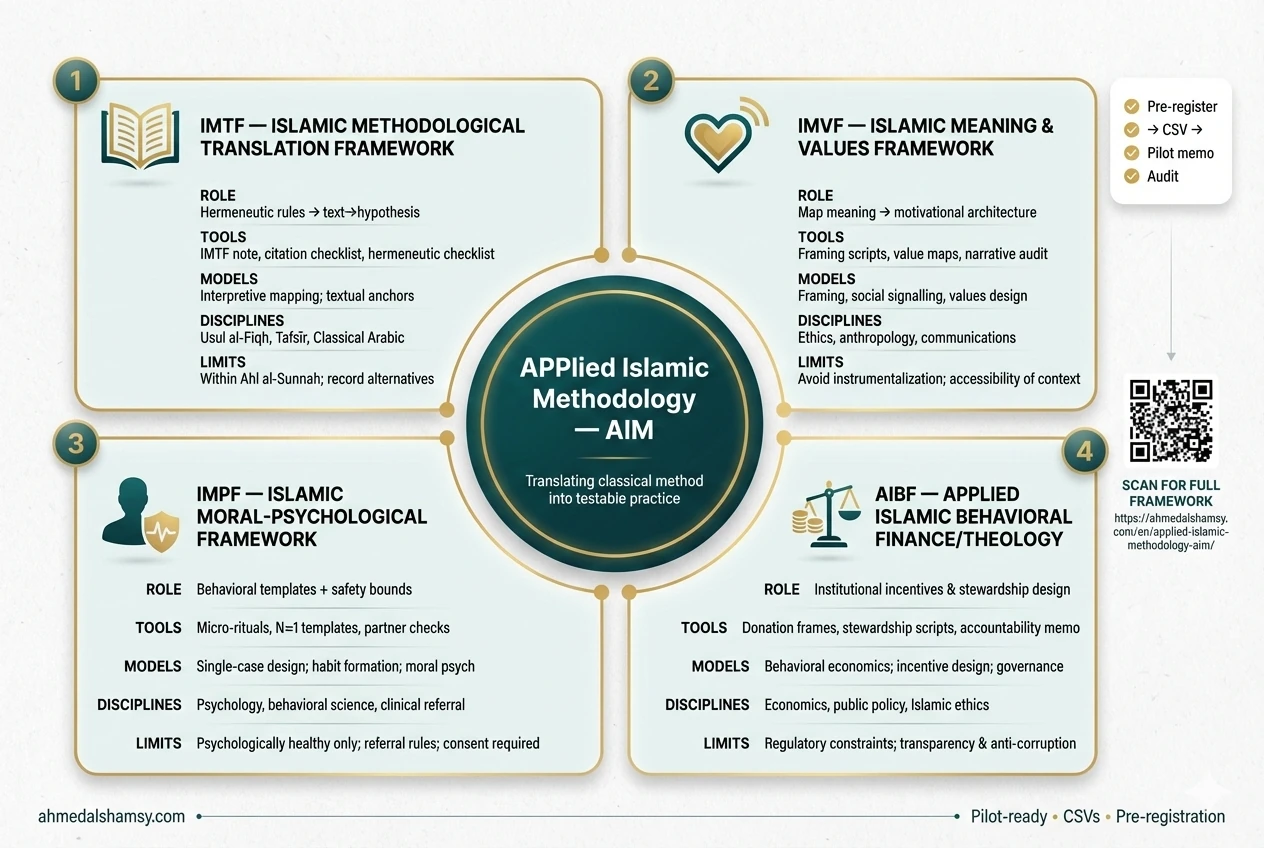
Applied Islamic Methodology (AIM) is a measurement-first program that translates classical Islamic hermeneutic practice into operational, auditable behavioral protocols. This hub is the canonical author and method index: it documents the full AIM architecture, the required article–protocol scaffold, pilot workflow and CSV conventions, mandatory templates and their use, the three-axis editorial scoring rubric with explicit point breakdown, the Pilot Registry and pre-registration rule, the limits on psychological scope (IMPF), and the site publication, SEO and accessibility requirements. All published AIM outputs must be traceable from primary textual claim → interpretive move → operational translation → pre-registered pilot → one-page pilot memo → three-axis audit memo.
Rationale and intellectual commitments
Applied Islamic Methodology (AIM) is intentionally interdisciplinary. It binds four commitments:
- Hermeneutic fidelity. Interpretive moves must trace to primary texts and explicit hermeneutic rules (IMTF). Variants must be recorded and justified; interpretive humility is mandatory. AIM’s hermeneutic commitment protects theological integrity and reduces ad-hoc operationalization.
- Behavioral operationality. A translation is not complete until it produces an observable behavioral mechanism with measurable outcomes and canonical logging conventions (CSV headers). This converts theological claims into falsifiable operational hypotheses.
- Measurement-first ethics. Interventions are designed to be minimally invasive, consented, versioned, auditable, and reversible. Interventions that risk harm or bypass volition are explicitly disallowed. For safety and interpretive clarity, IMPF limits application to psychologically healthy individuals and mandates referral protocols where indicated.
- Digital and publication accountability. Every pilot must be pre-registered; assets are versioned; procedural pages include HowTo JSON-LD and Dataset JSON-LD where appropriate; the hub maintains canonical author @id and Pilot Registry links for traceability and E-E-A-T [2].
Steel thread restated: These commitments exist so that any operational claim is both theologically defensible and empirically accountable.
Why AIM matters: AIM formalizes Islamic methodological translation for contemporary inquiry, preserving usul integrity while enabling applied reasoning. It generates frameworks disciplined and coherent, suitable for individuals, scholarship, governance, and real-world decision-making.
Steel Thread: How do we build a resilient human life using verified classical foundations?
AIM architecture — layers, roles and canonical authority
| Layer | Role | Tools & Models | Disciplines | Limits & Constraints |
|---|---|---|---|---|
| IMTF | Text extraction & heritage adherence | Concept maps, linguistic analysis. Model: Analytical | Usul al-Fiqh, Quranic & Hadith Sciences, Sunni Theology. |
Boundaries: Strictly heritage-compliant. No behavioral activation or therapy allowed at this layer. |
| IMVF | Meaning & value guidance | Value maps, meaning indicators. Model: Normative | Maqasid al-Sharia, Islamic Ethics, Positive Psychology (descriptive). |
Boundaries: Guidance only. No clinical therapy or psychological intervention. |
| IMPF | Understanding psyche & motivations | Psyche maps, intention analysis. Model: Cognitive/Moral | Islamic Moral Psychology, Sufism, Cognitive Science, Neuroscience. |
Boundaries: Restricted to healthy individuals. Purely descriptive, not therapeutic. |
| AIBF | Behavioral activation | Behavioral design, habit loops. Model: Behavioral Economics | Behavioral Science, Ethics, Neuroscience (descriptive). |
Boundaries: N=1 experiments only. Ethical & operational constraints apply. |
AIM is distributed across a canonical hub (this page) and four detailed methodological layer pages. The hub is the canonical author and method index; layer pages are deep operational nodes.
Canonical hub responsibilities (this page):
- Host the authoritative author profile and canonical @id.
- Maintain the Pilot Registry index and canonical CSV packages (versioned).
- Hold the Editorial Evaluation Charter and scoring templates.
- Publish site-wide templates (Narrative Audit, Language Reset, Spectacle Fast, Accountability Memo).
Methodological layers (each has its own deep page and downloadable protocol packages):
- IMTF — Islamic Methodological Translation Framework. Tasks: define permissible hermeneutic moves, list required primary-text citation practices, provide a hermeneutic checklist, and publish canonical examples of translation from text→mechanism. IMTF enforces alternate readings and precise textual anchors.
- IMVF — Islamic Meaning & Values Framework. Tasks: map theological meanings into motivational architectures (values signals, communal frames, reward structures), provide example framing scripts, and paired prototype CSVs for signaling experiments.
- IMPF — Islamic Moral-Psychological Framework. Tasks: behavioral design templates (micro-rituals), boundary conditions for psychological safety, N=1 experimental plans, and referral/stopping protocols. IMPF explicitly excludes clinical treatment and requires referral resources for participants showing clinical needs.
- AIBF — Applied Islamic Behavioral Framework
AIBF addresses economic and institutional drivers that mediate religious practice at scale. It focuses on design patterns, institutional incentives, and finance-adjacent governance that affect ritual economies, zakāh/waqf effectiveness, and communal provisioning. AIBF is a methodological node: it applies IMTF translation to economic texts, uses IMVF framing for communal meaning, and applies IMPF-safe micro-rituals where appropriate. Pilot examples include small-N trials of cash-flow framing for zakāh uptake, waqf stewardship messaging, and accountable micro-donation experiments (CSV templates and pre-registration required).
Authoring & byline rules: this hub contains the full author bio; layer pages include a concise byline that links back to the canonical hub. Structured data across the site must reference the same author @id to preserve E-E-A-T and avoid conflicting author entities. [1]Steel thread restated: Architecture ensures one authoritative voice for authoritativeness while giving each methodological layer operational independence for clarity and version control
Mandatory AIM article & protocol scaffold (detailed)
Every AIM article or pilot page must implement the scaffold below exactly. This is a gating checklist for editorial acceptance.
- H1 + lead + Steel Thread. The article must open with a concise lead and explicitly state the central question (steel thread).
- Executive summary (actionable). One–two paragraphs summarizing the hypothesis and pilot.
- Current Event / Trend Anchor. One paragraph connecting the article to a recent trend or event (semantic anchor for topical relevance).
- Theological ↔ Behavioral Mapping. Table rows showing: primary text citation; hermeneutic move; behavioral mechanism; canonical CSV header; pilot window; ethical tier. IMTF must be referenced for how the hermeneutic move was made.
- Framed analysis (2–4 axes). Each axis closes with the Steel Thread restatement.
- Operational Protocol (micro-ritual / checklist). Step-by-step instructions for the pilot including partner checks, timing, minimal equipment, consent script, stopping rules. Attach the canonical CSV header and an example row [3].
- One-page pilot memo template (attached). Pilot ID, pre-reg link, CSV filename/version, primary outcome, summary findings, and incidents. [1]
- Ethics & limits. Consent, data use, privacy protections, referral contacts, IMPF exclusions [4].
- Glossary excerpt — include terms from the “Glossary of Moral Systems Under Stress” if technical terms are used.
- HowTo JSON-LD — insert in page head for procedural content.
- Sequential bracketed footnotes — use numeric bracketed citations in ascending order; the final References list must mirror those numbers exactly with no gaps. This is mandatory.
- Attachments & JSON-LD assets. Attach canonical CSV (Dataset JSON-LD), include Tech data for SEO and Dataset accessibility.
Editorial enforcement: Submissions missing any item above will be returned with required corrections; publication is permitted only after the pre-reg, CSV, pilot memo, and audit memo are attached.
Steel thread restated: The scaffold enforces that a piece is publishable only if it closes the loop from hermeneutic claim to auditable pilot
Pre-registration requirement:
Each AIM pilot must be pre-registered before data collection. The pre-registration record must state the Pilot ID, primary outcome, sample definition, pilot window, primary analysis plan, and stopping rules. Records will be published on the site’s public Pilot Registry (or an external registry such as the Open Science Framework (OSF) Registrations, which provides time-stamped, citable pre registration records.) and linked from the pilot memo to ensure transparency and an auditable trial record.
Methodology & Article Construction (AIM Scaffold)
Hermeneutic method (brief):
Each operational translation records (a) the primary text citation (Qur’ān / ḥadīth), (b) a one-paragraph chain of reasoning tying the text to the behavioral hypothesis, and (c) documented alternative readings and limitations in the footnotes. This protocol preserves theological fidelity while enabling practical testing.
Each major study follows the AIM scaffold to be reproducible and auditable:
- Executive summary + central question.
- Theological vs. Behavioral Mapping (AIM Framework): side-by-side alignment of textual principle and observable mechanism.
- Framed analysis (2–4 axes): each axis ends by restating the Steel Thread.
- Operational checklist & micro-rituals (AIM Protocol): N=1 ready steps with timing, partner checks, and simple scripts.
- CSV template(s) for measurement (downloadable): preconfigured columns and example rows.
- Mandatory 10-point FAQ addressing theological and methodological friction.
- Ethics & limits: consent templates, anonymity guidance, reporting channels, and stopping rules [5].
The scaffold appears at article top and bottom and each study includes a one-page pilot memo and a ZIP of Protocol files when available.
Pre-registration requirement:
Each AIM pilot must be pre-registered before data collection. The pre-registration record must state the Pilot ID, primary outcome, sample definition, pilot window, primary analysis plan, and stopping rules. Records will be published on the site’s public Pilot Registry (or an external registry such as the Open Science Framework (OSF) Registrations, which provides time-stamped, citable pre registration records.) and linked from the pilot memo to ensure transparency and an auditable trial record.
The Master Mapping — Representative Examples of the AIM Protocol in Action
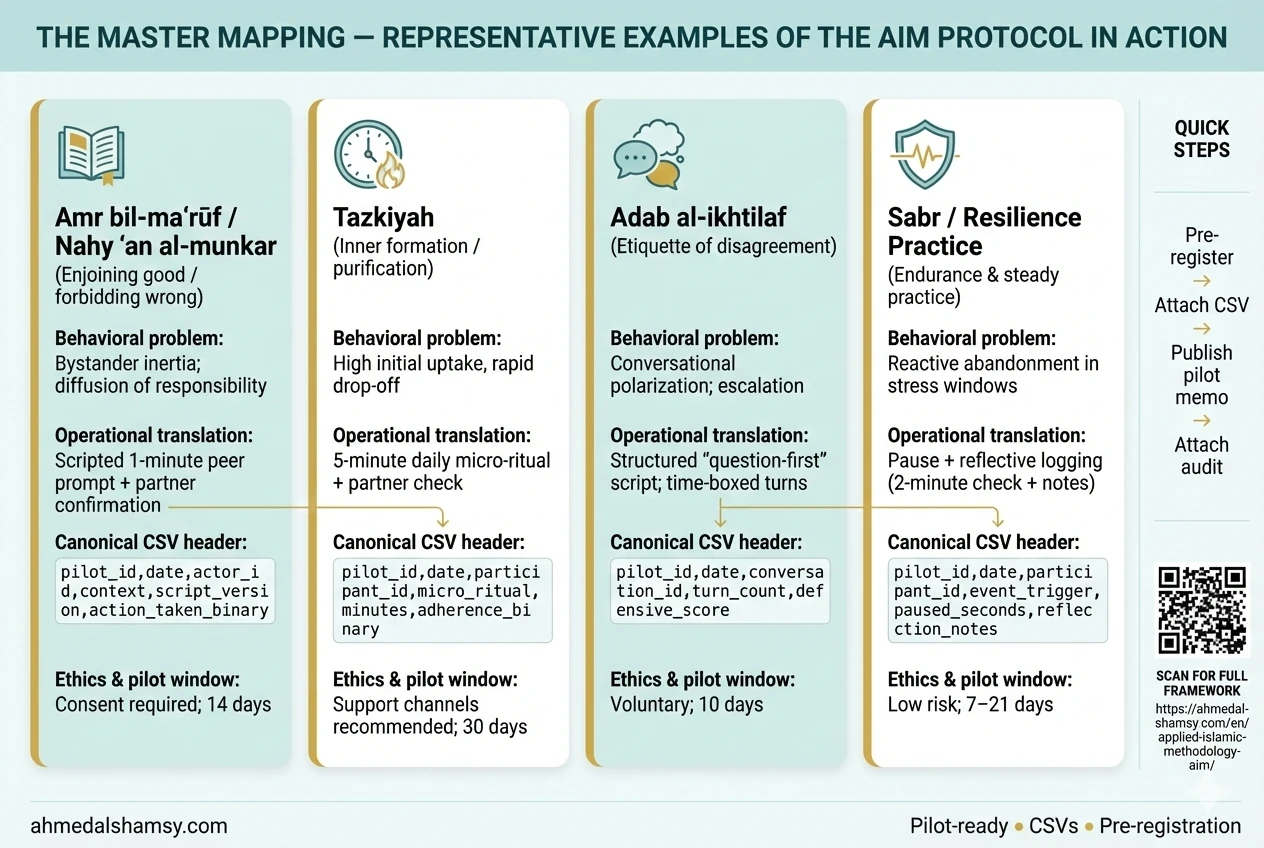
Theological vs. Behavioral Mapping: table translates core classical principles into operational AIM Protocol interventions, gives explicit CSV headers for measurement, flags ethical constraints, suggests pilot windows, and provides brief scaling notes and a qualitative expected effect / risk assessment for each row.
How to read and use this table
- Theological Principle: classical term and concise English translation. All translations and operational choices are made within the bounds of Ahl al-Sunnah wa-al-Jamāʿah and documented hermeneutic choices.
- Theological Rationale: a short justification that ties the principle to human behaviour.
- Behavioral Pattern Observed: the social or psychological failure the principle helps address.
- AIM Operational Translation (Protocol): a concrete, replicable intervention (script, micro-ritual, or structural change) that practitioners can pilot.
- Measurement / CSV columns: ready-to-copy CSV header for logging the pilot. Use these as the basis of the AIM Protocol file.
- Ethical considerations: minimal safeguards and consent notes.
- Pilot window: recommended duration for an initial small-N pilot.
- Expected effect & risk: pragmatic expectation (qualitative) to inform stopping rules and scaling.
Risk legend (standard): Low = minimal harm potential; Medium = requires monitoring and support channels; High = requires clinical or institutional oversight and formal ethics approval.| # | Theological Principle (Arabic + English) | Theological Rationale | Behavioral Pattern Observed | AIM Operational Translation (Protocol) | Measurement — CSV Header | Ethics & Safety | Pilot Window | Expected Effect & Risk |
|---|---|---|---|---|---|---|---|---|
| 1 | Amr bil maʿrūf / Nahy ʿan al-munkar (Enjoining Good) | Normative duty to promote good and restrain harm as communal care. | Bystander inertia and diffusion of responsibility. | Scripted peer-to-peer prompts (SMS/Voice) + 1-min checklist. | date,actor,context,script_version,action_taken_binary | Obtain consent; non-coercive prompts. Required ethics level: Medium | 14 days | Effect: Medium. Risk: Pressure. |
| 2 | Tazkiyah (Purification / Inner Formation) | Inner reform as the basis for outward conduct; incremental. | High initial uptake followed by rapid drop-off. | 5-minute daily micro-ritual + partner check. | date,participant_id,micro_ritual,minutes,adherence_binary | Monitor for distress; support channels. Required ethics level: Low | 30 days | Effect: Med-High. Risk: Emotional difficulty. |
| 3 | Adab al-ikhtilāf (Etiquette of Disagreement) | Norms regulating disagreement to preserve dignity. | Defensive escalation and conversational polarization. | Structured “question-first” scripts with timeboxed turns. | date,conversation_id,turn_count,defensive_score | Voluntary; stop rules if harm arises. Required ethics level: Medium | 10 days | Effect: Medium. Risk: Covert hostility. |
| 4 | Maslaha (Public Benefit / Common Good) | Weighing actions by public benefit; long-term orientation. | Short-term incentives crowding out long-term welfare. | Commitment device: micro-reward + visual timeline. | date,commitment_signed,immediate_reward,longterm_metric | Avoid coercive inducements. Required ethics level: Medium | 21–30 days | Effect: Medium. Risk: Value misalignment. |
| 5 | ʿAdl (Justice / Fairness) | Justice preserves moral order and institutional legitimacy. | Perceived unfairness leading to grievance escalation. | Transparent feedback channel + resolution process. | case_id,report_date,action_taken_date,satisfaction_rating | Confidentiality; data governance. Required ethics level: High | 30 days | Effect: Medium. Risk: Distrust. |
| 6 | Amānah (Trust / Responsibility) | Moral responsibility to safeguard entrusted goods. | Role neglect or opportunism in small groups. | Role-definition checklist + 7-day micro-audit. | role_id,task,self_reported_done,peer_reported_done | Consent for peer reporting; avoid shaming. Required ethics level: Medium | 14 days | Effect: Medium. Risk: Misuse for shaming. |
| 7 | Shūra (Consultation / Deliberation) | Collective consultative principle for decision legitimacy. | Top-down decisions with poor uptake and ownership. | Timeboxed mini-deliberation (30-60m) with feedback loop. | meeting_id,date,participants_count,pre_score,post_score | Inclusive facilitation; clear consent. Required ethics level: Medium | 7–14 days | Effect: Medium. Risk: Tokenism. |
| 8 | Tawqīf + ʿAql (Guided Reason) | Interaction of revelation and reason in complex choices. | Cognitive dissonance regarding abstract texts. | Decision template: textual citation + causal analysis. | case_id,principle_citation,predicted_outcome,pilot_plan | Scholarly review; document dissenting views. Required ethics level: High | 21–30 days | Effect: High. Risk: Interpretive disputes. |
| 9 | Sabr (Patience / Perseverance) | Endurance and measured responses protect cohesion. | High attrition under stress and reactive behavior. | Resilience package: daily breathing + weekly peer check. | date,breath_minutes,reflection_present,resilience_score | Screen for trauma; signposting to support. Required ethics level: Low | 30 days | Effect: Medium. Risk: Intrusion. |
| 10 | Ihsān (Excellence in Action) | Intentional, beautified performance via intrinsic motivation. | Minimal compliance without intrinsic motivation. | Quality-focused micro-task + symbolic recognition. | date,task,quality_rating,peer_feedback,recognition | Avoid competitive alienation; equitable recognition. Required ethics level: Low | 14–21 days | Effect: Small-Med. Risk: Pressure. |
How to use this table: choose a row, download the AIM Protocol CSV (linked on the pillar post), run the pilot, and report anonymized aggregated outcomes for feedback. Each pillar post contains an expanded table with citations and a downloadable ZIP of Protocol assets when available.
Steel Thread: How do we build a resilient human life using verified classical foundations?
Pilot lifecycle: pre-registration → data collection → audit → publication (step-by-step)
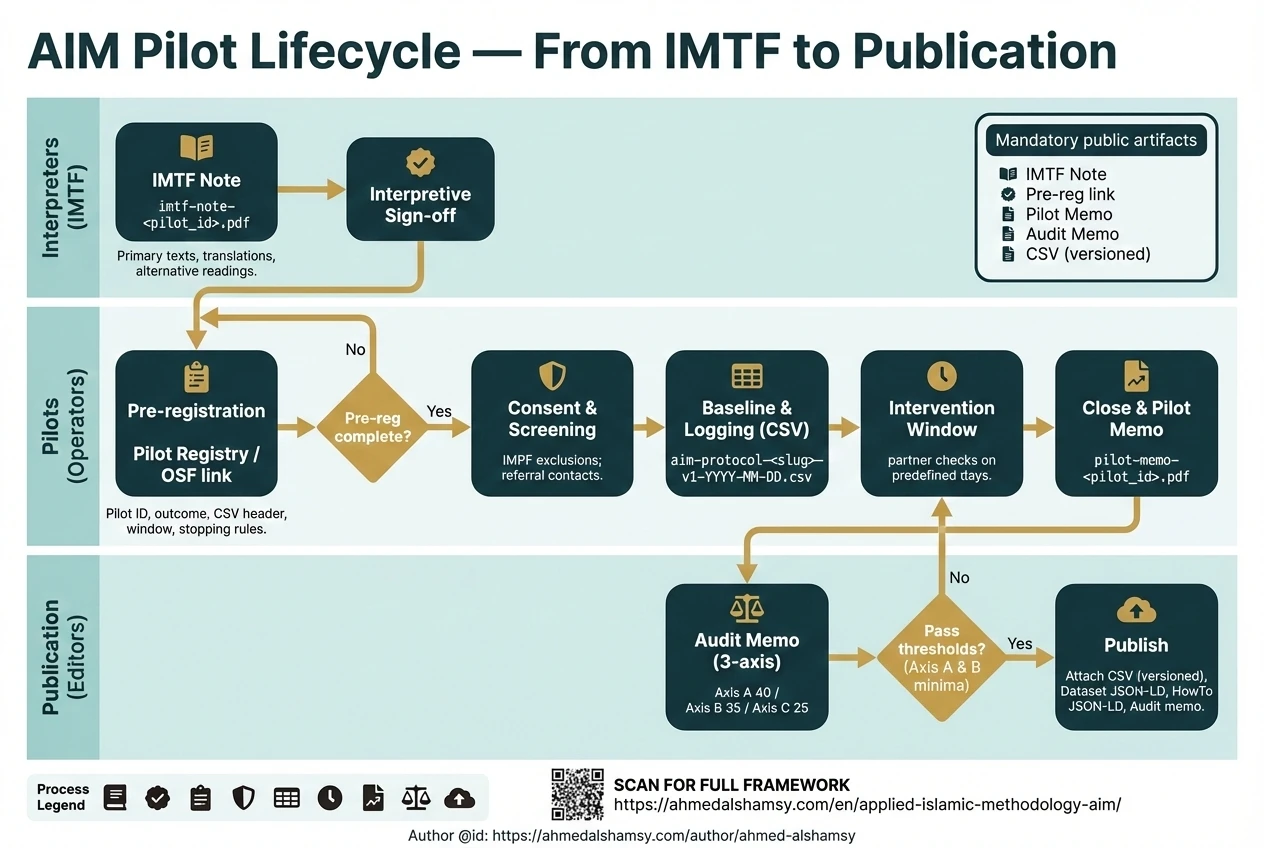
Each pilot must follow a fixed lifecycle. The steps below are the required sequence; skipping or re-ordering invalidates the pilot’s publishability.
- Design & hermeneutic trace. Draft the interpretive note (IMTF): cite primary texts, record alternative readings, and justify the chosen translation. Save this as imtf-note-<pilot_id>.md and link in the pre-reg. [1]
- Pre-registration (mandatory). Create a public pre-registration entry in the Pilot Registry including Pilot ID, primary outcome, measurement plan (CSV header), pilot window, stopping rules, data sharing plan, and referral protocols. The pre-reg must be created before any data collection.
- Consent & safety checks. Prepare written consent text and the referral list for IMPF participants. Consent must include data use, deletion requests, and support contacts.
- Baseline (Day 0). Collect baseline measures specified in the CSV (e.g., affect score pre). Record any pre-existing conditions and exclusions.
- Intervention window. Collect daily rows in the canonical CSV, perform partner checks as specified; maintain version control. If an incident occurs, pause and consult the audit protocol.
- Close & produce pilot memo. At pilot completion, produce the one-page pilot memo containing: Pilot ID, pre-reg link, CSV filename/version, raw data excerpt, adherence summary, brief visual analysis (single-case style), and incidents.
- Audit memo & scoring. The pilot is audited per the three-axis rubric. Produce an audit memo mapping each criterion to a score and justification. Attach Narrative Audit and other required templates.
- Publication gating. Publish only after the pre-reg, CSV, pilot memo, and audit memo are attached. Include HowTo JSON-LD and dataset JSON-LD on the article page. Follow COPE transparency guidance for reporting.
Steel thread restated: The lifecycle ensures that the pilot’s publication is an auditable chain from interpretation → intervention → data → audit.
Pilot lifecycle: expanded examples and operational playbooks
AIM requires every pilot to follow a fixed lifecycle so interpretive moves remain auditable and safe. Below are expanded, operational examples that you can copy, adapt, and pre-register. Each example maps directly to the IMTF→IMVF→IMPF chain, attaches canonical CSV headers, and ends with the audit touchpoints that must be present in the pilot memo and audit memo.
Core lifecycle (recap)
- IMTF note (textual anchor & alternatives) → 2. Pre-registration (Pilot Registry/OSF) → 3. Consent & screening (IMPF safety) → 4. Baseline measures → 5. Intervention window & logging (CSV) → 6. Partner checks & nested qualitative probes → 7. Close & pilot memo → 8. Audit memo (3-axis scoring) → 9. Publication (attach CSV + JSON-LD + pilot memo + audit).
Below are three ready-to-run pilot examples with stepwise guidance.
Example A — 7-day Tazkiyah micro-ritual (Individual N=1)
Aim: Test whether a 5-minute morning reflective ritual improves short-term affect and perceived self-efficacy.
IMTF anchor: Select a textual anchor (e.g., classical admonition to inward reflection) and justify interpretive move in 200–400 words in the IMTF note. Document alternative readings and why this particular practice adheres to Ahl al-Sunnah wa-al-Jamāʿah.
Pre-registration fields: Pilot ID, primary outcome (affect_score_post − affect_score_pre), measurement schedule, CSV header, pilot window (7 days), stopping rules, referral contacts.
Consent screen: Simple plain-language script describing task, data collected, retention, and referral resources. Screen for current severe mental-health symptoms; exclude and refer where present.
CSV header (canonical):
“`csv
pilot_id,date,participant_id,day_number,micro_ritual_description,minutes,adherence_binary,affect_score_pre,affect_score_post,notes
Measurement standards, single-case (N=1) reporting and conservative inference
AIM prioritizes single-case (N=1) and small-N designs to allow rapid, ethical, and faithful piloting. Use established single-case standards for design, data display, and inference. Key operational points:
- Predefine outcomes. Choose one primary outcome per pilot and predefine measurement rules (how affect scores are obtained, timing, and scaling). Avoid multiple outcome fishing.
- Visual analysis as primary inference. Single-case designs emphasize visual inspection of level, trend and variability across phases (baseline vs intervention). Report conservative claims and avoid sweeping generalizations. Use clear plots (each participant a separate figure) and include the raw CSV excerpt in the pilot memo.
- Replication logic. AIM relies on systematic replication across N=1 pilots (multiple replications under varying conditions) to build evidentiary weight rather than cross-sectional generalization. Document ecological conditions and any deviations in the pilot memo.
- Statistical supplements optional. If statistical tests are used, they must be predefined and limited to appropriate single-case methods. Always present visual graphs first.
- Reporting standards references. Use the APA single-case standards and Kazdin’s single-case design recommendations as the reporting backbone. Cite these standards in the pilot memo and audit memo.
Steel thread restated: Measurement practices must privilege conservative, transparent inference: N=1 evidence accumulates through systematic replication and careful audit.
Daily protocol: Participant performs the 5-minute ritual each morning, records adherence and affect before/after on a 1–5 Likert scale, and enters the day’s row into the CSV. On days 3 and 7 an accountability partner confirms adherence via a simple confirmation message logged in the CSV notes.
Analysis, endline & memo: Use visual inspection (single-case graph of affect scores across days). The pilot memo must include Pilot ID, pre-reg link, CSV filename/version, adherence percent, visual figure, 2–3 sentence conservative claim, and incidents. Audit memo maps to the three axes, noting hermeneutic trace, consent/stop rules, and dataset publication.
Example B — Conversation Script: Adab al-Ikhtilaf (Small Group; N=3)
Aim: Reduce escalation in group disagreement using a structured “question-first” conversation script.
IMTF anchor: Provide primary text and hermeneutic rationale for etiquette of disagreement and why a structured conversation is a permissible operationalization.
Design: Predefine 3 matched micro-communities (N=3 each). Run 10-minute moderated conversations in two phases: baseline (no script) and intervention (scripted turns). Each onversation is logged with turn_count, interruptions, defensive_score (0–3 coded by a trained observer), and perceived-outcome (participant post-survey).
CSV header:
pilot_id,date,conversation_id,participant_ids,phase,turn_count,interruptions,defensive_score,perceived_outcome,notes
Measurement & coding: Train observers on defensive_score codes; predefine coder reliability checks. Use inter-rater sample checks on 20% of recordings for quality control. On completion, pilot memo should include short qualitative excerpts, a transparency statement on coding reliability, and an explicit Language Reset applied to public language used when reporting.
Example C — Institutional protocol test (AIBF-adjacent trial)
Aim: A small pre-registered test of framing variants for zakāh stewardship emails sent to a community sample (N=50; A/B test) to observe donation conversion and long-term recurring commitment.
IMTF anchor: Identify textual/ethical basis for zakāh framing and preservation of obligations; document permissible framing variants and ethical constraints.
Design: Randomly assign recipients to two email frames: (1) normative-scholarship emphasis; (2) practical stewardship emphasis. Measure click, conversion, and sign-up for recurring donations over a 30-day window.
CSV header:
pilot_id,date,recipient_id,condition,email_opened,donation_amount,recurring_signup,notes
Ethics & safeguards: Provide opt-out, clear data use, and a public Accountability Memo that explains resource allocation and follow-up stewardship audit.
Audit touchpoints (applies to all pilots)
IMTF Note: saved document with primary texts, translations, and alternative readings. (Attach imtf-note-<pilot_id>.pdf to pre-reg.)
Pre-reg: public link stored in Pilot Registry / OSF.
Pilot Memo: one-page summary with CSV excerpt and figure.
Audit Memo: point-by-point scoring across Axis A (40), B (35), C (25) with minimal thresholds. If Axis A or B minima not met, do not publish.
Dataset & JSON-LD: attach canonical CSV and Dataset JSON-LD file; in procedural pages attach HowTo JSON-LD.
Versioning: append version and date to filename (e.g., aim-protocol-tazkiyah-v1-2026-01-10.csv).
Reporting & publication recommendations
Publish pilot with the CSV as downloadable asset and a dataset JSON-LD block that references the canonical author @id.
Include a short “Replication note” recommending next-step replications (contexts, partner variations, sample expansions).
When publishing, add a “what changed” line to note any post-hoc deviations; auditors prefer transparency over retroactive rationalizations.
Templates: Narrative Audit, Language Reset, Spectacle Fast, Accountability Memo, Pilot Memo — contents and examples
AIM requires a set of standardized templates appended to the pilot memo and audit package. Below are the required templates with field-level guidance.
Pilot Memo (one page — required fields)
- Pilot ID: unique identifier (e.g., AIM-TZKY-001).
- Title: short.
- Pre-registration URL: link.
- Primary outcome (predefined): e.g., adherence_binary; affect_score_post − affect_score_pre.
- CSV filename + version: e.g., aim-protocol-tazkiyah-v1-2026-01-10.csv.
- Pilot window: dates.
- Participants: N (and brief descriptors).
- Adherence summary: percent percent days adhered.
- Visual analysis: 2–3 sentences about level/trend/variability. Attach figure.
- Incidents / deviations: brief.
- Author / contact: name + canonical author @id
Narrative Audit (fields & purpose)
Purpose: map pilot narrative to textual trace and behavioral mechanism; used by auditors to confirm interpretive fidelity.
- Hermeneutic anchor: primary text citation(s) and short translation.
- Interpretive move summary: 3–5 sentences describing how IMTF translated text→mechanism.
- Alternative readings considered: list and short rationale for rejection/acceptance.
- Mechanism mapping: explicit CSV header mapping and measurement rationale.
- Ethical tier: low/medium/high and justification.
Language Reset (fields & purpose)
Purpose: ensure public materials use non-coercive framing and plain language.
- Original phrasing: paste.
- Risk analysis: potential for perceived coercion or manipulation.
- Reset phrasing: suggested alternative text.
- Readability score: target grade level and explanation.
Spectacle Fast
Purpose: a short checklist to avoid spectacle and performative framing that might distort participant understanding.
- Is the intervention framed as a test or a spectacle? yes/no.
- Is the imagery or language likely to attract undue attention? yes/no.
- Control steps: minimal exposure imagery, neutral titles, redirect to pilot memo.
Accountability Memo
Purpose: document accountability pathways for the pilot (who has access, version control, publication responsibilities).
- Owner: author contact.
- Data steward: who maintains CSV and dataset JSON-LD.
- Release plan: where CSV will be stored and how it will be shared.
- Retention policy: how long CSVs are archived.
All templates must be attached to the pilot’s publication package and be visible to the auditor.
Steel thread: Templates operationalize ethical and methodological safeguards that make pilot claims auditable and traceable.
Editorial Evaluation Charter — 100-point scoring rubric, criteria and minimum pass rules
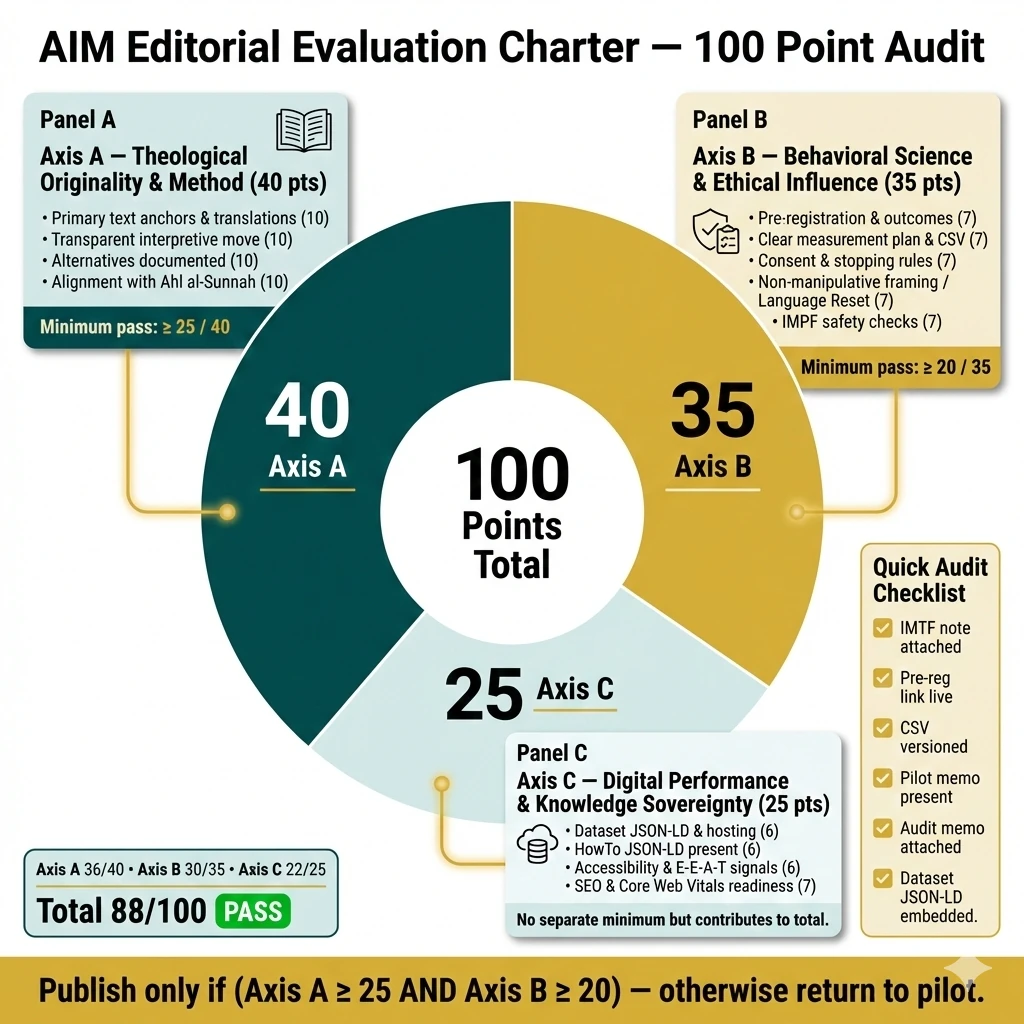
Every pilot is audited using a 100-point distribution across three axes. The audit memo must assign points and justify each allocation with evidence.
Point distribution
- Axis A — Theological Originality & Method: 40 points.
- Axis B — Behavioral Science & Ethical Influence: 35 points.
- Axis C — Digital Performance & Knowledge Sovereignty: 25 points.
Axis A (40 points) — scoring cues
- Full hermeneutic anchor with primary text citations and translation (10 pts).
- Transparent interpretive move explanation (10 pts).
- Alternatives documented and justified (10 pts).
- Alignment with Ahl al-Sunnah wa-al-Jamāʿah and internal theological checks (10 pts).
Axis B (35 points) — scoring cues
- Pre-registration and predefining outcomes (7 pts).
- Clear measurement plan and canonical CSV usage (7 pts).
- Consent, stopping rules and referral protocols (7 pts).
- Non-manipulative framing and Language Reset applied (7 pts).
- Suitability for IMPF population and safety checks (7 pts).
Axis C (25 points) — scoring cues
- Dataset JSON-LD and proper hosting/versioning (6 pts).
- HowTo JSON-LD present for procedural pages (6 pts).
- Accessibility (glossary, plain language) and E-E-A-T signals (6 pts).
- SEO and Core Web Vitals readiness (7 pts).
Minimum pass rule
- A pilot must score at least 70/100 to be publishable. Additionally, a minimum of 25/40 on Axis A and a minimum of 20/35 on Axis B are required to pass because theological fidelity and participant safety are non-negotiable.
Audit memo composition
- Numeric scores with one-sentence justification for each cue. Attach examples (CSV excerpt, IMTF note, consent).
Steel thread restated: The scoring system enforces a minimum standard of theological fidelity and safety before publication.
Data governance, privacy, and ethical boundaries (IMPF constraints)
AIM adheres to strict data governance and privacy norms. The policy below is the minimum required for pilot approval.
Privacy & contextual integrity
- Collect only data required by the pre-registered CSV header. Avoid metadata collection beyond what is necessary. Follow contextual integrity principles for consent and data flow [6].
Data minimization & retention
- Minimize personally identifiable information. Use participant IDs and separate the identity map when possible. Retention policy should be declared in the Accountability Memo.
IMPF safety & exclusions
- IMPF methods are explicitly for psychologically healthy individuals. Screen for mental health risk in consent and baseline. If clinical need arises, stop the pilot for that participant and refer to professional services. Document any such events in the pilot memo.
Incident response
- If a participant experiences harm or distress, stop the pilot for that participant, notify the data steward, and activate referral protocols. The incident is recorded in the audit memo and the pilot memo.
Dataset publication
- Publish redacted CSVs if needed, but maintain versioned canonical CSVs in a controlled asset store with Dataset JSON-LD indicating access and licensing terms.
Steel thread restated: Data governance and IMPF boundaries protect participant welfare and ensure the ethical legitimacy of published claims
What you’ll find here — categories
Each category includes a short “Start-a-Pilot” card linking to relevant Protocols and CSVs.
Tafsir & Quranic Studies
Applied tafsir that maps verses to behavioral interventions and micro-exercises. Accessible tafsir and close readings that connect Qur’anic verses to contemporary moral, social, and psychological questions. Posts include interpretive mapping, practical implications for daily practice, and suggested micro-exercises to test spiritual uptake.-Tafsir and Quranic Studies–
Seerah & History
Governance lessons and leadership heuristics translated into Protocol pilots. Narrative case studies and governance lessons drawn from prophetic biography and Islamic history. Articles extract leadership heuristics, crisis responses, and institutional lessons for modern organizational design. –Seerah and History–
Atheism & Doubts
Diagnostic flows and scripts for doubt management and respectful engagement. Analytical responses to common objections and doubts: rigorous but empathetic explanations, philosophical clarifications, and practical scripts for respectfully engaging skeptics and seekers. –Atheism and Doubts–
Faith & Conviction
Habit architecture and micro-ritual toolkits to support sustained practice. Materials for strengthening belief and practice: short rituals for resilience, guidance on sustaining conviction under pressure, and stepwise programs for spiritual formation and communal integrity. –Faith and Conviction
The Blog — applied reflections
Shorter reflections and cross-disciplinary essays applying Islamic teaching to contemporary issues (e.g., cross-disciplinary essays on AI ethics, education, finance, personal development and pilot reports). Blog posts often signpost or translate larger framework work into bite-size experiments. –Blog–
Measurement-first Templates & Diagnostics (AIM Protocol)
Downloadable CSVs, worksheets, and small-N research templates designed to let readers run repeatable experiments at home, in study circles, or within community groups.
AIM Framework PGP Key
AIM Framework packages are signed with our PGP key. Public key available at https://ahmedalshamsy.com/pgp-key.asc
Micro-ritual log
| date | participant_id | micro_ritual | minutes_practiced | partner_checkin | subjective_rating | outcome_note |
|---|---|---|---|---|---|---|
| 2026-01-01 | P001 | daily_breathing | 5 | yes | 4 | Felt calmer; reduced reactive speech. |
| 2026-01-02 | P001 | daily_breathing | 5 | yes | 5 | High focus sustained throughout morning. |
| 2026-01-03 | P002 | gratitude_log | 3 | no | 3 | Struggled with consistency; need repair protocol. |
| 2026-01-04 | P003 | silent_dhikr | 10 | yes | 5 | Significant reduction in anxiety markers. |
Conversation script pilot
| date | conversation_id | script_version | turns | total_time | defensive_language_score | positive_resolution_binary |
|---|---|---|---|---|---|---|
| 2026-01-10 | CNV-IKH-001 | v1.2_question_first | 8 | 12m | 2/10 | 1 |
| 2026-01-11 | CNV-IKH-002 | v1.0_baseline | 4 | 5m | 9/10 | 0 |
| 2026-01-11 | CNV-IKH-003 | v1.2_question_first | 14 | 22m | 1/10 | 1 |
| 2026-01-12 | CNV-IKH-004 | v1.2_question_first | 6 | 9m | 3/10 | 1 |
| 2026-01-13 | CNV-IKH-005 | v1.1_active_listen | 10 | 15m | 5/10 | 1 |
Pilot guidance
- Choose one micro-practice from an operational checklist.
- Download the AIM Protocol CSV and log baseline values for 3 days.
- Run the intervention for 7–30 days per recommended window.
- Predefine one primary outcome and inspect trend lines before scaling [7].
How to use this site — quick start (3 steps)
- Read a pillar post (start with Latest Articles).
- Download the template and run the suggested N=1 experiment for 7–30 days.
- Report back via the comments or contact form to share findings and get tailored suggestions.
Ethics & Safety — Summary Checklist
- Informed consent required for all pilots.
- Anonymize any personally identifying information in public reports.
- Minimize risk: prefer low-intensity micro-rituals and safe debrief protocols.
- Stopping rules: predefine thresholds that halt the pilot if adverse signals appear.
- Transparency: publish method, sample, window, and primary outcome in the pilot memo [8].
Author Deep Dive — Credentials & The Pedagogical Root

The Pedagogical Root: From Special Needs to AIM
The architectural core of the AIM Protocol was not born in a library but in the classroom. Training in Special Needs Groups conditioned a specific design ethos: the necessity of radical fragmentation. When teaching individuals with complex learning needs, success requires breaking a macro behaviour into its smallest, most granular micro-tasks.
In Special Needs pedagogy, we instrument practice: define the baseline, provide adaptive scaffolding, and measure frequency of success in real time. This conditioning directly informs the AIM Protocol. Where some see “spirituality” as abstract, AIM reconceives it as a system of routine encoding. By applying special education rigor—fragmentation, frequent instrumentation, adaptive repair—we convert classical theological virtues into fieldable, measurable routines.
AIM’s operational sensibility originates in special-needs pedagogy: break complex capacities into granular micro-tasks, instrument progress with frequent measurement, and adapt scaffolding responsively. This pedagogy taught the necessity of minimal viable actions, frequent feedback, and repair procedures — the exact mechanics manifest in AIM Protocols.
Academic Foundation:
- Bachelor of Science and Education: — empirical classroom methods and assessment. Bridging empirical inquiry with educational theory.
- Postgraduate Diploma — Curriculum & Instruction: — learning design and competency frameworks. Specializing in the architecture of learning pathways and behavioral transformation.
- Postgraduate Diploma — Teaching Special Needs Groups: — specialization in behavioral fragmentation. Providing a unique lens for managing human behavior under stress and crisis conditions.
Classical Training & Authority: Ahmed has completed intensive, multi-year programs in Traditional Islamic Sciences within the bounds of Ahl al-Sunnah wa-al-Jamāʿah, with a primary focus on Quranic Hermeneutics (Tafsir), Classical Jurisprudence, and Theological Method.
Furthermore, he has acquired an Ijaza (license) in the Holy Quran for the Hafs and Shu’bah (Shoba) recitation narrations (riwaya) from the chain of Asim, ensuring the highest level of precision in the transmission and study of the Divine Text.
Steel Thread: How do we build a resilient human life using verified classical foundations?
Contact & resources: [https://ahmedalshamsy.com/en/contact/]
Last updated: [20 January 2026]
Glossary of Terms
The sovereign framework developed by Ahmed Alshamsy. It translates classical Islamic insight into operational AIM Framework & Protocols, featuring measurement-first diagnostics and CSV templates for modern life application.
A single-subject clinical trial methodology used to measure individual-level effects of a behavioral intervention over time, allowing for precision in habit engineering.
A high-density, repeatable practice lasting 1–10 minutes. These serve as the “Routine Encoding” layer in the AIM framework to produce measurable behavioral change.
A rigorous alignment exercise that ensures a behavioral action remains a faithful translation of its textual/theological source (Asl), preserving hermeneutic fidelity.
A strategic editorial technique involving the constant reiteration of the central hypothesis throughout a document to maintain structural coherence and logical persistence.
Expertise, Experience, Authoritativeness, and Trustworthiness. These are the core signals used by search engines to evaluate the sovereign credibility of a platform.
A systematic assessment of current behavioral patterns against theological ideals (Asl) to identify specific gaps, inertia, or deviations before applying a protocol.
A formal authorization and licence indicating mastery of a specific discipline; specifically in this context, the transmission chain (Sanad) of Qur’anic recitation.
The classical etiquette of disagreement. In AIM, this is operationalized through question-first scripts and defensive language scoring to reduce escalation.
The purification of the soul. AIM treats Tazkiyah as a systems-engineering challenge, linking internal states to measurable behavioral micro-rituals.
The legal and theological consideration of public benefit. It serves as a criterion in AIM for designing incentives and long-term payoff visibility in social pilots.
A granular, quantitative indicator (e.g., a binary 0/1 or a 1-5 scale) used to track the progress of a micro-practice within a timeboxed pilot window.
A predefined procedure for restoring behavioral or social function after an intervention fails or a routine is broken, ensuring resilience under stress.
The structural “why” behind actor choices. It identifies the foundational drivers—theological or psychological—that sustain long-term behavioral adherence.
The primary operational output of the AIM Protocol. A minimal spreadsheet structure used for logging inputs, metrics, and outcomes for rigorous trend analysis.
A state where a platform’s authority is derived from both rigorous technical E-E-A-T and deep alignment with foundational theological principles, creating an unshakeable trust loop.
Editorial standards, citations & corrections
Corrections: substantive corrections are logged in each post’s revision history; please report factual issues via the contact link
Citation format: site uses APA-7 for references in major studies; primary sources and standard translations are linked directly.
Translation & transliteration: methods are documented in footnotes; transliteration follows consistent conventions across posts.
Conclusion — the steel thread revisited and operational mandate
AIM’s mandate is narrow and disciplined: to translate verified classical teachings into operational micro-practices that are minimally invasive, ethically sound, and auditable. The procedural demands — IMTF traceability, canonical CSV headers, single-case conservative inference, mandatory pre-registration, the three-axis audit, and accessible structured data — are not bureaucratic overhead; they are the methodological guardrails that make claims trustworthy and replicable. Every published AIM output must be a transparent chain from text to trial to audit.
Steel thread restated (final): The success criterion for any AIM translation is simple and testable: does the translation produce a repeatable, measurable micro-practice that demonstrably and responsibly contributes to resilience? If not, the translation must be reworked, re-registered, or retired.
FAQs
1. Why include measurement templates on the About page?
Because operational claims require operational evidence. The AIM approach is measurement-first — we provide CSV templates and Protocols so readers can run reproducible pilots (N=1 or small-N), log outcomes, and produce auditable evidence. Including templates on the About page signals to researchers and search engines that the site is practice-oriented (keywords: “AIM Protocol CSV”, “measurement-first template”, “pilot memo”). Practical next steps: download the CSV, define a primary metric, pre-register the pilot window (7–30 days), and keep an audit trail for later aggregation and review.
2. Are your theological readings definitive?
No — readings are methodical, sourced, and transparent about interpretive plurality. All AIM Framework translations are developed within the bounds of Ahl al-Sunnah wa-al-Jamāʿah and documented with chain-of-reasoning notes. Where multiple legitimate readings exist we explain the hermeneutic choices and provide alternative translations in the article footnotes (keywords: “Ahl al-Sunnah wa-al-Jamāʿah”, “methodological translation”, “hermeneutic transparency”). This improves trust signals for both human reviewers and automated evaluators.
3. Will you publish raw participant data?
No — raw personal data is never published; only anonymized aggregates are shared with consent. Privacy and governance are core to AIM ethics. We store raw logs privately, publish only anonymized and aggregated summary statistics, and require informed consent for all pilots. Data governance practices include minimal data retention, clear consent language, and publication of pilot memos that contain sample, window, and primary outcome (keywords: “anonymized aggregate”, “data governance”, “consent”, “audit trail”).
4. How long should I run an N=1 experiment?
Typical windows are 7–30 days depending on the intervention and expected signal latency. Short micro-rituals (e.g., 1–10 minutes daily) usually produce detectable trends in 7–14 days; habit formation or institutional pilots often require 21–30 days. Choose your primary metric, log daily in the AIM Protocol CSV, and adopt predefined stopping rules. For automated or AI-assisted deployments, pre-test with a 7–14 day human-monitored pilot before any automation (keywords: “N=1 experiment”, “pilot window”, “measurement-first”).
5. Can these frameworks be used in public institutions?
Yes — with explicit ethical oversight, legal alignment, and transparent governance. AIM Protocols are designed to be institutionally adoptable but require an ethics checklist (consent forms, data protection, equity safeguards), alignment with local law, and a governance board or a human review loop before scaling or automating. For institutional pilots, we recommend an independent ethics reviewer, a public pilot memo, and a post-pilot audit report (keywords: “institutional pilot”, “ethics checklist”, “governance”, “human review loop”).
6. Do you provide bespoke AIM Protocols or consulting?
Yes — bespoke Protocols and consulting are available by request, starting with a 30-minute clarity session. The typical workflow: (1) clarity session to define scope and primary outcome, (2) bespoke Protocol (CSV + scripts + pilot memo), (3) optional field support and ethics review, (4) post-pilot analysis. Deliverables include machine-readable CSVs, a one-page pilot memo, and recommended stopping rules. Pricing and timelines are scoped to institutional needs (keywords: “bespoke AIM Protocol”, “consulting”, “pilot memo”).
7. How are corrections and updates handled?
Substantive corrections are logged in each post’s revision history and summarized in metadata. We maintain transparency via a public corrections log: every substantive update includes the date, reason, and a short erratum notice at the article top. Minor edits are timestamped in metadata. This practice supports E-E-A-T and provides an audit trail for researchers and algorithms that evaluate content freshness and trustworthiness (keywords: “revision history”, “erratum”, “E-E-A-T”, “audit trail”).
8. Why does the site use APA-7 citation style?
APA-7 ensures consistent, machine-readable bibliographic metadata for academic and policy audiences. Using APA-7 (with bolded author names per site style) makes references parsable by citation harvesters and improves credibility signals for research and institutional linkages. Primary religious sources are also footnoted and cross-referenced to maintain theological rigor. Include DOI/URLs where available to maximize machine discoverability (keywords: “APA-7”, “machine-readable citations”, “E-E-A-T”).
9. What is Applied Islamic Behavioral Theology (AIM)?
AIM is the proprietary framework developed by Ahmed Alshamsy that bridges classical theological method and behavioral engineering. AIM consists of the AIM Framework (hermeneutic method that converts theological principles into testable hypotheses within Ahl al-Sunnah wa-al-Jamāʿah) and the AIM Protocol (operational CSV templates, scripts, micro-ritual checklists, and pilot memos). Use cases include conversation scripts for doubt management, micro-rituals for resilience, and institutional pilot designs. The Protocols are measurement-first, ethically constrained, and designed to create clear audit trails suitable for AI-assisted analysis or future automation (keywords: “AIM Framework”, “AIM Protocol”, “measurement-first”, “behavioral engineering”).
10. How do I request a full CV, institutional verification, or pilot collaboration?
Contact via the site’s consulting/contact page to request verification documents or propose collaboration. Requests for CVs, institutional verification, or collaborative pilots begin with a confidential contact form submission. For institutional partners we provide a verification packet (scanned certificates, pilot references, a redacted project CV) after an initial nondisclosure or verification step. For pilot collaboration, describe scope, sample, and ethical constraints when contacting us to accelerate the scoping process (keywords: “institutional verification”, “pilot collaboration”, “consulting request”, “CV request”).
References
- Lally, P., van Jaarsveld, C. H. M., Potts, H. W. W., & Wardle, J. (2010). How are habits formed: Modelling habit formation in the real world. European Journal of Social Psychology, 40(6), 998–1009. https://doi.org/10.1002/ejsp.674 ↩︎
- Committee on Publication Ethics (COPE). (2019). COPE guidance and resources. Committee on Publication Ethics. https://publicationethics.org/ (see specific guidance pages as needed) ↩︎
- Kazdin, A. E. (2011). Single-Case Research Designs: Methods for Clinical and Applied Settings (2nd ed.). Oxford University Press. https://global.oup.com/ushe/product/single-case-research-designs-9780190079987 ↩︎
- Nissenbaum, H. (2010). Privacy in Context: Technology, Policy, and the Integrity of Social Life. Stanford University Press. https://www.sup.org/books/law/privacy-context ↩︎
- Fogg, B. J. (2020). Tiny Habits: The Small Changes that Change Everything. Houghton Mifflin Harcourt. https://tinyhabits.com/book/ ↩︎
- Masten, A. S. (2001). Ordinary magic: Resilience processes in development. American Psychologist, 56(3), 227–238. https://doi.org/10.1037/0003-066X.56.3.227 ↩︎
- Kratochwill, T. R., Hitchcock, J., Horner, R. H., et al. (2013). Single-case intervention research standards. American Psychological Association. https://doi.org/10.1177/0741932512452794 ↩︎
- Darley, J. M., & Latané, B. (1968). Bystander intervention in emergencies: Diffusion of responsibility. Journal of Personality and Social Psychology, 8(4, Pt.1), 377–383. https://doi.org/10.1037/h0025589 ↩︎